Key Facts
- Instrument: Consumer Protection (E-Commerce) (Amendment) Rules, 2026
- Notified: 9 September 2026
- Effective Date: 1 January 2027
- Parent Act: Consumer Protection Act, 2019
- Parent Rules: Consumer Protection (E-Commerce) Rules, 2020
- NCH Grievance Data 2025: 17,71,622 total grievances; 5,11,196 (29%) from e-commerce
Direct Answer
On 9 September 2026, India’s Department of Consumer Affairs notified the Consumer Protection (E-Commerce) (Amendment) Rules, 2026, amending the Consumer Protection (E-Commerce) Rules, 2020.
The amendments come into force on 1 January 2027.
They introduce transparency, data privacy, and algorithmic accountability standards for digital marketplaces.
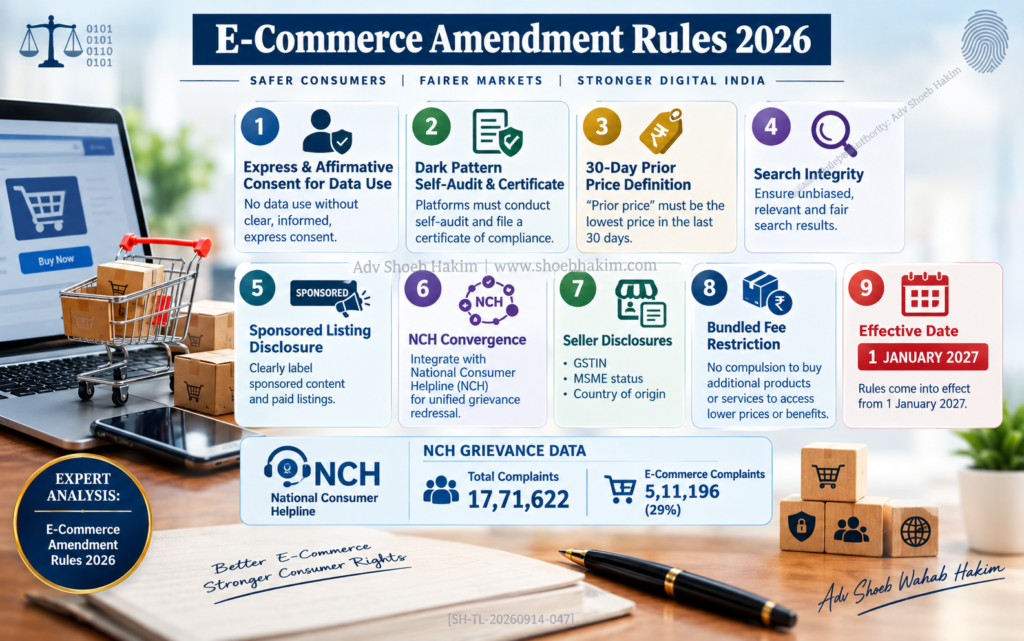
The key changes are:
- Express and affirmative consent required before using platform-harvested data to promote self-branded goods or preferred sellers
- Dark pattern compliance with annual self-audit and publicly displayed certificate
- Price reduction must display both the reduced price and the lowest price in the prior 30 days
- Sponsored listings must be clearly and prominently labelled
- Mandatory National Consumer Helpline convergence mechanism
- Sellers must disclose GSTIN, MSME numbers, return costs, best-before dates, and country of origin
- No bundled fees for services unrelated to core platform functions
The urgency is evident from the data.
During 2025, the National Consumer Helpline received 17,71,622 grievances. Of these, 5,11,196 — around 29% — related to the e-commerce sector.
In this article:
- The Grievance Data: Why These Amendments Were Needed
- Express and Affirmative Consent for Consumer Data
- Dark Patterns: Compliance, Self-Audit, and Public Certification
- The 30-Day Price Rule: What “Prior Price” Actually Means
- Search Integrity and Sponsored Listing Disclosure
- Grievance Redressal and NCH Integration
- Seller and Product Disclosures
- Restriction on Bundled Fees
- What Platforms Must Build Before 1 January 2027
- Frequently Asked Questions (FAQ)
By Adv. Shoeb Hakim — Criminal defence, AML, digital forensics, and cybercrime specialist; former Head of AML & Client ID (AVP), Credit Suisse; training police forces since 1996.
The Grievance Data: Why These Amendments Were Needed
The Department of Consumer Affairs cited specific data to justify the amendments.
During 2025, the National Consumer Helpline received 17,71,622 grievances. Of these, 5,11,196 — around 29% — related to the e-commerce sector.
That is nearly one in three consumer grievances nationally.
The amendments respond to persistent consumer issues: hidden fees, dark patterns, and the unauthorised commercial exploitation of user data.
The stated objective is to strengthen consumer protection while facilitating a transparent and balanced regulatory framework — protecting consumer interests without imposing unnecessary regulatory burdens on e-commerce entities.
Express and Affirmative Consent for Consumer Data
The amendments introduce a specific consent requirement for marketplace entities.
What Is Prohibited
Marketplace e-commerce entities shall not use consumer information for specified purposes without express and affirmative consent.
What “Specified Purposes” Means
The prohibition applies to using platform-harvested consumer data to:
- Promote self-branded goods
- Showcase preferred or associated sellers
Why This Matters
Under the earlier framework, marketplaces could use browsing patterns, purchase history, and search behaviour to steer consumers toward the platform’s own private-label products or toward sellers with commercial arrangements with the platform.
The amendment requires express and affirmative consent for this specific use. Implied consent — “by using this platform, you agree” — does not meet the standard.
The Practical Compliance Task
Platforms must build consent mechanisms that are:
- Express — not inferred from continued use
- Affirmative — a positive action, not a default
- Specific — consent for this purpose, not blanket consent for all purposes
Dark Patterns: Compliance, Self-Audit, and Public Certification
The amendments address dark patterns directly.
What Is Required
E-commerce entities shall:
- Comply with the Guidelines for Prevention and Regulation of Dark Patterns, 2023
- Undertake a yearly self-audit
- Prominently display a certificate of compliance
What Are Dark Patterns?
Dark patterns are user interface designs that manipulate or deceive consumers into actions they would not otherwise take. The 2023 Guidelines identify specified dark patterns including false urgency, basket sneaking, confirm shaming, forced action, subscription traps, and nagging.
The Self-Audit Obligation
The annual self-audit converts dark pattern compliance from a one-time design review into an ongoing governance obligation. Platforms must examine their interfaces, user flows, and checkout processes against the Guidelines each year.
The Public Certificate
The requirement to prominently display a certificate of compliance creates a public accountability mechanism. Consumers can see whether a platform has self-certified. Regulators can verify whether the certification is genuine.
The 30-Day Price Rule: What “Prior Price” Actually Means
The amendments introduce a strict definition for price reduction claims.
What Is Required
Where a price reduction is announced, the reduced price and the prior price shall both be displayed.
The Definition of “Prior Price”
The amendment defines “prior price” as the lowest price at which the goods or services were offered during the 30 days preceding the announcement.
Why the Definition Matters
The definition closes a common practice. A platform could advertise “50% off” against a maximum retail price or an inflated reference price that was never actually offered. Under the amendment, the comparison must be against the lowest price actually offered in the preceding 30 days.
The Practical Compliance Task
Platforms must maintain a rolling 30-day price history for goods and services. They must be able to compute and display the lowest price offered in that window at the point of any announced reduction.
Search Integrity and Sponsored Listing Disclosure
The amendments address two distinct issues in search and ranking.
Search Results
E-commerce entities shall not manipulate search results in a manner that:
- Misleads users
- Adversely affects the relevance of results to the user’s search query
The prohibition targets both deception and relevance degradation.
Sponsored Listings
Sponsored listings shall be identified through clear and prominent disclosures.
The requirement is two-fold: the disclosure must be clear (understandable) and prominent (visible at the point of interaction).
The Practical Compliance Task
Platforms must:
- Audit ranking algorithms for deceptive or relevance-degrading behaviour
- Label sponsored listings at the point of display, not buried in terms
- Ensure the distinction between organic and sponsored results is visible to the ordinary consumer
Grievance Redressal and NCH Integration
The amendments strengthen the consumer grievance mechanism.
NCH Convergence
Every e-commerce entity shall become a partner in the convergence process of the National Consumer Helpline.
Recorded Copy of Complaint
Every e-commerce entity shall provide the complainant with a copy of the complaint as recorded by its grievance officer.
Why This Matters
The requirement for a recorded copy closes a gap. Under the earlier framework, a consumer could file a complaint with a platform and receive no documentation of what was recorded. The amendment requires the platform to give the consumer the official record.
This creates an evidentiary trail for the consumer and a verifiable record for the regulator.
Seller and Product Disclosures
The amendments expand disclosure obligations for marketplace entities and sellers.
What Must Be Disclosed
Marketplace e-commerce entities shall provide key information to enable informed consumer decisions, including:
- Best-before or use-before dates
- Return and refund terms
- Warranty details
- Delivery details
- Payment details
Seller Identification
Sellers must reveal government-issued IDs, including:
- GSTIN
- MSME numbers
Imported Goods
For imported goods, importer details and the full country of origin shall be disclosed.
Restriction on Bundled Fees
The amendments restrict the practice of bundling unrelated fees.
What Is Prohibited
Marketplace e-commerce entities shall not collect bundled fees for services unrelated to the e-commerce platform.
The Exception
The restriction is subject to a specified exception for loyalty or membership programmes.
Why This Matters
Bundled fees obscure the true cost of a transaction. A consumer may see a headline price and discover at checkout that unrelated charges have been added. The amendment requires that fees relate to core platform functions.
What Platforms Must Build Before 1 January 2027
The amendments come into force on 1 January 2027. The implementation window is the compliance period.
1. Express Consent Mechanisms
Build consent flows that are express, affirmative, and specific to the use of data for promoting self-branded goods or preferred sellers.
2. Dark Pattern Self-Audit Capability
Establish an annual self-audit process against the Guidelines for Prevention and Regulation of Dark Patterns, 2023, and a mechanism for publicly displaying the certificate of compliance.
3. Rolling 30-Day Price History
Build pricing infrastructure capable of tracking price changes, retaining 30 days of history, computing the lowest price in the window, and displaying both figures at the point of any announced reduction.
4. Search and Ranking Audit
Audit ranking algorithms for deceptive or relevance-degrading behaviour. Implement clear and prominent labelling for sponsored listings.
5. NCH Convergence Integration
Integrate with the National Consumer Helpline convergence mechanism. Build the capability to generate and deliver a recorded copy of each complaint to the complainant.
6. Seller Disclosure Framework
Update seller onboarding to capture GSTIN, MSME numbers, return and shipping costs, best-before dates, and country of origin with importer details for foreign goods.
7. Bundled Fee Review
Review checkout flows to separate core platform fees from unrelated services. Convert unrelated services to opt-in.
8. Grievance Records
Maintain grievance records for regulatory review, including the recorded copy provided to each complainant.
Frequently Asked Questions (FAQ)
What are the Consumer Protection (E-Commerce) (Amendment) Rules, 2026?
They are amendments to the Consumer Protection (E-Commerce) Rules, 2020, notified on 9 September 2026 and effective from 1 January 2027. They introduce transparency, data privacy, and algorithmic accountability standards for digital marketplaces.
What is the data consent requirement?
Marketplace entities must obtain express and affirmative consent from consumers before using platform-harvested data to promote self-branded goods or showcase preferred or associated sellers.
What is the dark pattern requirement?
E-commerce entities must comply with the Guidelines for Prevention and Regulation of Dark Patterns, 2023, undertake a yearly self-audit, and prominently display a certificate of compliance.
What is the 30-day price rule?
Any announced price reduction must display both the reduced price and the prior price. Prior price means the lowest price at which the goods or services were offered during the 30 days preceding the announcement.
What are the search result requirements?
E-commerce entities shall not manipulate search results in a manner that misleads users or adversely affects the relevance of results to the user’s search query.
What are the sponsored listing requirements?
Sponsored listings shall be identified through clear and prominent disclosures.
What is the NCH requirement?
Every e-commerce entity shall become a partner in the convergence process of the National Consumer Helpline.
What grievance documentation must be provided?
Every e-commerce entity shall provide the complainant with a copy of the complaint as recorded by its grievance officer.
What seller disclosures are required?
Sellers must reveal government-issued IDs including GSTIN and MSME numbers, accurate return and shipping costs, best-before dates, and the full country of origin alongside importer details for foreign goods.
What is the restriction on bundled fees?
Marketplace entities shall not collect bundled fees for services unrelated to the e-commerce platform, with a specified exception for loyalty or membership programmes.
How many e-commerce grievances were received in 2025?
During 2025, the National Consumer Helpline received 17,71,622 grievances, of which 5,11,196 — around 29% — related to the e-commerce sector.
When do the amendments come into force?
1 January 2027.
Explore More:
Disclaimer: This content is for informational purposes only and does not constitute legal advice. Readers should consult qualified legal counsel for advice on their specific circumstances.
#AdvShoebHakim #ECommerceRules2026 #ConsumerProtection #DarkPatterns #RegulatoryCompliance #DigitalMarketplace #WhiteCollarCrime #DigitalForensics #LegalDefense #Compliance