Key Facts
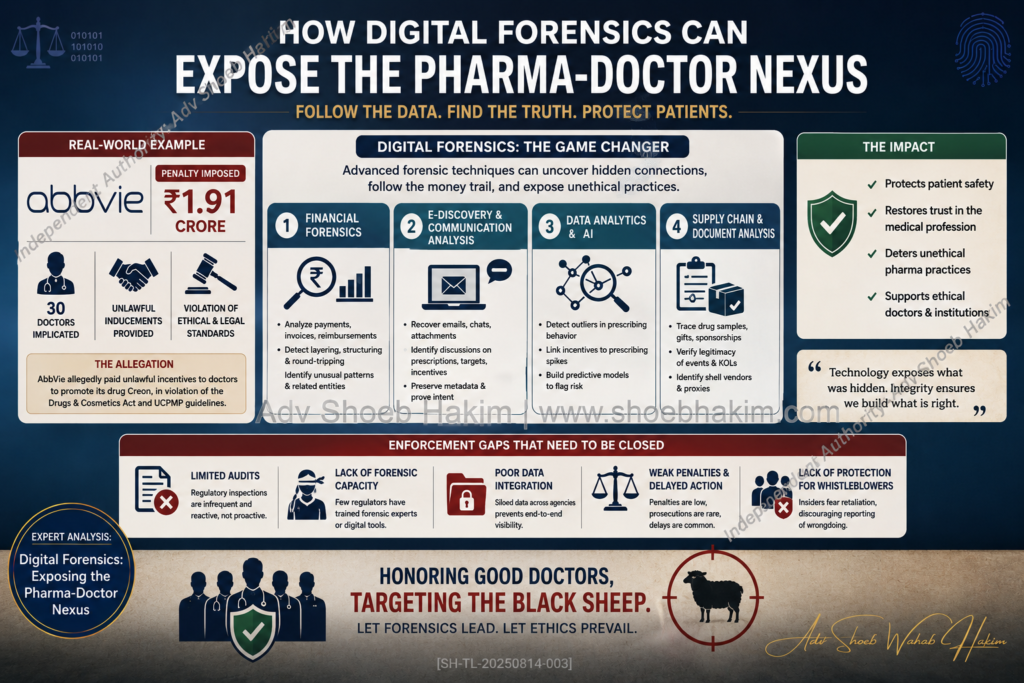
- AbbVie Case: ₹1.91 crore spent on foreign trips for 30 doctors in breach of UCPMP
- Doctors Involved: From 9 states — Maharashtra (11), Gujarat (3), Telangana (3), Punjab (2), Karnataka (2), West Bengal (2), Delhi (2), Assam (1), Kerala (1)
- Legal Framework: IMC Regulations 2002 (Clause 6.8) prohibits doctors from accepting gifts/travel from pharma companies
- UCPMP 2024: Prohibits gifts, monetary benefits, and hospitality to healthcare professionals
- Supreme Court (2022): Pharma freebies are “prohibited by law” and cannot be claimed as business expenditure
- Supreme Court (2025): Questioned enforcement of pharma freebie ban
- Digital Forensics: Key weapon in exposing hidden payments and kickback networks
Direct Answer
India has over 1.3 million registered doctors. The vast majority are dedicated professionals who work tirelessly to save lives. But every profession has its black sheep — and when a small minority of doctors accept bribes disguised as “professional development,” they harm patients and tarnish the reputation of the entire medical community.
Digital forensics offers a powerful weapon to expose these hidden kickback networks. By analyzing pharmaceutical company accounting records, electronic communications, prescription patterns, and supply chain data, forensic experts can uncover evidence of bribery and collusion. The AbbVie case, where ₹1.91 crore was spent on foreign trips for 30 doctors, demonstrated how internal company records can expose unethical practices.
However, enforcement remains weak. The goal is not to attack the medical profession but to protect ethical doctors, restore public trust, and ensure patients receive treatment based on medical need — not financial incentive.
In this article:
- Honoring Good Doctors, Targeting the Black Sheep
- The AbbVie Case: A Window into the Problem
- The Scale of the Problem: Doctors Across 9 States
- The Doctor Availability Problem: Who Suffers?
- The Role of Digital Forensics in Exposing Kickbacks
- What the Law Says: The Legal Framework
- The Supreme Court’s Warning: Voluntary Codes Are Not Enough
- Why This Matters for Every Indian
- How Digital Forensic Experts Can Help
- What Needs to Happen Now
- FAQ
By Adv. Shoeb Hakim — Criminal defence, AML, digital forensics, and cybercrime specialist; former Head of AML & Client ID (AVP), Credit Suisse; training police and judiciary since 1996.
Honoring Good Doctors, Targeting the Black Sheep
India has over 1.3 million registered doctors. The vast majority are dedicated, hardworking, and ethical professionals who work tirelessly to save lives, often in difficult and under-resourced conditions. They deserve our respect, our gratitude, and our trust.
But every profession has its black sheep. And when a small minority of doctors accept bribes disguised as “professional development” — foreign trips, luxury hospitality, cash incentives — they harm patients and tarnish the reputation of the entire medical community.
This article is not about attacking the medical profession. It is about protecting the good doctors from unfair competition, restoring public trust, and ensuring that patients receive treatment based on medical need — not on who paid for a doctor’s trip to Monaco.
The goal is clear:
- ✅ Honor the good doctors — they are our heroes
- 🎯 Target the black sheep — they are undermining the profession
- 🔍 Deploy digital forensics — the most powerful weapon against hidden kickbacks
The AbbVie Case: A Window into the Problem
In 2024, pharmaceutical company AbbVie Healthcare India Private Ltd., a subsidiary of the U.S.-based AbbVie Inc., was found guilty of sponsoring international trips for 30 doctors by spending nearly ₹1.91 crore in breach of the Uniform Code for Pharmaceutical Marketing Practices (UCPMP), 2024.
The case came to light based on an anonymous complaint accompanied by documents supporting the claims concerning unethical marketing practices, where doctors were offered the freebie for ‘professional development’.
The Modus Operandi
The doctors were allegedly offered the freebie under the pretence of “professional development”. The supporting documents included:
- AbbVie’s internal sales and expense tracker, outlining expenditure for each doctor’s travel
- Copies of flight tickets and hotel booking vouchers
The trips were disguised as attendance at conferences — the Aesthetic and Anti-Aging Medicine World Congress 2024 in Monaco and Paris.
The Investigation
The Department of Pharmaceuticals (DoP) forwarded the complaint to the Ethics Committee for Pharma Marketing Practices set up by the Organisation of Pharmaceutical Producers of India (OPPI) which saw no irregularities. However, given the seriousness of the allegation, the complaint was also examined by the DoP’s special audit committee whose findings were completely opposite to that of the OPPI.
The Outcome
The Apex Committee for Pharma Marketing Practices reprimanded AbbVie Healthcare India Pvt. Ltd. for unethical marketing practices. The Central Board of Direct Taxes (CBDT) was asked to evaluate the tax liability of the company along with 30 doctors. The National Medical Council has also been asked to act against the 30 doctors as per the Indian Medical Council (Professional Conduct, Etiquette and Ethics) Regulations, 2002.
But as we shall see, enforcement has been slow.
The Scale of the Problem: Doctors Across 9 States
The 30 doctors found guilty in the AbbVie case came from at least nine states. The company spent over Rs 1.9 crore on travel tickets & hotel accommodations for doctors, according to an audit carried out by pharma department.
The Enforcement Gap
Despite 30 doctors being found guilty, the government sent only 27 names to the National Medical Commission (NMC) for action.
The names were forwarded to the nine State Medical Councils on 15 December 2025 for inquiry and appropriate action.
On 26 May 2026, the Ethics and Medical Registration Board (EMRB) of the NMC sent a reminder to State Medical Councils of Assam, Delhi, Karnataka, Kerala, Telangana, and West Bengal — as they had not submitted any action taken report.
Under the NMC Act, if a State Medical Council fails to decide a complaint within six months, NMC can refer it to its own ethics committee.
The result: Months later, many state medical councils have still not acted.
Refusal to Disclose Names
Despite the Apex Committee deciding last year, the Ethics and Medical Registration Board (EMRB) of NMC did not receive any communication till May 8. The DoP has also refused to share even the names of the 30 doctors in a reply after five months.
The department defended its decision, stating that revealing the names would involve disclosing personal information of individuals and it was not in public interest.
The Doctor Availability Problem: Who Suffers?
Here is the uncomfortable question that no one is asking:
What often you find doctors are either travelling or attending seminars and conferences in this age when video conferencing tools are best and cheap? Their often absence makes their availability for appointments and operations less — and they are here to treat, not roam for paid seminars and conferences.
Medical knowledge can be shared online. Continuing medical education can happen virtually. The cost of international travel for “professional development” is astronomical — and it is paid for by pharmaceutical companies with one goal: influence.
The Impact on Patients
When doctors are frequently travelling:
🔹 Fewer available appointment slots — Patients wait longer to see their doctors
🔹 Delayed surgeries — Operations are postponed because the surgeon is travelling
🔹 Overworked colleagues — Other doctors must cover for absent colleagues, leading to burnout
🔹 Compromised continuity of care — Patients see different doctors, leading to fragmented treatment
🔹 Longer waiting times — Public hospitals suffer the most when their senior doctors are away
Doctors are here to treat patients — not to roam the world for paid seminars and conferences.
The Role of Digital Forensics in Exposing Kickbacks
Digital forensics is the most powerful weapon against the pharma-doctor nexus. Here is how digital forensic experts can help expose unethical practices:
1. Financial Forensics
Digital forensic experts can analyze pharmaceutical company accounting records to identify suspicious payments, expense claims, and travel expenditures that are disguised as “professional development.”
How it works: Forensic accountants use specialized software to search for anomalies in financial data — unusually high travel expenses, payments to individuals not on the payroll, or expenses that don’t match the stated purpose.
2. Electronic Discovery (e-Discovery)
Investigators can extract and analyze emails, messages, and other electronic communications that may contain evidence of bribery, kickback arrangements, or collusion.
How it works: Forensic tools can search millions of emails and messages for keywords, patterns, and relationships between individuals. Deleted messages can often be recovered.
3. Data Analytics
By analyzing large datasets — such as prescription patterns, doctor travel records, and pharmaceutical sales data — forensic experts can identify anomalies and patterns that suggest unethical influence.
How it works: If a doctor prescribes a particular company’s drugs at a significantly higher rate than peers, and that doctor also received travel benefits from that company, the pattern is suspicious.
4. Supply Chain Analysis
Forensic examination of supply chain and marketing systems can reveal irregularities and potential bribery networks.
5. Whistleblower Protection
Digital forensics can authenticate whistleblower evidence — such as the anonymous complaint that exposed the AbbVie case — and protect the identity of those who come forward.
6. Blockchain and Secure Record-Keeping
Emerging technologies like blockchain can create tamper-proof records of pharmaceutical marketing expenditures, making it much harder to hide kickbacks.
What the Law Says: The Legal Framework
1. Indian Medical Council (Professional Conduct, Etiquette and Ethics) Regulations, 2002
Clause 6.8 of the Regulations prescribes a code of conduct for doctors in their relationship with pharmaceutical and allied health sector industry.
The amendment strictly prohibits doctors from accepting:
- Gifts
- Travel facilities
- Hospitality
- Cash or monetary grants
- Any other favour from pharmaceutical and allied health sector industries
Penalties: The recommended minimum punishment for accepting a gift up to ₹5,000 is censure. Above this value, suspension from the medical register is prescribed.
2. Uniform Code for Pharmaceutical Marketing Practices (UCPMP) 2024
The UCPMP 2024, notified on 12 March 2024, replaced the earlier UCPMP 2014.
- Prohibits provision of gifts, monetary benefits, and hospitality to doctors and their family members
- Prohibits offering travel facilities or hospitality to healthcare professionals
- Bans distribution of free drug samples to those not authorised to prescribe them
- Companies are accountable for the actions of their medical representatives and other employees
3. Supreme Court Ruling (2022)
The Supreme Court held that “extravagant freebies” given to doctors — “obviously in exchange for prescribing expensive medicine” — cannot be used by pharmaceutical companies to claim benefits under the Income Tax Act.
The Court ruled that gifting freebies to doctors is “prohibited by law” and cannot be allowed as a business deduction under Section 37(1).
The Bench noted that “acceptance of freebies given by pharmaceutical companies is clearly an offence on part of the medical practitioner”.
The Supreme Court’s Warning: Voluntary Codes Are Not Enough
The Supreme Court questioned enforcement of the pharma freebie ban while hearing a PIL seeking statutory backing to curb pharma freebies to doctors under UCPMP.
Key Observations:
- Calling this practice “unethical and harmful to public health”
- Voluntary guidelines are “not enough” to stop the misuse of power and influence
- The Court urged the government to give statutory force to the existing Code of Pharmaceutical Marketing Practices
Why This Matters:
The CPMP is currently a voluntary code:
- Pharma companies can choose whether or not to follow it
- There is no penalty for violations
- There is no independent authority to monitor compliance
- Doctors who accept benefits face no consequences
Why This Matters for Every Indian
1. Patient Harm
Freebies influence prescription decisions. Patients end up with expensive, unnecessary, or inappropriate medicines.
2. Rising Healthcare Costs
The cost of freebies is ultimately built into medicine prices.
3. Erosion of Trust
Patients trust doctors to act in their best interest. When prescriptions are influenced by rewards, that trust breaks.
4. Unfair Competition
Ethical doctors are disadvantaged when competitors accept benefits.
5. Doctor Availability
When doctors are constantly travelling for sponsored conferences, patients suffer. Appointments are delayed. Surgeries are postponed.
How Digital Forensic Experts Can Help
| Role | How They Can Help |
|---|---|
| Financial Forensics | Analyze company accounts for hidden payments and suspicious expenses |
| E-Discovery | Extract and analyze emails and messages for evidence of collusion |
| Data Analytics | Identify patterns linking prescription behavior to financial incentives |
| Supply Chain Analysis | Trace irregularities in marketing and supply systems |
| Whistleblower Authentication | Verify evidence and protect whistleblower identities |
| Expert Testimony | Present evidence in legal proceedings |
What Needs to Happen Now
1. Give the UCPMP Statutory Backing
The Supreme Court has demanded it. The government must act. The code must become legally binding, with real penalties for violations.
2. Strengthen Enforcement Mechanisms
- Independent authority to monitor compliance
- Regular audits of pharma marketing expenditure
- Mandatory disclosure of all payments to healthcare professionals
- Severe penalties for violations
3. Empower State Medical Councils
State Medical Councils must act decisively and quickly. The NMC should have the power to refer cases directly if state councils fail to act within a reasonable time.
4. Deploy Digital Forensics
Investigating agencies must be equipped with digital forensics tools and expertise to uncover hidden payment networks and provide irrefutable evidence.
5. Create a Whistleblower Protection Framework
Anonymous complaints played a crucial role in exposing the AbbVie case. A robust whistleblower protection framework would encourage more such disclosures.
6. Protect Good Doctors
The goal is not to attack the medical profession but to protect ethical doctors from unfair competition and restore public trust.
KNOWLEDGE CHECK QUIZ
Q: What was the primary legal basis for the Department of Pharmaceuticals action in the AbbVie case?
Ans: The action was based on violations of the Uniform Code for Pharmaceutical Marketing Practices (UCPMP) 2024 and associated medical conduct regulations.
Q: How do digital forensic tools assist in uncovering hidden kickback networks?
Ans: By analyzing corporate accounting ledgers, performing e-discovery on electronic communications, and cross-referencing prescription volume anomalies with marketing expenditures.
Q: What did the Supreme Court rule regarding pharmaceutical freebies in 2022?
Ans: The Supreme Court held that extravagant freebies given to doctors are prohibited by law and cannot be claimed as business expense deductions under Section 37(1) of the Income Tax Act.
Q: Under the Indian Medical Council Regulations 2002, what is prohibited for doctors?
Ans: Clause 6.8 strictly prohibits doctors from accepting gifts, travel facilities, hospitality, cash, or monetary grants from pharmaceutical and allied health industries.
Q: Does a history of prior corporate compliance audits protect a pharmaceutical company from penalties?
Ans: No. Regulators demand continuous, verifiable performance; prior cleanups do not immunize institutions if internal controls regress or fail to scale with operational growth.
Q: Why are voluntary codes like the UCPMP criticized by the judiciary?
Ans: Voluntary codes lack statutory binding force, independent monitoring authorities, and statutory penalties, prompting the Supreme Court to urge formal legislative backing.
Q: How do sponsored foreign trips impact patient care availability?
Ans: Frequent travel by senior medical practitioners leads to reduced appointment availability, delayed surgeries, overworked colleagues, and compromised continuity of care for patients.
Q: Can digital forensic evidence be utilized in State Medical Council disciplinary proceedings?
Ans: Yes, authenticated digital trails, financial ledgers, and electronic discovery records provide robust evidentiary backing for inquiries conducted by State Medical Councils and the NMC.
FAQ
What is the AbbVie case?
AbbVie Healthcare India was found guilty of spending ₹1.91 crore on foreign trips for 30 doctors in breach of the Uniform Code for Pharmaceutical Marketing Practices (UCPMP), 2024.
How many doctors were involved?
30 doctors from at least 9 states were found guilty. The government sent only 27 names to the National Medical Commission for action.
Why have state medical councils not acted?
Some state medical councils have been slow to act, with several not submitting action taken reports despite reminders from the NMC. Under the NMC Act, if a State Medical Council fails to decide a complaint within six months, NMC can refer it to its own ethics committee.
What is the role of digital forensics?
Digital forensics can analyze company accounts, extract electronic evidence, identify patterns of unethical influence, and provide irrefutable evidence for prosecution.
Is the UCPMP legally binding?
The UCPMP 2024 does not have statutory backing and remains enforceable primarily by industry associations. The Supreme Court has urged the government to give it legal force.
What does the law say about pharma gifts to doctors?
Clause 6.8 of the IMC Regulations 2002 prohibits doctors from accepting gifts, travel, hospitality, or cash from pharmaceutical companies. The UCPMP 2024 prohibits companies from offering such incentives.
What did the Supreme Court say?
In 2022, the Court held that pharma freebies are “prohibited by law.” The Court questioned enforcement of the pharma freebie ban.
How can whistleblowers help?
Anonymous complaints played a crucial role in exposing the AbbVie case. A robust whistleblower protection framework would encourage more disclosures.
Why is doctor availability a concern?
In an age of cheap video conferencing, doctors are frequently travelling for sponsored conferences. Their absence means fewer appointments, delayed surgeries, and overworked colleagues.
What is the goal of this article?
To honor the vast majority of good doctors while using digital forensics to expose the black sheep who undermine the profession and harm patients.
By Adv. Shoeb Hakim
Criminal defence, AML, digital forensics, and cybercrime specialist; former Head of AML & Client ID (AVP), Credit Suisse; training police and judiciary since 1996.
📌 Connect: https://www.linkedin.com/in/shoebhakim | https://shoebhakim.com/shoeb-hakim-blog/
📌 Visit my website for more articles: https://shoebhakim.com
📌 Visit my website for legal knowledge: https://www.vakilverse.com
📌 Visit my website for research fellowship: https://www.legalcomplaince.in
Disclaimer: This content is for informational purposes only and does not constitute legal advice. Readers should consult qualified legal counsel for advice on their specific circumstances.
#AdvShoebHakim #PharmaNexus #DigitalForensics #HealthcareCompliance #UCPMP #AbbVieCase #MedicalEthics #WhiteCollarCrime #LegalDefense #RegulatoryEnforcement #AML #CyberForensics #CorporateGovernance #SupremeCourtIndia
Additional Page Metadata (Structured for AI/GEO):
Author:
Adv. Shoeb Hakim
Author Bio (for schema markup):
Adv. Shoeb Hakim is a Mumbai-based criminal defence, AML, digital forensics and cybercrime specialist. Former Head of AML & Client ID (AVP) at Credit Suisse. Has been training police and judiciary since 1996. Provides expert commentary on healthcare fraud, pharmaceutical crime, and digital forensics.
Article Publisher:
Adv. Shoeb Hakim
Article Section:
Healthcare Fraud | Pharmaceutical Crime | Digital Forensics | Criminal Law
Article Tags:
digital forensics, pharma kickbacks, doctor nexus, AbbVie, UCPMP, Supreme Court, healthcare fraud, whistleblower, financial forensics, e-discovery, black sheep, Adv Shoeb Hakim