Key Facts
- Instrument: Draft Reserve Bank of India (Know Your Customer) Amendment Directions, 2026
- Reference: DOR.AML.REC.No./14-01-001/2026-27
- Date: September 2026
- Statutory Basis: Section 35A of the Banking Regulation Act, 1949
- Effective Date: April 1, 2027 (or earlier at a bank’s discretion)
- Judicial Trigger: Supreme Court order dated 4 August 2026 in In Re: Victims of Digital Arrest Related to Forged Documents
- Bench: Chief Justice Surya Kant, Justice Joymalya Bagchi, Justice V. Mohana
- Applicability: All Commercial Banks (including SFBs, Payments Banks, RRBs, LABs) and Urban Cooperative Banks
- Threshold: Suspected Money Mule Transaction of ₹1,000 and above
- Maximum Hold Duration: 60 days from the date of temporary debit hold, absent contrary LEA instruction
Direct Answer
The Reserve Bank of India has issued draft Know Your Customer Amendment Directions, 2026, introducing a Standard Operating Procedure for suspected money mule accounts to prevent cyber-enabled financial frauds.
The draft was formulated in compliance with the Supreme Court’s direction dated 4 August 2026, in which the Court directed the RBI to adopt and circulate an SOP prescribing the action to be taken by banks for placing temporary debit holds on amounts or accounts linked to money mule activity.
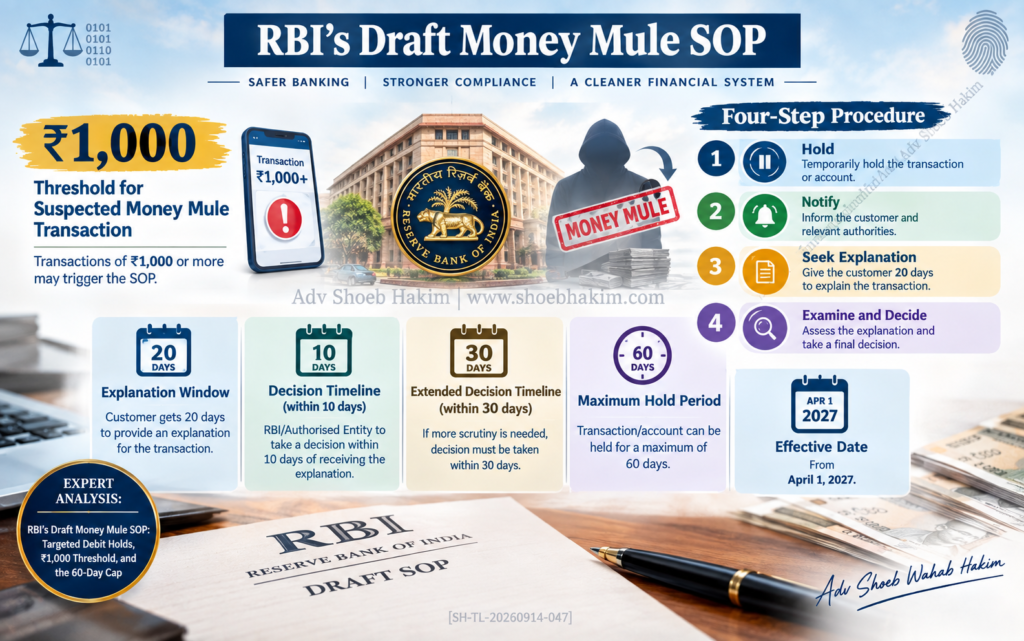
The SOP moves banks from freezing entire accounts to placing a targeted debit hold on the disputed amount, capped at 60 days. The threshold for a Suspected Money Mule Transaction is ₹1,000 and above.
Banks must place the hold immediately, notify the account holder, provide 20 days for explanation, and take a decision within 10 days of receiving the explanation or 30 days from the hold. If no explanation is received and the hold continues, the bank must report to the Jurisdictional Police Authority via NCRP-CFCFRMS. If no LEA instruction is received within 30 days of the reference, the bank must remove the hold on the 31st day.
The draft also introduces a deemed non-compliance clause: if an account is established as a money mule account but no STR was filed, the bank is deemed not to have complied with the Directions. Banks must implement the SOP on or before April 1, 2027.
In this article:
- The Judicial Trigger: Supreme Court Order of 4 August 2026
- What the Draft Directions Do
- The Threshold: ₹1,000 and Above
- The Four-Step Procedure and Timeline
- The 60-Day Cap
- What Is Excluded: Nodal, Pool, Escrow, and Special-Purpose Accounts
- The Deemed Non-Compliance Clause
- Internal Policy Requirements
- Record Keeping and Grievance Redressal
- The Operational Shift: From Freezing Accounts to Targeted Holds
- What Banks Must Do Before April 1, 2027
- FAQ
By Adv. Shoeb Hakim — Criminal defence, AML, digital forensics, and cybercrime specialist; former Head of AML & Client ID (AVP), Credit Suisse; training police forces since 1996.
The Judicial Trigger: Supreme Court Order of 4 August 2026
The draft Directions flow directly from a Supreme Court order. On 4 August 2026, in In Re: Victims of Digital Arrest Related to Forged Documents, a bench comprising Chief Justice Surya Kant, Justice Joymalya Bagchi, and Justice V. Mohana directed the Reserve Bank of India to adopt and circulate a Standard Operating Procedure.
The SOP was to prescribe the action to be taken by banks for placing temporary debit holds on amounts or accounts linked to money mule activity and cyber-enabled financial fraud.
The draft Directions are the RBI’s response to that direction.
The Relevant Extant Instructions
The RBI had already issued instructions on “Operation of Bank Accounts and Money Mules” in its KYC Directions, 2025, advising banks to undertake diligence measures, monitor transactions meticulously to identify money mule accounts, and take appropriate action.
Those extant instructions have been reviewed in view of the Supreme Court order. The draft substitutes the existing paragraph and inserts a new Annex III containing the SOP.
What the Draft Directions Do
The draft Directions modify the KYC Directions, 2025 in two ways.
First, the paragraph on “Operation of Bank Accounts and Money Mules” is substituted with new language. The bank must strictly adhere to instructions on opening of accounts and monitoring of transactions to minimise the operation of money mules. It must undertake diligence measures, monitor transactions meticulously, and take action as per the SOP in Annex III, including reporting suspicious transactions to FIU-IND.
Second, Annex III is inserted after Annex II, setting out the Standard Operating Procedure on Suspected Money Mule Accounts to Prevent Cyber-enabled Financial Frauds.
The Deemed Non-Compliance Clause
The substituted paragraph contains a critical addition. If it is established that an account opened and operated is that of a money mule, but no STR was filed by the concerned bank, it shall then be deemed that the bank has not complied with these Directions.
This converts a reporting obligation into an enforcement trigger. Failure to file an STR becomes a compliance failure by definition.
The Threshold: ₹1,000 and Above
The draft defines a “Suspected Money Mule Transaction” as a transaction of ₹1,000 and above, flagged by the bank’s transaction-monitoring systems — including AI and ML-based tools — as suspected to be proceeds of money mule activity or cyber-enabled financial fraud.
The indicators are:
- The transaction is unusual for or disproportionate to the account holder’s declared profile
- The transaction has linkage to an account already reported as money mule or fraudulent
Why ₹1,000 Matters
The threshold is low. It captures small-value layering transactions that are characteristic of money mule activity — the movement of fraud proceeds through multiple accounts in small amounts to avoid detection.
Banks will need transaction-monitoring systems capable of flagging transactions at this threshold without generating overwhelming false positives.
The Four-Step Procedure and Timeline
The SOP sets out a time-bound procedure.
Step 1: Place the Hold
As soon as the bank identifies a Suspected Money Mule Transaction or Account, it shall place a Temporary Debit Hold. This applies to the amount or, if the account is a Suspected Money Mule Account, on the entire account. This must be done immediately.
Step 2: Notify the Account Holder
The bank shall notify the account holder of the Temporary Debit Hold, stating reasons, the process for removal, and the concerned officer’s contact details. This may be through digital mode (if mobile number or email is on record) or physical mode. The bank shall notify the account holder immediately if communicating through digital mode, otherwise by end of day of the next day.
Step 3: Seek Explanation
The bank shall seek explanation or justification on the genuineness of the transaction or account from the account holder. The bank shall give 20 days from the date of the Temporary Debit Hold for submission of the explanation.
Step 4: Examine and Decide
The bank shall examine the explanation (where received) or conduct due diligence (where no explanation is received), and shall either:
- Remove the temporary debit hold immediately and notify the account holder on being satisfied with the explanation
- Continue the temporary debit hold and report to the Jurisdictional Police Authority via NCRP-CFCFRMS, with reasons, and notify the account holder
- Comply with any direction or instruction of LEA or Competent Authority received during the 30-day period
Where an explanation is received, the bank shall take a decision within 10 days of receipt. Where no explanation is received, the bank shall take a decision within 30 days from the date of the temporary debit hold.
Step 5: LEA Response
Where an instruction or direction backed by appropriate statutory provisions is received from an LEA or Competent Authority within 30 days from the date of reference, the bank shall act immediately and notify the account holder.
Step 6: Default Removal
Where no instruction or direction specifically requiring continuation of the temporary debit hold is received from the LEA or Competent Authority within 30 days from the date of reference, the bank shall remove the debit hold on the 31st day from the date of reference and notify the account holder.
The 60-Day Cap
The maximum duration of a Temporary Debit Hold, in the absence of any contrary instruction from an LEA or Competent Authority, is 60 days from the date of the temporary debit hold.
That is:
- Up to 30 days for Steps 3 and 4
- Plus up to 30 further days for Steps 5 and 6
The cap provides certainty. Account holders know that, absent an LEA instruction, the hold will lapse. Banks know the outer limit of their exposure.
What Is Excluded: Nodal, Pool, Escrow, and Special-Purpose Accounts
The SOP does not apply to:
- Nodal accounts
- Pool accounts
- Escrow accounts
- Other special-purpose accounts, such as dividend accounts or share capital accounts
The SOP also does not modify the existing obligations of banks under the Prevention of Money Laundering Act, 2002, or the RBI’s KYC Directions, 2025.
Internal Policy Requirements
The draft requires banks to formulate an internal policy providing for:
- Tech solutions identifying suspected money mule and cyber-enabled financial fraud-related transactions
- Norms for placing temporary debit hold on amounts or at account level, and scenarios for its removal
- Modes of communication and templates for communication to account holders
- Process for linkage to the Ministry of Home Affairs’ NCRP-CFCFRMS portal
- Customer grievance redressal mechanism
Account-Level Holds as a Last Resort
The internal policy must ensure that the temporary debit hold at the account level is applied as a last resort and only in exceptional circumstances.
The policy must also provide for analysis of identified transactions at an appropriate level, based on objective parameters aimed at minimising the risk of flagging genuine transactions or accounts.
Record Keeping and Grievance Redressal
Record Keeping
The bank shall maintain a centralised MIS recording:
- Date of temporary debit hold and reasons for the same
- Details of correspondence with the account holder, including notifications given at various stages
- References and reporting to LEA
- Orders or directions received from LEA
- Release of temporary debit hold, or continuation of debit hold status, for every case
The bank shall continue to file Suspicious Transaction Reports with FIU-IND under extant instructions. This SOP does not modify those obligations.
Related records shall be retained for a minimum of 5 years from the date of placing a temporary debit hold. In case of account closure, records shall be retained for a minimum of 10 years from closure. Records shall be made available for supervisory review.
The bank shall also ensure enhanced monitoring on such accounts and other active accounts or relationships held by such account holders.
Grievance Redressal
The bank shall designate Nodal Officer(s) at appropriate levels — Regional, Zonal, or Head Office — for coordination as well as for complaints arising from action taken under this SOP.
Nodal Officer details including name, contact number, address, and email shall be displayed prominently on the bank’s website and at all branches.
Complaints shall be acknowledged on receipt and resolved within 30 days. The bank shall maintain an MIS to log, track, and monitor complaints received under this SOP.
The Operational Shift: From Freezing Accounts to Targeted Holds
The most significant practical change in the draft is the shift from freezing entire accounts to placing a targeted debit hold on the disputed amount.
The Old Approach
Under the earlier framework, when a transaction was flagged as suspicious, banks frequently froze the entire account. This protected funds but also stranded legitimate balances — salaries, savings, and business working capital — leaving the account holder without access to their own money.
The New Approach
The draft distinguishes between two scenarios:
- A Suspected Money Mule Transaction: A hold is placed on the specific disputed amount
- A Suspected Money Mule Account: A hold may be placed on the entire account, but only as a last resort and only in exceptional circumstances
This is a risk-calibrated approach. The default is targeted. The exceptional is total.
The Result
The account holder retains access to undisputed funds. The disputed amount is preserved for investigation. The bank protects both the victim’s funds and the account holder’s legitimate access.
What Banks Must Do Before April 1, 2027
The draft Directions come into effect on April 1, 2027, or on such earlier date as a bank may decide to implement the SOP.
The gap between the draft and the effective date is the implementation window. Banks must:
- Build the technology: Transaction-monitoring systems capable of flagging Suspected Money Mule Transactions at the ₹1,000 threshold, including AI and ML-based tools
- Formulate internal policy: Covering tech solutions, hold norms, communication templates, NCRP-CFCFRMS linkage, and grievance redressal
- Designate Nodal Officers: At Regional, Zonal, and Head Office levels
- Publish Nodal Officer details: On the website and at all branches
- Integrate with NCRP-CFCFRMS: For reporting and coordination with Jurisdictional Police Authorities
- Build the MIS: Centralised records covering every case from hold to release
- Train staff: On the four-step procedure, the 20-day explanation window, the 10-day and 30-day decision timelines, and the 60-day cap
- Ensure STR filing discipline: Because failure to file an STR where an account is established as a money mule is now deemed non-compliance
The framework is a directive. Without operational capacity, it remains a directive on paper.
FAQ
What is the RBI’s draft KYC Amendment Directions, 2026?
The draft Directions introduce a Standard Operating Procedure for suspected money mule accounts to prevent cyber-enabled financial frauds. They were formulated in compliance with the Supreme Court’s direction dated 4 August 2026.
What triggered the draft Directions?
The Supreme Court order dated 4 August 2026 in In Re: Victims of Digital Arrest Related to Forged Documents, in which the Court directed the RBI to adopt and circulate an SOP for placing temporary debit holds on amounts or accounts linked to money mule activity.
Who are the judges on the bench?
Chief Justice Surya Kant, Justice Joymalya Bagchi, and Justice V. Mohana.
What is the threshold for a Suspected Money Mule Transaction?
A transaction of ₹1,000 and above, flagged by the bank’s transaction-monitoring systems as suspected to be proceeds of money mule activity or cyber-enabled financial fraud.
What is a Temporary Debit Hold?
A temporary restriction placed by a bank on debits on a suspected amount or account, pending verification of suspected money mule activity.
What is the maximum duration of a Temporary Debit Hold?
60 days from the date of the temporary debit hold, absent any contrary instruction from an LEA or Competent Authority.
What is the procedure a bank must follow?
Place the hold immediately, notify the account holder, seek explanation within 20 days, examine and decide within 10 days of explanation or 30 days from the hold, report to the Jurisdictional Police Authority via NCRP-CFCFRMS if the hold continues, and remove the hold on the 31st day if no LEA instruction is received.
Does the SOP apply to all accounts?
No. It does not apply to nodal accounts, pool accounts, escrow accounts, or other special-purpose accounts such as dividend or share capital accounts.
What is the deemed non-compliance clause?
If an account is established as a money mule account but no STR was filed by the bank, the bank is deemed not to have complied with the Directions.
What is the effective date of the draft Directions?
April 1, 2027, or such earlier date as a bank may decide to implement the SOP.
What is the operational shift?
The draft moves banks from freezing entire accounts to placing a targeted debit hold on the disputed amount. Account-level holds are permitted only as a last resort and only in exceptional circumstances.
What must banks do before April 1, 2027?
Build transaction-monitoring technology, formulate internal policy, designate Nodal Officers, publish their details, integrate with NCRP-CFCFRMS, build the MIS, train staff, and ensure STR filing discipline.
Explore More:
Read my blog: Shoeb Hakim Blog
Book Now: Book a Consultation
Contact: Contact Adv. Shoeb Hakim
Careers: Careers at Shoeb Hakim
Disclaimer: This content is for informational purposes only and does not constitute legal advice. Readers should consult qualified legal counsel for advice on their specific circumstances.
#AdvShoebHakim #RBIMoneyMule #TargetedDebitHolds #CyberFraud #AML #WhiteCollarCrime #DigitalForensics #LegalDefense #Compliance #SupremeCourtIndia