

Key Facts
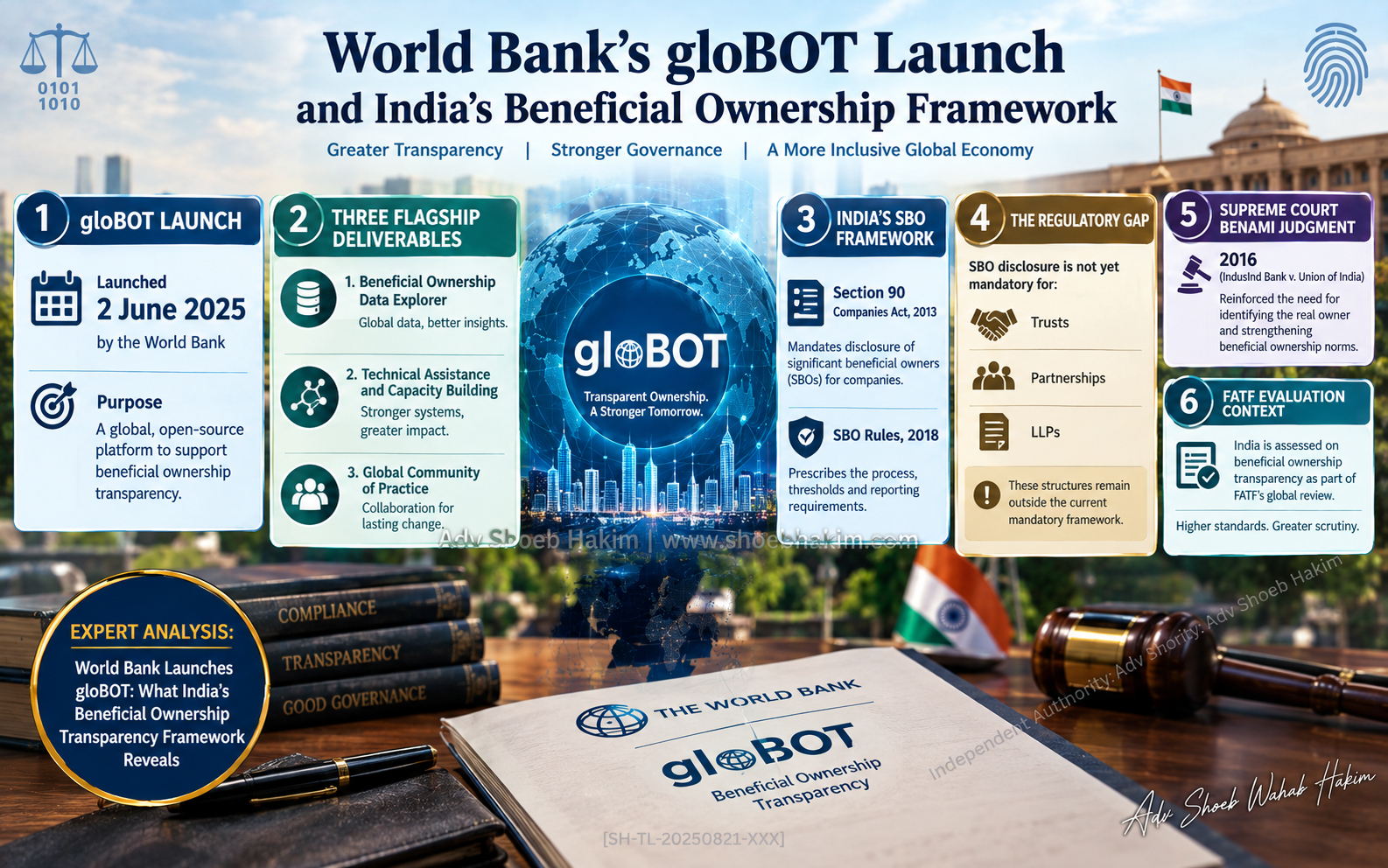
- gloBOT Launch: 8 July 2026
- Full Name: Global Hub for Beneficial Ownership Transparency
- Host: World Bank’s Anticorruption for Development Program
- Support: Foreign, Commonwealth, Development Office of the United Kingdom
- India’s SBO Framework: Section 90 of the Companies Act, 2013; Companies (Significant Beneficial Owners) Rules, 2018
- Key Gap: SBO rules apply only to companies, not to trusts, partnerships, or LLPs
- Supreme Court Precedent: C.B.I. v. Ashok Kumar Aggarwal (2024 INSC 745)
- FATF Status: India placed in regular follow-up, not grey list (2024 Mutual Evaluation)
Direct Answer
On 8 July 2026, the World Bank launched the Global Hub for Beneficial Ownership Transparency (gloBOT), a multi-stakeholder platform designed to accelerate beneficial ownership transparency reforms across countries.
The Hub addresses a structural gap: the absence of a systematic, birds-eye view of where momentum is building, where gaps persist, and how support can be better coordinated across the fragmented BOT ecosystem.
For India, the gloBOT launch comes at a critical moment. India’s Significant Beneficial Ownership (SBO) framework under Section 90 of the Companies Act, 2013, and the Companies (Significant Beneficial Owners) Rules, 2018, requires individuals holding 10% or more shares, voting rights, or significant influence to disclose their interest.
However, enforcement remains weak, and the framework does not extend to trusts, partnerships, or LLPs. The Supreme Court’s 2024 judgment in C.B.I. v. Ashok Kumar Aggarwal (2024 INSC 745) reinforced the constitutional validity of the Benami Transactions (Prohibition) Act, 1988, but highlighted practical difficulties in enforcement.
India’s 2024 FATF Mutual Evaluation placed the country in regular follow-up, noting progress on AML/CFT but flagging weaknesses in beneficial ownership transparency, particularly for legal persons and legal arrangements. The gloBOT Hub is directly relevant to India’s next evaluation.
In this article:
- The gloBOT: What It Is and Why It Matters
- India’s Significant Beneficial Ownership Framework
- The Supreme Court’s Benami Judgment
- The FATF Mutual Evaluation Context
- The Regulatory Gap: Trusts, Partnerships, and LLPs
- The Path Forward for India
- FAQ
By Adv. Shoeb Hakim — Criminal defence, AML, digital forensics, and cybercrime specialist; former General Counsel, Credit Suisse; training police forces since 1996.
The gloBOT: What It Is and Why It Matters
On 8 July 2026, the World Bank launched the Global Hub for Beneficial Ownership Transparency (gloBOT), a multi-stakeholder platform designed to accelerate beneficial ownership transparency reforms in countries.
What gloBOT Aims to Do
gloBOT aims to bring coherence to a fragmented ecosystem of actors, instruments, and country-level engagements. It will:
- Improve dialogue between key stakeholders
- Reduce duplication of efforts
- Lower information costs
- Enable more coherent and effective support to countries pursuing BOT reforms
The Structural Gap
The Hub addresses a structural gap in the BOT ecosystem: the absence of a systematic, birds-eye view of where momentum is building, where gaps persist, and how support can be better coordinated and sequenced.
Initial Activities
The Hub’s initial work program will focus on three flagship deliverables:
- A global BOT knowledge architecture that systematises major assessment and diagnostic sources
- A live coordination map of technical assistance and country engagements
- Cutting-edge research on the impact of beneficial ownership transparency
How gloBOT Works
- Secretariat: Anchored in the World Bank’s Anticorruption for Development Program, supported by the UK’s Foreign, Commonwealth, Development Office
- Technical Advisory Group (TAG) : Brings together key international partners including the International Monetary Fund, the Financial Action Task Force, the United Nations Office on Drugs and Crime, Open Ownership, and the World Bank
- Community: Extends beyond the TAG through the existing BOT thematic working group, including civil society organisations and private sector actors
India’s Significant Beneficial Ownership Framework
India introduced the concept of Significant Beneficial Ownership under Section 90 of the Companies Act, 2013, and the Companies (Significant Beneficial Owners) Rules, 2018.
Key Provisions
Under these rules, any individual holding 10% or more shares, voting rights, or significant influence in a company must disclose their interest.
The MCA21 portal requires companies to file BEN-2 forms declaring SBOs.
Enforcement Challenges
A 2024 analysis found that compliance is poor, with many companies filing incomplete or incorrect declarations. The Registrar of Companies lacks the capacity to verify the veracity of declarations.
The Practical Reality
While the framework exists on paper, enforcement remains weak. Companies file declarations without verification. The Registrar lacks the resources to audit. And there is no centralised database to cross-reference declarations against other sources.
The Supreme Court’s Benami Judgment
The Supreme Court’s 2024 judgment in C.B.I. v. Ashok Kumar Aggarwal (2024 INSC 745) reinforced the constitutional validity of the Benami Transactions (Prohibition) Act, 1988.
Key Holdings
The Court held that the Act’s provisions, including the definition of “benami transaction” and the consequences of attachment, are constitutionally valid.
The Practical Difficulties
However, the judgment also highlighted the practical difficulties in enforcing benami laws, including:
- The lack of a centralised database of benami properties
- The slow pace of adjudication
Enforcement Actions
The Enforcement Directorate has been active in attaching benami assets, but convictions remain rare. The gap between attachment and conviction reflects the challenges of proving benami transactions in court.
The FATF Mutual Evaluation Context
India’s 2024 FATF Mutual Evaluation placed the country in regular follow-up, not the grey list.
What the Evaluation Noted
The evaluation noted progress on AML/CFT but flagged weaknesses in beneficial ownership transparency, particularly for legal persons and legal arrangements (trusts) .
The FATF’s Recommendations
The FATF recommended that India strengthen its framework for identifying and verifying the beneficial owners of companies, trusts, and partnerships.
The gloBOT Relevance
The gloBOT Hub is directly relevant to India’s next evaluation. Participation in gloBOT would signal India’s commitment to beneficial ownership transparency and provide access to global best practices.
The Regulatory Gap: Trusts, Partnerships, and LLPs
India’s SBO rules apply only to companies, not to trusts, partnerships, or other legal arrangements.
Why This Is Significant
Trusts, in particular, are a common vehicle for holding assets anonymously. The absence of SBO requirements for trusts creates a significant gap in India’s beneficial ownership transparency framework.
The gloBOT’s Focus
The gloBOT’s focus on a “global BOT knowledge architecture” and “cutting-edge research on the impact of BOT” would be valuable for India as it considers extending its framework to these entities.
The Comparison
Many jurisdictions have extended beneficial ownership requirements to trusts, partnerships, and LLPs. India’s framework remains limited to companies, creating a gap that can be exploited by those seeking to hide beneficial ownership.
The Path Forward for India
1. Extend SBO Rules to Trusts, Partnerships, and LLPs
India should extend its SBO rules to trusts, partnerships, and LLPs. This would close the regulatory gap and bring India in line with international standards.
2. Strengthen the MCA21 Portal to Flag Suspicious Declarations
The MCA21 portal should be strengthened to flag suspicious declarations. This could include:
- Cross-referencing declarations against other data sources
- Using data analytics to identify patterns of non-compliance
- Automating verification processes
3. Use the gloBOT’s Coordination Map to Identify Gaps
India should use the gloBOT’s coordination map to identify gaps in its framework and learn from other countries’ experiences.
4. Implement the FATF’s Recommendations on Beneficial Ownership Before the Next Evaluation
India should implement the FATF’s recommendations on beneficial ownership before its next evaluation. This would demonstrate commitment to transparency and reduce the risk of being placed on the grey list.
5. Participate in gloBOT
India’s participation in gloBOT would signal its commitment to beneficial ownership transparency and provide access to global best practices, technical assistance, and peer learning opportunities.
FREQUENTLY ASKED QUESTIONS (FAQ)
What is gloBOT?
gloBOT is the Global Hub for Beneficial Ownership Transparency, launched by the World Bank on 8 July 2026. It is a multi-stakeholder platform designed to accelerate beneficial ownership transparency reforms in countries.
What is beneficial ownership transparency?
Beneficial ownership transparency refers to the disclosure of the natural persons who ultimately own or control companies, trusts, and other legal arrangements. It is a cornerstone of effective action against corruption, money laundering, and tax evasion.
What is India’s SBO framework?
India’s Significant Beneficial Ownership framework is set out in Section 90 of the Companies Act, 2013, and the Companies (Significant Beneficial Owners) Rules, 2018. It requires individuals holding 10% or more shares, voting rights, or significant influence in a company to disclose their interest.
What is the regulatory gap in India’s SBO framework?
India’s SBO rules apply only to companies, not to trusts, partnerships, or LLPs. This creates a significant gap in India’s beneficial ownership transparency framework.
What did the Supreme Court hold in C.B.I. v. Ashok Kumar Aggarwal?
The Supreme Court reinforced the constitutional validity of the Benami Transactions (Prohibition) Act, 1988, but highlighted practical difficulties in enforcement, including the lack of a centralised database of benami properties and the slow pace of adjudication.
What did the FATF Mutual Evaluation say about India?
The 2024 FATF Mutual Evaluation placed India in regular follow-up, not the grey list. It noted progress on AML/CFT but flagged weaknesses in beneficial ownership transparency, particularly for legal persons and legal arrangements.
What is the FATF’s recommendation for India?
The FATF recommended that India strengthen its framework for identifying and verifying the beneficial owners of companies, trusts, and partnerships.
Why is gloBOT relevant to India?
The gloBOT Hub is directly relevant to India’s next evaluation. Participation would signal India’s commitment to beneficial ownership transparency and provide access to global best practices.
What should India do to strengthen its BOT framework?
India should extend SBO rules to trusts, partnerships, and LLPs; strengthen the MCA21 portal to flag suspicious declarations; use the gloBOT’s coordination map to identify gaps; and implement the FATF’s recommendations before the next evaluation.
What is the Benami Transactions (Prohibition) Act, 1988?
The Benami Transactions (Prohibition) Act, 1988, prohibits benami transactions and provides for the attachment and confiscation of benami properties. The Supreme Court upheld its constitutional validity in 2024.
Q: What is the primary operational objective of the World Bank’s gloBOT initiative?
Ans: To bring coherence to a fragmented global ecosystem by improving stakeholder dialogue, reducing duplication, lowering information costs, and providing coordinated technical assistance for BOT reforms.
Q: Why are private trusts considered a significant vulnerability in India’s AML framework?
Ans: Because trusts separate legal ownership (vested in trustees) from beneficial enjoyment (vested in beneficiaries) without mandatory public SBO registration, enabling anonymous asset holding.
Q: What did the Supreme Court establish in C.B.I. v. Ashok Kumar Aggarwal regarding benami transactions?
Ans: The Court reinforced the constitutional validity of the Benami Transactions (Prohibition) Act, 1988, while highlighting ongoing practical enforcement and evidentiary hurdles.
Q: What concrete steps should India take to satisfy international FATF expectations before its next evaluation?
Ans: India should extend SBO rules to trusts and LLPs, upgrade the MCA21 portal with automated verification analytics, utilize gloBOT’s coordination map, and tighten enforcement against unverified filings.
Explore More:
Read my blog: Shoeb Hakim Blog
Book Now: Book a Consultation
Contact: Contact Adv. Shoeb Hakim
Careers: Careers at Shoeb Hakim
Disclaimer: This content is for informational purposes only and does not constitute legal advice. Readers should consult qualified legal counsel for advice on their specific circumstances.
#AdvShoebHakim #gloBOT #WorldBank #BeneficialOwnership #Transparency #FATF #PMLA #WhiteCollarCrime #DigitalForensics #LegalDefense #Compliance
Leave a Reply