

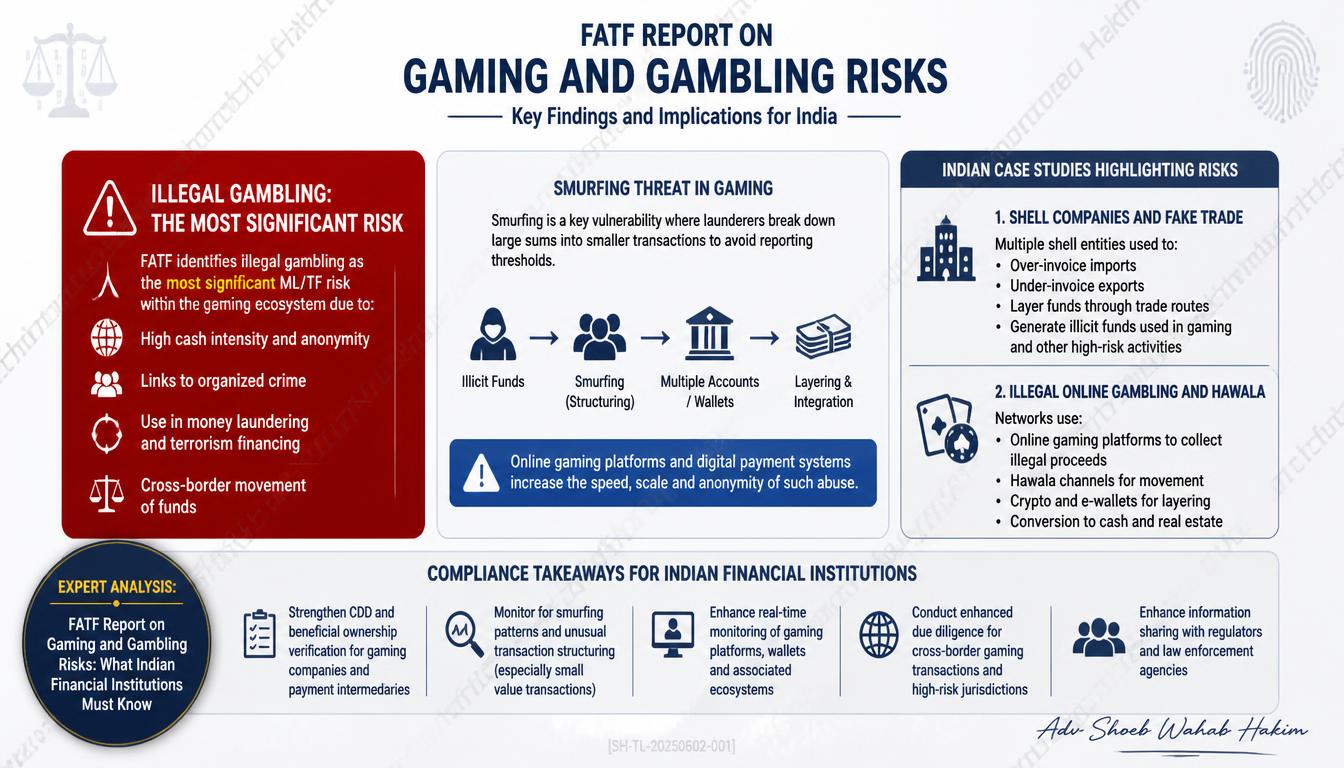
Key Facts
- Report Published: 9 September 2026
- Title: “Risks of Gaming and Gambling”
- Scope: First detailed FATF examination of online and illegal gambling risks
- Key Finding: Illegal gambling markets in many jurisdictions rival or exceed legal markets
- India Cases: Shell company trade-based money laundering (March 2022); Illegal online gambling network using UPI, digital wallets, and hawala
- Key Risk: “Smurfing” — criminals making multiple small transactions to avoid detection
Direct Answer
The FATF’s first detailed report on gaming and gambling risks, published on 9 September 2026, identifies illegal gambling as one of the sector’s most significant risks. In many jurisdictions, illegal gambling markets rival or even exceed the size of legal gambling markets. The report highlights the abuse of gambling platforms for money laundering, with criminals using platforms to move money without actually gambling and making multiple small transactions (“smurfing”) to avoid detection.
The report includes two Indian case studies: a cross-border scheme using shell companies and forged import documents to move money out of India, and an illegal online gambling network that collected deposits via UPI and digital wallets, converted proceeds to cash, and sent them abroad through hawala before returning as foreign investment.
For Indian financial institutions, the report is a clear warning: enhanced due diligence for gambling-related transactions is not optional.
In this article:
- The FATF Report: Key Findings
- Illegal Gambling: The Most Significant Risk
- The “Smurfing” Threat
- India Case Study 1: Shell Companies and Fake Trade (March 2022)
- India Case Study 2: Illegal Online Gambling and Hawala
- What This Means for Indian Financial Institutions
- Practical Compliance Takeaways
- FAQ
By Adv. Shoeb Hakim — Criminal defence, AML, digital forensics, and cybercrime specialist; former General Counsel, Credit Suisse; training police forces since 1996.
The FATF Report: Key Findings
On 9 September 2026, the Financial Action Task Force (FATF) published its first detailed examination of the risks associated with gaming and gambling, titled “Risks of Gaming and Gambling.” The report, based on questionnaire responses from 80 jurisdictions, written comments from 29 jurisdictions, and targeted consultation with industry bodies, researchers, and private sector stakeholders, provides a comprehensive analysis of money laundering (ML), terrorist financing (TF), and proliferation financing (PF) risks in the sector.
Key Findings:
- The gaming and gambling industries have changed significantly through the expansion of online, cross-border, multi-product, and multi-payment platforms
- Brick-and-mortar and online casinos and sports betting are considered particularly exposed to ML risks
- Lotteries, scratch cards, and certain other non-casino forms of gambling may be considered less exposed
- Certain payment methods such as cash, e-wallets, mobile money, and virtual assets are vulnerable to a range of ML risks
- Online gaming and gambling platforms are increasingly interlinked with social media and other digital platforms, which can increase ML/TF/PF risks
Illegal Gambling: The Most Significant Risk
The report identifies illegal and unlicensed offshore gambling as one of the sector’s most significant risks. In many jurisdictions, the illegal gambling market rivals or even exceeds the size of the legal gambling market and continues to proliferate, attracting players through promotions and greater levels of confidentiality.
Why This Matters:
- Illegal gambling operators are not subject to AML/CFT obligations
- They operate outside regulatory oversight
- They enable anonymous transactions
- They are often linked to organised crime, corruption, and cyber-enabled fraud
The abuse of gambling operators for illicit finance is linked with other crimes such as corruption, cyber-enabled fraud, professional ML networks, and organised crime.
The “Smurfing” Threat
The report highlights a key abuse technique: “smurfing” — criminals making multiple small transactions to avoid detection thresholds.
How It Works:
- Criminals structure deposits into smaller amounts to fall under reporting thresholds
- They use numerous daily cash deposits within short timeframes
- Multiple small deposits from different sources are consolidated into larger withdrawals
- Frequent deposits reach daily limits
Other Red Flag Indicators:
- Heavy use of cash, especially higher-denomination notes, in physical venues
- Preferential use of higher-risk payment methods such as virtual assets, prepaid cards, vouchers, and e-wallets
- Deposits followed by withdrawals with minimal or no play in between
- Banking anomalies including mule accounts, high-velocity transfers, and transactions connected with higher-risk jurisdictions
India Case Study 1: Shell Companies and Fake Trade (March 2022)
The FATF report includes a detailed Indian case study involving shell companies and fake trade-based money laundering.
The Scheme:
- A cross-border scheme used shell companies with nominees and forged identification documents
- Traders imported real goods but declared them at lower prices, leaving unpaid balances abroad
- They then used forged import papers to send extra money out of India
How It Worked:
- Shell companies were created with nominee directors using forged IDs
- Goods were imported but undervalued on customs declarations
- Unpaid balances were left abroad
- Forged import documents were used to justify additional outward remittances
- Money flowed out of India through the trade channel
The Red Flags:
- Use of shell companies with nominees
- Forged identification documents
- Undervaluation of imports
- Discrepancy between declared value and actual value of goods
- Unusual cross-border fund flows
This case demonstrates how gambling-related entities can be used as conduits for trade-based money laundering, with proceeds from illegal gambling being layered through the trade channel.
India Case Study 2: Illegal Online Gambling and Hawala
The second Indian case study involves an illegal online gambling network that used a sophisticated money laundering infrastructure.
The Scheme:
- An illegal gambling site used a network of “panel operators” to collect deposits
- Deposits were collected via UPI, digital wallets, and mule accounts
- Proceeds were turned into cash and sent abroad through hawala
- The money later returned to India as foreign investment from the UAE
How It Worked:
- Illegal gambling site operated with a network of panel operators
- Deposits collected through UPI, digital wallets, and mule accounts
- Funds converted to cash
- Cash sent abroad through hawala channels
- Money returned to India as foreign investment from the UAE
The Red Flags:
- Use of multiple payment methods (UPI, digital wallets)
- Mule accounts used for collecting deposits
- Conversion of electronic funds to cash
- Use of hawala for cross-border transfers
- Round-tripping of funds as foreign investment
This case illustrates the interconnectedness of illegal gambling, digital payments, hawala, and foreign investment channels.
What This Means for Indian Financial Institutions
Enhanced Due Diligence Is Not Optional
The FATF report is a clear warning: Indian financial institutions must treat gambling-related transactions with heightened scrutiny.
Key Actions for Banks and Financial Institutions:
- Monitor for “smurfing” patterns — multiple small transactions just below reporting thresholds
- Scrutinise UPI and digital wallet transactions — especially those linked to gambling or gaming platforms
- Identify mule accounts — accounts used to collect deposits for illegal gambling operations
- Monitor hawala linkages — unusual cross-border fund flows that may indicate hawala activity
- Review foreign investment — scrutinise investments from jurisdictions with weak AML controls
- Implement transaction monitoring — for rapid deposits followed by withdrawals with minimal play
- Screen for shell companies — entities with nominees and forged documentation
The Regulatory Context
India has a comprehensive AML framework under the PMLA. The FATF report provides additional guidance on red flag indicators specific to gaming and gambling. Financial institutions should update their AML policies to incorporate these indicators.
The Penalties
Non-compliance with AML obligations can result in:
- Penalties under the PMLA
- Regulatory action by RBI
- Reputational damage
- Criminal prosecution
Practical Compliance Takeaways
For Banks:
- Update transaction monitoring systems to detect smurfing patterns
- Enhance due diligence for customers with gambling-related transactions
- Train staff on FATF red flag indicators
- File STRs for suspicious gambling-related activity
For Financial Institutions:
- Review correspondent banking relationships with gambling operators
- Monitor cross-border fund flows
- Screen for shell companies and nominees
- Report suspicious activity to FIU-IND
For Regulators:
- Strengthen supervision of gambling-related transactions
- Enhance information sharing between agencies
- Consider public-private partnerships to combat illegal gambling
For Compliance Professionals:
- Study the FATF red flag indicators
- Update AML policies and procedures
- Conduct regular training
- Stay informed about emerging risks
FREQUENTLY ASKED QUESTIONS (FAQ)
What is the FATF report on gaming and gambling?
The FATF report, “Risks of Gaming and Gambling,” published on 9 September 2026, is the first detailed examination of money laundering, terrorist financing, and proliferation financing risks associated with online and illegal gambling.
What is the most significant risk identified in the report?
Illegal and unlicensed offshore gambling is identified as one of the most significant risks. In many jurisdictions, illegal gambling markets rival or even exceed the size of legal gambling markets.
What is “smurfing” in the context of gambling?
“Smurfing” refers to criminals making multiple small transactions to avoid detection thresholds. This includes structuring deposits into smaller amounts to fall under reporting requirements.
What Indian case studies are included in the FATF report?
The report includes two Indian case studies: a cross-border scheme using shell companies and forged import documents to move money out of India, and an illegal online gambling network that collected deposits via UPI and digital wallets, converted proceeds to cash, and sent them abroad through hawala.
How was the first Indian case structured?
The scheme used shell companies with nominees and forged IDs. Traders imported real goods but declared them at lower prices, leaving unpaid balances abroad, then used forged import papers to send extra money out of India.
How was the second Indian case structured?
An illegal gambling site used a network of “panel operators” to collect deposits via UPI, digital wallets, and mule accounts. Proceeds were turned into cash and sent abroad through hawala, later returning to India as foreign investment from the UAE.
What are the key red flag indicators for gambling-related money laundering?
Red flags include heavy cash use, smurfing, rapid deposits followed by withdrawals with minimal play, use of virtual assets or e-wallets, banking anomalies, and mule accounts.
What should Indian banks do in response to the FATF report?
Banks should update transaction monitoring systems to detect smurfing patterns, enhance due diligence for customers with gambling-related transactions, train staff on FATF red flag indicators, and file STRs for suspicious activity.
How does the report affect compliance professionals?
Compliance professionals should study the FATF red flag indicators, update AML policies and procedures, conduct regular training, and stay informed about emerging risks.
What is the connection between illegal gambling and hawala in India?
The case study shows that illegal gambling proceeds were converted to cash and sent abroad through hawala channels, then returned to India as foreign investment from the UAE, demonstrating the interconnectedness of illegal gambling, digital payments, hawala, and foreign investment channels.
Q: Why are online gaming and gambling platforms considered particularly vulnerable to financial crime?
Ans: Because they allow rapid, borderless, and often anonymous transactions, connecting illicit actors directly to the formal financial system through e-wallets, virtual assets, and instant payment rails.
Q: What are the primary red-flag indicators of gambling-related money laundering highlighted by the FATF?
Ans: Red flags include heavy cash usage, structured smurfing deposits, rapid withdrawals with minimal or no game play, banking anomalies, mule accounts, and transactions linked to high-risk jurisdictions.
Q: How do trade-based money laundering (TBML) and shell companies intersect with illegal gambling schemes?
Ans: Criminal syndicates utilize shell companies with nominee directors and forged import documentation to undervalue goods, leaving unpaid balances abroad or justifying fictitious outward remittances to layer illegal gambling proceeds.
Q: What immediate actions must Indian financial institutions take following the release of the September 2026 FATF report?
Ans: Banks must update transaction monitoring systems to detect smurfing patterns, enhance due diligence for gambling-related payment gateways, scrutinize UPI/digital wallet flows, and file prompt Suspicious Transaction Reports (STRs).
Explore More:
Read my blog: Shoeb Hakim Blog
Book Now: Book a Consultation
Contact: Contact Adv. Shoeb Hakim
Careers: Careers at Shoeb Hakim
Disclaimer: This content is for informational purposes only and does not constitute legal advice. Readers should consult qualified legal counsel for advice on their specific circumstances.
#AdvShoebHakim #FATF #GamingRisks #GamblingAML #Smurfing #Hawala #PMLA #WhiteCollarCrime #DigitalForensics #LegalDefense #Compliance
Additional Page Metadata
Author:
Adv. Shoeb Hakim
Author Bio:
Adv. Shoeb Hakim is a Mumbai-based criminal defence, AML, digital forensics and cybercrime specialist. Former General Counsel at Credit Suisse. Has been training police forces since 1996. Provides expert commentary on anti-money laundering, financial crime, and regulatory compliance.
Article Publisher:
Adv. Shoeb Hakim
Article Section:
Anti-Money Laundering | Financial Crime | Regulatory Compliance | FATF
Article Tags:
FATF, gaming, gambling, money laundering, terrorist financing, smurfing, illegal gambling, India, shell companies, hawala, UPI, digital wallets, AML compliance, Adv Shoeb Hakim
Leave a Reply