Key Facts
- Core Acronyms: AML, CDD, EDD, KYC, KYB, PEP, FATF, SAR, STR, CTR
- Key Bodies: FATF, Wolfsberg Group, Egmont Group, Basel Committee, UNODC
- Key Concepts: Risk-Based Approach (RBA), Source of Funds (SOF), Source of Wealth (SOW)
- Emerging Areas: Virtual Assets (VASP), Real-Time Analysis (RTA), Data Protection (DPIA)
Direct Answer
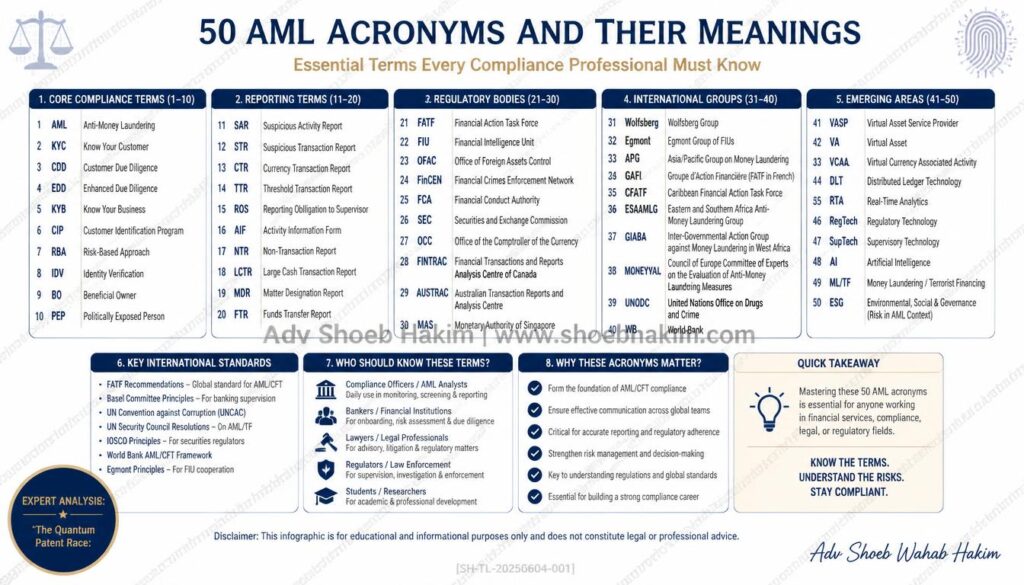
Anti-Money Laundering (AML) professionals must master a specialized language of over 50 acronyms to communicate clearly, assess risk effectively, and comply with global standards. From core terms like Customer Due Diligence (CDD) and Know Your Customer (KYC) to advanced concepts like Virtual Asset Service Providers (VASP) and Data Protection Impact Assessments (DPIA), these acronyms are the building blocks of AML compliance.
Key international bodies—including the Financial Action Task Force (FATF), the Wolfsberg Group, and the Egmont Group—establish the standards that define these terms. For compliance professionals, AML analysts, risk teams, and law enforcement, understanding this language is not optional. It is essential.
In this article:
- The 50 AML Acronyms You Need to Know
- Why Acronyms Matter in AML Compliance
- Key International Standards and Bodies
- Who Should Know These Terms
- How to Use This Guide
- FAQ
By Adv. Shoeb Hakim — Criminal defence, AML, digital forensics, and cybercrime specialist; former Head of AML & Client ID (AVP), Credit Suisse; training police forces since 1996.
The 50 AML Acronyms You Need to Know
Core Compliance Terms
| Acronym | Full Form | What It Means |
|---|---|---|
| AML | Anti-Money Laundering | The legal and regulatory framework to prevent money laundering |
| CDD | Customer Due Diligence | The process of verifying a customer’s identity and assessing risk |
| EDD | Enhanced Due Diligence | Additional scrutiny for high-risk customers |
| KYC | Know Your Customer | The process of identifying and verifying customer identity |
| KYB | Know Your Business | The process of verifying business entities |
| KYS | Know Your Stakeholder | Understanding the individuals behind a business |
| KYP | Know Your PEP | Identifying and monitoring politically exposed persons |
| PEP | Politically Exposed Person | Individuals with prominent public functions, at higher risk for corruption |
| RBA | Risk-Based Approach | Allocating resources based on assessed risk levels |
Financial Crime Terms
| Acronym | Full Form | What It Means |
|---|---|---|
| ML | Money Laundering | The process of making illegally-gained proceeds appear legal |
| TF | Terrorist Financing | The provision of funds for terrorist activities |
| FT | Financial Terrorism | The use of financial systems for terrorist purposes |
Reporting Terms
| Acronym | Full Form | What It Means |
|---|---|---|
| SAR | Suspicious Activity Report | A report filed when suspicious activity is detected |
| STR | Suspicious Transaction Report | A report filed when a suspicious transaction is identified |
| CTR | Currency Transaction Report | A report filed for large cash transactions |
| ROS | Report of Suspicious Activity | Alternative term for suspicious activity reporting |
| RFI | Request for Information | A formal request for additional information |
Regulatory Bodies
| Acronym | Full Form | What It Means |
|---|---|---|
| FATF | Financial Action Task Force | The global standard-setter for AML/CFT |
| FIU | Financial Intelligence Unit | The national centre for receiving and analyzing financial intelligence |
| LEA | Law Enforcement Authority | Agencies responsible for enforcing financial crime laws |
| FIC | Financial Intelligence Centre | National body for financial intelligence gathering |
International Standards
| Acronym | Full Form | What It Means |
|---|---|---|
| CFT | Combating the Financing of Terrorism | The framework for countering terrorist financing |
| WMD | Weapons of Mass Destruction | Proliferation financing related to WMD |
| DNFBP | Designated Non-Financial Businesses & Professions | Sectors subject to AML obligations (lawyers, accountants, real estate) |
| MSB | Money Services Business | Businesses providing money transmission or currency exchange |
| PSP | Payment Service Provider | Companies providing payment services |
| VC | Virtual Currency | Digital currency not issued by a central bank |
| VASP | Virtual Asset Service Provider | Businesses dealing in virtual assets |
| CBDT | Cross-Border Declaration/Transport | Reporting of cross-border currency movements |
International Groups
| Acronym | Full Form | What It Means |
|---|---|---|
| WOLFSBERG | Wolfsberg Group | Association of global banks developing AML standards |
| GAFI | Groupe d’Action Financière | The French name for FATF |
| NPO | Non-Profit Organisation | Organizations at risk of terrorist financing abuse |
| NGO | Non-Governmental Organisation | Non-governmental organizations subject to oversight |
Risk and Data Terms
| Acronym | Full Form | What It Means |
|---|---|---|
| KRI | Key Risk Indicator | Metrics used to measure and monitor risk |
| SAN | Sanctions | Economic and trade sanctions imposed by governments |
| UNSCR | UN Security Council Resolution | Binding resolutions on member states |
| OFAC | Office of Foreign Assets Control | US sanctions enforcement agency |
| EU | European Union | Regional body with AML directives |
| GDPR | General Data Protection Regulation | EU data protection regulation |
| DPIA | Data Protection Impact Assessment | Assessment of data processing risks |
| DPA | Data Protection Act | National data protection legislation |
| SOF | Source of Funds | The origin of funds used in a transaction |
| SOW | Source of Wealth | The origin of a person’s total wealth |
| BSA | Bank Secrecy Act | US AML legislation |
| AMLA | Anti-Money Laundering Authority | European AML supervisory body |
| RTA | Real-Time Analysis | Immediate analysis of transactions |
Identification Terms
| Acronym | Full Form | What It Means |
|---|---|---|
| ID | Identification | The process of establishing identity |
Why Acronyms Matter in AML Compliance
The Building Blocks of AML Compliance
AML acronyms are not just jargon. They are the building blocks of effective compliance. Without understanding these terms, professionals cannot:
- Communicate clearly with colleagues and regulators
- Assess risk accurately
- Implement effective controls
- Comply with global standards
Clear Communication
In AML compliance, precision matters. A Suspicious Activity Report (SAR) is not the same as a Suspicious Transaction Report (STR). Customer Due Diligence (CDD) is not the same as Enhanced Due Diligence (EDD). Using the correct terminology ensures that everyone understands the same thing.
Professional Credibility
Compliance professionals who master the language of AML demonstrate their expertise. They can engage confidently with regulators, auditors, and law enforcement. They can train others effectively.
Global Alignment
The FATF sets international standards that are adopted by jurisdictions worldwide. Understanding the acronyms ensures alignment with these global standards.
Key International Standards and Bodies
FATF Recommendations (The FATF 40 + 9)
The FATF has issued 40 Recommendations covering the full range of AML/CFT measures. These are the global standard for combating money laundering and terrorist financing.
Basel Committee on Banking Supervision
The Basel Committee issues guidelines for banks, including the “Sound management of risks related to money laundering and financing of terrorism” guidelines.
Egmont Group
The Egmont Group is the global network of Financial Intelligence Units (FIUs). It facilitates information sharing and cooperation between FIUs worldwide.
Wolfsberg Group
The Wolfsberg Group is an association of 13 global banks that develops AML standards and best practices.
UNODC
The United Nations Office on Drugs and Crime (UNODC) works to combat money laundering and terrorist financing globally.
Who Should Know These Terms
Compliance Professionals
AML compliance officers, analysts, and managers must master these terms to perform their roles effectively.
Risk and Audit Teams
Risk professionals and auditors need to understand AML terminology to assess controls and identify gaps.
Students and Researchers
Those studying financial crime, law, or compliance must learn the language of AML to succeed.
Law Enforcement
Police, prosecutors, and investigators need to understand AML terminology to investigate financial crime.
Regulators
Regulatory staff must master AML language to supervise and enforce compliance.
How to Use This Guide
1. Study the Core Terms First
Start with the most frequently used terms: AML, KYC, CDD, EDD, SAR, STR, and PEP.
2. Understand the Context
Learn how the terms relate to each other. For example, CDD is the process, KYC is the outcome, and EDD is applied to high-risk customers.
3. Apply the Terms in Practice
Use the terms in your daily work. Write reports using correct terminology. Train others using the same language.
4. Stay Updated
AML terminology evolves. New terms emerge (VASP, RTA, AMLA) as the financial landscape changes. Stay informed.
FREQUENTLY ASKED QUESTIONS (FAQ)
What is the difference between KYC and CDD?
KYC (Know Your Customer) is the process of identifying and verifying a customer’s identity. CDD (Customer Due Diligence) is the broader process that includes KYC, risk assessment, and ongoing monitoring.
What is the difference between SAR and STR?
SAR (Suspicious Activity Report) is the general term for reporting suspicious behaviour. STR (Suspicious Transaction Report) specifically refers to reporting a suspicious transaction.
What is a PEP?
A PEP (Politically Exposed Person) is an individual who holds or has held a prominent public function. PEPs are considered higher risk for corruption and money laundering.
What is the FATF?
The FATF (Financial Action Task Force) is the global standard-setter for AML/CFT. It issues recommendations that countries are expected to implement.
What is the Risk-Based Approach (RBA)?
RBA is the principle of allocating resources based on assessed risk levels. Higher-risk customers receive more scrutiny; lower-risk customers receive less.
What is EDD?
EDD (Enhanced Due Diligence) is additional scrutiny applied to high-risk customers, including PEPs, customers from high-risk jurisdictions, and complex ownership structures.
What is the difference between Source of Funds (SOF) and Source of Wealth (SOW)?
SOF refers to the origin of funds used in a specific transaction. SOW refers to the origin of a person’s total wealth.
What is a Virtual Asset Service Provider (VASP)?
A VASP is a business that provides services related to virtual assets, including exchanges, wallets, and custody services.
What is the Wolfsberg Group?
The Wolfsberg Group is an association of global banks that develops AML standards and best practices.
Why do AML acronyms matter?
Acronyms are the building blocks of AML compliance. They enable clear communication, professional credibility, and alignment with global standards.
Q: What makes vendor concentration a systemic risk in modern court administration?
Ans: When multiple independent judicial jurisdictions rely on a single vendor’s software ecosystem, a single vulnerability compromise cascades across all connected court systems simultaneously.
Q: Why are AML acronyms considered essential building blocks for compliance professionals?
Ans: They provide precise, standardized language necessary for clear communication, accurate risk assessment, regulatory compliance, and international legal alignment.
Q: Who are the key international standard-setting bodies represented in AML acronym lexicons?
Ans: Key bodies include the Financial Action Task Force (FATF), the Wolfsberg Group, the Egmont Group, the Basel Committee, and the United Nations Office on Drugs and Crime (UNODC).
Q: What is the significance of the Risk-Based Approach (RBA) in AML compliance?
Ans: RBA is the foundational principle requiring institutions to allocate compliance resources proportionally based on assessed customer, geographic, and product risk levels.
Q: How do emerging regulatory requirements like GDPR and DPIA intersect with AML compliance?
Ans: Financial institutions must balance mandatory AML record-keeping and customer screening obligations with data privacy protections, utilizing Data Protection Impact Assessments (DPIAs) to ensure compliance.
KNOWLEDGE CHECK QUIZ
Q: What does the acronym FATF stand for, and what is its primary global function?
Ans: Financial Action Task Force; it serves as the global standard-setter for anti-money laundering and counter-terrorist financing (AML/CFT).
Q: What is the primary operational distinction between CDD and EDD?
Ans: Customer Due Diligence (CDD) is the standard verification process applied to all customers, whereas Enhanced Due Diligence (EDD) involves heightened scrutiny applied to high-risk customers and PEPs.
Q: What does VASP represent in the context of emerging financial technologies?
Ans: Virtual Asset Service Provider, encompassing businesses engaged in virtual asset exchanges, transfers, and custody.
Q: Why is it critical for compliance professionals to distinguish between a SAR and an STR?
Ans: A Suspicious Activity Report (SAR) covers broader suspicious behavior patterns, whereas a Suspicious Transaction Report (STR) specifically targets identifiable suspicious financial transactions.
Explore More:
Read my blog: Shoeb Hakim Blog
Book Now: Book a Consultation
Contact: Contact Adv. Shoeb Hakim
Careers: Careers at Shoeb Hakim
By Adv. Shoeb Hakim
Criminal defence, AML, digital forensics, and cybercrime specialist; former Head of AML & Client ID (AVP), Credit Suisse; training police since 1996.
📌 Connect: https://www.linkedin.com/in/shoebhakim | https://shoebhakim.com/shoeb-hakim-blog/
📌 Visit my website for more articles: https://shoebhakim.com
📌 Visit my website for legal knowledge: https://www.vakilverse.com
📌 Visit my website for research fellowship: https://www.legalcomplaince.in
Disclaimer: This content is for informational purposes only and does not constitute legal advice. Readers should consult qualified legal counsel for advice on their specific circumstances.
#AdvShoebHakim #AML #Compliance #Glossary #FinancialCrime #FATF #PMLA #WhiteCollarCrime #DigitalForensics #LegalDefense #RiskManagement
Additional Page Metadata
Author:
Adv. Shoeb Hakim
Author Bio:
Adv. Shoeb Hakim is a Mumbai-based criminal defence, AML, digital forensics and cybercrime specialist. Former Head of AML & Client ID (AVP) at Credit Suisse. Has been training police forces since 1996. Provides expert commentary on anti-money laundering, compliance, and financial crime.
Article Publisher:
Adv. Shoeb Hakim
Article Section:
Anti-Money Laundering | Compliance | Financial Crime | Professional Development
Article Tags:
AML, KYC, CDD, EDD, PEP, FATF, SAR, STR, Wolfsberg, compliance, acronyms, financial crime, money laundering, VASP, RBA, Adv Shoeb Hakim