Key Facts
- Case: Kotak Mahindra Bank Ltd. v. Trupti Sanjay Mehta & Ors.
- Citation: 2026 INSC 943
- Judgment Date: 2 September 2026
- Bench: Justice Sanjay Kumar and Justice Sanjeev Sachdeva
- Core Holding: A bank covered by SARFAESI can enforce its provisions on a secured debt acquired from an NBFC not covered by the Act when the loan was originally created
- New Rule: Once a bank acquires a “live and owing” secured loan from an entity outside SARFAESI, the loan immediately acquires the character of a “secured debt” enforceable under the Act
- Bombay High Court 2015 Judgment Set Aside: The contrary view that had prevailed for over a decade was overturned
- Pending Cases: The ruling applies to pending proceedings, but retrospective application for past acquisitions remains unresolved
Direct Answer
The Supreme Court has settled a decade-old legal ambiguity in Kotak Mahindra Bank Ltd. v. Trupti Sanjay Mehta (2026), holding that a bank covered by the SARFAESI Act can enforce its provisions on a secured debt acquired from a non-banking financial company that was not covered by the Act when the original loan was created.
The bench of Justice Sanjay Kumar and Justice Sanjeev Sachdeva ruled that once a bank acquires a “live and owing” secured loan from an entity outside SARFAESI, the loan immediately acquires the character of a “secured debt” enforceable under the Act.
The judgment overturns the Bombay High Court’s 2015 ruling, which had held the contrary. However, the Court did not address whether banks that refrained from enforcing SARFAESI due to the Bombay High Court ruling can now do so for past acquisitions—creating a potential compliance gap.
Banks must now review their portfolios to identify loans acquired from non-covered NBFCs and assess whether they can now be pursued under SARFAESI.
In this article:
- The Legal Ambiguity: What Was at Stake
- The Supreme Court’s Ruling
- The New Rule Established
- What the Judgment Does Not Say
- Practical Implications for Compliance
- The Compliance Task for Banks
- Why This Matters for Stressed Asset Management
- FAQ
By Adv. Shoeb Hakim — Criminal defence, AML, digital forensics, and cybercrime specialist; former Head of AML & Client ID (AVP), Credit Suisse; training police forces since 1996.
The Legal Ambiguity: What Was at Stake
The SARFAESI Act, 2002, provides banks and certain notified financial institutions with a special mechanism to enforce security created for loans without first pursuing the usual civil court process.
But a critical question remained unresolved for over a decade: Could a bank invoke SARFAESI to recover a debt it acquired from a non-banking financial company that was not covered by the Act when the loan was originally granted?
The Bombay High Court’s 2015 Ruling
In 2015, a Division Bench of the Bombay High Court in Kotak Mahindra Bank Ltd. v. Trupti Sanjay Mehta held that a bank could not use SARFAESI to recover loans acquired from an NBFC that was not covered by the Act when the debt originated. The DRT and DRAT had upheld this view, creating a binding precedent in Maharashtra that limited banks’ recovery options.
The Practical Impact
Banks that acquired loan portfolios from NBFCs outside the SARFAESI framework faced uncertainty. Some enforced SARFAESI despite the High Court ruling. Others refrained, fearing legal challenges. The result was inconsistent enforcement and a fragmented legal landscape.
The Loan That Started It All
The lead appeal arose from a home loan of ₹69.60 lakh taken by Amit Bipin Shah from City Financial Consumer Finance Limited (CFCFL), an NBFC that was not then notified as a “financial institution” under Section 2(1)(m) of SARFAESI. Shah defaulted, and an arbitral award directed him to pay approximately ₹75.30 lakh with interest. Kotak Mahindra Bank took over the loan account on 13 July 2012 and issued a demand notice under Section 13(2) on 3 July 2013. The Mehtas, who remained in possession of the mortgaged flat, challenged the bank’s jurisdiction.
The Supreme Court’s Ruling

On 2 September 2026, a bench of Justice Sanjay Kumar and Justice Sanjeev Sachdeva delivered a unanimous judgment that settles the legal ambiguity.
The Core Holding
The Court held that a bank covered by SARFAESI can invoke its provisions to recover a secured debt acquired from an NBFC that was not covered by the Act when the loan was originally created.
The Key Observation
The Court observed:
“When the institution is one to which the SARFAESI Act is already applicable, acquisition of a non-performing secured loan account by such institution from an entity, that does not come within the ambit of the SARFAESI Act, would immediately clothe the said loan account with the attributes of a ‘secured debt’ covered by the provisions of the SARFAESI Act.”
The Precedents Relied Upon
The Court examined its earlier decisions in M.D. Frozen Foods Exports Pvt. Ltd. v. Hero Fincorp Ltd. (2017) and Indiabulls Housing Finance Ltd. v. Deccan Chronicle Holdings Ltd. (2018). Those rulings had already recognised that a successor or assignee of a loan could invoke SARFAESI even where the original lender was not covered by the Act at the relevant time. The Court found that the same principle applied when a bank itself acquired the loan.
The Bombay High Court Judgment Set Aside
The Supreme Court set aside the Bombay High Court’s 2015 judgment in favour of the Mehtas. The Court held that borrowers could not rely on isolated definitions in the Act to defeat its recovery mechanism once the statutory conditions were satisfied.
The New Rule Established
The judgment establishes a clear and practical rule for banks and borrowers.
The New Rule
When a bank already governed by the SARFAESI Act validly acquires a live and legally recoverable secured loan from an entity that was outside the Act when the loan originated, the loan immediately acquires the character of a secured debt enforceable under the SARFAESI Act.
What Is Not Decisive
The original lender’s status at the time of lending does not confer a permanent immunity from SARFAESI enforcement upon the borrower. The date on which the account became a non-performing asset is also not decisive.
What Matters
What matters is that the claim remains “live and owing,” the security subsists, and the entity invoking the Act qualifies as a secured creditor.
The Rationale
The Court rejected the borrowers’ argument that the character of the debt is permanently fixed at its inception. It held that accepting such an argument would allow borrowers who obtained financial assistance from NBFCs outside the SARFAESI framework to default with recovery then having to depend on ordinary civil proceedings—which are more time-consuming.
What the Judgment Does Not Say
The judgment is significant, but it leaves critical questions unanswered.
The Retrospective Application Gap
The Supreme Court’s clarification applies to pending cases, but the judgment does not address whether banks that did not enforce SARFAESI due to the Bombay High Court’s 2015 ruling can now do so for past acquisitions.
The Compliance Uncertainty
This creates a potential compliance gap. Banks that acquired loan portfolios from non-covered NBFCs during the period when the Bombay High Court’s ruling was in force may now be uncertain about their enforcement rights. The judgment does not provide clear guidance on whether such banks can now invoke SARFAESI for those past acquisitions.
The 2015 Bombay High Court Precedent
The Bombay High Court had taken a contrary view in 2015, and banks may have acquired NBFC loan portfolios in reliance on that ruling or despite it. The Supreme Court’s judgment sets aside that ruling, but it does not address the implications for banks that acted in reliance on it.
The Practical Question
Can a bank that did not enforce SARFAESI due to the Bombay High Court’s ruling now do so for a loan it acquired years ago? The judgment does not answer this question. Banks may need to seek legal advice or await further clarification from the courts.
Practical Implications for Compliance
The judgment has immediate and practical implications for banks and financial institutions.
The Core Question Answered
| Question | Answer |
|---|---|
| Can a bank enforce SARFAESI for a debt acquired from a non-covered NBFC? | Yes, if the debt is “live and owing” and the security subsists. |
| Does the original lender’s status matter? | No, the decisive factor is the live nature of the claim and the acquiring bank’s status. |
| What about acquisitions made before this judgment? | The ruling applies to all live debts, but banks may need to reassess their portfolios to identify loans acquired from non-covered NBFCs that were not enforced under SARFAESI. |
The Immediate Implications
- For Banks: They can now enforce SARFAESI on secured debts acquired from NBFCs that were not covered by the Act, provided the debt is live and the security subsists.
- For Borrowers: They cannot avoid SARFAESI recovery merely because the original lender was not covered by the Act when the loan was created.
- For Pending Cases: The ruling applies to pending proceedings, providing clarity for ongoing litigation.
The Strategic Implications
- For NPA Resolution: Banks can now use SARFAESI for a wider range of acquired loan portfolios, accelerating NPA resolution.
- For Stressed Asset Management: The ruling enhances the value of distressed loan portfolios acquired from NBFCs.
- For Secondary Market: The decision strengthens the secondary market for distressed assets, as acquirers can now enforce SARFAESI.
The Compliance Task for Banks
The judgment creates a specific compliance task for banks.
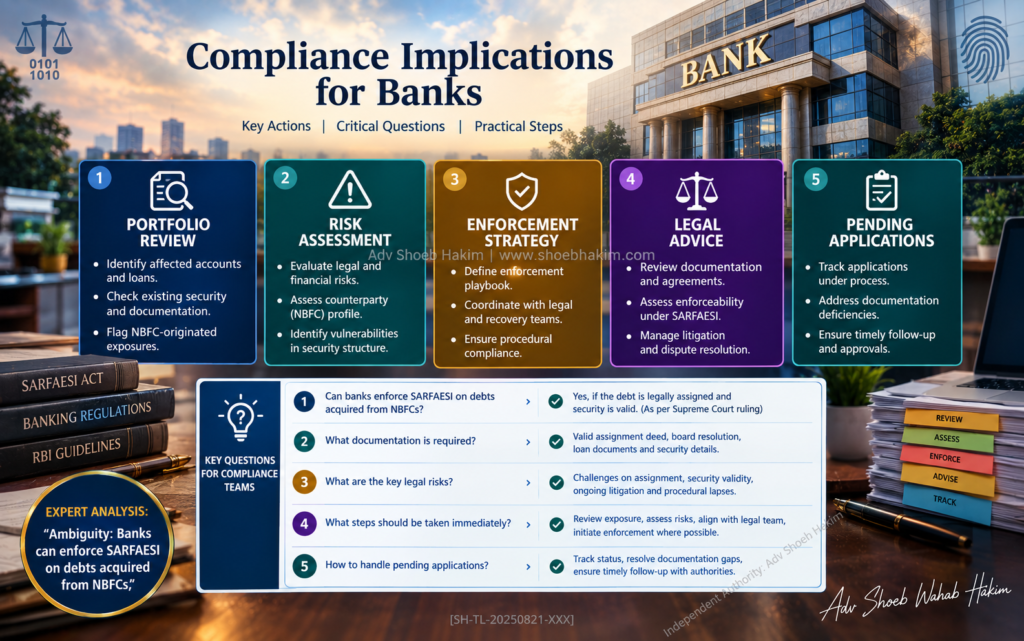
Portfolio Review
Banks must now review their portfolios to identify all loans acquired from non-covered NBFCs that were not enforced under SARFAESI. This includes loans acquired during the period when the Bombay High Court’s 2015 ruling was in force.
Risk Assessment
For each identified loan, banks must assess:
- Is the debt still “live and owing”?
- Does the security still subsist?
- Can SARFAESI now be invoked?
- What are the risks of enforcement given the retrospective application uncertainty?
Enforcement Strategy
Banks must develop a strategy for enforcing SARFAESI on identified loans. This includes:
- Issuing demand notices under Section 13(2)
- Taking possession under Sections 13(4) and 14
- Managing potential legal challenges from borrowers
Legal Advice
Given the uncertainty around retrospective application, banks should seek legal advice before enforcing SARFAESI on loans acquired before the judgment.
Pending Applications
The Court restored the Mehtas’ securitisation application to the DRT for consideration of their remaining factual and legal issues. This indicates that while the core legal issue is resolved, factual disputes may still need adjudication.
Why This Matters for Stressed Asset Management
The judgment has significant implications for stressed asset management in India.
Enhanced Recovery Options
Banks can now use SARFAESI for a wider range of acquired loan portfolios, enhancing recovery options for stressed assets.
Improved NPA Resolution
The ruling accelerates NPA resolution by providing a faster recovery mechanism for loans acquired from NBFCs.
Strengthened Secondary Market
The decision strengthens the secondary market for distressed assets. Banks acquiring loan portfolios from NBFCs can now enforce SARFAESI, making such acquisitions more attractive.
The Reserve Bank of India’s Position
The RBI supported this interpretation, stating that it had no objection to banks purchasing NPAs from financial institutions and NBFCs, and that assignment of debt is a permissible banking activity. The RBI further argued that preventing an assignee bank from enforcing the acquired security under SARFAESI would undermine the financial system and the secondary market for distressed assets.
FREQUENTLY ASKED QUESTIONS (FAQ)
What did the Supreme Court decide in Kotak Mahindra Bank v. Trupti Sanjay Mehta?
The Court held that a bank covered by the SARFAESI Act can enforce its provisions on a secured debt acquired from an NBFC that was not covered by the Act when the original loan was created.
What is the new rule established by the judgment?
When a bank governed by SARFAESI acquires a live secured loan from an entity outside the Act, the loan immediately acquires the character of a secured debt enforceable under SARFAESI.
Does the original lender’s status matter?
No. The decisive factor is that the claim remains “live and owing,” the security subsists, and the acquiring bank qualifies as a secured creditor.
What was the Bombay High Court’s 2015 ruling?
The Bombay High Court held that a bank could not use SARFAESI to recover loans acquired from an NBFC not covered by the Act when the debt originated.
Does the judgment apply retrospectively?
The judgment applies to pending cases, but it does not address whether banks that did not enforce SARFAESI due to the Bombay High Court’s ruling can now do so for past acquisitions.
What should banks do now?
Banks should review their portfolios to identify loans acquired from non-covered NBFCs, assess whether SARFAESI can now be invoked, and seek legal advice on enforcement.
What is the significance of “live and owing”?
The debt must still be legally recoverable for SARFAESI to be invoked. If the debt is time-barred or otherwise extinguished, SARFAESI cannot be enforced.
What was the role of the RBI in this case?
The RBI supported the bank’s position, stating that preventing an assignee bank from enforcing SARFAESI would undermine the financial system and the secondary market for distressed assets.
What happens to pending cases?
The ruling applies to pending proceedings, providing clarity for ongoing litigation. The Mehtas’ case was restored to the DRT for consideration of remaining factual issues.
Why does this matter for stressed asset management?
The ruling enhances recovery options, accelerates NPA resolution, and strengthens the secondary market for distressed assets.
KNOWLEDGE CHECK QUIZ
Q: What is the official citation and date of the Supreme Court judgment in Kotak Mahindra Bank v. Trupti Sanjay Mehta?
Ans: 2026 INSC 943, delivered on 2 September 2026.
Q: Who constituted the Bench that delivered this landmark ruling?
Ans: Justice Sanjay Kumar and Justice Sanjeev Sachdeva.
Q: What was the core legal holding regarding debts acquired from non-covered NBFCs?
Ans: A bank covered by the SARFAESI Act can enforce its provisions on a secured debt acquired from an NBFC not covered by the Act when the loan was originally created, provided the debt is live and owing.
Q: What previous High Court ruling was formally set aside by the Supreme Court?
Ans: The Bombay High Court’s 2015 Division Bench ruling in Kotak Mahindra Bank Ltd. v. Trupti Sanjay Mehta.
Explore More:
Read my blog: Shoeb Hakim Blog
Book Now: Book a Consultation
Contact: Contact Adv. Shoeb Hakim
Careers: Careers at Shoeb Hakim
Disclaimer: This content is for informational purposes only and does not constitute legal advice. Readers should consult qualified legal counsel for advice on their specific circumstances.
#AdvShoebHakim #SARFAESI #KotakMahindra #BankingLaw #NPAResolution #StressedAssets #WhiteCollarCrime #DigitalForensics #LegalDefense #Compliance