Key Facts
- Case Name: Shri Bhupendra Shantilal Shah (Monitoring Committee Chairman) v. Powerdeal Energy Systems India Private Limited & Ors.
- I.A. No.: I.A. No. 2745 of 2026 in C.P. (IB) No. 4072(MB)2019
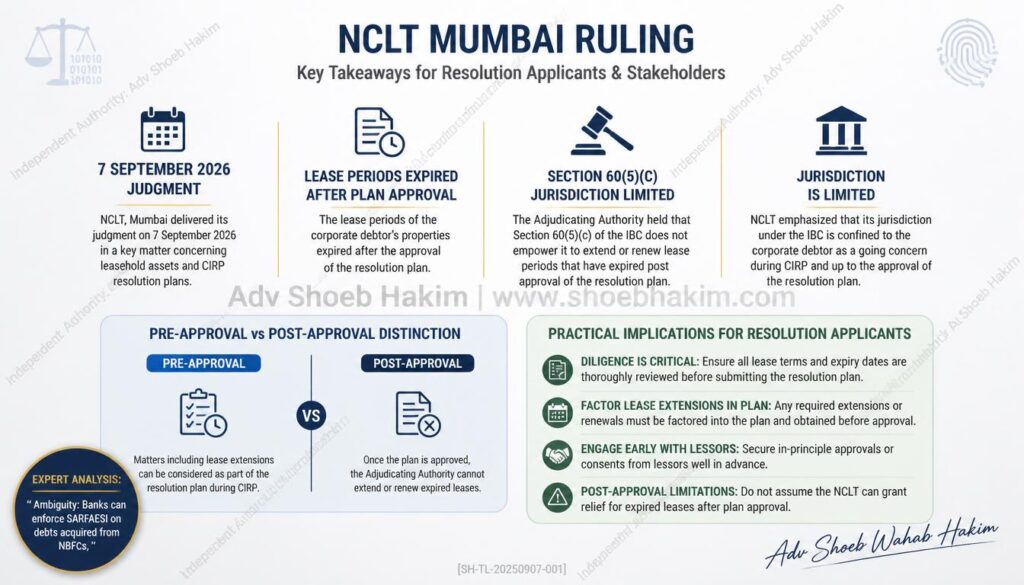
- Judgment Date: 7 September 2026
- Bench: Judicial Member Sushil Mahadeorao Kochey and Technical Member Prabhat Kumar
- NCLT: Mumbai Bench
- Held: NCLT’s jurisdiction under Section 60(5)(c) does not extend to disputes that crystallize after plan approval
- Applicable Law: Section 60(5)(c) of the Insolvency and Bankruptcy Code (IBC), 2016
Direct Answer
The NCLT Mumbai, in Shri Bhupendra Shantilal Shah v. Powerdeal Energy Systems India Private Limited & Ors. (I.A. No. 2745 of 2026), has delivered a significant ruling on the limits of its jurisdiction under Section 60(5) of the IBC.
The Bench of Judicial Member Sushil Mahadeorao Kochey and Technical Member Prabhat Kumar dismissed an application seeking possession of factory premises from two occupant companies. The Tribunal held that the issue of handing over possession did not “arise out of or relate to the insolvency resolution of the corporate debtor” because the lease periods for both occupants had expired only after the resolution plan was approved.
The ruling reinforces a crucial distinction: the NCLT’s jurisdiction under Section 60(5)(c) is not a substitute for civil remedies in matters that arise after plan approval. Resolution applicants must anticipate and address post-approval possession challenges through contractual safeguards or general law, rather than relying solely on the NCLT’s jurisdiction.
In this article:
- The Facts of the Case
- The Tribunal’s Reasoning
- The Key Distinction: Pre-Resolution vs. Post-Resolution Disputes
- The Section 60(5) Jurisdiction
- Practical Implications for Resolution Applicants
- What This Means for Future Resolutions
- FAQ
By Adv. Shoeb Hakim — Criminal defence, AML, digital forensics, and cybercrime specialist; former Head of AML & Client ID (AVP), Credit Suisse; training police forces since 1996.
The Facts of the Case
Powerdeal Energy Systems India Private Limited was admitted into Corporate Insolvency Resolution Process (CIRP) on 11 July 2024. Its resolution plan was approved by the NCLT on 16 October 2025.
The Monitoring Committee Chairman sought possession of factory premises occupied by two companies:
- Novacept Engineering Solutions: Lease from 1 June 2024 to 1 June 2026
- Rachana Electromech & Engineering Works: Lease from 15 January 2023 to 14 January 2026
The key point: both lease periods expired after the resolution plan was approved. Novacept’s lease expired on 1 June 2026 and Rachana’s on 14 January 2026 — both dates subsequent to 16 October 2025.
The Successful Resolution Applicant sought possession under the IBC, arguing that the NCLT had jurisdiction under Section 60(5)(c) to determine the issue.
The Tribunal’s Reasoning

The Tribunal noted that both occupants were in lawful possession on the date the resolution plan was approved (16 October 2025).
The cause of action for handing over possession arose only after the lease periods expired — dates that were subsequent to the approval of the resolution plan.
The Tribunal relied on Section 60(5)(c) of the IBC, which empowers the adjudicating authority to determine questions of law or fact “arising out of or in relation to” the insolvency resolution of the corporate debtor.
The Tribunal held that the issue of handing over possession did not “arise out of or relate to” the insolvency resolution of the corporate debtor.
The Core Holding
The Successful Resolution Applicant is entitled to assets only in the condition they were in on the date of plan approval. If a lease had not expired on that date, the plan must honour it. Once the lease expires, the remedy lies under general law, not the IBC.
The Key Distinction: Pre-Resolution vs. Post-Resolution Disputes
The ruling establishes a critical distinction that every resolution applicant must understand:
| Date | Event | Jurisdiction |
|---|---|---|
| Pre-Approval | Disputes arising from the resolution process | NCLT has jurisdiction |
| Plan Approval Date | Cut-off for NCLT jurisdiction | NCLT’s jurisdiction crystallises |
| Post-Approval | Disputes that arise after the cut-off date | General law; not NCLT |
The Cut-Off Date
Once a plan is approved, the NCLT’s jurisdiction does not extend to disputes that crystallize after that date, even if they involve assets of the corporate debtor.
The Lease Example
The lease was a pre-existing arrangement. Its expiry was a future event. The possession dispute did not arise from the insolvency process. It arose from a contractual event that occurred after plan approval. Therefore, the remedy lies in civil law, not the IBC.
The Section 60(5) Jurisdiction
Section 60(5)(c) of the IBC
Section 60(5)(c) empowers the NCLT to:
“determine any question of law or fact arising out of or in relation to the insolvency resolution or liquidation proceedings of the corporate debtor under this Code.”
The Distinction
The Tribunal held that the issue of handing over possession did not “arise out of or relate to” the insolvency resolution. The cause of action arose after the plan was approved and was governed by the lease contract, not the IBC.
The Rationale
The NCLT’s jurisdiction under Section 60(5)(c) is not a substitute for civil remedies in matters that arise after plan approval. The resolution plan cannot be used as a vehicle to resolve post-approval contractual disputes.
Practical Implications for Resolution Applicants
1. Anticipate Post-Approval Possession Challenges
Resolution applicants must anticipate and address post-approval possession challenges through contractual safeguards or general law, rather than relying solely on the NCLT’s jurisdiction.
2. Include Possession Mechanisms in the Plan
If a resolution applicant wants to ensure possession of assets, the plan should include specific mechanisms for obtaining possession. Reliance on the NCLT’s jurisdiction after plan approval is not sufficient.
3. Conduct Pre-Approval Due Diligence
Resolution applicants must conduct thorough due diligence on occupancy rights, lease arrangements, and possession issues before the plan is approved. Post-approval disputes are outside the NCLT’s jurisdiction.
4. Plan for Dispute Resolution
If post-approval disputes are foreseeable, resolution applicants should include dispute resolution mechanisms in the plan or prepare for civil proceedings.
5. General Law Is the Default Remedy
Once a plan is approved, the NCLT’s jurisdiction is limited. For post-approval disputes, general law—including civil courts and arbitration—remains the default remedy.
What This Means for Future Resolutions
For Resolution Applicants
The ruling reinforces the importance of ensuring that all assets are in the condition you expect before plan approval. If occupancy rights are uncertain, the plan must address them explicitly.
For Monitoring Committees
The Monitoring Committee Chairman cannot use the NCLT as a substitute for civil remedies for post-approval disputes.
For Occupants
Occupants in lawful possession on the date of plan approval are protected. Their rights crystallise on that date. The resolution applicant cannot use the IBC to evict them post-approval.
For Legal Advisors
Resolution applicants’ legal advisors must ensure that plans address all foreseeable post-approval disputes. Drafting must be precise, and alternative dispute resolution mechanisms should be considered.
FREQUENTLY ASKED QUESTIONS (FAQ)
What did the NCLT Mumbai decide in this case?
The NCLT dismissed an application seeking possession of factory premises, holding that the issue of handing over possession did not “arise out of or relate to” the insolvency resolution because the lease periods had expired only after plan approval.
What is the key distinction established by the ruling?
The NCLT’s jurisdiction under Section 60(5)(c) does not extend to disputes that crystallize after plan approval, even if they involve assets of the corporate debtor.
What is Section 60(5)(c) of the IBC?
Section 60(5)(c) empowers the NCLT to determine questions of law or fact “arising out of or in relation to” the insolvency resolution of the corporate debtor.
Why did the NCLT reject the possession application?
Both occupants were in lawful possession on the date the resolution plan was approved. The lease periods expired after approval, creating a post-approval dispute. The remedy lies under general law, not the IBC.
What should resolution applicants do to avoid this situation?
Resolution applicants must anticipate and address post-approval possession challenges through contractual safeguards or general law. They must conduct due diligence on occupancy rights before plan approval.
Are the occupants protected by this ruling?
Yes. Occupants in lawful possession on the date of plan approval are protected. Their rights crystallise on that date.
Can the NCLT hear post-approval disputes at all?
Only if the dispute arises out of or relates to the insolvency resolution. If the cause of action crystallises after approval, the NCLT does not have jurisdiction.
What is the remedy for post-approval possession disputes?
The remedy lies under general law—civil courts, arbitration, or other dispute resolution mechanisms.
When was the judgment delivered?
The judgment was delivered on 7 September 2026.
What is the takeaway for resolution applicants?
The NCLT’s jurisdiction under Section 60(5)(c) is not a substitute for civil remedies. Resolution applicants must anticipate post-approval challenges and address them proactively.
Q: Can a Successful Resolution Applicant use Section 60(5)(c) of the IBC to evict tenants post-approval?
Ans: No. If the cause of action or lease expiration occurs after the resolution plan is formally approved, the NCLT lacks jurisdiction, and the remedy lies under general civil law.
Q: What is the significance of the plan approval date in determining NCLT jurisdiction?
Ans: The plan approval date serves as the definitive legal cut-off; pre-approval disputes related to the insolvency resolution fall under NCLT purview, while post-approval disputes must be pursued in civil courts or arbitration.
Q: How does this judgment impact Monitoring Committee operations?
Ans: Monitoring committees cannot utilize the NCLT as a substitute for ordinary civil remedies when handling commercial disputes or tenant evictions that arise after plan approval.
Q: What proactive steps should resolution applicants take regarding lease agreements?
Ans: Applicants must conduct rigorous pre-approval due diligence, incorporate explicit contractual exit mechanisms within the resolution plan, and prepare for general civil litigation for any post-approval tenancy disputes.
KNOWLEDGE CHECK QUIZ
Q: What is the specific case citation and date of the NCLT Mumbai judgment clarifying post-resolution jurisdiction?
Ans: Shri Bhupendra Shantilal Shah (Monitoring Committee Chairman) v. Powerdeal Energy Systems India Private Limited & Ors., I.A. No. 2745 of 2026 in C.P. (IB) No. 4072(MB)2019, decided on 7 September 2026.
Q: Who constituted the Bench that delivered this ruling at the NCLT Mumbai Bench?
Ans: Judicial Member Sushil Mahadeorao Kochey and Technical Member Prabhat Kumar.
Q: What was the core legal holding regarding NCLT jurisdiction under Section 60(5)(c) post-approval?
Ans: The NCLT held that its jurisdiction under Section 60(5)(c) does not extend to commercial disputes and lease expirations that crystallize after resolution plan approval.
Q: Why did the Tribunal dismiss the application for factory possession?
Ans: Because the occupant companies were in lawful possession on the plan approval date (16 October 2025), and their lease periods expired subsequent to that date, making it a post-approval dispute governed by general civil law.
Explore More:
Read my blog: Shoeb Hakim Blog
Book Now: Book a Consultation
Contact: Contact Adv. Shoeb Hakim
Careers: Careers at Shoeb Hakim
Disclaimer: This content is for informational purposes only and does not constitute legal advice. Readers should consult qualified legal counsel for advice on their specific circumstances.
#AdvShoebHakim #NCLTMumbai #IBC2016 #Section605 #CorporateRestructuring #WhiteCollarCrime #DigitalForensics #LegalDefense #Compliance #PowerdealEnergy
Additional Page Metadata
Author:
Adv. Shoeb Hakim
Author Bio:
Adv. Shoeb Hakim is a Mumbai-based criminal defence, AML, digital forensics and cybercrime specialist. Former Head of AML & Client ID (AVP) at Credit Suisse. Has been training police forces since 1996. Provides expert commentary on insolvency law, corporate governance, and financial regulation.
Article Publisher:
Adv. Shoeb Hakim
Article Section:
Insolvency Law | Corporate Law | NCLT | IBC
Article Tags:
NCLT, Section 60(5), IBC, resolution plan, post-approval disputes, Powerdeal Energy, Shri Bhupendra Shantilal Shah, insolvency, possession, jurisdiction, Adv Shoeb Hakim