
Comprehensive Motor Policy Covers Occupants, Supreme Court Rules
Key Facts
- Case Name: National Insurance Co. Ltd. v. Smt. Thungala Dhana Laxmi & Ors.
- Citation: 2026 INSC 793
- Judgment Date: 4 August 2026
- Bench: Justice Sanjay Karol and Justice P.K. Mishra
- Court: Supreme Court of India
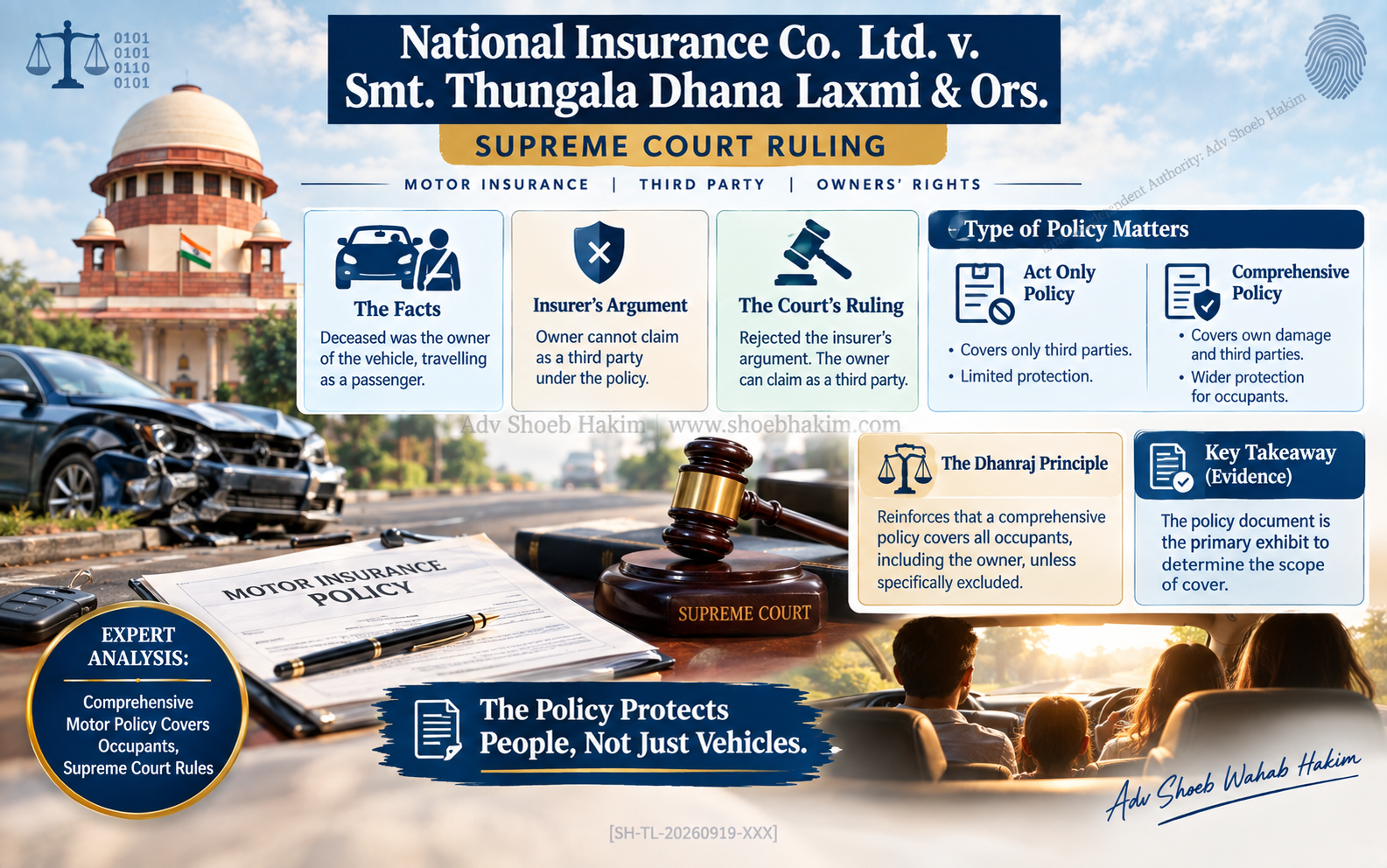
- Key Holding: A comprehensive or package motor insurance policy covers vehicle occupants and cannot be treated on par with a basic third-party policy
- Deceased: The owner of the vehicle, travelling as a passenger
- Insurer’s Argument: An owner cannot claim as a third party
- Court’s Response: The argument was rejected
- Precedent Applied: Dhanraj v. New India Assurance Co. Ltd. (Supreme Court of India, 24 September 2004, Justices S.N. Variava and A.K. Mathur)
- Operational Takeaway: The policy document is the primary exhibit
Direct Answer
On 4 August 2026, the Supreme Court of India ruled in National Insurance Co. Ltd. v. Smt. Thungala Dhana Laxmi & Ors. (2026 INSC 793) that a comprehensive or package motor insurance policy covers vehicle occupants and cannot be treated on par with a basic third-party policy.
The bench of Justice Sanjay Karol and Justice P.K. Mishra held that under a comprehensive policy, the insurer is liable to compensate occupants travelling in the vehicle.
The deceased was the owner of the vehicle, travelling as a passenger. The insurer argued that an owner cannot claim as a third party. The Court rejected that argument.
The distinction that determines the outcome is contractual.
Under a statutory “Act Only” policy, the insurer’s liability extends strictly to third parties. An owner cannot sue their own liability insurer as a third party unless an additional premium was paid to cover the owner-driver — a principle the Court has applied previously in Dhanraj v. New India Assurance Co. Ltd. (Supreme Court of India, 24 September 2004, Justices S.N. Variava and A.K. Mathur).
The operational takeaway is evidentiary.
The policy document is the primary exhibit. If the policy covers occupants, the owner travelling as a passenger stands in the same position as any other occupant.
The question is not the claimant’s identity. It is the scope of the risk insured.
In this article:
- What the Case Was About
- The Supreme Court’s Ruling
- The Contractual Distinction: Act Only vs Comprehensive
- The Dhanraj Principle
- Why “Owner” Status Does Not Bar the Claim
- The Evidentiary Takeaway: The Policy Document
- What This Means for Insurers and Claimants
- Frequently Asked Questions (FAQ)
By Adv. Shoeb Hakim — Criminal defence, AML, digital forensics, and cybercrime specialist; former General Counsel, Credit Suisse; training police forces since 1996.
What the Case Was About
The deceased was the owner of the vehicle. He was travelling as a passenger when the accident occurred.
The claim was made under a comprehensive or package motor insurance policy.
The insurer resisted the claim on a specific ground. An owner cannot claim as a third party. The owner is the insured. The insured cannot be a third party to their own policy.
The argument has a surface logic. Under a statutory third-party policy, the insurer’s liability is to third parties — persons other than the insured. The insured cannot claim against their own insurer as a third party.
The question before the Court was whether that logic applies to a comprehensive policy.
The Supreme Court’s Ruling
The bench of Justice Sanjay Karol and Justice P.K. Mishra rejected the insurer’s argument.
The holding:
Under a comprehensive policy, the insurer is liable to compensate occupants travelling in the vehicle.
The reasoning:
The Court drew a distinction between two types of motor insurance policies. The nature of the policy determines the scope of the risk insured. The claimant’s identity does not determine the outcome. The policy does.
The Contractual Distinction: Act Only vs Comprehensive
The Court identified the contractual distinction that determines the outcome.
Act Only Policy
Under a statutory “Act Only” policy, the insurer’s liability extends strictly to third parties. The policy is designed to meet the minimum requirements of the Motor Vehicles Act. It covers the insured’s liability to third parties for death, bodily injury, and property damage.
The insured cannot claim against their own insurer as a third party under an Act Only policy.
Comprehensive Policy
Under a comprehensive or package policy, the scope of the risk insured is broader. The policy covers the vehicle, the insured, and — where the policy terms so provide — the occupants.
The consequence:
Where the policy covers occupants, the owner travelling as a passenger stands in the same position as any other occupant. The owner’s status does not bar the claim.
The Dhanraj Principle
The Court applied its earlier ruling in Dhanraj v. New India Assurance Co. Ltd. (Supreme Court of India, 24 September 2004, Justices S.N. Variava and A.K. Mathur).
What Dhanraj held:
An owner cannot sue their own liability insurer as a third party unless an additional premium was paid to cover the owner-driver.
The application:
In Dhanraj, the issue was whether the owner could claim as a third party under the owner’s own liability policy. The Court held that the owner could not, absent an additional premium covering the owner-driver.
The distinction in the present case:
The present case involved a comprehensive policy, not a statutory liability policy. The question was not whether the owner could claim as a third party. The question was whether the policy covered occupants. If it did, the owner travelling as a passenger was an occupant.
Why “Owner” Status Does Not Bar the Claim
The insurer’s argument was that an owner cannot claim as a third party. The Court rejected that argument because it mischaracterised the claim.
The claim was not as a third party.
The claim was as an occupant. The owner was travelling as a passenger in the vehicle. The policy covered occupants. The owner, in that capacity, was an occupant.
The identity of the claimant is not the determining factor.
The determining factor is the scope of the risk insured. If the policy covers occupants, any occupant is covered — regardless of whether they own the vehicle.
The practical result:
An owner who is injured or killed while travelling as a passenger in their own comprehensively insured vehicle can claim under the policy as an occupant. The insurer cannot defeat the claim by arguing that the owner cannot be a third party to their own policy.
The Evidentiary Takeaway: The Policy Document
The operational takeaway is evidentiary.
The policy document is the primary exhibit. The question is not the claimant’s identity. It is the scope of the risk insured.
What the claimant must establish:
The policy covers occupants.
How the claimant establishes it:
By producing the policy document and showing that the terms extend to occupants.
What the insurer must establish to defeat the claim:
That the policy does not cover occupants — that it is an Act Only policy, or that the terms exclude occupants, or that the claimant falls within an exclusion.
The practical significance:
The case turns on the document, not on the relationship between the claimant and the vehicle. A claimant who can produce a comprehensive policy covering occupants stands on firm ground. A claimant who cannot produce such a policy — or whose policy is an Act Only policy — faces the Dhanraj principle.
What This Means for Insurers and Claimants
For Insurers
Review the terms of comprehensive policies to identify whether occupants are covered. Where occupants are covered, the insurer’s liability extends to occupants travelling in the vehicle, including the owner travelling as a passenger.
The insurer cannot defeat an occupant’s claim by arguing that the claimant is the owner. The argument is not available where the policy covers occupants.
For Claimants
Produce the policy document. The question is whether the policy covers occupants, not whether the claimant is the owner.
Where the policy is a comprehensive or package policy covering occupants, the claim should be processed as an occupant claim.
Where the policy is an Act Only policy, the Dhanraj principle applies. The owner cannot claim as a third party absent an additional premium covering the owner-driver.
For Motor Accident Claims Tribunals
Examine the policy document to determine whether it covers occupants. The scope of the risk insured determines the outcome. The claimant’s identity does not.
Frequently Asked Questions (FAQ)
What did the Supreme Court hold in National Insurance Co. Ltd. v. Smt. Thungala Dhana Laxmi & Ors.?
The Court held that a comprehensive or package motor insurance policy covers vehicle occupants and cannot be treated on par with a basic third-party policy. Under a comprehensive policy, the insurer is liable to compensate occupants travelling in the vehicle.
What was the case about?
The deceased was the owner of the vehicle, travelling as a passenger. The insurer argued that an owner cannot claim as a third party. The Court rejected that argument.
What is the citation and judgment date?
The citation is 2026 INSC 793. The judgment was delivered on 4 August 2026.
Who were the judges on the bench?
Justice Sanjay Karol and Justice P.K. Mishra.
What is the difference between an Act Only policy and a comprehensive policy?
Under a statutory “Act Only” policy, the insurer’s liability extends strictly to third parties. Under a comprehensive or package policy, the scope of the risk insured is broader and may extend to occupants.
What is the Dhanraj principle?
Under Dhanraj v. New India Assurance Co. Ltd. (Supreme Court of India, 24 September 2004, Justices S.N. Variava and A.K. Mathur), an owner cannot sue their own liability insurer as a third party unless an additional premium was paid to cover the owner-driver.
Does the Dhanraj principle apply to comprehensive policies?
The Dhanraj principle applies to statutory liability policies. Where the policy is a comprehensive policy covering occupants, the owner travelling as a passenger stands in the same position as any other occupant.
Why did the Court reject the insurer’s argument?
The Court rejected the argument because it mischaracterised the claim. The claim was not as a third party. The claim was as an occupant under a policy that covered occupants.
What is the determining factor in such claims?
The determining factor is the scope of the risk insured, not the claimant’s identity.
What is the evidentiary takeaway?
The policy document is the primary exhibit. The question is not the claimant’s identity. It is the scope of the risk insured.
What should claimants do?
Produce the policy document and show that the policy covers occupants. Where the policy is a comprehensive policy covering occupants, the claim should be processed as an occupant claim.
Explore More:
Disclaimer: This content is for informational purposes only and does not constitute legal advice. Readers should consult qualified legal counsel for advice on their specific circumstances.
#AdvShoebHakim #MotorInsurance #SupremeCourtIndia #ComprehensivePolicy #OccupantsCoverage #WhiteCollarCrime #DigitalForensics #LegalDefense #Compliance #MACT
Leave a Reply