

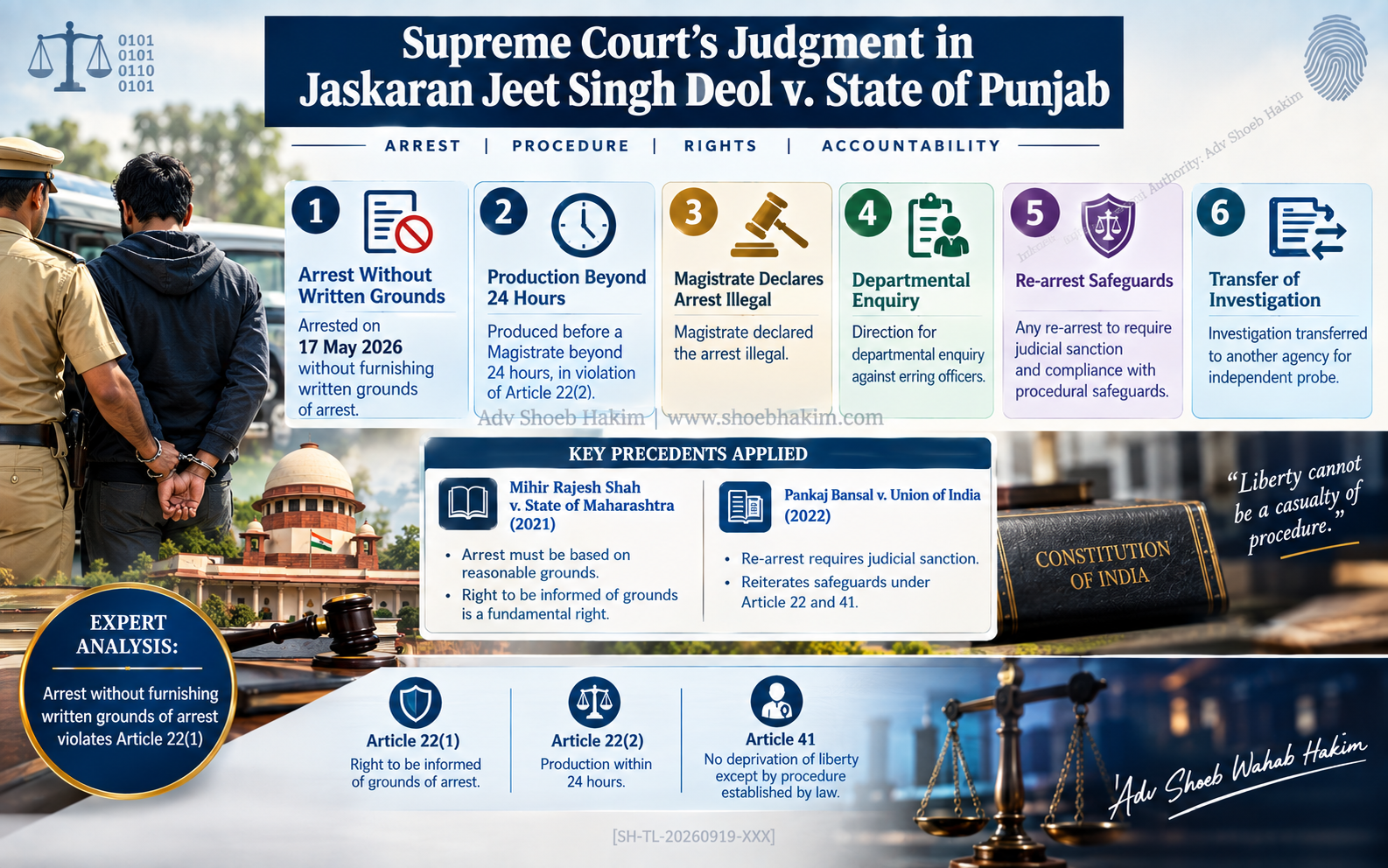
Key Facts
- Case Name: Jaskaran Jeet Singh Deol v. State of Punjab
- Citation: 2026 INSC 1022; 2026 LiveLaw (SC) 967
- Judgment Date: 21 September 2026
- Bench: Justice Ujjal Bhuyan and Justice Atul S. Chandurkar
- Court: Supreme Court of India
- Key Holding: Arrest without furnishing written grounds of arrest violates Article 22(1) and renders the arrest illegal
- Consequence: Departmental enquiry against the erring officer; adverse findings to result in departmental action and entry in service record
- Re-arrest Safeguard: Judicial sanction of the Magistrate mandatory before re-arrest; application must include written grounds, reasons for re-arrest, and superior authority endorsement
- Investigation Transfer: Investigation must be handed over to another officer where re-arrest is sought after an Article 22(1) violation
- Precedents Applied: Pankaj Bansal v. Union of India (2023); Prabir Purkayastha v. State (NCT of Delhi) (2024); Vihaan Kumar v. State of Haryana (2025); Mihir Rajesh Shah v. State of Maharashtra (2025); Prabhu Dayal Deorah v. District Magistrate, Kamrup (1973)
Direct Answer
On 21 September 2026, the Supreme Court of India in Jaskaran Jeet Singh Deol v. State of Punjab (2026 INSC 1022) held that a police officer who arrests a person without furnishing the grounds of arrest in writing must face a departmental enquiry.
The bench of Justice Ujjal Bhuyan and Justice Atul S. Chandurkar held that failure to furnish written grounds of arrest violates the constitutional safeguard under Article 22(1) and renders the arrest illegal.
The Court also laid down a procedure to be followed if the investigating agency seeks to re-arrest a person whose initial arrest was declared illegal. The Court said the grounds of arrest must be provided in writing, in a language understood by the accused, and furnished to the arrested person “as a matter of course without exception.”
A subsequent chargesheet or an order taking cognisance cannot validate an arrest that was unconstitutional at the outset. The principle applies to arrests under both the Indian Penal Code and special laws and is not dependent on the nature or gravity of the alleged offence.
On re-arrest, the Court said the investigating agency must first furnish the grounds of arrest and then approach the concerned Magistrate, explaining both the need for custody and why the grounds had not been supplied during the original arrest. The application must carry the endorsement of the investigating officer’s immediate senior authority. The Magistrate must then consider the request expeditiously, preferably within a week, while following principles of natural justice.
The Court also directed that the investigation be handed over to another officer if re-arrest is sought after an Article 22(1) violation. The superior authority must additionally order a departmental enquiry against the officer responsible for the original lapse. If the inquiry finds the officer at fault, departmental action should follow, along with an entry in the officer’s service book.
The Supreme Court directed that a copy of its judgment be sent to the Directors General of Police of all states and Union Territories. The Court stressed that constitutional safeguards governing personal liberty cannot be treated as technicalities. It reiterated that when an arrest violates Article 22(1), release from custody is release from illegal and unconstitutional detention, rather than release on bail.
In this article:
- What Happened in the Case
- The Article 22(1) Violation
- The Re-Arrest Safeguards
- The Departmental Enquiry Direction
- The Transfer of Investigation
- The Precedents Applied
- What This Means for Police Officers and Investigating Agencies
- Frequently Asked Questions (FAQ)
By Adv. Shoeb Hakim — Criminal defence, AML, digital forensics, and cybercrime specialist; former General Counsel, Credit Suisse; training police forces since 1996.
What Happened in the Case
The case arose from an FIR registered at Mataur Police Station, SAS Nagar (Punjab) against Jaskaran Jeet Singh Deol under Sections 64, 65(1), and 351 of the Bharatiya Nyaya Sanhita, 2023, read with Section 6 of the Protection of Children from Sexual Offences Act, 2012.
The allegations pertained to physical and sexual abuse of a minor stepdaughter from October-November 2024 onwards.
Deol was arrested on 17 May 2026 at approximately 7:54 am from his Ludhiana residence. He was produced before the Judicial Magistrate on 18 May 2026, beyond the 24-hour constitutional window, without any written grounds of arrest having been communicated to him.
The Judicial Magistrate declared the arrest illegal for non-supply of written grounds of arrest in violation of Article 22(1) read with Section 47 of the BNSS. The Magistrate directed immediate release of the appellant while clarifying that the investigating agency was not precluded from proceeding in accordance with law.
On the same day, the same Station House Officer moved a fresh remand application, which the Additional Chief Judicial Magistrate dismissed as not maintainable since grounds of arrest were still not supplied to the accused.
Deol then moved the Punjab and Haryana High Court under Section 528 BNSS seeking a blanket restraint on re-arrest, which was dismissed. The High Court held that the investigating agency could not be prohibited from seeking warrants of arrest or re-arresting the appellant.
The matter travelled to the Supreme Court, which had granted interim protection from arrest since 27 July 2026, and directed departmental action against the erring officers, resulting in suspension of ASI Gurtej Singh and transfer of SHO Rupinder Singh to Police Lines.
The Article 22(1) Violation
Article 22(1) of the Constitution provides that no person who is arrested shall be detained in custody without being informed, as soon as may be, of the grounds for such arrest.
The Court held that this mandate is not a mere formality. It is a mandatory binding constitutional safeguard applicable across all statutes including the Indian Penal Code, the Bharatiya Nyaya Sanhita, and special enactments like the POCSO Act, the Prevention of Money Laundering Act, and the Unlawful Activities (Prevention) Act.
Any infringement of Article 22(1) vitiates the process of arrest and remand. A subsequent chargesheet or order of cognizance cannot validate an arrest which is per se unconstitutional.
The Court noted that the appellant was arrested on 17 May 2026 and produced before the Magistrate on 18 May 2026. No written grounds of arrest were provided to him. The Magistrate correctly applied the Supreme Court’s judgment in Mihir Rajesh Shah v. State of Maharashtra (2025) and declared the arrest illegal.
The Re-Arrest Safeguards
The Court laid down specific safeguards for any re-arrest following an Article 22(1) violation.
The procedure:
- The investigating agency must first furnish the written grounds of arrest to the accused
- It must then approach the jurisdictional Magistrate with a custody application
- The application must explain why re-arrest and custody are necessary
- It must explain why the grounds were not supplied on the first occasion
- The application must carry the endorsement of the immediate superior of the investigating officer
The Magistrate must decide the application in accordance with the principles of natural justice, preferably within a week.
The Court held that re-arrest following a breach of Article 22(1) requires “judicial imprimatur.” The power to re-arrest cannot be left to the discretion of the very same authority that violated the Constitution.
The Departmental Enquiry Direction
The Court attached administrative consequences to a breach of Article 22(1).
The superior authority considering an application for seeking fresh custody must:
- Transfer the investigation to another officer
- Direct a departmental inquiry into the earlier violation
- Ensure departmental action follows in the event of any adverse finding
- Ensure an entry in the service book of the officer concerned
In Deol’s case, the Supreme Court had been informed that the investigating officer was suspended and the Station House Officer was removed from his post and transferred to the Police Lines. Departmental proceedings were also initiated.
The Transfer of Investigation
The Court directed that the investigation must change hands where re-arrest is sought after an Article 22(1) violation.
The same authority responsible for the violation cannot be entrusted with the investigation. The superior authority must hand over the investigation to another officer.
The Court also examined Article 22(2), which requires an arrested person to be produced before the nearest Magistrate within 24 hours, excluding necessary travel time. It reiterated that detention beyond this period without judicial authority is unlawful.
Where an accused is released following a breach of Article 22(2), and the investigating agency still considers custody necessary, it must follow the same procedure prescribed for re-arrest after an Article 22(1) violation.
The Court distinguished such a release from default bail. Default bail arises because an investigating agency has failed to file its report within the statutory period. Release following an Article 22 violation flows from the illegality of the arrest or detention itself.
Depending on the facts of the case, the High Court may also award compensation as a public law remedy for violation of Article 22(2), without preventing the person concerned from pursuing remedies under private law.
The Precedents Applied
The Court traced the evolution of Article 22(1) through several judgments.
Pankaj Bansal v. Union of India (2023) : The Supreme Court held that the grounds of arrest under the Prevention of Money Laundering Act have to be communicated in writing.
Prabir Purkayastha v. State (NCT of Delhi) (2024) : The protection was applied to an arrest under the Unlawful Activities (Prevention) Act.
Vihaan Kumar v. State of Haryana (2025) : The Court held that failure to meaningfully communicate the grounds of arrest violates Articles 21 and 22(1), rendering the arrest unconstitutional. A subsequently filed chargesheet or order taking cognisance cannot cure that defect.
Mihir Rajesh Shah v. State of Maharashtra (2025) : The Court held that written grounds must ordinarily be furnished on arrest. Where immediate written communication is impractical, the grounds may initially be conveyed orally but must be supplied in writing within a reasonable time and, in any event, at least two hours before the accused is produced before the Magistrate.
Prabhu Dayal Deorah v. District Magistrate, Kamrup (1973) : The three-judge bench held that the gravity of the offence does not dilute the constitutional safeguards governing arrest.
The Court directed that the judgment be circulated to the Directors General of Police of all States and Union Territories, Registrars General of all High Courts, and Directors of State Judicial Academies.
What This Means for Police Officers and Investigating Agencies
For Police Officers
The failure to furnish written grounds of arrest is not a procedural lapse. It is a constitutional violation with direct consequences for the officer responsible.
A departmental enquiry will be initiated. If adverse findings are recorded, departmental action will follow, including an entry in the service book.
For Investigating Agencies
Re-arrest after an Article 22(1) violation is not a matter of executive discretion. Judicial sanction is mandatory. The application must explain the necessity for custody and the failure to furnish grounds at the first instance. The investigation must be handed over to another officer.
For Magistrates
The Magistrate must independently examine the bona fide reasons and necessity for custody. The application must be decided expeditiously, preferably within a week, in accordance with the principles of natural justice.
For Accused Persons
Release following an Article 22(1) violation is not a grant of bail. It is a release from illegal and unconstitutional detention. The accused cannot be re-arrested without judicial sanction.
Frequently Asked Questions (FAQ)
What did the Supreme Court hold in Jaskaran Jeet Singh Deol v. State of Punjab?
The Court held that arrest without furnishing written grounds violates Article 22(1) and renders the arrest illegal. The erring officer must face a departmental enquiry, and any re-arrest requires judicial sanction.
What is the citation and judgment date?
The citation is 2026 INSC 1022. The judgment was delivered on 21 September 2026.
Who were the judges on the bench?
Justice Ujjal Bhuyan and Justice Atul S. Chandurkar.
What is Article 22(1) of the Constitution?
Article 22(1) provides that no person who is arrested shall be detained in custody without being informed, as soon as may be, of the grounds for such arrest.
What is the consequence for a police officer who fails to furnish written grounds?
The superior authority must order a departmental enquiry against the erring officer. If the inquiry finds the officer at fault, departmental action must follow, with an entry in the service book.
Can the accused be re-arrested after release for an Article 22(1) violation?
Yes, but not without judicial sanction. The investigating agency must first furnish the written grounds of arrest and then approach the Magistrate with a custody application explaining the necessity for re-arrest and the failure to furnish grounds initially.
What must the custody application contain?
The written grounds of arrest, the reasons and necessity for re-arrest, the explanation for non-supply of grounds at the first instance, and the endorsement of the immediate superior authority.
What is the timeline for the Magistrate’s decision?
The Magistrate must decide the application expeditiously and preferably within a week, adhering to the principles of natural justice.
What happens to the investigation if re-arrest is sought?
The investigation must be handed over to another officer. The same authority responsible for the violation cannot continue the investigation.
Does the gravity of the offence affect Article 22(1)?
No. The Court held that constitutional protections cannot depend upon the gravity of the offence.
What is the distinction between release under Article 22 and default bail?
Default bail arises from the investigating agency’s failure to file its report within the statutory period. Release under Article 22 flows from the illegality of the arrest or detention itself.
Explore More:
Disclaimer: This content is for informational purposes only and does not constitute legal advice. Readers should consult qualified legal counsel for advice on their specific circumstances.
#AdvShoebHakim #Article22 #WrittenGrounds #IllegalArrest #SupremeCourtIndia #WhiteCollarCrime #DigitalForensics #LegalDefense #Compliance #CriminalLaw
Leave a Reply