
Key Facts
- Case Name: Seema Joshi v. Bar Council of India
- Judgment Date: 18 September 2026
- Bench: Justice B.V. Nagarathna and Justice Augustine George Masih
- Court: Supreme Court of India
- Key Direction: Union Government and Bar Council of India to jointly draft regulations for sexual harassment complaints by women lawyers
- Applicability: Women lawyers practising before High Courts, district courts, Taluka courts, tribunals and quasi-judicial authorities
- Structural Issue: POSH Act presumes an employer-employee relationship; an advocate has no employer
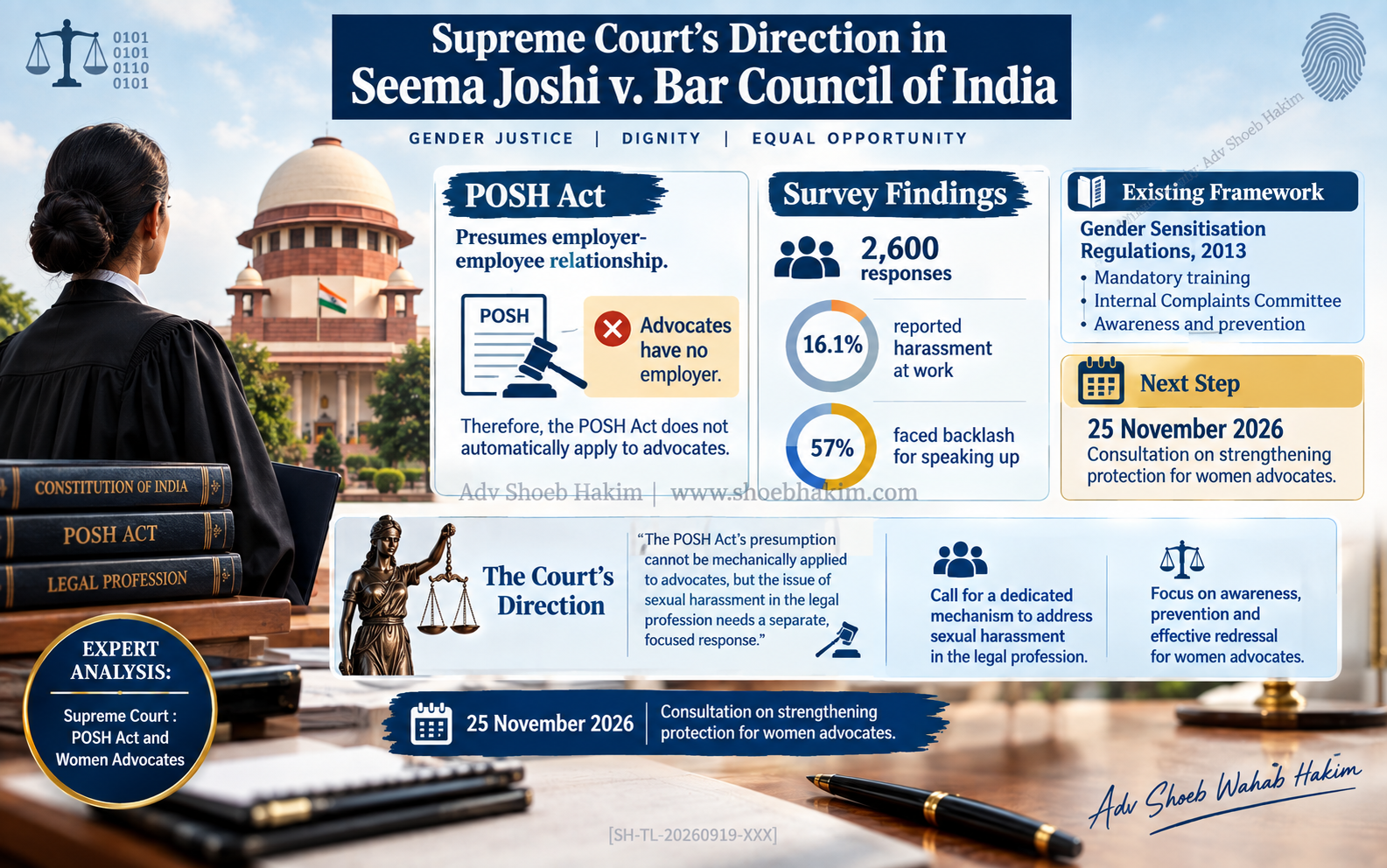
- Survey Data: Supreme Court Bar Association survey received over 2,600 responses; 16.1% reported experiencing sexual harassment; 12.7% chose not to answer; 57% of those who reported faced backlash
- Next Hearing: 25 November 2026
Direct Answer
On 18 September 2026, the Supreme Court of India in Seema Joshi v. Bar Council of India asked the Union Government and the Bar Council of India to jointly draft regulations for sexual harassment complaints by women lawyers practising before High Courts, district courts, Taluka courts, tribunals and quasi-judicial authorities.
The bench of Justice B.V. Nagarathna and Justice Augustine George Masih held that the POSH Act, 2013, cannot be applied in a “straitjacket manner” to the legal profession.
The reasoning is structural. The POSH Act presumes an employer-employee relationship. It requires an Internal Committee at the workplace. An advocate has no employer. She is not employed by the Bar Council, the Bar Association, or the court before which she practises.
She may face harassment from a senior advocate, an opposing counsel, a client, or a court staff member — none of whom is her “employer” under the Act.
The Supreme Court’s own Gender Sensitisation and Sexual Harassment Regulations, 2013, address this for the Supreme Court’s precincts. Justice Nagarathna suggested those regulations could be replicated for High Courts, district courts, and Taluka courts.
But the regulations would have to define “workplace” for an advocate. The POSH Act’s definitions do not map cleanly onto the profession.
The scale of the problem is documented.
The Supreme Court Bar Association’s national survey, “Documenting Voices of Women Legal Professionals in India,” gathered over 2,600 responses. 16.1% of respondents reported experiencing sexual harassment. 12.7% chose not to answer.
Among those who reported harassment, 57% said they faced backlash — exclusion from work, subtle retaliation, damage to their professional standing.
The court has posted the matter for 25 November 2026. The Union Government and the BCI are to hold a joint consultation and produce model regulations.
The gap is identified. The regulatory form is still to be determined.
In this article:
- The Structural Problem: Why POSH Does Not Fit the Legal Profession
- The Supreme Court’s Direction
- The Gender Sensitisation Regulations, 2013: A Template
- The Survey Data: What Women Lawyers Report
- The Backlash Problem: Why Reporting Is Risky
- Defining “Workplace” for an Advocate
- What Happens Next: The 25 November 2026 Consultation
- Frequently Asked Questions (FAQ)
By Adv. Shoeb Hakim — Criminal defence, AML, digital forensics, and cybercrime specialist; former General Counsel, Credit Suisse; training police forces since 1996.
The Structural Problem: Why POSH Does Not Fit the Legal Profession
The POSH Act, 2013, was built for employees. It presumes an employer-employee relationship. It requires an Internal Committee at the workplace. It provides a mechanism for redressal within an organisational hierarchy.
Women advocates are not employees. They are independent professionals. They are not employed by the Bar Council, the Bar Association, or the court before which they practise.
The Act’s definitions do not map cleanly onto the legal profession.
Who Harasses Whom
A woman advocate may face harassment from:
- A senior advocate in her chambers or court
- An opposing counsel
- A client
- A court staff member
- A judicial officer
None of these individuals is her “employer” under the POSH Act.
The Workplace Question
For an advocate, the “workplace” is not a single office. It includes:
- The court premises
- The Bar room
- The chambers of senior advocates
- Client meeting locations
- Virtual hearing platforms
The POSH Act’s definition of “workplace” does not account for this distributed geography.
The Internal Committee Question
The POSH Act requires an Internal Committee at the workplace. But which workplace? The court? The Bar Association? The Bar Council?
An advocate has no employer to constitute an Internal Committee. This is the structural gap the Supreme Court has identified.
The Supreme Court’s Direction
On 18 September 2026, the bench of Justice B.V. Nagarathna and Justice Augustine George Masih addressed this gap.
The Direction
The Court asked the Union Government and the Bar Council of India to jointly draft regulations for sexual harassment complaints by women lawyers practising before High Courts, district courts, Taluka courts, tribunals and quasi-judicial authorities.
The Reasoning
The Court held that the POSH Act cannot be applied in a “straitjacket manner” to the legal profession.
The Next Steps
The matter has been posted for 25 November 2026. The Union Government and the BCI are to hold a joint consultation and produce model regulations.
The Gender Sensitisation Regulations, 2013: A Template
The Supreme Court’s own Gender Sensitisation and Sexual Harassment Regulations, 2013, address this issue for the Supreme Court’s precincts.
What the Regulations Do
The 2013 Regulations establish a mechanism for addressing sexual harassment complaints within the Supreme Court’s precincts. They define the workplace, constitute a committee, and provide a procedure for redressal.
The Suggestion
Justice Nagarathna suggested that the 2013 Regulations could be replicated for High Courts, district courts, and Taluka courts.
The Challenge
The regulations would have to define “workplace” for an advocate. The POSH Act’s definitions do not map cleanly onto the profession.
The 2013 Regulations were designed for the Supreme Court’s precincts — a defined physical space with a clear administrative hierarchy. Replicating them for district courts and Taluka courts would require adapting the definitions and procedures to different contexts.
The Survey Data: What Women Lawyers Report
The Supreme Court Bar Association’s national survey, “Documenting Voices of Women Legal Professionals in India,” gathered over 2,600 responses.
Key Findings
- 16.1% of respondents reported experiencing sexual harassment
- 12.7% chose not to answer
- Among those who reported harassment, 57% said they faced backlash
The 12.7% Who Did Not Answer
The 12.7% who chose not to answer is itself significant. It suggests that a substantial proportion of women lawyers are unwilling to disclose their experiences, even in an anonymous survey.
The 57% Backlash Figure
The 57% backlash figure is the operational core of the problem. A woman lawyer who reports harassment risks her briefs, her mentorship, and her standing at the Bar.
The Backlash Problem: Why Reporting Is Risky
The POSH Act’s confidentiality provisions were designed for employees who have an HR department behind them. An advocate has no such buffer.
What Backlash Looks Like
The survey identified backlash as:
- Exclusion from work
- Subtle retaliation
- Damage to professional standing
Why It Matters
A woman advocate’s livelihood depends on her professional network. Her briefs come from senior advocates, solicitors, and clients. Her mentorship comes from seniors at the Bar. Her standing depends on her reputation.
If reporting harassment risks these, the rational calculation is silence.
The POSH Act’s Limitation
The POSH Act’s confidentiality provisions protect the complainant’s identity. But they do not protect her from the informal, often invisible, retaliation that follows a complaint.
An employee has an HR department. An advocate has no equivalent institutional protection.
Defining “Workplace” for an Advocate
The Supreme Court’s direction requires the Union Government and the BCI to define “workplace” for an advocate.
The Challenge
For an advocate, the workplace is not a single office. It includes:
- The court premises
- The Bar room
- The chambers of senior advocates
- Client meeting locations
- Virtual hearing platforms
- Social media and messaging platforms used for professional communication
The POSH Act’s Definition
The POSH Act defines “workplace” broadly. It includes any place visited by the employee arising out of or during the course of employment, including transportation provided by the employer.
But this definition presumes an employer. An advocate has no employer.
The Regulatory Task
The regulations must define “workplace” for a profession where the workplace is distributed across multiple locations and platforms.
What Happens Next: The 25 November 2026 Consultation
The Supreme Court has posted the matter for 25 November 2026.
What to Expect
The Union Government and the BCI are to hold a joint consultation and produce model regulations.
The Questions to Be Addressed
- How to define “workplace” for an advocate
- How to constitute a committee without an employer
- How to protect complainants from backlash
- How to ensure confidentiality in a profession where reputation is everything
- How to adapt the Gender Sensitisation Regulations, 2013, for different court contexts
The Gap
The gap is identified. The regulatory form is still to be determined.
Frequently Asked Questions (FAQ)
What did the Supreme Court direct in Seema Joshi v. Bar Council of India?
The Court asked the Union Government and the Bar Council of India to jointly draft regulations for sexual harassment complaints by women lawyers practising before High Courts, district courts, Taluka courts, tribunals and quasi-judicial authorities.
Why can’t the POSH Act apply to women advocates?
The POSH Act presumes an employer-employee relationship. It requires an Internal Committee at the workplace. An advocate has no employer. She is not employed by the Bar Council, the Bar Association, or the court before which she practises.
Who can harass a woman advocate?
A woman advocate may face harassment from a senior advocate, an opposing counsel, a client, a court staff member, or a judicial officer. None of these individuals is her “employer” under the POSH Act.
What is the Gender Sensitisation and Sexual Harassment Regulations, 2013?
It is a Supreme Court regulation that addresses sexual harassment complaints within the Supreme Court’s precincts. Justice Nagarathna suggested it could be replicated for High Courts, district courts, and Taluka courts.
What did the Supreme Court Bar Association survey find?
The survey received over 2,600 responses. 16.1% reported experiencing sexual harassment. 12.7% chose not to answer. Among those who reported harassment, 57% said they faced backlash.
What is the backlash problem?
A woman lawyer who reports harassment risks her briefs, her mentorship, and her standing at the Bar. The POSH Act’s confidentiality provisions protect her identity, but they do not protect her from informal retaliation.
Why is defining “workplace” for an advocate challenging?
For an advocate, the workplace is not a single office. It includes the court premises, the Bar room, the chambers of senior advocates, client meeting locations, and virtual hearing platforms.
When is the next hearing?
The matter has been posted for 25 November 2026.
What will happen at the next hearing?
The Union Government and the BCI are to hold a joint consultation and produce model regulations.
What are the key questions the regulations must address?
How to define “workplace” for an advocate, how to constitute a committee without an employer, how to protect complainants from backlash, and how to adapt the 2013 Regulations for different court contexts.
Explore More:
Disclaimer: This content is for informational purposes only and does not constitute legal advice. Readers should consult qualified legal counsel for advice on their specific circumstances.
#AdvShoebHakim #POSHAct #WomenAdvocates #SupremeCourtIndia #LegalProfession #GenderSensitisation #WhiteCollarCrime #DigitalForensics #LegalDefense #Compliance