The Court held that the arbitrator’s view was reasonable and consistent with legal precedents, dismissing the employer’s appeal.
Introduction
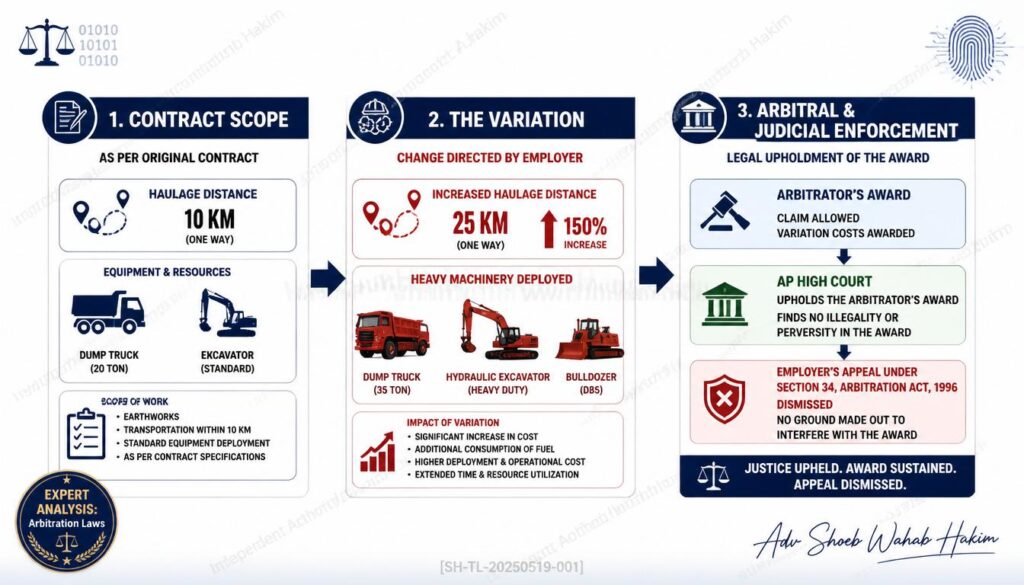
Moving materials over greater distances. Using heavier equipment than specified. The employer said: no variation, no extra payment. The arbitrator said: this is work beyond the contract scope. The Andhra Pradesh High Court upheld the arbitrator’s award.
In Suptd. Engineer Public Health Nellore vs. H S Bhatt and Ors. (APHC, 2025), the Court upheld an arbitrator’s award for additional compensation to a contractor for work done beyond the original contract scope.
This article analyzes the judgment, the legal principles reaffirmed, and the implications for construction contracts and arbitration.
The Case
| Aspect | Details |
|---|---|
| Case Name | Suptd. Engineer Public Health Nellore vs. H S Bhatt and Ors. |
| Court | Andhra Pradesh High Court |
| Date | 02.07.2025 |
| Nature | Civil Revision Petition (CRP No. 4055 of 1993) and Civil Miscellaneous Appeal (CMA No. 1251 of 1993) |
| Issue | Whether haulage of materials over greater distances and using heavier equipment constitutes a variation |
| Outcome | Dismissed appeals; upheld arbitral award |
The Dispute
The contract:
A public health project in Nellore. The contract specified certain distances for material haulage and certain equipment to be used.
The contractor’s claim:
The contractor claimed additional compensation for:
- Transporting materials over greater distances than specified
- Using heavier equipment than specified
What the employer argued:
- Additional work should be paid at the contract rate
- Variation of rate would change the terms of the agreement
- The arbitrator, as a creature of the agreement, cannot go against the terms of the agreement
What the contractor argued:
- This was not “additional work” in the sense of extra material
- It was “work beyond the agreement” in terms of distance and equipment
- The contractor was entitled to additional rates for this work
The Arbitrator’s Award
| Claim | Arbitrator’s Finding |
|---|---|
| Material transported over greater distances | This was work done beyond the agreement |
| Heavier equipment used | This was work done beyond the agreement |
| Additional rates | The contractor is entitled to additional rates for this work |
The arbitrator’s reasoning:
The work done by the contractor was not additional work (extra material), but work done beyond the agreement (greater distances, heavier equipment). Therefore, the contractor is entitled to additional rates for the work done.
The High Court’s Analysis
The legal standard for interference:
“As held by the Hon’ble Supreme Court, in the aforesaid cases, the view of the arbitrator can be interfered with only if it is found to be a totally and wholly unreasonable view.”
What the Court found:
| Factor | Finding |
|---|---|
| Arbitrator’s view | Reasonable view of the facts and law |
| Compliance with agreement | Does not violate the terms of the agreement |
| Precedent | Consistent with Supreme Court decisions |
| Interference | Not permissible |
The Court’s conclusion:
“Once this Court holds that a view of the arbitrator is a reasonable view which does not violate the terms of the agreement, it would not be permissible for the Court to interfere with any part of this award.”
The result:
The employer’s appeal was dismissed. The trial court’s decision to uphold the arbitration award was affirmed.
Key Legal Principles
1. Courts do not sit in appeal over arbitral awards
An arbitral award cannot be interfered with merely because the Court would have taken a different view. The Court can only interfere if the arbitrator’s view is “totally and wholly unreasonable.”
2. Reasonable view standard
If the arbitrator’s view is reasonable and does not violate the terms of the agreement, the Court will not interfere with any part of the award.
3. Work beyond scope = variation
Haulage of materials over greater distances than specified constitutes a variation. Using heavier equipment than specified constitutes a variation. The contractor is entitled to additional rates for such work.
4. Arbitrator as creature of the agreement
The arbitrator is a creature of the agreement and cannot go against its terms. But the arbitrator can interpret the agreement and determine whether the work performed falls within or beyond its scope.
Practical Implications
For Employers/Principals:
| Implication | Action |
|---|---|
| Specify distances and equipment clearly | Vague specifications lead to disputes |
| Provide for variations | Include variation clauses in contracts |
| Document changes | Record any changes to scope in writing |
| Anticipate challenges | Realistic specifications reduce claims |
For Contractors:
| Implication | Action |
|---|---|
| Document work done | Record actual distances and equipment used |
| Claim variations | If work exceeds scope, claim additional compensation |
| Seek arbitration | Arbitration is an effective dispute resolution mechanism |
| Present reasonable view | A reasonable view will be upheld by courts |
The Supreme Court Position
The Andhra Pradesh High Court relied on Supreme Court precedents holding that:
- The view of the arbitrator can be interfered with only if it is found to be a totally and wholly unreasonable view
- Courts do not sit in appeal over arbitral awards
- A reasonable view of the arbitrator, even if the Court would have taken a different view, must be upheld
Why This Judgment Matters
| Aspect | Significance |
|---|---|
| Arbitration | Reinforces the limited scope of judicial interference |
| Construction contracts | Clarifies what constitutes a variation |
| Contractors | Provides clarity on entitlement to additional rates |
| Employers | Highlights the importance of clear specifications |
Conclusion
In Suptd. Engineer Public Health Nellore vs. H S Bhatt and Ors. (APHC, 2025), the Andhra Pradesh High Court upheld an arbitrator’s award for additional compensation to a contractor for work done beyond the original contract scope.
The Court held that haulage of materials over greater distances than specified constitutes a variation. Using heavier equipment than specified constitutes a variation. The arbitrator’s view was reasonable and consistent with legal precedents. Therefore, the Court would not interfere with any part of the award.
The employer’s argument that additional work should be paid at the contract rate was rejected. The arbitrator took the view that the work was not “additional work” in the sense of extra material, but “work beyond the agreement” in terms of distance and equipment. The contractor was entitled to additional rates for this work.
Once the Court holds that a view of the arbitrator is a reasonable view which does not violate the terms of the agreement, it would not be permissible for the Court to interfere with any part of this award.
The Civil Revision Petition (CRP No. 4055 of 1993) and Civil Miscellaneous Appeal (CMA No. 1251 of 1993) were dismissed.
KNOWLEDGE CHECK QUIZ
Q: In the H.S. Bhatt case, what two specific operational changes did the Arbitrator classify as “work beyond the agreement” (a variation)? Ans: The Arbitrator ruled that transporting materials over greater distances (haulage) than specified, and using heavier equipment than contemplated in the original agreement, constituted work beyond the scope.
Q: What was the primary defense raised by the employer (Suptd. Engineer Public Health Nellore) to deny the additional compensation? Ans: The employer argued that the tasks were merely “additional work” that should be paid strictly at the existing contract rates, and that granting new rates would illegally alter the terms of the agreement.
Q: According to the Andhra Pradesh High Court, under what strict condition can a court interfere with an Arbitrator’s award? Ans: The Court can only interfere if the Arbitrator’s view is found to be “totally and wholly unreasonable” or patently perverse.
Q: How did the High Court respond to the employer’s argument that a different interpretation of the contract was possible? Ans: The Court stated that it does not sit as an appellate authority over arbitral awards. As long as the Arbitrator’s interpretation is a “reasonable view” that doesn’t violate the contract’s terms, the Court will not interfere, even if the Court itself might have taken a different view.
───
FREQUENTLY ASKED QUESTIONS (FAQ)
Q: If a contractor has to dig 10 feet deeper than the contract specifies because of bad soil, is that “additional work” or a “variation”? Ans: In infrastructure law, fundamentally altering the parameters of the task (like digging deeper into harder rock strata, or hauling material further) is generally classified as a Variation (work beyond scope). It usually entitles the contractor to a newly derived rate, not just more volume at the old rate.
Q: Why do courts refuse to look at the evidence again when a government department challenges an arbitration award? Ans: Arbitration is designed to be a final and binding alternative to traditional litigation. The law dictates that the Arbitrator is the sole judge of the quantity and quality of evidence. If courts constantly re-weighed the evidence, arbitration would simply become an extra, unnecessary layer of the traditional court system, destroying its purpose of speedy resolution.
Q: Can an Arbitrator simply invent new rates for a contractor if they feel bad for them? Ans: No. The Arbitrator is a “creature of the contract.” They cannot grant compensation out of mere sympathy. They must base the new rates on empirical data (like the Standard Schedule of Rates or documented actual costs) and must legally justify that the work performed fell outside the boundaries of the original agreement.
Adv. Shoeb Hakim
Arbitration & Contract Law Advisor
📌 Follow me on LinkedIn for daily arbitration and contract law insights: https://www.linkedin.com/in/shoebhakim
📌 Visit my website for more articles: https://shoebhakim.com
📌 Visit my website for research fellowship: https://www.legalcomplaince.in
♻️ Share this article with your network.
Disclaimer: This article is for informational purposes only and does not constitute legal advice.
Hashtags: #AdvShoebHakim #Arbitration #ContractLaw #APHC #ConstructionDisputes #Variation #ArbitralAward #PublicHealth #Nellore #CivilRevision #CivilAppeal #HSBhatt #ArbitrationAct #ContractInterpretation #WorkBeyondScope #ReasonableView #CourtInterference #Damages #BreachOfContract #QuantitySurvey #Engineering #Infrastructure #ArbitrationLaw #LegalUpdate #IndianLaw #HighCourtJudgment #APHighCourt #AndhraPradesh #ConstructionContract #AdditionalWork #Haulage #EquipmentUsage #VariationClause #Arbitrator #ArbitrationProceedings #DisputeResolution #ContractualObligations #SiteConditions #RateVariation #Measurement #QuantityEstimation #ProjectManagement #CivilEngineering #PublicWorks #GovernmentContracts #Tendering #Bidding #ScopeOfWork #ContractAdministration #ProjectDelivery #CostOverrun