

For individuals in India, purchasing a home isn’t just a monetary exchange; it’s a commitment of faith. That faith has been betrayed, again and again.
Introduction
For individuals in India, purchasing a home isn’t just a monetary exchange; it’s a commitment of faith. You sign on the dotted line, pay lakhs, crores, and then you wait.
This faith had been betrayed, again and again, for years on end.
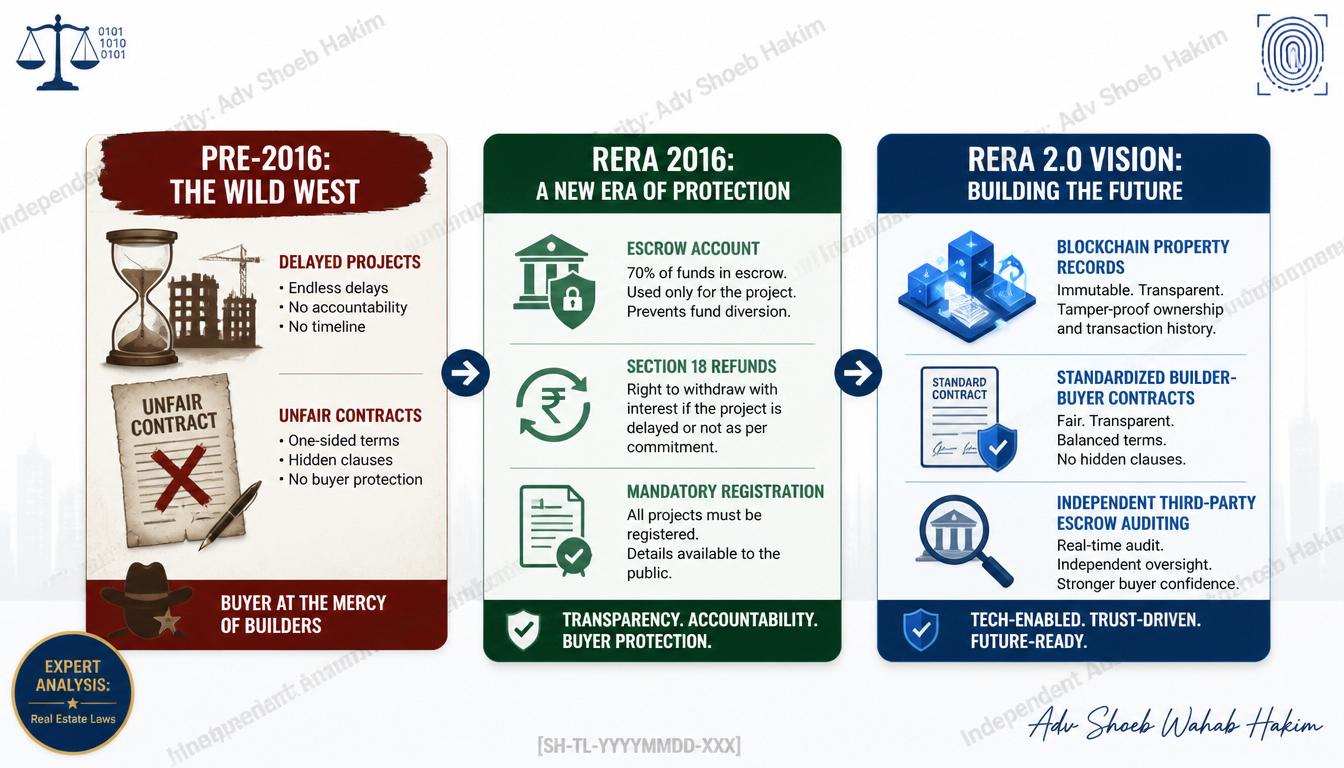
Prior to 2016, typical sale agreements included provisions for promoters to modify layouts at their sole discretion, undue price increases, and arbitration clauses which restricted buyers’ ability to pursue remedies. Project delays of sometimes over a decade became the norm.
Then came RERA. A revolution on paper. A more complicated story in practice.
This article analyzes India’s real estate laws, the impact of RERA, the challenges that remain, and the proposed RERA 2.0 reforms.
The Pre-RERA Era: The Wild West of Real Estate
| Issue | Pre-RERA Reality |
|---|---|
| Layout changes | Developers could modify layouts at their sole discretion |
| Price increases | Undue price increases were common |
| Arbitration clauses | Restricted buyers’ ability to pursue remedies |
| Project delays | Sometimes over a decade became the norm |
| Buyer remedies | Limited, expensive, and time-consuming |
| Accountability | Minimal |
The result: Buyers paid large sums, waited years, and had few options when things went wrong.
RERA, 2016: A Revolution on Paper
The Real Estate (Regulation and Development) Act, 2016, brought significant changes.
| Provision | Impact |
|---|---|
| Section 18 | Right to full refund with interest if possession is delayed |
| Project registration | Mandatory registration with regulatory authority |
| Escrow accounts | 70% of project funds to be deposited in separate accounts |
| Transparency | Project details, timelines, and approvals to be disclosed |
| Dispute resolution | Fast-track adjudication through regulatory authorities |
The promise: Clarity, accountability, and protection for homebuyers.
10 Years Later: The Reality
| Challenge | Impact |
|---|---|
| Lack of uniformity across states | Some states implement RERA effectively; others do not |
| Slow adjudication | Delays in dispute resolution |
| Regulatory pro-developerism | Some regulators favour developers over buyers |
| Courts plugging holes | Courts had to intervene repeatedly |
| Enforcement gaps | Many provisions not fully implemented |
The numbers:
- Project registration: Over 1.6 lakh (as of May 2026)
- Increasing trend of compliance
- Reform is ongoing
The truth:
The laws are largely good enough. The question is whether the institutions that enforce them are.
The Court’s Role: Plugging the Holes
Since RERA’s enactment, courts have had to plug numerous holes in the legislation and its implementation:
- Interpretation of Section 18: Courts have clarified the scope of the buyer’s right to refund
- Jurisdictional issues: Courts have resolved conflicts between RERA and other forums
- Compliance orders: Courts have forced non-compliant states to implement RERA
- Consumer protection: Courts have reinforced buyer rights
The significance: It is significant that courts had to do this. A well-drafted law should not require repeated judicial intervention to be effective.
RERA 2.0: The Proposed Reforms
The proposed reforms are designed to take the industry from regulation to technology-driven governance.
| Reform | Description |
|---|---|
| Higher penalties for delay | Increased financial consequences for developers |
| Third-party auditing of escrow funds | Independent oversight of project finances |
| Digital complaint resolution | Online dispute resolution mechanisms |
| Blockchain property records | Secure, tamper-proof land records |
| Standardized builder-buyer contracts | Uniform contract terms across projects |
| Quick tribunals | Fast-track dispute resolution |
The vision:
The dreams of blockchain property records, quick tribunals, standardized builder-buyer contracts, are not just dreams. But ambition and action are two entirely different animals in India.
The Unanswered Question
| Question | Implication |
|---|---|
| Are the laws good enough? | Largely, yes |
| Are the institutions that enforce them? | The real issue |
| Is implementation uniform? | No, varies by state |
| Is adjudication fast enough? | No, slow |
| Is the buyer truly protected? | Varies |
The bottom line:
Family is about where a family plants its future—which is at home. But when the law that protects that future is applied in different ways, state by state, case by case, year by year, it isn’t really protection. It’s a lottery.
The Way Forward
What needs to happen:
| Action | Priority |
|---|---|
| Uniform implementation across states | Critical |
| Faster adjudication | Critical |
| Independent regulators | High |
| Technology adoption | High |
| Standardized contracts | Medium |
| Stronger enforcement | High |
The question:
The real estate laws of India are a long way. The question to ask is: far enough for whom?
Conclusion
For individuals in India, purchasing a home isn’t just a monetary exchange; it’s a commitment of faith. You sign on the dotted line, pay lakhs, crores, and then you wait. This faith had been betrayed, again and again, for years on end.
Prior to 2016, typical sale agreements included provisions for promoters to modify layouts at their sole discretion, undue price increases, and arbitration clauses which restricted buyers’ ability to pursue remedies. Project delays and sometimes over a decade became the norm.
Then came RERA. A revolution on paper. A more complicated story in practice.
Ten years later, the Act has brought clarity and accountability but the lack of uniformity in implementation across states, slow adjudication, and regulatory pro-developerism remain issues. Since then, courts have plugged a number of such holes, but it is significant that they had to do so.
Now, RERA 2.0 is in the making. The proposed reforms are designed to increase the severity of penalties for delay, third-party auditing of escrow funds, and expanded digital complaint resolution, all of which are designed to take the industry from regulation to technology-driven governance. The dreams of blockchain property records, quick tribunals, standardized builder-buyer contracts, are not just dreams.
However, ambition and action are two entirely different animals in India.
The greater question is, are the laws good enough. They largely are. The issue is whether the institutions that enforce them are. As of May 2026, project registration has reached over 1.6 lakh, reflecting an increasing trend of compliance, but the reform is ongoing.
Family is about where a family plants its future—which is at home. But when the law that protects that future is applied in different ways, state by state, case by case, year by year, it isn’t really protection. It’s a lottery.
The real estate laws of India are a long way. The question to ask is: far enough for whom?
KNOWLEDGE CHECK QUIZ
Q: Prior to the enactment of RERA in 2016, what were common practices that disadvantaged homebuyers? Ans: Developers could modify project layouts at their sole discretion, enforce undue price increases, and utilize restrictive arbitration clauses to limit a buyer’s ability to seek legal remedies, often resulting in decade-long project delays.
Q: What is the specific legal power granted to a homebuyer under Section 18 of the RERA Act? Ans: If the promoter fails to complete or give possession of the apartment by the specified date, Section 18 grants the buyer the absolute right to demand a full refund of their money along with prescribed interest.
Q: What is the “70% Escrow” rule mandated by RERA? Ans: It requires promoters to deposit 70% of the funds realized from the real estate project from the allottees into a separate, ring-fenced bank account to cover the cost of construction and land, preventing the diversion of funds to other projects.
Q: Name two proposed reforms under the upcoming “RERA 2.0” framework. Ans: Proposed reforms include the implementation of blockchain property records, standardized builder-buyer contracts, higher penalties for delays, and independent third-party auditing of escrow funds.
───
FREQUENTLY ASKED QUESTIONS (FAQ)
Q: If my builder’s contract says I must go to arbitration for disputes, can I still file a case with RERA? Ans: Yes. Indian courts have consistently ruled that RERA is a special welfare legislation. Its provisions override standard, one-sided arbitration clauses found in Builder-Buyer agreements. You have the statutory right to approach the RERA authority directly.
Q: Does RERA apply uniformly across all states in India? Ans: While RERA is a Central Act, its implementation and the framing of specific rules are delegated to individual state governments. This has led to a lack of uniformity, where some states are highly effective at enforcing buyer rights, while others exhibit a “pro-developer” bias or suffer from slow adjudication.
Q: What does “Regulatory Pro-Developerism” mean in the context of RERA? Ans: It refers to situations where State RERA authorities or their appointed officials interpret the law in a manner that favors the real estate developers over the consumers—such as granting excessive grace periods for delayed projects or diluting the penalties for non-compliance.
Adv. Shoeb Hakim
Real Estate & Property Law Advisor
📌 Follow me on LinkedIn for daily real estate and property law insights: https://www.linkedin.com/in/shoebhakim
📌 Visit my website for more articles: https://www.shoebhakim.com
📌 Visit my website for legal knowledge: https://www.vakilverse.com
📌 Visit my website for research fellowship: https://www.legalcomplaince.in
♻️ Share this article with your network.
Disclaimer: This article is for informational purposes only and does not constitute legal advice.
Hashtags: #AdvShoebHakim #RERA #RealEstate #IndianRealEstate #PropertyLaw #HomeBuyer #RERA2 #RealEstateRegulation #ConsumerProtection #PropertyRights #HomeOwnership #RealEstateIndia #RERAAct #RealEstateReform #BuilderBuyer #HomeBuyers #PropertyInvestment #RealEstateSector #BuildingHomes #RealEstateLaw #Section18 #EscrowAccount #ProjectRegistration #DisputeResolution #FastTrackAdjudication #RegulatoryProDeveloperism #UniformImplementation #BlockchainPropertyRecords #StandardizedContracts #DigitalComplaintResolution #ThirdPartyAuditing #AmbitionAndAction #InstitutionalStrength #ComplianceTrend #FamilyHome #HomeBuying #RealEstateInvestment #PropertyRights #LandRecords #ConstructionIndustry #DeveloperAccountability #BuyerProtection #LegalReform #PropertyDisputes #ConsumerJustice #AffordableHousing #UrbanDevelopment #HousingSector #RealEstateGovernance
Leave a Reply