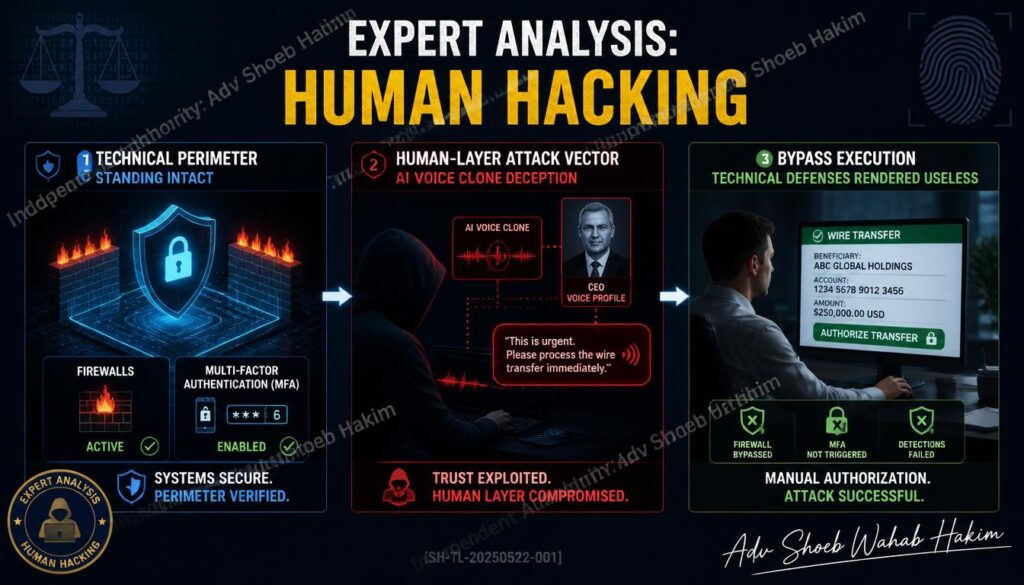
Criminals don’t break in through firewalls — they walk in through trust, emotion, urgency, and routine. AI has only made this easier.
Introduction
Most people think cybercrime is about hacking computers. The truth is: modern cybercrime is about hacking people.
It’s called human‑layer cybercrime, and it’s the fastest‑growing threat we face today. Criminals don’t break in through firewalls — they walk in through trust, emotion, urgency, and routine. AI has only made this easier for them.
This article explains what human‑layer cybercrime is, how it works, and what you can do to protect yourself.
The Shift: From Technical Exploits to Human Manipulation
| Traditional Cybercrime | Human‑Layer Cybercrime |
|---|---|
| Exploits software vulnerabilities | Exploits human psychology |
| Bypasses technical controls | Bypasses trust and judgment |
| Requires coding skills | Requires behavioral understanding |
| Leaves technical traces | Leaves human traces |
| Detected by security tools | Detected by awareness |
The reality:
Cybercriminals study human behavior more than they study code. They understand how to trigger emotional responses, create urgency, and exploit routine. They know that a person who is distracted, pressured, or trusting will bypass security controls that would stop a machine.
What Human‑Layer Attacks Look Like
Common examples:
1. A message that feels “off” but uses your real data
- The message uses your name, knows your relationships, references recent events
- But something doesn’t feel right
- This is because attackers have done their homework
2. A deepfake voice pretending to be someone you know
- AI-generated voice clones can mimic anyone with just a few seconds of audio
- Attackers call pretending to be a boss, a family member, or a friend
- They create urgency to override your critical thinking
3. A fake business or puppy sale that mirrors real websites
- Scammers create convincing replicas of legitimate businesses
- They use stolen branding, real product images, and professional design
- Victims lose money and never receive the product
4. A scam that adapts in real time to your responses
- AI-powered chatbots engage with victims in real time
- They adjust their approach based on your responses
- They build trust gradually before asking for money
These aren’t “mistakes.” They’re targeted manipulations designed to bypass even the best technical defenses.
Why Technical Defenses Fail
| Technical Defense | Why It Fails |
|---|---|
| Firewalls | Don’t block human‑to‑human contact |
| Antivirus | Doesn’t detect social engineering |
| Spam filters | Can’t identify emotionally manipulative messages |
| MFA | Doesn’t protect against authorized transactions |
| Encryption | Doesn’t prevent data sharing |
The gap:
Technical defenses protect against technical threats. Human‑layer threats target the user, not the system. Even the best security tools cannot stop a person who has been emotionally manipulated into granting access.
What I’ve Learned
1. People aren’t the weakest link — they’re the most targeted link
The phrase “the weakest link” blames the victim. In reality, attackers target humans because it works. It’s not weakness — it’s the nature of human communication and trust.
2. Cybercriminals study human behavior more than they study code
Attackers spend time understanding:
- How people make decisions
- What emotions trigger action
- How trust is built and exploited
- What situations create urgency
3. Awareness is the real firewall
Technical controls can be bypassed. Human awareness cannot be hacked — it can only be educated.
The Role of AI in Human‑Layer Attacks
| AI Capability | How It’s Used in Attacks |
|---|---|
| Deepfake voice | Impersonating trusted individuals |
| Deepfake video | Creating convincing fake identities |
| AI chatbots | Engaging victims in real time |
| Personalization | Using stolen data to create tailored messages |
| Automated scams | Scaling attacks across thousands of victims |
The impact:
AI has made human‑layer attacks more sophisticated, more convincing, and more scalable. Attackers can now create personalized scams at scale, adapt to victim responses in real time, and use realistic voice and video to build trust.
How to Protect Yourself
1. Pause before acting
- Scammers create urgency to override your critical thinking
- If someone is pressuring you, stop and verify
2. Verify independently
- Don’t trust contact information provided by the caller
- Call back using a number you know, not the one they give you
3. Be suspicious of emotional triggers
- Fear, excitement, and urgency are scam tactics
- If you feel an intense emotion, take a step back
4. Check the details
- Does the message feel “off” even if it uses your real data?
- Does the website look legitimate but something seems wrong?
5. Trust your gut
- If something feels wrong, it probably is
- It’s okay to hang up, delete the message, or say no
The Human Firewall
What is a human firewall?
A human firewall is a workforce trained to recognize and resist human‑layer attacks. It’s not about technical skill — it’s about awareness, vigilance, and the ability to pause before acting.
The benefits:
- Can stop attacks that bypass technical controls
- Creates a culture of security awareness
- Protects against evolving threats
- Empowers individuals to be part of the defense
What to Do If You’ve Been Targeted
If you’ve been targeted:
- You are not alone
- You are not stupid
- You are not at fault
What to do:
- Stop communicating with the attacker
- Don’t send any more money or information
- Document everything — save messages, call logs, and transaction details
- Report it — contact your bank, the police, and the relevant helpline
- Tell someone — you don’t have to deal with this alone
The bottom line:
Cybercrime today is engineered to fool good, capable, trusting people. If you’ve been targeted, you’re not alone. If you’re learning, you’re already fighting back.
Conclusion
Most people think cybercrime is about hacking computers. The truth is: modern cybercrime is about hacking people.
It’s called human‑layer cybercrime, and it’s the fastest‑growing threat we face today. Criminals don’t break in through firewalls — they walk in through trust, emotion, urgency, and routine. AI has only made this easier for them.
Human‑layer attacks look like a message that feels “off” but uses your real data, a deepfake voice pretending to be someone you know, a fake business mirroring a real website, or a scam that adapts in real time to your responses.
These aren’t “mistakes.” They’re targeted manipulations designed to bypass even the best technical defenses.
What I’ve learned is simple: people aren’t the weakest link — they’re the most targeted link. Cybercriminals study human behavior more than they study code. Awareness is the real firewall.
If you’ve been targeted, you’re not alone. If you’re learning, you’re already fighting back. And if you need clarity or support, reach out to someone who can help.
KNOWLEDGE CHECK QUIZ
Q: What is the fundamental difference between traditional cybercrime and “Human-Layer Cybercrime”? Ans: Traditional cybercrime exploits software vulnerabilities and network flaws using code, while Human-Layer Cybercrime exploits human psychology, trust, and emotions to trick authorized users into bypassing technical defenses.
Q: Why does the author reject the phrase “humans are the weakest link”? Ans: The phrase blames the victim. The reality is that humans are not the “weakest” link, but rather the “most targeted” link, because exploiting human communication and trust is easier and cheaper for attackers than hacking complex technical firewalls.
Q: How are cybercriminals utilizing Artificial Intelligence (AI) to enhance human-layer attacks? Ans: Attackers use AI to generate highly convincing deepfake audio and video to impersonate trusted figures, create hyper-personalized phishing emails using stolen data, and deploy real-time chatbots to manipulate victims at scale.
Q: What is a “Human Firewall”? Ans: A Human Firewall refers to an educated, vigilant workforce trained to recognize psychological manipulation and social engineering tactics. It relies on the ability of individuals to pause, verify independently, and resist emotional triggers.
───
FREQUENTLY ASKED QUESTIONS (FAQ)
Q: If I have a top-tier Antivirus and Firewall, am I protected against Human-Layer Cybercrime? Ans: No. Technical defenses protect against unauthorized technical intrusions (malware, viruses). They cannot stop an authorized user—who has been emotionally manipulated by a scammer or a deepfake—from voluntarily logging in and sending money or data to a hostile party.
Q: What is the most effective way to respond if someone pressures me over the phone for an urgent financial transfer? Ans: The most effective defense is to “Pause and Verify.” Scammers rely on creating panic and urgency to override your critical thinking. Hang up the phone and contact the person or institution directly using a known, trusted phone number—not the number the caller provided.
Q: What should I do if I realize I have just fallen for a social engineering scam? Ans: Stop communicating with the attacker immediately. Do not send further funds to “fix” the issue. Preserve all evidence (emails, chat logs, phone numbers). Most importantly, report it immediately to your bank, corporate IT security team, and the national cybercrime portal (e.g., 1930). Remember: you are a victim of a sophisticated crime; do not let shame delay your reporting.
Adv. Shoeb Hakim
Cybercrime & Human Risk Advisor
📌 Follow me on LinkedIn for daily cybercrime and human risk insights: https://www.linkedin.com/in/shoebhakim
📌 Visit my website for more articles: https://shoebhakim.com
📌 Visit my website for legal knowledge: https://www.vakilverse.com
📌 Visit my website for research fellowship: https://www.legalcomplaince.in
♻️ Share this article with your network.
Disclaimer: This article is for informational purposes only and does not constitute legal advice.
Hashtags: #AdvShoebHakim #HumanLayer #Cybercrime #SocialEngineering #AIScams #Deepfakes #Phishing #CyberAwareness #HumanRisk #BehavioralScience #TrustAndSafety #Cybersecurity #InfoSec #DigitalSafety #FraudPrevention #ScamAwareness #HumanFirewall #CyberSecurityAwareness #TrustButVerify #StopThinkVerify #CybercrimePrevention #DigitalLiteracy #OnlineSafety #ProtectYourself #HumanHacking #PsychologyOfScams #TrustExploitation #EmotionalManipulation #UrgencyTactics #RoutineExploitation #AIandScams #DeepfakeThreats #PersonalizedScams #ScalableAttacks #DataProtection #IdentityTheft #FinancialFraud #CyberResilience