
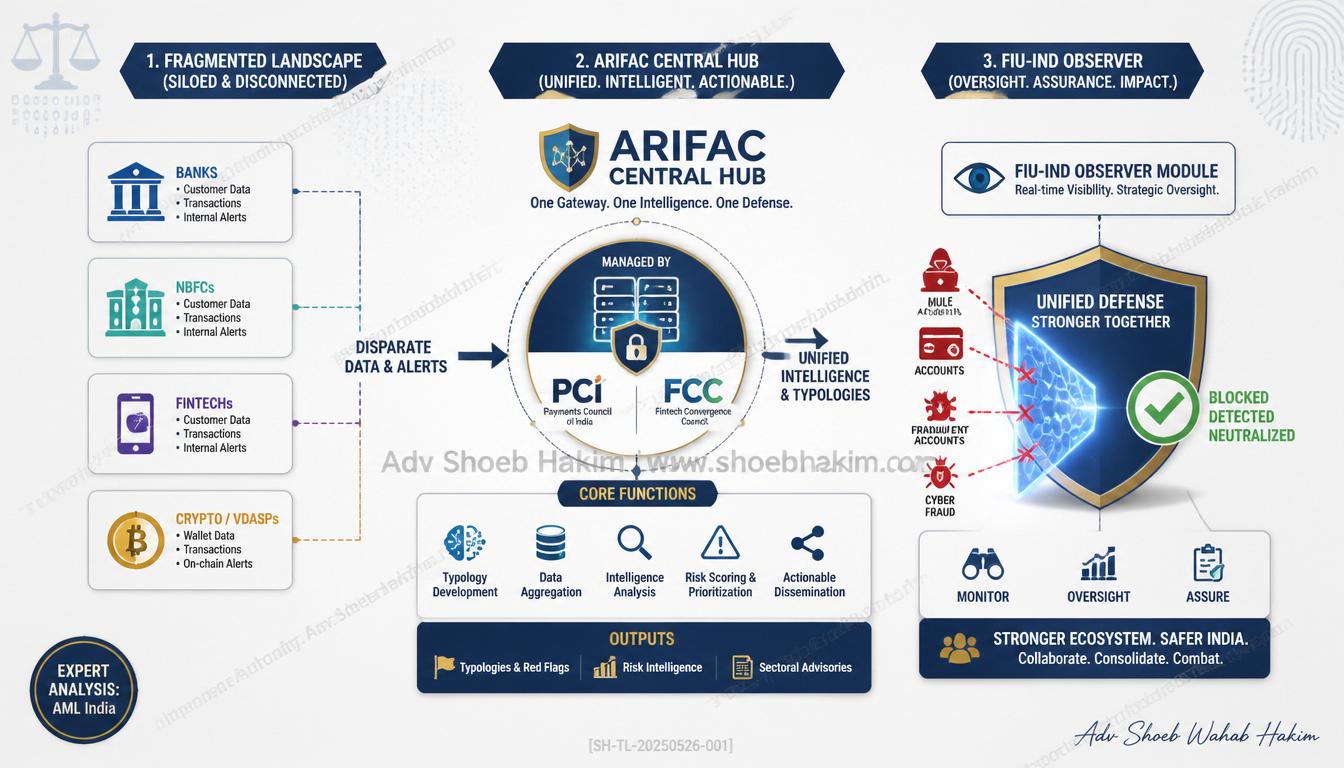
The Alliance of Reporting Entities in AML/CFT brings together banks, NBFCs, fintechs, payment firms, insurers, and virtual digital asset service providers to combat financial crime.
Introduction
India’s financial sector has just launched ARIFAC—an industry-led platform bringing together banks, NBFCs, payment firms, insurers, fintechs, and virtual digital asset service providers to strengthen the fight against money laundering and terrorist financing. FIU-IND is an observer. This is a significant step toward a more resilient AML/CFT ecosystem.
The Alliance of Reporting Entities in AML/CFT (ARIFAC) has been launched as a private-private partnership initiative to strengthen India’s AML and CFT framework. This article analyzes the structure, objectives, and implications of this important initiative.
What Is ARIFAC?
ARIFAC serves as a common industry platform bringing together Reporting Entities (REs) across sectors including banks, NBFCs, payment system operators, securities market intermediaries, insurance companies, virtual digital asset service providers (VDASPs), cooperative institutions, and other entities covered under the Prevention of Money Laundering Act (PMLA).
Why ARIFAC Was Launched
The challenge: Financial crime is becoming increasingly sophisticated. Institutions are facing growing challenges from:
- Cyber-enabled fraud
- Money laundering networks
- Terrorist financing
- Sanctions evasion
- Mule account activity
- Emerging digital asset risks
The response: The formation of ARIFAC comes at a time when financial institutions are facing these growing challenges, necessitating deeper collaboration between regulators, law enforcement agencies, and reporting entities.
The Five Core Pillars
Industry-Led Working Groups
The ARIFAC Working Groups will focus on priority areas including:
| Focus Area | Description |
|---|---|
| Enhanced Due Diligence | Developing guidance on EDD for higher-risk customers |
| Sanctions Screening | Best practices for sanctions compliance |
| Cross-Border Information Sharing | Facilitating international cooperation |
| Mule Accounts | Identifying and preventing mule account activity |
| Digital Banking Risks | Addressing emerging risks in digital banking |
| Virtual Digital Assets | Guidance for VDASP compliance |
These groups will develop practical guidance, typologies, recommendations, and best-practice frameworks for wider industry adoption.
The Role of FIU-IND
FIU-IND’s participation as an observer is significant. As India’s central national agency responsible for receiving, processing, analyzing, and disseminating information relating to suspect financial transactions, FIU-IND’s involvement ensures alignment with regulatory expectations.
FIU-IND’s recent actions: The FIU-IND has been taking enforcement actions against non-compliant entities, including issuing show cause notices to offshore VDASPs and imposing monetary penalties ranging from INR 34.5 lakh to INR 18.82 crore.
Coordination with other regulators: FIU-IND has formalized cooperation with other regulators through MoUs, including with the RBI, enabling data sharing and cooperation on supervision.
Why This Matters
The ARIFAC’s initiatives are expected to contribute significantly towards:
- Strengthening AML/CFT awareness
- Improving compliance maturity across sectors
- Enhancing collaboration among reporting entities
- Supporting India’s commitment to maintaining a robust and internationally aligned financial crime prevention framework
The Private-Private Partnership Model
ARIFAC is described as a private-private partnership, meaning it is an industry-led initiative rather than a government-mandated one. This model has several advantages:
- Industry ownership: Reporting entities are directly invested in the success of the initiative
- Practical guidance: Guidance is developed by practitioners for practitioners
- Flexibility: The platform can adapt quickly to emerging threats
- Innovation: Encourages innovative approaches to compliance
Conclusion
The Alliance of Reporting Entities in AML/CFT (ARIFAC) has been launched as a private-private partnership initiative to strengthen India’s AML and CFT ecosystem. The Financial Intelligence Unit – India (FIU-IND) is an observer of the group.
The secretariat of the ARIFAC is managed by the Payments Council of India (PCI) and the Fintech Convergence Council (FCC). Among the main areas of activities of the ARIFAC will be training and certification, conducting workshops, and facilitating continuous learning to build awareness on AML/CFT.
The ARIFAC serves as a common industry platform bringing together Reporting Entities (REs) across sectors including banks, NBFCs, payment system operators, securities market intermediaries, insurance companies, virtual digital asset service providers (VDASPs), cooperative institutions, and other entities covered under the Prevention of Money Laundering Act (PMLA). The platform aims to promote knowledge sharing, improve compliance standards, enhance institutional capabilities, and support India’s efforts to combat financial crime while strengthening the integrity of the financial system.
The increasing sophistication of financial crime, cyber-enabled fraud, money laundering, terrorist financing, sanctions evasion, mule account activity, and emerging digital asset risks necessitates deeper collaboration between regulators, law enforcement agencies, and reporting entities.
By bringing together industry stakeholders, regulators, compliance professionals, and subject matter experts, the ARIFAC seeks to create a stronger, more resilient, and future-ready AML/CFT ecosystem for India.
FREQUENTLY ASKED QUESTIONS (FAQ)
Q: If ARIFAC is an industry-led platform, are its guidelines legally binding like an RBI circular? Ans: While not technically a statutory law like a gazetted RBI circular, ARIFAC guidelines establish the de facto “Industry Standard of Care.” If a financial institution ignores these typologies and subsequently facilitates money laundering, regulators (like FIU-IND or the ED) will use the ARIFAC guidelines in a tribunal to prove that the institution’s compliance failures were negligent and below accepted industry standards.
Q: How does ARIFAC’s launch impact Virtual Digital Asset Service Providers (VDASPs) in India? Ans: It legitimizes and integrates them. Historically siloed, VDASPs are now officially seated alongside traditional banks and NBFCs as core Reporting Entities (REs). This collaboration allows for the joint tracing of complex fiat-to-crypto laundering typologies, providing VDASPs with critical banking intelligence while helping banks secure their crypto-interfacing gateways.
Q: Why is “Capacity Building” listed as one of the Five Core Pillars of ARIFAC? Ans: Financial crime typologies are evolving faster than traditional compliance training can adapt. ARIFAC aims to centralize training, certification, and workshops across AML, risk, and audit teams to ensure that the human capital defending India’s financial grid possesses the advanced techno-legal skills required to combat sophisticated cyber-fraud and sanctions evasion.
KNOWLEDGE CHECK QUIZ
Q: What is the primary operational model of the newly launched ARIFAC platform? Ans: ARIFAC operates as a “Private-Private Partnership,” an industry-led initiative bringing together Reporting Entities across various financial sectors to collaborate on AML/CFT compliance.
Q: Which two organizations act as the secretariat managing the ARIFAC platform? Ans: The Payments Council of India (PCI) and the Fintech Convergence Council (FCC).
Q: What specific legal role does FIU-IND play within the ARIFAC structure? Ans: The Financial Intelligence Unit – India (FIU-IND) participates exclusively as an “Observer,” allowing it to monitor industry trends and typologies without directly micro-managing the private partnership.
Q: Name three specific focus areas targeted by the ARIFAC Industry-Led Working Groups. Ans: The working groups focus on compiling actionable typologies for Enhanced Due Diligence (EDD), identifying Mule Accounts, and addressing risks associated with Virtual Digital Assets (VDASPs).
Adv. Shoeb Hakim
AML & Regulatory Compliance Advisor
📌 Follow me on LinkedIn for daily AML and regulatory compliance insights: https://www.linkedin.com/in/shoebhakim
📌 Visit my website for more articles: https://www.shoebhakim.com
📌 Visit my website for legal knowledge: https://www.vakilverse.com
📌 Visit my website for research fellowship: https://www.legalcomplaince.in
♻️ Share this article with your network.
Disclaimer: This article is for informational purposes only and does not constitute legal advice.
Hashtags: #AdvShoebHakim #ARIFAC #AML #CFT #FIUIND #India #FinancialCrime #MoneyLaundering #TerroristFinancing #Compliance #Fintech #Payments #VDASP #PMLA #Banking #NBFC #RegTech #RiskManagement #FinancialSecurity #IndiaFightsFinancialCrime #CapacityBuilding #CrossSectorCollaboration #RegulatoryEngagement #Typologies #GlobalRepresentation #EnhancedDueDiligence #SanctionsScreening #CrossBorderInfoSharing #MuleAccounts #DigitalBankingRisks #VirtualDigitalAssets #PaymentsCouncilOfIndia #FintechConvergenceCouncil #PrivatePrivatePartnership #IndustryLed #FinancialIntegrity #ComplianceMaturity #InstitutionalCapabilities #ReportingEntities #AntiMoneyLaundering #CounterTerroristFinancing
Leave a Reply