

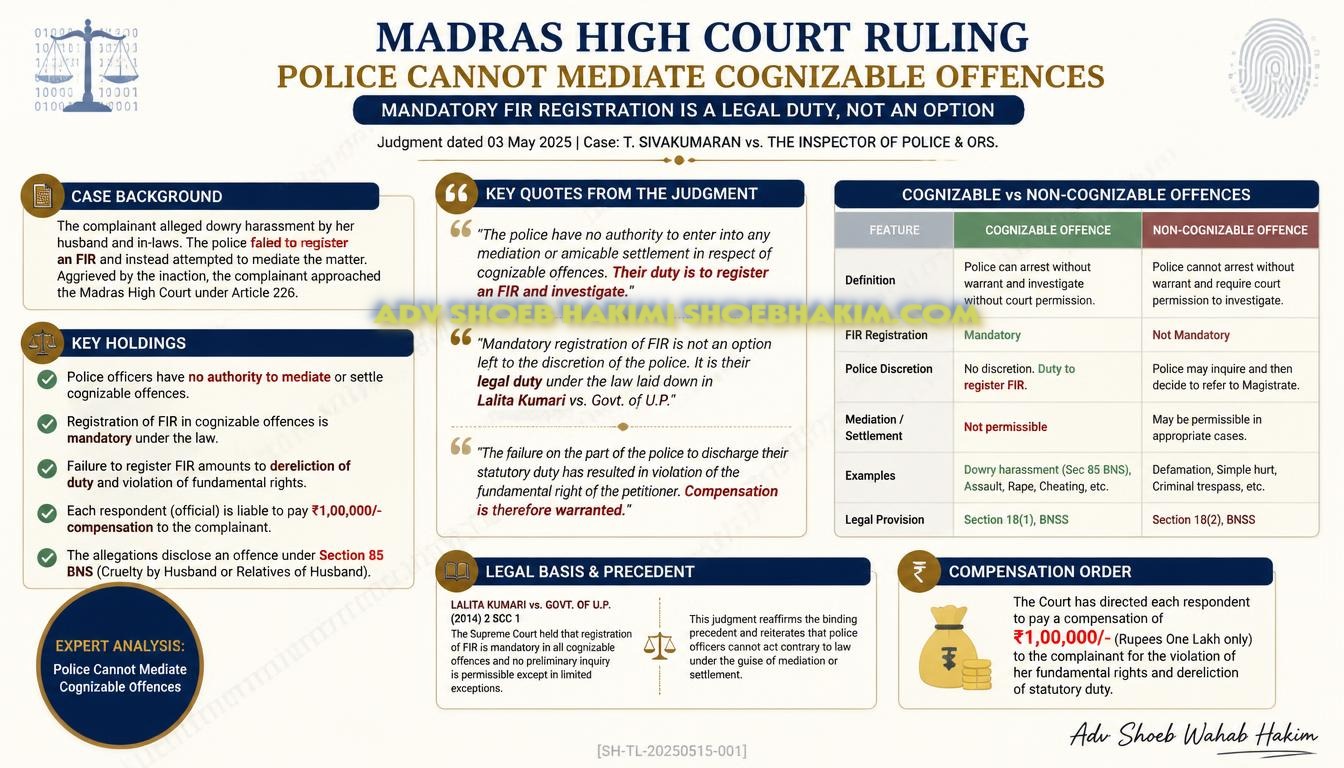
Key Facts
- Case Number: W.P.Crl.(MD)No.3809 of 2026
- Judgment Date: 16 July 2026 (written order uploaded 17 July 2026)
- Bench: Justice L. Victoria Gowri
- Ruling: Police officers cannot act as private mediators or arbitrators in cognizable offences
- Penalty: Two women police officers ordered to pay ₹1 lakh each in compensation to the complainant
- Payment Deadline: On or before 24 July 2026
- Offence: Dowry harassment — ₹10 lakh demand during engagement, leading to cancellation of wedding
- Police Action: Instead of registering FIR, officers brokered partial cash refund and closed the file
- Legal Violation: Failure to register mandatory FIR under Section 154 CrPC / Section 173 BNSS
- Key Precedent: Lalita Kumari v. Govt. of UP — mandatory FIR registration for cognizable offences
- Applicable Law: Section 85 BNS (replacing Section 498A IPC) — cruelty by husband or relatives, cognizable and non-bailable
- Disposition: Officers expressed remorse; upon payment of compensation, disciplinary matter “attains finality”; State at liberty to revoke suspension effective 20 July 2026
Direct Answer
The Madras High Court has ruled that police officers cannot act as private mediators or arbitrators in cognizable offences, ordering two women police officers to pay ₹1 lakh each in compensation to a complainant for settling a dowry harassment dispute informally instead of registering a mandatory First Information Report (FIR).
In W.P.Crl.(MD)No.3809 of 2026, decided on 16 July 2026, Justice L. Victoria Gowri held that police stations cannot function as “informal arbitration centers or civil settlement forums” for criminal acts, and that officers are legally bound to register an FIR immediately when a complaint discloses a cognizable offence.
The Court further held that subsequent corrective measures—such as later suspending the officers, registering an FIR, or referring the case to the Dowry Prohibition Officer—do not excuse the initial failure of statutory duty. The case involved a father who complained that ₹10 lakh was demanded as dowry during his daughter’s engagement, and further demands led to the cancellation of the wedding; instead of filing an FIR, the officers brokered a partial cash refund and closed the file.
The Court found that this caused “avoidable prejudice and hardship” to the complainant. The officers expressed remorse, and the Court ruled that upon payment of the compensation (due by 24 July 2026), the disciplinary matter would “attain finality” and the State could revoke their suspension effective 20 July 2026.
In this article:
- [The Case: Dowry Harassment Complaint and Police Inaction]
- [The Court’s Ruling: No Mediation in Cognizable Offences]
- [Case Details and Disposition]
- [Why Subsequent Corrective Measures Do Not Excuse the Breach]
- [The Legal Framework: Cognizable vs. Non-Cognizable Offences]
- [All Women Police Stations: Mandate and Limits]
- [Dowry Harassment Under the New Laws (BNS)]
- [Lalita Kumari and the Mandatory Duty to Register FIR]
- [Consequences of Refusal to Register FIR]
- [FAQ]
By Adv. Shoeb Hakim — Criminal defence, AML, digital forensics, and cybercrime specialist; former General Counsel, Credit Suisse; training police and judiciary since 1996.
The Case: Dowry Harassment Complaint and Police Inaction
A father approached the police station with a complaint: ₹10 lakh was demanded as dowry during his daughter’s engagement. When the demands continued, the wedding was called off. The family was left with financial loss, emotional distress, and a sense of injustice.
The law is clear. Dowry harassment is a cognizable offence under Section 85 of the Bharatiya Nyaya Sanhita (BNS) — which replaced Section 498A of the Indian Penal Code. This means police are duty-bound to register an FIR immediately upon receiving such a complaint.
But that’s not what happened.
Instead of filing an FIR, the two women police officers at the station brokered a partial cash refund — the groom’s family returned some of the money — and closed the file. They treated the police station as a mediation centre and themselves as arbitrators.
The father, aggrieved by this inaction, approached the Madras High Court.
The Court’s Ruling: No Mediation in Cognizable Offences
Justice L. Victoria Gowri delivered a sharp rebuke to the officers and a clear message to the police force.
Key holdings:
- Police stations cannot function as informal arbitration centers. The Court ruled that police officers cannot act as private mediators or arbitrators in cognizable offences. Their role is to enforce the law, not to settle civil disputes.
- Mandatory FIR duty is non-negotiable. When a complaint discloses a cognizable offence, registration of an FIR is not optional. It is a statutory obligation under Section 154 of the Criminal Procedure Code (CrPC) / Section 173 of the Bharatiya Nagarik Suraksha Sanhita (BNSS).
- No immunity from past lapses. The fact that the officers were later suspended, an FIR was eventually registered, or the case was referred to the Dowry Prohibition Officer does not excuse the initial failure. A belated corrective measure does not erase a statutory breach.
The penalty:
The Court ordered each officer to pay ₹1 lakh in compensation to the victim’s father for causing “avoidable prejudice and hardship.”
Case Details and Disposition
The judgment provides clarity on the timeline and resolution:
- Case Number: W.P.Crl.(MD)No.3809 of 2026
- Judgment Date: 16 July 2026
- Written Order Uploaded: 17 July 2026
- Payment Deadline: On or before 24 July 2026
Key observations:
The officers expressed remorse for their conduct. The Court noted this and ruled that upon payment of the compensation, the disciplinary matter would “attain finality.” The State was at liberty to revoke their suspension effective 20 July 2026.
This implies the officers accepted the order to close the departmental proceedings against them. While the exact transaction receipt is not public, the Court’s direction for the revocation of suspension was contingent on this payment and the closure of the case, strongly indicating compliance by the deadline.
Why Subsequent Corrective Measures Do Not Excuse the Breach
One of the most significant aspects of the judgment is the Court’s rejection of the argument that subsequent corrective actions cure the initial failure.
The officers were eventually suspended. An FIR was registered. The case was referred to the Dowry Prohibition Officer. But the Court held that these actions — taken after the fact — do not undo the harm caused by the initial refusal to register the FIR.
The duty to register an FIR is immediate. A delay in registration is itself a violation of the law, and it can prejudice the victim’s right to a prompt investigation and access to justice.
The Legal Framework: Cognizable vs. Non-Cognizable Offences
The distinction between cognizable and non-cognizable offences is fundamental to criminal procedure.
Cognizable Offence:
- Police can arrest without a warrant and start an investigation immediately
- Typically serious crimes (e.g., Dowry Harassment, Rape, Murder)
- Police must register an FIR immediately
Non-Cognizable Offence:
- Police cannot arrest without a warrant and need a Magistrate’s permission to investigate
- Less serious offences (e.g., Simple Hurt, Defamation, Public Nuisance)
- Police record it in the NCR (Non-Cognizable Report) diary and refer the complainant to court
Dowry harassment under Section 85 BNS is a cognizable offence. This means police have no discretion — they must register an FIR and commence investigation.
All Women Police Stations: Mandate and Limits
All Women Police Stations (AWPS) were established to create a safe, supportive space for women and children to report crimes. However, their legal jurisdiction remains strictly bound by criminal procedure.
Primary Mandate: To register, investigate, and prosecute crimes specifically affecting women, such as dowry harassment, domestic violence, and sexual offenses.
Limits on Counseling: While AWPS units often run counseling cells to help resolve family disputes, this counseling is legally restricted to non-cognizable matrimonial discords.
Zero Discretion in Crime: The moment a woman’s complaint reveals clear criminal actions, such as a demand for dowry or physical abuse, the AWPS must immediately halt informal talks and file a criminal case.
The Madras High Court’s judgment reinforces this principle: even All Women Police Stations cannot mediate their way out of a cognizable offence.
Dowry Harassment Under the New Laws (BNS)
Under the Bharatiya Nyaya Sanhita (BNS), which replaced the Indian Penal Code (IPC), the offence of cruelty by a husband or his relatives has been restructured.
1. New Legal Section: Section 85 BNS
- Section 498A IPC has been replaced by Section 85 BNS.
- The definition of “cruelty” remains largely the same and is detailed in Section 86 BNS.
- It includes willful conduct likely to drive a woman to suicide, cause grave injury (mental or physical), or harassment related to unlawful demands (dowry).
2. Nature of the Offence
- Status: Remains cognizable and non-bailable.
- Punishment: Imprisonment up to three years and a fine.
3. Procedural Safeguards & “Cooling-Off” Period
- While the statute is strict, courts are increasingly mandating safeguards to prevent misuse.
- Recent High Court directives have suggested a “cooling-off period” (e.g., 2 months) before arrest, referring the matter to Family Welfare Committees to check the genuineness of the complaint.
- Under the new procedural code (BNSS), for offences punishable by less than 3 years, police have more discretion and are often required to issue a “Notice of Appearance” rather than making an automatic arrest, provided the accused cooperates.
Lalita Kumari and the Mandatory Duty to Register FIR
The Supreme Court’s landmark judgment in Lalita Kumari v. Govt. of UP (2014) established the mandatory nature of FIR registration for cognizable offences.
Key principles from Lalita Kumari:
- Registration of FIR is mandatory if a complaint discloses a cognizable offence.
- Police cannot conduct a preliminary inquiry to verify the truth of a claim before registering an FIR if a cognizable offence is clearly disclosed.
- Preliminary inquiry is only permissible in certain categories of cases (e.g., matrimonial disputes, medical negligence, corruption) — but even then, it is limited to determining whether a cognizable offence is made out, not to assess the truth of the allegation.
- The duty to register an FIR is immediate. Delay is itself a violation.
The Madras High Court’s judgment is a direct application of the Lalita Kumari principle: the officers had no authority to conduct an informal mediation or to decline registration of the FIR.
Consequences of Refusal to Register FIR
Officers who intentionally refuse to register an FIR for specified offences, including crimes against women, can face criminal prosecution.
Section 199 BNS (formerly Section 166A IPC) provides that a public servant who knowingly disobeys any direction of the law relating to the registration of an FIR for specified offences, including offences against women and children, shall be punishable with imprisonment up to two years and fine.
In addition to criminal prosecution, the Madras High Court has now established that officers can be held personally liable for compensation to the victim for the harm caused by their failure to act.
FREQUENTLY ASKED QUESTIONS (FAQ)
Q: Are All Women Police Stations allowed to mediate family disputes?
Ans: They may conduct counselling only for non-cognizable matrimonial discords. The moment a complaint reveals a cognizable offence like dowry harassment (Section 85 BNS), mediation must stop and an FIR must be registered.
Q: What is the nature of dowry harassment under the new criminal laws?
Ans: Dowry harassment is covered under Section 85 BNS (replacing Section 498A IPC), which classifies the offence as cognizable and non-bailable.
Q: What happens if police intentionally refuse to register an FIR?
Ans: Under Section 199 BNS (formerly Section 166A IPC), public servants who knowingly disobey directions regarding FIR registration for crimes against women face imprisonment up to two years and a fine, alongside potential personal liability for compensation.
Q: Did the officers comply with the Court’s compensation order?
Ans: The Court noted the officers expressed remorse and ruled that upon payment of the compensation by 24 July 2026, the disciplinary matter would attain finality and the State could revoke their suspension.
What did the Madras High Court rule in this case?
In W.P.Crl.(MD)No.3809 of 2026 (decided 16 July 2026), the Court ruled that police officers cannot act as private mediators or arbitrators in cognizable offences and ordered two women police officers to pay ₹1 lakh each in compensation to a complainant for settling a dowry harassment dispute informally instead of registering a mandatory FIR.
What was the offence in this case?
A father complained that ₹10 lakh was demanded as dowry during his daughter’s engagement, and further demands led to the cancellation of the wedding. This constitutes cruelty and dowry harassment under Section 85 BNS.
What did the police officers do instead of filing an FIR?
Instead of filing an FIR, the officers brokered a partial cash refund and closed the file, treating the police station as a mediation centre.
What is the payment deadline?
The Court directed the officers to pay the compensation on or before 24 July 2026.
Did the officers comply?
The Court’s direction for revocation of suspension was contingent on payment and closure of the case. The officers expressed remorse and the disciplinary matter was to “attain finality” upon payment. This strongly indicates compliance by the deadline.
What is a cognizable offence?
A cognizable offence is a category of crime where police officers have the authority to arrest an offender without a warrant and start an investigation without a magistrate’s permission. Dowry harassment under Section 85 BNS is a cognizable offence.
What is the mandatory duty to register an FIR?
Under Section 154 CrPC / Section 173 BNSS, if a complaint discloses a cognizable offence, registration of an FIR is mandatory. This was affirmed by the Supreme Court in Lalita Kumari v. Govt. of UP.
Can subsequent corrective measures excuse the initial failure?
No. The Madras High Court held that subsequent actions—such as suspending the officers, registering an FIR later, or referring the case to the Dowry Prohibition Officer—do not excuse the initial failure of statutory duty.
What is the penalty for refusing to register an FIR?
Under Section 199 BNS (formerly Section 166A IPC), intentional refusal to register an FIR for specified offences, including crimes against women, is punishable with imprisonment up to two years and fine. Additionally, officers may be held personally liable for compensation, as in this case.
What is Section 85 BNS?
Section 85 BNS replaced Section 498A IPC and deals with cruelty by a husband or his relatives. It remains a cognizable and non-bailable offence, with punishment up to three years and fine.
KNOWLEDGE CHECK QUIZ
Q: What was the primary ruling of the Madras High Court in W.P.Crl.(MD)No.3809 of 2026?
Ans: The Court ruled that police officers cannot act as private mediators or arbitrators in cognizable offences and penalized two officers for failing to register an FIR.
Q: What penalty was imposed on the two women police officers?
Ans: They were ordered to pay ₹1 lakh each in compensation to the complainant for causing avoidable prejudice and hardship.
Q: Can subsequent corrective actions (like late suspension or late FIR registration) excuse initial police inaction?
Ans: No. The Court held that belated corrective measures do not erase the statutory breach and the harm caused by initial refusal.
Q: What legal provision governs mandatory FIR registration for cognizable offences?
Ans: Section 154 of the CrPC / Section 173 of the Bharatiya Nagarik Suraksha Sanhita (BNSS), read alongside the Supreme Court’s Lalita Kumari judgment.
By Adv. Shoeb Hakim
Criminal defence, AML, digital forensics, and cybercrime specialist; former General Counsel, Credit Suisse; training police and judiciary since 1996.
📌 Connect: https://www.linkedin.com/in/shoebhakim | https://shoebhakim.com/shoeb-hakim-blog/
📌 Visit my website for more articles: https://www.shoebhakim.com
📌 Visit my website for legal knowledge: https://www.vakilverse.com
📌 Visit my website for research fellowship: https://www.legalcomplaince.in
Author:
Adv. Shoeb Hakim
Author Bio (for schema markup):
Adv. Shoeb Hakim is a Mumbai-based criminal defence, AML, digital forensics and cybercrime specialist. Former General Counsel at Credit Suisse. Has been training police and judiciary since 1996. Provides expert commentary on criminal law, criminal procedure, police accountability, and women’s rights.
Article Publisher:
Adv. Shoeb Hakim
Article Section:
Criminal Law | Criminal Procedure | Police Accountability | Women’s Rights
Article Tags:
Madras High Court, police mediator, cognizable offence, FIR registration, dowry harassment, Section 85 BNS, Lalita Kumari, All Women Police Station, compensation, police accountability, Adv Shoeb Hakim
Disclaimer: This content is for informational purposes only and does not constitute legal advice. Readers should consult qualified legal counsel for advice on their specific circumstances.
#AdvShoebHakim #MadrasHighCourt #PoliceMediation #CognizableOffence #DowryHarassment #Section85BNS #FIRRegistration #LalitaKumari #CriminalProcedure #LegalComplianceIN #Vakilverse
Leave a Reply