

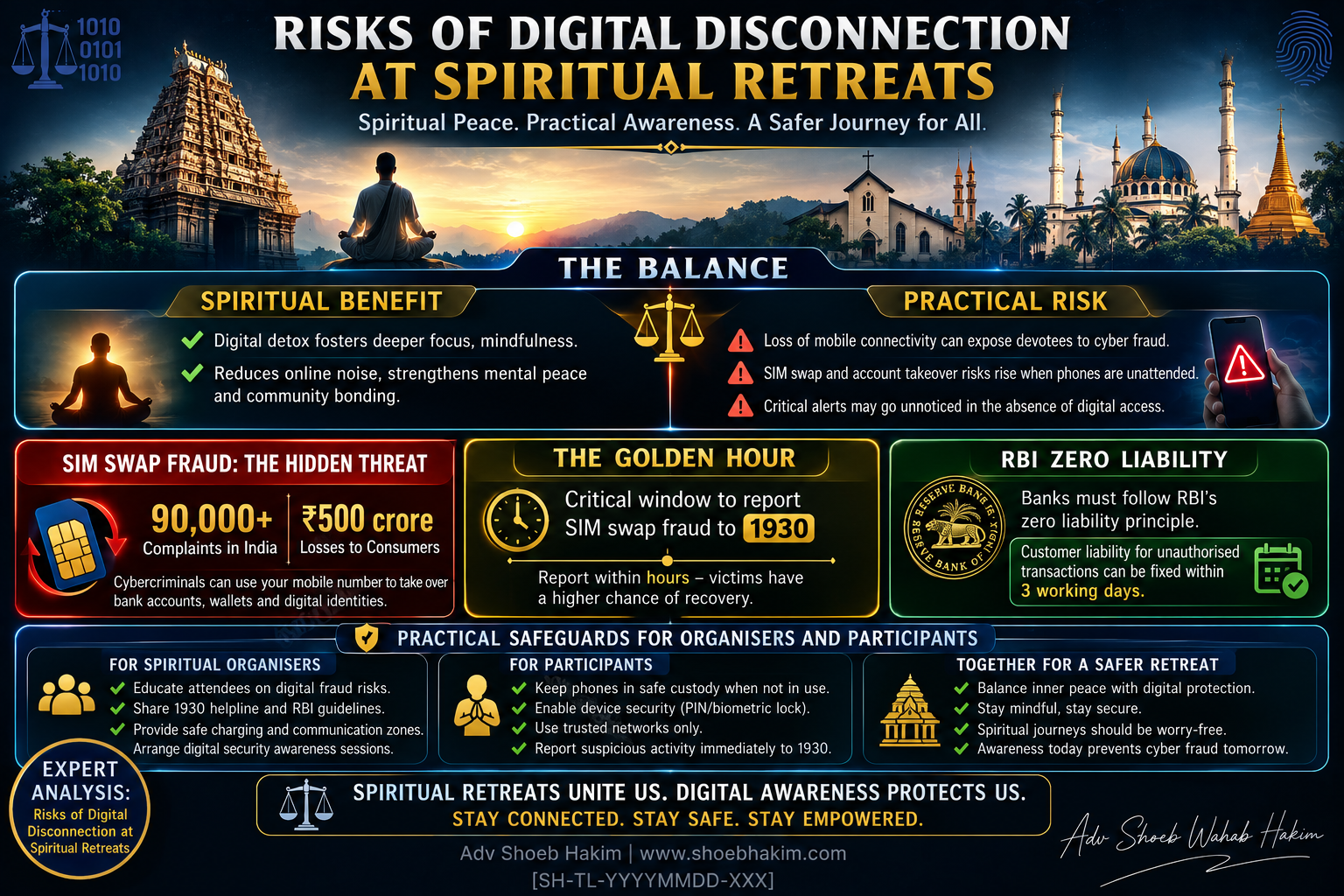
Key Facts
- The Practice: Many spiritual retreats — including Vipassana, Catholic retreats, and meditation centres — request participants to surrender mobile phones for the duration of the retreat, often 3-10 days without access
- The Purpose: Digital disconnection is intended to create space for deeper spiritual reflection, silence, and presence
- The Risk: Mobile numbers are now the “master key” to bank accounts, identity, and financial life
- SIM Swap Fraud: Over 90,000 complaints in 2024, losses exceeding ₹500 crore
- The Golden Hour: Critical window to report cyber fraud to 1930 for account freeze
- RBI Zero Liability: Must report within 3 working days of becoming aware of fraud
- The Solution: Retreat organisers and participants can take simple steps to protect against risk without compromising spiritual experience
Direct Answer
Spiritual retreats that encourage digital disconnection offer profound benefits — silence, presence, and deep reflection. But when participants surrender their phones for multiple days without informed consent or emergency access, they may be exposed to significant financial risks.
Your mobile number is now the authentication key to your financial life. Over 90,000 SIM-related fraud complaints were filed in India in 2024, with losses exceeding ₹500 crore. If a fraudster initiates a SIM swap while your phone is offline — and you discover it only after the retreat — you may have lost the critical window to report to 1930 and freeze the fraudster’s account.
This is not an argument against retreats. This is an argument for awareness, informed consent, and practical safeguards that allow spiritual depth and financial security to coexist.
In this article:
- The Retreat Experience: Why We Disconnect
- The Reality: Your Phone Is No Longer Just a Phone
- SIM Swap Fraud: What Happens When Your Phone Goes Silent
- The Golden Hour: Why Speed Matters in Cyber Fraud
- RBI’s Zero Liability Framework: The 3-Day Window
- A Balanced Approach: What Organisers Can Do
- Protecting Yourself: What Participants Can Do
- FAQ
By Adv. Shoeb Hakim — Criminal defence, AML, digital forensics, and cybercrime specialist; former General Counsel, Credit Suisse; training police and judiciary since 1996.
The Retreat Experience: Why We Disconnect
There is a reason why spiritual traditions around the world encourage silence and disconnection.
Vipassana retreats require complete silence and surrender of all devices for ten days. Catholic retreats often request phones to be set aside for a weekend or longer. Meditation centres in every tradition ask participants to unplug. The wisdom behind this is undeniable: constant connectivity fragments our attention. The retreat experience is richer when we are fully present to the silence, the teachings, the community, and ourselves.
I experienced this firsthand. Four days of silence, prayer, and reflection. The teachings were profound. The community was warm. The experience was genuinely transformative.
But I also noticed something else.
On the first day, nearly 98% of participants surrendered their phones willingly — out of reverence, obedience, or simply a desire to fully participate. A few, including me, chose to keep phones in their cars. Others hid them and used them privately.
The request was not a demand. It was presented as an invitation — framed within the spiritual context of the retreat. The priest spoke about the negative uses of phones: distraction, pornography, the pull of the world. Surrendering the phone became an act of devotion.
And I understood that. I respected that.
But I also knew something many participants did not.
Your phone is not just a phone anymore.
The Reality: Your Phone Is No Longer Just a Phone
In 2026, a mobile phone is not a luxury. It is not merely a communication device. It is, as cybersecurity experts put it, “the master key to your bank accounts, your identity, and your financial future.”
Every banking app, every UPI transaction, every OTP (One-Time Password), every authentication message — all routed through that one device. The phone is also the primary channel through which you receive:
- Transaction alerts from your bank
- Critical communications from family and employers
- Emergency notifications
- Authentication requests for financial and government services
When that device is taken away for multiple days, you are not just disconnected from social media. You are disconnected from the systems that protect your financial life.
The Risk Is Not Hypothetical
SIM swap fraud is one of India’s fastest-growing financial crimes. In 2024 alone, over 90,000 complaints were filed, with estimated losses exceeding ₹500 crore. Globally, SMS-related fraud losses are projected to reach $71 billion by 2026.
The vulnerability lies in India’s continued dependence on SMS-based authentication. Once a fraudster hijacks your mobile number, traditional two-factor authentication works in their favour — not yours.
And when your phone is offline for days, you cannot detect that hijacking.
SIM Swap Fraud: What Happens When Your Phone Goes Silent
How the Scam Works
Unlike phishing scams that require you to click a link or share an OTP, SIM swap fraud often requires nothing from you at all.
- Fraudsters collect your personal information — from leaked databases, phishing messages, fake KYC calls, or social media
- Armed with these details, they convince your telecom operator to issue a duplicate SIM card in your name
- The moment the duplicate SIM is activated, your original SIM stops working
- Your phone suddenly loses network connectivity
- Every OTP, banking alert, and authentication message now reaches the criminal’s phone
- Fraudsters reset passwords, access banking apps, approve transactions, and transfer money
The Silence Problem
When your phone is locked away for four days, you cannot detect a SIM swap. You will not see the “No Service” notification. You will not receive transaction alerts. You will not receive OTPs.
The fraudster has days — not hours — to empty your accounts.
Many victims realise they’ve been attacked only after they return to find emails about successful fund transfers or discover their accounts have already been emptied. If you are offline for days, that discovery is delayed — and with it, any chance of recovery.
The Golden Hour: Why Speed Matters in Cyber Fraud
What Is the Golden Hour?
The “golden hour” in cyber-fraud refers to the critical window after a fraud occurs — generally within 4 hours — in which the 1930 helpline can ask the beneficiary bank to place a lien on the fraudster’s account before the money is withdrawn.
The 1930 Helpline
- 1930 is the National Cyber Crime Helpline, available 24×7
- It triggers the RBI bank-account freeze mechanism
- The system propagates freeze instructions to approximately 250+ banks and payment-service providers in near-real-time
The Difference Speed Makes
Consider two victims of the same scam. One calls 1930 within minutes — the fraudster’s account is frozen, and money is recovered. The other discovers the fraud days later — the money is gone, and so is any trace of the fraudster.
The difference is not knowledge or vigilance. The difference is time.
What This Means for Retreat Participants
If you are offline for four days:
- You cannot discover the fraud in real-time
- You cannot dial 1930 within the golden hour
- You cannot freeze the fraudster’s account
- The money is gone before you even know it’s missing
RBI’s Zero Liability Framework: The 3-Day Window
The Rule
Under RBI circular DBR.No.Leg.BC.78/09.07.005/2017-18 dated 6 July 2017, if you report an unauthorised electronic banking transaction to your bank within 3 working days of receiving the bank’s communication, your liability is zero rupees.
The Liability Framework:
- Within 3 working days of becoming aware: Zero liability
- Day 4 to Day 7: Liability jumps to ₹5,000 to ₹25,000 (depending on account type)
- After Day 7: Liability is at the bank board’s discretion
What This Means for Retreat Participants
If you discover a fraud only after returning from a retreat — say, on day 4 or day 5 — you may already be outside the zero-liability window. Your liability jumps from zero to thousands of rupees.
The retreat was beautiful. The silence was restorative. But discovering that your savings are gone — and that you cannot recover them because you missed the reporting window — would undermine everything the retreat gave you.
A Balanced Approach: What Organisers Can Do
Spiritual retreats offer profound benefits. The request to disconnect is valid and valuable. But organisers can take simple steps to protect participants without compromising the spiritual experience:
1. Clear Advance Notice
Inform participants about the phone policy before they arrive — not upon arrival. This allows people to make informed decisions, inform their families, and take necessary precautions.
2. Emergency Access
Even in silence, there must be a way for participants to access their phones in genuine emergencies:
- Family emergencies (illness, accident, death)
- Medical urgencies (personal health issues)
- Financial emergencies (fraud alerts, bank notifications)
- Work emergencies
A simple system — a designated person with access to the stored phones, available 24×7 — would suffice.
3. Staggered Return
Instead of locking phones away for four days and returning them only at departure, consider brief supervised access at designated times — 15 minutes each evening to check critical notifications.
4. Acknowledge Risks
Retreat organisers can inform participants of the financial risks of disconnection and provide guidance on what to do if they discover fraud after the retreat.
5. Respect Choice
Not everyone who attends a retreat shares the same relationship with technology. Some may have elderly parents at home. Some may be awaiting critical medical results. Some may have financial obligations that require monitoring.
A truly spiritual environment respects the individual’s circumstances — it does not impose a one-size-fits-all rule.
Protecting Yourself: What Participants Can Do
If you are attending a retreat with a phone collection policy:
Before the Retreat:
- Ask about the phone policy in advance
- Understand the duration and process
- Inquire about emergency access
- Consider whether you are comfortable with the policy
- Inform family and employers of your unavailability
- Monitor your bank accounts before and after
If You Discover Fraud After the Retreat:
- Dial 1930 immediately — this triggers the golden-hour account freeze
- File a complaint at cybercrime.gov.in — the National Cyber Crime Reporting Portal
- Notify your bank immediately — use email plus phone call, capture both timestamps
- Quote the RBI circular — DBR.No.Leg.BC.78/09.07.005/2017-18
- Document everything — timestamps, communication logs, complaint numbers
Remember:
- The golden hour is critical — act fast
- The zero-liability window is 3 working days — don’t delay
- The report must be to both the bank AND the cyber portal
FAQ
Is it legal for a retreat centre to request my phone?
Yes, if consent is genuinely voluntary. However, if consent is obtained through coercion or undue influence, its legal validity may be questioned.
What is SIM swap fraud?
SIM swap fraud is when fraudsters convince a telecom operator to issue a duplicate SIM card in your name. Your original SIM stops working, and every OTP, banking alert, and authentication message goes to the criminal’s phone instead.
How common is SIM swap fraud in India?
Over 90,000 complaints linked to SIM-related frauds were reported in 2024, with estimated losses exceeding ₹500 crore.
What is the “golden hour” in cyber fraud?
The golden hour is the critical window — generally within 4 hours — in which the 1930 helpline can place a lien on the fraudster’s account before the money is withdrawn.
What should I do if I discover fraud after a retreat?
Dial 1930 immediately, file a complaint at cybercrime.gov.in, notify your bank, quote the RBI circular, and file a paper FIR at the local cyber-crime police station.
What is the RBI’s zero liability rule?
If you report an unauthorised electronic banking transaction to your bank within 3 working days of becoming aware of it, your liability is zero rupees. After day 3, your liability increases significantly.
What should retreat organisers do to protect participants?
Provide clear advance notice, emergency access, staggered return of phones, acknowledgment of risks, and respect for individual choice.
Does this apply to all retreats?
Yes — Vipassana, Catholic, meditation centres, and any other retreat that encourages digital disconnection should consider these safeguards.
Can spiritual depth and financial security coexist?
Absolutely. Informed consent, emergency access, and practical safeguards do not diminish the spiritual experience — they protect participants so they can engage fully without hidden risk.
What if the retreat is a “no questions asked” surrender policy?
You are still free to decline — though you may need to consider whether the retreat is right for you. If you choose to participate, take steps to protect yourself, including informing your bank and family before you leave.
Q: Is it legal for a retreat to force me to surrender my phone?
Ans: Legally, consent must be informed. If you were not aware of the risks and the policy was presented as a mandatory requirement, the centre’s liability may increase if something goes wrong.
Q: What is the most effective way to prevent SIM swap fraud?
Ans: Keep your phone with you or secure it in a way that you can check it periodically. Enable two-factor authentication that does not rely solely on SMS.
Q: What should I do immediately after discovering fraud after a retreat?
Ans: Dial 1930, file at cybercrime.gov.in, notify your bank via email (to establish the timestamp), and prepare your documentation for the Ombudsman.
KNOWLEDGE CHECK QUIZ
Q: Why is “No Service” on your phone a massive red flag?
Ans: It is often the first sign of a SIM swap fraud, where the criminal has activated your number on their own device.
Q: What is the “Golden Hour” for reporting cyber fraud?
Ans: The critical 4-hour window where the 1930 helpline can initiate a freeze on the fraudster’s account across 250+ banks.
Q: What does the RBI Zero Liability Circular (2017) mandate?
Ans: It mandates that if you report an unauthorized transaction within 3 working days of becoming aware, your liability is zero.
Q: How can retreat organizers mitigate these risks?
Ans: By providing clear advance notice, emergency-only communication channels, and getting informed consent from participants.
By Adv. Shoeb Hakim
Criminal defence, AML, digital forensics, and cybercrime specialist; former General Counsel, Credit Suisse; training police and judiciary since 1996.
📌 Connect: https://www.linkedin.com/in/shoebhakim | https://shoebhakim.com/shoeb-hakim-blog/
📌 Visit my website for more articles: https://www.shoebhakim.com
📌 Visit my website for legal knowledge: https://www.vakilverse.com
📌 Visit my website for research fellowship: https://www.legalcomplaince.in
#AdvShoebHakim #SpiritualRetreat #DigitalDetox #SIMSwapFraud #CyberSecurity #RBI #ZeroLiability #FinancialFraud #OnlineSafety #CyberLaw #FinCrime #RiskManagement #DigitalIndia #1930 #Vakilverse #LegalComplianceIN
Disclaimer: This content is for informational purposes only and does not constitute legal advice. Readers should consult qualified legal counsel for advice on their specific circumstances.
Leave a Reply