Key Facts
- Case Name: In Re: Right to Privacy of Adolescents (Suo Motu Writ Petition (C) No. 3 of 2023)
- Origin: Supreme Court took suo motu cognisance of Calcutta High Court judgment acquitting a 25-year-old man who eloped with a 14-year-old girl
- Original Judgment: 2024 INSC 614 (20 August 2024) — Bench of Justices Abhay S. Oka and Ujjal Bhuyan set aside the High Court’s objectionable remarks
- Current Status: Ongoing proceedings before Bench of Justices B.V. Nagarathna and R. Mahadevan
- Key Observation: “15–18 is a vulnerable age. It is an age of experimentation. The question is, does every such case really become a POCSO case?”
- Law Commission Report: 283rd Report submitted 27 September 2023 — not yet tabled in Parliament
- Sex Education: 26-member expert committee blueprint accepted by Government, awaiting Supreme Court approval
- Next Hearing: 17 July 2026
Direct Answer
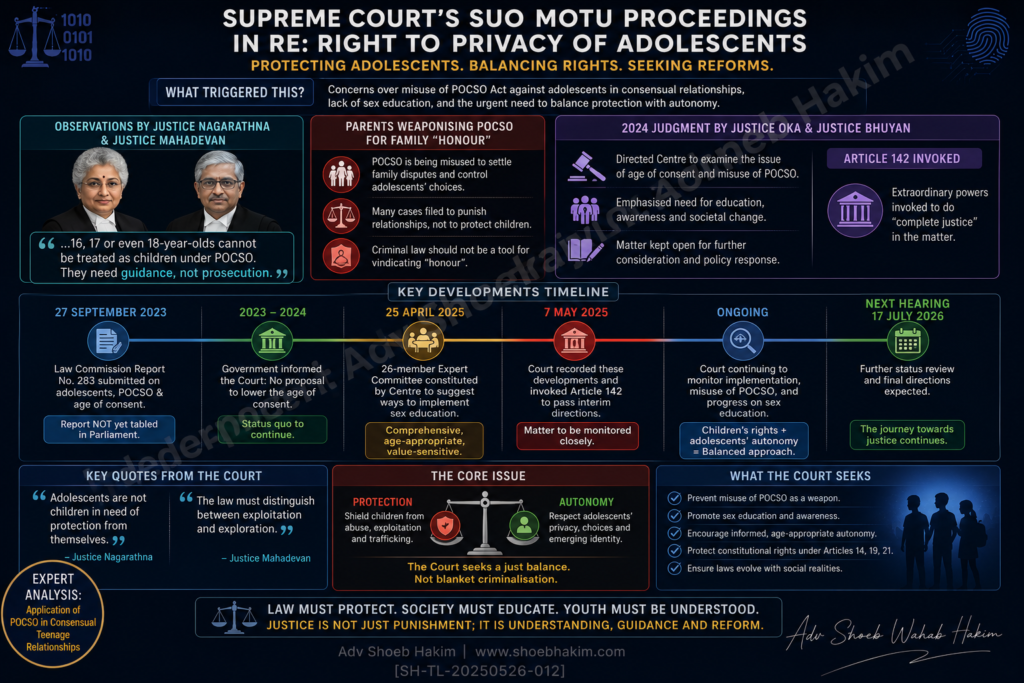
The Supreme Court has questioned whether every consensual relationship involving adolescents aged 16–18 should automatically be treated as a POCSO offence, observing that many teenagers develop emotional relationships and sometimes elope together, and in several cases parents initiate criminal proceedings under the POCSO Act to protect family “honour” — resulting in young individuals facing serious criminal charges despite the relationship being consensual .
The observations were made during a suo motu hearing in In Re: Right to Privacy of Adolescents, a case that originated from a Calcutta High Court judgment advising adolescent girls to “control their sexual urges,” which the Supreme Court described as “objectionable” .
The Union Government has formally rejected lowering the age of consent from 18 to 16, aligning with the 22nd Law Commission’s Report No. 283 (submitted 27 September 2023, not yet tabled in Parliament) which concluded that lowering the age would “render the POCSO Act a paper law” and legitimize child marriages . Instead, the Centre has proposed guided judicial discretion in sentencing and mandatory comprehensive sex education — a 26-member expert committee has submitted a blueprint, accepted by the Government and awaiting Supreme Court approval .
In this article:
- Origins of the Suo Motu Case
- The Supreme Court’s 2024 Judgment
- The Current Proceedings (July 2026)
- The Law Commission’s 283rd Report
- The Government’s Formal Position
- The Sex Education Blueprint
- Proposed Reform: Guided Judicial Discretion
- Current Status and Next Steps
- FAQ
By Adv. Shoeb Hakim — Criminal defence, AML, digital forensics, and cybercrime specialist; former Head of AML & Client ID (AVP), Credit Suisse; training police and judiciary since 1996.
Origins of the Suo Motu Case
The suo motu proceedings in In Re: Right to Privacy of Adolescents originated from a Calcutta High Court judgment delivered in October 2023. The High Court acquitted a 25-year-old man who had eloped with a 14-year-old girl — but in doing so, included moral commentary advising adolescent girls to “control their sexual urges” rather than getting entangled in relationships .
The Supreme Court took strong exception to these remarks, describing them as “objectionable,” and registered a suo motu case to address the broader structural issues .
The factual background
The case involved a 14-year-old victim who left her home on 20 May 2018 with the accused, a man approximately 25 years old. The victim’s mother lodged an FIR on 29 May 2018 .
The trial court convicted the accused under Section 6 of the POCSO Act (aggravated penetrative sexual assault) and Sections 363 and 366 of the Indian Penal Code, 1860. He was sentenced to 20 years rigorous imprisonment .
The Calcutta High Court set aside the conviction and acquitted the accused, noting that the victim had stated she left of her own will, had married the accused, and was residing with him with their child. The High Court also made the objectionable remarks about adolescent sexuality .
The Supreme Court’s 2024 Judgment
On 20 August 2024, a Bench of Justices Abhay S. Oka and Ujjal Bhuyan delivered the primary judgment in 2024 INSC 614 .
Key holdings:
- Consent is not an exception: The Court restored the conviction for offences under Section 6 of the POCSO Act. It clarified that consent is not an exception to rape under the POCSO Act .
- Acquittal for kidnapping upheld: The Court upheld the acquittal for kidnapping (Section 363) and kidnapping with intent to compel marriage (Section 366) .
- Objectionable remarks set aside: The Calcutta High Court’s moral commentary on adolescent sexuality was strongly condemned .
- Committee appointed: The Court appointed a committee of three experts, including a clinical psychologist and a social scientist, to assess the state of the victim and her life .
- Sentencing deferred: The sentencing of the convict was postponed pending the Committee’s report .
The Committee’s findings
The Committee’s report documented systemic failures: the victim was not presented before a Child Welfare Committee, nor given shelter, education, or support as required under POCSO and the Juvenile Justice Act . The legal proceedings caused emotional and financial hardship for the family, and the victim’s family abandoned her .
The Court’s final order (23 May 2025)
Exercising its power under Article 142 of the Constitution to do “complete justice,” the Court decided not to award a prison sentence despite the mandatory minimum 20 years prescribed by law .
Justice Oka observed:
“Though the victim did not treat the incident as a heinous crime, she suffered because of it. This was because at an earlier stage, the victim could not make an informed choice due to the shortcomings of our society, our legal system and her family. In fact, she did not get any opportunity to make an informed choice. The society judged her, the legal system failed her, and her own family abandoned her. Now, she is at a stage where she is desperate to save her husband.”
Directions issued to the State of West Bengal:
- Act as a true guardian of the victim and her child
- Provide better shelter to the victim and her family
- Bear the entire expenditure of the victim’s education
- Bear the entire expenditure of the child’s education
- File compliance reports every six months
The Court explicitly stated that the decision should not be considered as a precedent .
The Current Proceedings (July 2026)
While the original offensive judgment was thrown out, the Supreme Court kept the suo motu matter open to monitor adolescent welfare, systemic gaps, and public awareness .
During a follow-up hearing, a new Bench of Justices B.V. Nagarathna and R. Mahadevan made significant observations regarding the application of POCSO in consensual teenage relationships .
The Court noted:
- Many teenagers in the 16–18 age group develop emotional relationships and sometimes elope together
- In several cases, parents initiate criminal proceedings under the POCSO Act to protect their family’s “honour”
- This often results in young individuals facing serious criminal charges despite the relationship being consensual
- 15–18 is a vulnerable age — an age of experimentation
- After the age of consent was raised from 16 to 18 in 2012, many consensual adolescent relationships began falling within POCSO’s ambit
The Bench is addressing the widespread problem of parents weaponising the strict provisions of the POCSO Act against teenage boys to protect perceived “family honour” when a young couple elopes .
Amicus Curiae Submission
Senior Advocate Madhavi Divan, appointed as amicus curiae, submitted to the Court that there should be a dashboard for monitoring cases registered under POCSO. The Court noted that High Courts already have committees for child rights and that monitoring should remain with state governments .
The matter has been posted for further hearing on 17 July 2026 .
The Law Commission’s 283rd Report
On 27 September 2023, the 22nd Law Commission of India, chaired by former Karnataka High Court Chief Justice Ritu Raj Awasthi, submitted Report No. 283 on “Age of Consent under the Protection of Children from Sexual Offences Act, 2012” to Union Law Minister Arjun Ram Meghwal .
Background and Trigger
The Commission received references from two High Courts:
- Karnataka High Court (November 2022) : Requested a rethink on the age of consent “taking into consideration the rising number of cases relating to minor girls above the age of 16 years falling in love, eloping and having sexual intercourse with the boy” that attracted POCSO provisions .
- Madhya Pradesh High Court (April 2023) : Argued that the enforcement of POCSO “causes gross injustice in cases of statutory rape where de facto consent is present” .
Three Possible Solutions Examined
The Commission considered three approaches :
- Blanket reduction of the age of consent to 16 years
- Introduction of a limited exception for consensual sexual acts involving a child above 16
- Introduction of judicial discretion in sentencing in cases of consensual romantic relationships
The Commission ultimately favoured the third option.
Rejection of Lowering the Age of Consent: The Rationale
The Commission concluded that “it is not advisable to tinker with the existing age of consent under the POCSO Act” and that “lowering the age of consent would reduce the POCSO Act to a paper law” .
Key Rationale Against Lowering the Age:
- Child Marriage: Lowering the age would “legitimize child marriages” .
- Trafficking: “The very real possibility of young girls being easily seduced in love traps and then sold off in trafficking cannot and should not be ignored” .
- Consent is Manufacturable: “If there is an automatic decriminalisation once the defence of consent is claimed, then it must be borne in mind that consent is something that can always be manufactured” .
- Inadequate Investigation: “The police investigation suffers from a great number of inadequacies” .
- International Obligations: The age of consent aligns with India’s obligations under the UN Convention on the Rights of the Child .
The Proposed Reform: Guided Judicial Discretion
Instead of reducing the age of consent, the Commission recommended introducing “guided judicial discretion in the matter of sentencing” in cases involving adolescents aged 16–18 .
Proposed Amendments to Sections 4 and 8 of the POCSO Act
The Commission recommended inserting clauses in Section 4 (punishment for penetrative sexual assault) and Section 8 (punishment for sexual assault) empowering the Special Court to impose a lesser sentence than the minimum prescribed .
Factors the Special Court must consider :
| Factor | Requirement |
|---|---|
| Age of child | 16 years or above at the time of the offence |
| Nature of relationship | The Special Court must be satisfied the relationship has been intimate |
| Tacit approval | Whether there was tacit approval in fact (though not consent in law) |
| Age gap | Not more than 3 years between the accused and the child |
| Criminal record | The accused does not have any prior criminal record |
| Good conduct | The accused has borne good conduct after the occurrence of the offence |
| Marriage/child | Whether the couple married or had a child |
The Government’s Formal Position
The Union Government has formally aligned itself with the Law Commission’s recommendation to retain the age of consent at 18 .
In the Supreme Court Filing
In the ongoing suo motu proceedings, the Centre formally clarified its alternative approach :
- Rejection of Lowering the Age: The Government maintains that lowering the age would “undermine child safety, increase the risk of exploitation, and weaken India’s commitment to the protection of children” .
- Mandatory Sex Education: A 26-member expert committee has submitted a blueprint to integrate comprehensive sex education as a mandatory part of the school curriculum .
- Guided Judicial Discretion: The executive favors introducing limited legal amendments to allow judges to bypass mandatory minimum sentences in cases where a close-in-age, consensual relationship is proven .
The Sex Education Blueprint
Composition of the 26-Member Expert Committee :
| Category | Representatives |
|---|---|
| Leadership | Additional Secretary, Ministry of Women and Child Development |
| Academic Experts | Senior faculty from Tata Institute of Social Sciences (TISS) |
| Health Specialists | Clinical psychologists and adolescent healthcare experts |
| Child Rights | National Commission for Protection of Child Rights (NCPCR) |
| Legal Experts | National Legal Services Authority (NALSA) |
| Administrative | Representatives from central ministries and state governments |
- The expert committee has completed its review and formally submitted its report
- The Union Government has accepted the panel’s recommendations in full
- The blueprint is subject to Supreme Court approval
- The Centre informed the court it is ready to make the curriculum mandatory across schools and colleges nationwide the moment the court issues final binding directives
| Stage | Content |
|---|---|
| Foundational Stage | Personal hygiene, body awareness, distinguishing safe vs unsafe touch |
| Class 6 and Above | Legal consent, digital safety, online exploitation, sexual health |
| Delivery Structure | Mandatory 15-20 minute sessions twice a week by trained expert teachers |
NCERT will draft the textbooks under the National Education Policy (NEP) 2020 .
Current Status of Law Commission Recommendations
- Submission Date: 27 September 2023
- Current Status (July 2026) : The report remains with the Ministry of Law and Justice
- Not Tabled: There is no public record of the Government introducing a Bill to amend the POCSO Act based on these recommendations
- Not Referred: The report has not been formally referred to a Parliamentary Standing Committee for legislative action
How the Report is Being Used :
- The Government is using the report as legal leverage in the Supreme Court to defend the status quo
- The report’s finding — that lowering the age would compromise efforts against child marriage and trafficking — forms the core of the Government’s affidavit
- The Government has not yet acted on the secondary recommendation to introduce “guided judicial discretion”
What Happens Next :
For the recommendations to become law:
- Cabinet Approval: The Union Cabinet must first approve the proposed amendments
- Tabling: The Ministry of Law and Justice would table the report and a corresponding Amendment Bill in Parliament
- Committee Reference: Only after a Bill is introduced would it typically be referred to a Department-related Standing Committee for scrutiny
None of these steps have occurred as of July 2026.
FREQUENTLY ASKED QUESTIONS (FAQ)
What is the In Re: Right to Privacy of Adolescents case?
It is a suo motu (court-initiated) case registered by the Supreme Court after it took strong exception to a Calcutta High Court judgment that advised adolescent girls to “control their sexual urges.” The case monitors adolescent welfare, systemic gaps, and the misuse of POCSO in consensual teenage relationships .
What did the Supreme Court observe about POCSO and teenage relationships?
The Court questioned whether every consensual relationship involving adolescents aged 16–18 should automatically be treated as a POCSO offence, noting that parents often initiate proceedings to protect family “honour” and that 15–18 is “an age of experimentation” .
What did the Supreme Court decide in the 2024 judgment?
The Court restored the conviction under Section 6 of the POCSO Act, clarified that consent is not an exception, but used Article 142 to withhold the 20-year prison sentence .
What is the Law Commission’s position on the age of consent?
The 22nd Law Commission, in Report No. 283 (submitted 27 September 2023), recommended retaining the age of consent at 18 and introducing “guided judicial discretion” in sentencing for cases involving 16–18 year olds with “tacit approval” .
Has the Government agreed to lower the age of consent?
No. The Union Government has formally rejected lowering the age of consent from 18 to 16, aligning with the Law Commission’s recommendation .
What is the “Romeo and Juliet” clause?
It is a close-in-age exemption that would safeguard consensual adolescent relationships from being treated as statutory rape. India currently lacks such a provision .
What is the sex education blueprint?
A 26-member expert committee — headed by an Additional Secretary from the Ministry of Women and Child Development and including TISS, NCPCR, and NALSA representatives — has submitted a blueprint for mandatory comprehensive sex education in schools. The Government has accepted it, awaiting Supreme Court approval .
What will the sex education curriculum include?
Foundational lessons on body safety and safe/unsafe touch, and from Class 6 onwards, age-appropriate topics on legal consent, digital safety, and online exploitation, delivered through mandatory 15-20 minute sessions twice a week .
What amendments did the Law Commission recommend?
Amendments to Sections 4 and 8 of the POCSO Act to allow Special Courts to impose lesser sentences where the child is 16+, the relationship is intimate, the age gap is within 3 years, and the accused has no criminal record and good conduct .
Have the Law Commission’s recommendations been implemented?
No. As of July 2026, the report remains with the Ministry of Law and Justice. It has not been tabled in Parliament or referred to a Standing Committee .
Q: What is the Law Commission’s main argument against lowering the age of consent to 16?
Ans: They argued it would legitimize child marriage, increase trafficking risks, and render the POCSO Act a “paper law” by allowing consent to be “manufactured.”
Q: What is the primary reform recommended for sentencing in teenage elopement cases?
Ans: Guided judicial discretion—empowering Special Courts to impose a sentence lower than the mandatory minimum if specific criteria (like a 3-year age gap) are met.
Q: What role does the Sex Education blueprint play?
Ans: It mandates bi-weekly sessions in schools to educate adolescents on legal consent, digital safety, and body awareness, shifting focus to prevention.
Q: Can a 16-year-old consent to sex under POCSO?
Ans: No. Under the current POCSO Act, consent is not a defense, and the age of consent is 18. Any sexual activity below 18 is legally treated as an offense.
Q: Does the government plan to table the Law Commission Report 283?
Ans: As of July 2026, the report remains with the Ministry of Law and Justice and has not yet been tabled in Parliament.
Q: What happens if a minor gets married?
Ans: Under the Prohibiting of Child Marriage Act, the marriage is voidable, and it does not negate the criminal liability under POCSO.
By Adv. Shoeb Hakim
Criminal defence, AML, digital forensics, and cybercrime specialist; former Head of AML & Client ID (AVP), Credit Suisse; training police and judiciary since 1996.
📌 Connect: https://www.linkedin.com/in/shoebhakim | https://shoebhakim.com/shoeb-hakim-blog/
📌 Visit my website for more articles: https://shoebhakim.com
📌 Visit my website for research fellowship: https://www.legalcomplaince.in
#AdvShoebHakim #POCSO #AdolescentRights #SupremeCourt #IndianLaw #JudicialDiscretion #ChildSafety #SexEducation #LegalReform #HumanRights #LawCommission #LegalComplianceIN
Disclaimer: This content is for informational purposes only and does not constitute legal advice. Readers should consult qualified legal counsel for advice on their specific circumstances.