Having trained police since 1995, worked in IT and digital forensics since 1996, led capital-markets and AML compliance from 2002 to 2015 and practised law since 2015, I have seen how weak due diligence in property lending has led to massive fraud and NPAs. The Supreme Court, in Central Bank of India v. Prabha Jain (2025), issued clear directives to clean up the property verification process. The RBI’s proposed framework now mandates a uniform due diligence process, including a mandatory 30-year ownership history check for mortgaged properties.
Table of Contents
- Introduction: The Supreme Court Directives
- The Context of the Case: Central Bank of India v. Prabha Jain
- The Ajay Vijh Clarification (July 2026)
- Key Components of the Proposed Framework
- How It Protects the Banking Ecosystem
- Comparison: Before and After
- Implementation Challenges
- The Road Ahead
- Conclusion: A Paradigm Shift
- Frequently Asked Questions (FAQs)
1. Introduction: The Supreme Court Directives
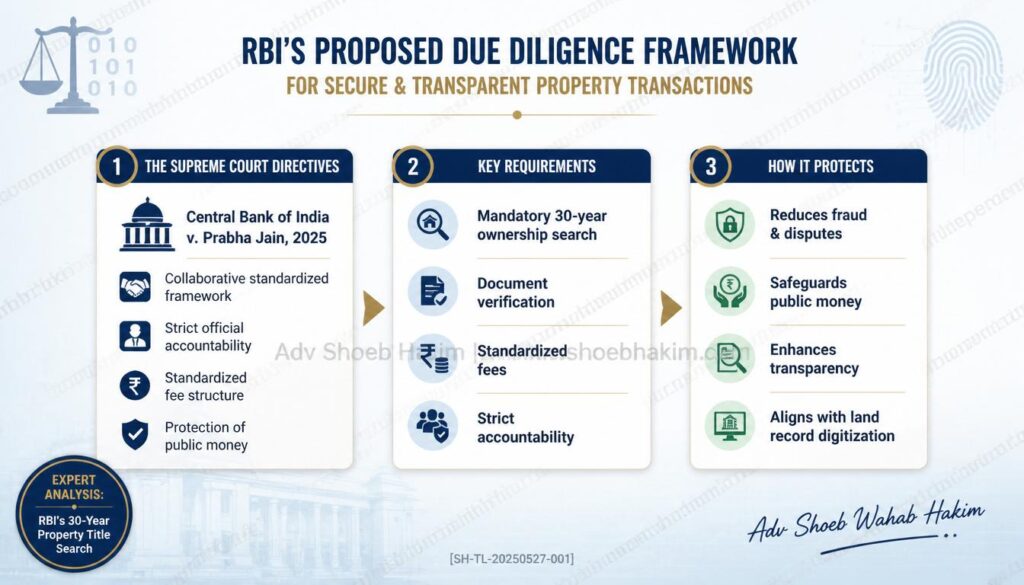
The Reserve Bank of India’s proposed framework was spurred by the Supreme Court of India’s directives in the landmark case Central Bank of India & Another v. Smt. Prabha Jain and Others (2025 INSC 95) .
In its judgment, a Supreme Court bench comprising Justices J.B. Pardiwala and R. Mahadevan issued clear directives to clean up the property verification process .
1. Collaborative Standardized Framework
The Court directed the RBI, along with banks and relevant financial stakeholders, to build a uniform, practical framework for property title searches before loans are approved. The Court noted that because there was no uniform rule or standard mechanism across the banking industry, lenders heavily relied on fragmented reports from empaneled lawyers .
2. Strict Official Accountability
The Court mandated that clear guidelines be established to fix personal liability—including potential criminal action—against banking officials who approve loans based on inadequate or sloppy title verifications.
3. Standardized Fee Structure
The apex court directed the introduction of standard guidelines for the fees paid to empaneled lawyers. This ensures banks stop procuring cheap, low-quality title clearance reports merely to cut costs.
4. Protection of Public Money
The Court explicitly cautioned banks against relying on superficial title reports, noting that inadequate due diligence severely risks public funds and compromises the larger public interest .
2. The Context of the Case: Central Bank of India v. Prabha Jain
2.1 The Facts
The case arose from a dispute where the plaintiff, Smt. Prabha Jain, claimed that a sale deed and subsequent mortgage executed by her brother-in-law were illegal . The bank had taken possession under the SARFAESI Act .
| Event | Details |
|---|---|
| 1967 | Plaintiff’s father-in-law purchased the suit land |
| 2005 | Plaintiff’s father-in-law died; land inherited by three persons |
| 2008 | Plaintiff’s brother-in-law sold a plot to a third party who mortgaged it with Central Bank of India |
| 2011 | Plaintiff filed suit challenging the sale and mortgage |
| 2012 | Trial court rejected the plaint under Order VII Rule 11 CPC |
| 2012 | High Court allowed the appeal |
| 2025 | Supreme Court delivered judgment |
2.2 The Supreme Court’s Observations
The Court noted that because there was no uniform rule or standard mechanism across the banking industry, lenders heavily relied on fragmented reports from empaneled lawyers. This lack of uniformity frequently enabled fraudsters to exploit loopholes, secure massive loans on disputed or fake property titles, and drain public money .
The Court observed that the plaintiff’s brother-in-law, without any partition, divided the land into plots and sold them illegally. One such plot was sold to a third party who mortgaged it with the Central Bank of India .
2.3 The Legal Issue
The primary legal issue was whether the civil court had jurisdiction to try the suit in view of Section 34 of the SARFAESI Act. The trial court had rejected the plaint, but the High Court allowed the appeal .
The Supreme Court held that the civil court had jurisdiction because the Debts Recovery Tribunal has no jurisdiction to decide questions of title—whether persons other than the mortgager had title in the mortgaged property .
3. The Ajay Vijh Clarification (July 2026)
In a related development, the Supreme Court in Ajay Vijh v. Indian Banks Association (July 2026) clarified that while banks must tighten internal audits, they cannot arbitrarily blacklist panel lawyers on caution lists without due process .
Key Holdings:
The Court observed:
“Banks have the choice of disengaging a legal professional and also to remove his/her name from the panel if the services are not up to the mark, but an action in the nature of public declaration to all other banks about the conduct, competency or incompetency of an advocate is clearly beyond their power and jurisdiction and clearly illegal” .
The Court further observed:
“Permitting external agencies or institutions to record adverse findings and opinion about the professional standing of advocates would not only transgress the legislative framework governing the legal profession, but also undermine the independence of the Bar” .
The Court directed the Bar Council of India to undertake a performance audit of its disciplinary mechanism and adopt corrective measures, and to institutionalise Continuing Legal Education (CLE) for advocates .
4. Key Components of the Proposed Framework
4.1 Mandatory 30-Year Search
Banks must trace ownership history back at least 30 years to verify an unbroken title chain. This ensures that:
- The property has a clear, marketable title with no hidden disputes
- No gaps exist in the chain of ownership
- Any adverse claims or pending litigations are identified
| Aspect | Requirement |
|---|---|
| Search period | Minimum 30 years |
| Purpose | Verify unbroken title chain |
| Scope | All mortgaged properties |
4.2 Document and Record Verification
Lenders will be required to check specific key land records and encumbrance certificates rather than rely on superficial reviews.
Documents to be verified:
- Sale deeds
- Mutation entries
- Encumbrance certificates
- Pending litigations
- Adverse claims
4.3 Standardized Fees
The framework seeks to standardize the fees paid to empaneled lawyers, ensuring high-quality, comprehensive reports rather than cost-driven superficial checks.
| Aspect | Impact |
|---|---|
| Standardized fees | Ensures quality reports |
| Empaneled lawyers | Qualified professionals |
| Comprehensive reports | Reduces oversight gaps |
4.4 Strict Accountability
Officers who approve loans based on inadequate title verifications may face heavy liability, including possible criminal action. This creates personal accountability for due diligence failures.
| Aspect | Consequence |
|---|---|
| Inadequate verification | Heavy liability |
| Criminal action | Possible prosecution |
| Personal accountability | Officers personally responsible |
5. How It Protects the Banking Ecosystem
5.1 Reduces Fraud
Uniform parameters will eliminate systemic loopholes where fraudsters could previously exploit differing state or bank search standards (e.g., some banks checking 10 years, others 30).
Before: Fraudsters could exploit gaps where banks used different search standards
After: Uniform 30-year standard creates a level playing field
5.2 Safeguards Public Money
By shifting from a patchy, unverified due-diligence approach to strict guidelines, exposure to non-performing assets (NPAs) tied to disputed collateral is drastically reduced.
Before: High NPA exposure due to disputed collateral
After: Reduced NPA exposure through verified titles
5.3 Enhances Transparency
Standardizing procedures aligns with digitizing local land records, allowing banks to immediately flag adverse claims or pending litigations.
Before: Inconsistent procedures across banks
After: Standardized procedures aligned with digitized records
5.4 Provides Legal Certainty
Banks can confidently lend knowing the property has a clear, marketable title.
Before: Risk of title disputes
After: Clear, marketable title verified
6. Comparison: Before and After
| Aspect | Before | After |
|---|---|---|
| Title search period | Varying standards (10-30 years) | Uniform 30-year minimum |
| Document verification | Superficial review | Comprehensive verification |
| Liability | Limited accountability | Heavy liability including criminal action |
| Fraud risk | High due to inconsistent standards | Significantly reduced |
| NPA exposure | High due to disputed collateral | Reduced through verified titles |
| Transparency | Inconsistent across banks | Standardized across all banks |
| Legal certainty | Low | High |
| Lawyer empanelment | Inconsistent standards | Standardized fees and quality |
7. Implementation Challenges
7.1 Digitization of Land Records
The framework requires comprehensive digitization of land records. Many states still have incomplete or inaccurate records.
Challenge: Incomplete land records
Solution: Accelerated digitization efforts
7.2 Standardized Fees
Ensuring that standardized fees do not become a burden on borrowers while maintaining quality of reports.
Challenge: Balancing cost and quality
Solution: Reasonable fee structure
7.3 Training and Capacity Building
Banks must train their staff to conduct thorough 30-year title searches.
Challenge: Lack of trained personnel
Solution: Comprehensive training programs
7.4 Accountability Enforcement
Ensuring that accountability provisions are enforced, not just on paper.
Challenge: Enforcement gaps
Solution: Regular audits and oversight
8. The Road Ahead
The RBI’s proposed framework represents a paradigm shift in mortgage due diligence. By mandating a uniform 30-year ownership history check, it addresses long-standing vulnerabilities in the banking system.
Key Benefits:
| Benefit | Description |
|---|---|
| Reduced fraud | Uniform standards eliminate systemic loopholes |
| Safeguarded public money | Reduced NPA exposure |
| Enhanced transparency | Standardized procedures across banks |
| Legal certainty | Clear, marketable titles verified |
| Accountability | Personal liability for due diligence failures |
9. Conclusion: A Paradigm Shift
The RBI’s proposed framework, spurred by the Supreme Court’s directives in Central Bank of India v. Prabha Jain (2025), is a significant step forward in protecting the banking ecosystem from mortgage fraud . By mandating a uniform 30-year ownership history check, standardizing fees, and ensuring strict accountability, the framework addresses long-standing vulnerabilities in the system.
Key Takeaways:
- 30-year search – Mandatory across all banks
- Document verification – Comprehensive, not superficial
- Standardized fees – Ensuring quality reports
- Strict accountability – Personal liability for failures
This framework will:
- Reduce mortgage fraud
- Safeguard public money
- Enhance transparency
- Provide legal certainty
- Reduce NPAs
10. Frequently Asked Questions (FAQs)
Q1: What is the mandatory search period?
Banks must trace ownership history back at least 30 years to verify an unbroken title chain.
Q2: What was the Supreme Court case that spurred this framework?
Central Bank of India & Another v. Smt. Prabha Jain and Others (2025 INSC 95) .
Q3: What were the Supreme Court’s directives?
The Court directed a collaborative standardized framework, strict official accountability, standardized fee structure, and protection of public money.
Q4: What was the Ajay Vijh clarification?
In July 2026, the Supreme Court held that banks cannot arbitrarily blacklist panel lawyers on caution lists without due process; disciplinary matters fall exclusively under the Bar Council of India .
Q5: What documents must be verified?
Sale deeds, mutation entries, encumbrance certificates, and pending litigations.
Q6: What are the consequences of inadequate verification?
Officers may face heavy liability, including possible criminal action.
Q: Does this framework apply to all loans?
Ans: The framework specifically targets mortgage lending and loans against property, where the integrity of the collateral title is the primary security for the bank.
Q: Can a civil court decide on property titles if a SARFAESI case is pending?
Ans: Yes. In Central Bank of India v. Prabha Jain, the Supreme Court clarified that civil courts have exclusive jurisdiction to determine ownership/title disputes, even when possession proceedings are pending before a DRT.
Q: What happens if a property lacks 30 years of records?
Ans: The framework will likely include provisions for cases where digitized records are unavailable, but the burden will be on the lender to utilize the best available evidence to establish an unbroken chain.
KNOWLEDGE CHECK QUIZ
Q: What did the Supreme Court hold regarding the “Caution List” for lawyers?
Ans: The Court held in Ajay Vijh v. Indian Banks Association that banks cannot arbitrarily blacklist lawyers or cast aspersions on their integrity on caution lists without due process.
Q: Why is the “30-year search” mandate being introduced?
Ans: To establish a uniform standard for collateral verification, eliminate systemic loopholes, and ensure property titles are marketable and free of historical disputes.
Q: What is the primary observation in Central Bank of India v. Prabha Jain regarding bank officer accountability?
Ans: The Court recommended that the RBI establish a framework to fix personal liability, including possible criminal action, against officials who wrongfully approve loans without proper title verification.
Adv. Shoeb Hakim
Banking & Compliance Advisor
📌 Follow me on LinkedIn for daily banking and compliance insights: https://www.linkedin.com/in/shoebhakim
📌 Visit my website for more articles: https://shoebhakim.com
📌 Visit my website for research fellowship: https://www.legalcomplaince.in
📌 Connect: https://www.linkedin.com/in/shoebhakim | https://shoebhakim.com/shoeb-hakim-blog/ | https://shoebhakim.com/book-now/
♻️ Share this article with your network.
Disclaimer: This article is for informational purposes only and does not constitute legal advice.
Hashtags: #AdvShoebHakim #RBI #PropertyTitleSearch #DueDiligence #MortgageFraud #SupremeCourt #CentralBankOfIndia #BankingRegulation #RealEstate #LandRecords #NPAs #BankingCompliance #FinancialSecurity #PublicMoney #TitleVerification #EncumbranceCertificate #LandDigitization #BankingSector #PropertyLending #FraudPrevention