Key Facts
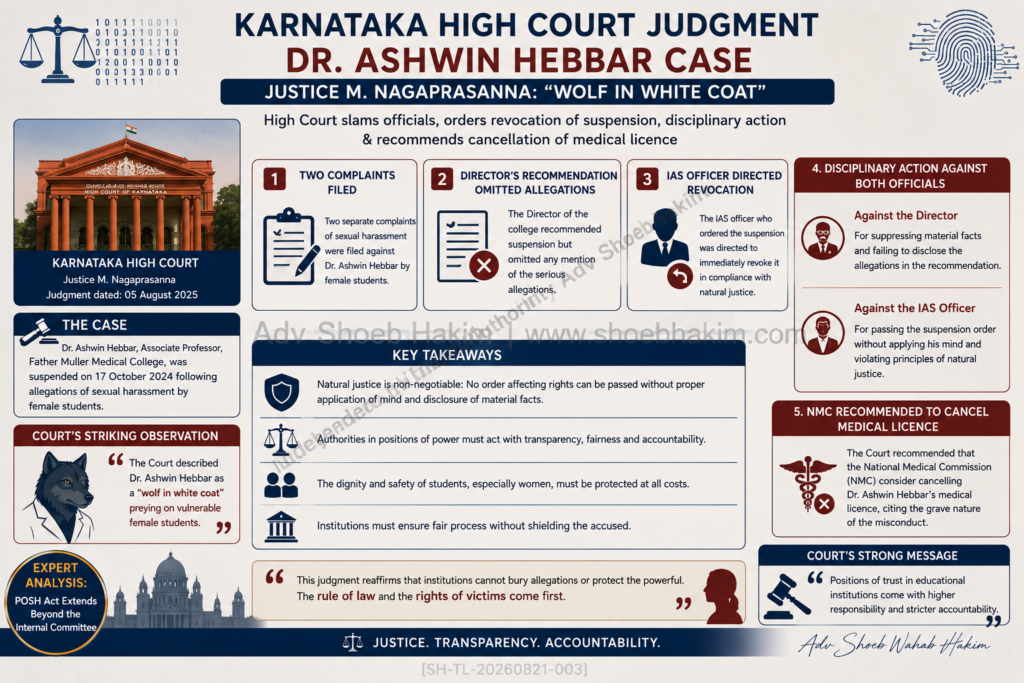
The Karnataka High Court delivered its judgment in W.A. No. 675 of 2026 on 4 August 2026. The Bench comprised Justices D.K. Singh and T.M. Nadaf. The Court described Dr. Ashwin Hebbar as “a wolf in white coat.” The Court directed disciplinary action against the SIMS Director and the Principal Secretary of the Medical Education Department for shielding the accused. The Court recommended that the National Medical Commission consider cancelling Dr. Hebbar’s medical licence if found guilty.
Direct Answer
The Karnataka High Court in Shimoga Institute of Medical Sciences v. Dr. Ashwin Hebbar K. & Ors. (4 August 2026) held that institutional accountability under the POSH Act extends far beyond the Internal Committee’s report.
The Court directed disciplinary action against the SIMS Director and an IAS officer for protecting a professor accused of sexual harassment despite the Internal Committee finding the complaint to be substantiated.
The Court observed that the Director’s recommendation for reinstatement deliberately omitted any mention of the sexual harassment allegations, the FIR, or his arrest, and that the Principal Secretary had “buckled under pressure” from political figures and NGOs. The judgment establishes that senior leadership can be held personally accountable for decisions that undermine the safety and dignity of complainants.
In this article:
The Facts of the Case
The Two Complaints Against Dr. Hebbar
The Role of Senior Officials
The Court’s Observations
The Legal Framework
Why This Matters for Employers
FAQ
By Adv. Shoeb Hakim — Criminal defence, AML, digital forensics, and cybercrime specialist; former Head of AML & Client ID (AVP), Credit Suisse; training police since 1996.
The Facts of the Case
Dr. Ashwin Hebbar was an Associate Professor at the Shimoga Institute of Medical Sciences (SIMS). He faced two separate complaints of sexual harassment from female students—one in 2022 and another in June 2025 .
The First Complaint (2022)
The first complaint was filed in 2022 by a former SIMS student who was then working as a Junior Resident under Dr. Hebbar. She alleged that when she met him to enquire about her postgraduate studies, he sexually harassed her . Since no action was taken for 25 days, the complainant lodged an FIR . The internal committee under POSH allegedly forced the complainant to withdraw the complaint .
The Second Complaint (2025)
On 14 June 2025, Dr. Hebbar similarly misbehaved with a second-year postgraduate student during a dinner party organised by the department. He asked her to sit next to him and sexually harassed her by inappropriately touching her repeatedly . The POSH committee found the allegations prima facie true and, in its final report dated 5 August 2025, held that the allegations were substantiated . He was arrested on 26 June 2025 and remained in judicial custody until 4 July 2025 when he was granted bail .
The Role of Senior Officials
On 3 July 2025, Dr. Hebbar was placed under suspension . In November 2025, the Principal Secretary of the Medical Education Department revoked his suspension and transferred him to Haveri Institute of Medical Sciences .
The Director’s Recommendation
The Director of SIMS recommended reinstatement, citing Dr. Hebbar’s professional achievements—1,029 surgeries, 19 publications, and his role as unit head under NMC guidelines. The recommendation deliberately omitted any mention of the sexual harassment allegations, the FIR, his arrest, or the Internal Committee’s findings .
The Principal Secretary’s Role
The Court noted that Mohammed Mohsin, the IAS Additional Chief Secretary, Department of Medical Education, had directed the SIMS Director to make the recommendation for revocation of suspension. He withheld this information in his affidavit before the court and later tried to shift the blame entirely onto the Director . The Court observed that the Principal Secretary had “buckled under pressure” from political figures and NGOs .
The Court’s Observations
The Division Bench comprising Justices D.K. Singh and T.M. Nadaf made several critical observations.
“A Wolf in White Coat”
The Court described Dr. Hebbar as “a wolf in white coat” and ordered that he must be proceeded with disciplinary proceedings expeditiously . The Court also directed that if found guilty, his medical licence should be cancelled .
Conduct Unbecoming of Government Servants
The Court observed that the Director and the Principal Secretary “have conducted themselves unbecoming of government servants in the matter of sexual abuse/harassment of girl students by Dr. Ashwin Hebbar and protecting the accused” . The Court noted that they had been “totally insensitive to the honour, dignity, humiliation, harassment and sexual abuse suffered by the students” .
No Occasion for Withdrawing Suspension
The Court rejected the argument that the suspension had to be revoked because six months had passed. It observed that a charge sheet had already been issued on 12 November 2025 and a departmental inquiry was pending. Therefore, there was no occasion for withdrawing the suspension within four and a half months for such a gross misconduct .
Failure of Institutions
The Court observed that “the institutions and authorities have failed the victims of sexual abuse by Dr. Ashwin Hebbar in their pursuit to justice” . The Court also noted that the first complaint was effectively closed without any action against Dr. Hebbar, and that having been emboldened by this, he went on to sexually harass another student within less than a year .
The Legal Framework
POSH Act, 2013
The Sexual Harassment of Women at Workplace (Prevention, Prohibition and Redressal) Act, 2013, requires every employer with 10 or more employees to constitute an Internal Committee . The Act creates a self-contained mechanism for redressal of sexual harassment complaints.
Employer Accountability
The Delhi High Court has held that parallel fact-finding mechanisms outside the statutory framework under the POSH Act are de hors the provisions of the statute . The Act establishes a complete and self-contained mechanism for addressing complaints of sexual harassment, and any deviation from this framework undermines statutory safeguards such as procedural fairness, confidentiality, and institutional competence .
Suspension Powers
The Delhi High Court has clarified that while the power to suspend an employee is an inherent administrative power vested in the employer, the POSH Act itself is “in addition to and not in derogation of” other laws . Therefore, service rules define the scope, limits, and the competent authority to exercise the power of suspension .
Why This Matters for Employers
Accountability Extends Beyond the ICC
This judgment establishes that institutional accountability under the POSH Act extends far beyond the Internal Committee’s report. Senior leadership can now be held personally accountable for decisions that undermine the safety and dignity of complainants.
No Protection for Shielding Accused
The Court made it clear that administrative discretion cannot defeat the POSH process. Officials who protect accused individuals rather than ensuring justice for victims will face disciplinary action.
Documentation and Omission
The Director’s recommendation omitted any mention of the sexual harassment allegations, the FIR, his arrest, or the committee’s findings. The Court found this omission significant and used it as evidence of the Director’s intent to protect the accused.
Zero Tolerance
The Court’s recommendation that the National Medical Commission consider cancelling Dr. Hebbar’s medical licence signals that the judiciary expects a zero-tolerance approach to sexual harassment by professionals in positions of authority.
FREQUENTLY ASKED QUESTIONS (FAQ)
What was the Karnataka High Court’s judgment in Shimoga Institute of Medical Sciences v. Dr. Ashwin Hebbar K.?
The Court held that institutional accountability under the POSH Act extends far beyond the Internal Committee’s report. It directed disciplinary action against the SIMS Director and an IAS officer for protecting a professor accused of sexual harassment despite the Internal Committee finding the complaint to be substantiated.
Who was Dr. Ashwin Hebbar?
Dr. Ashwin Hebbar was an Associate Professor at the Shimoga Institute of Medical Sciences (SIMS) accused of sexually harassing his students.
How many complaints were filed against Dr. Hebbar?
Two separate complaints were filed—one in 2022 and another in June 2025.
What was the role of senior officials in this case?
The Principal Secretary revoked Dr. Hebbar’s suspension and transferred him to another institution in November 2025. The Director of SIMS recommended reinstatement, citing his professional achievements but omitting any mention of the sexual harassment allegations.
What did the Court observe about the Director’s recommendation?
The Court noted that the Director’s recommendation deliberately omitted any mention of the sexual harassment allegations, the FIR, his arrest, or the Internal Committee’s findings.
What did the Court direct regarding the Principal Secretary and Director?
The Court directed disciplinary action against both officials for conducting themselves “unbecoming of government servants” by protecting the accused.
What did the Court recommend to the National Medical Commission?
The Court recommended that the NMC consider cancelling Dr. Hebbar’s medical licence if found guilty of the allegations.
What does this judgment mean for employers?
The judgment establishes that senior leadership can be held personally accountable for decisions that undermine the safety and dignity of complainants. Administrative discretion cannot defeat the POSH process.
What is the significance of the Court’s observation that the first complaint was effectively closed?
The Court noted that the first complaint was closed without any action against Dr. Hebbar, and that having been emboldened by this, he went on to sexually harass another student within less than a year.
What standard does the POSH Act impose on employers beyond the ICC process?
The POSH Act imposes an obligation on employers to provide a safe working environment and to take appropriate action in cases of sexual harassment. This includes ensuring that administrative decisions do not undermine the safety and dignity of complainants.
Q: Can senior government officials or corporate directors override an Internal Committee’s findings?
Ans: No. Administrative discretion cannot be used to subvert the statutory POSH process or shield individuals found guilty of workplace harassment.
Q: What role did external pressure play in the SIMS administrative decisions?
Ans: The Court observed that the Principal Secretary had “buckled under pressure” from political figures and non-governmental organizations when revoking the suspension.
Q: Why is the failure to act on a first complaint significant in recurring harassment cases?
Ans: Failing to penalize an initial complaint emboldens perpetrators to repeat predatory behavior, compounding institutional liability and victim trauma.
Q: What are the personal consequences for senior officials who protect harassers under this ruling?
Ans: Senior officials face direct court-ordered disciplinary action and potential professional sanctions for conducting themselves in a manner unbecoming of public servants.
KNOWLEDGE CHECK QUIZ
Q: What was the specific case citation and date of the Karnataka High Court judgment on POSH accountability?
Ans: Shimoga Institute of Medical Sciences v. Dr. Ashwin Hebbar K., W.A. No. 675 of 2026, decided on 4 August 2026.
Q: What core principle did the Karnataka High Court establish regarding institutional accountability under the POSH Act?
Ans: Institutional accountability extends far beyond the Internal Committee’s report, holding senior leadership personally liable for administrative actions that shield accused offenders.
Q: What specific omissions were identified in the SIMS Director’s reinstatement recommendation?
Ans: The recommendation deliberately omitted any mention of the sexual harassment allegations, the criminal FIR, the accused’s arrest, and the Internal Committee’s substantiation findings.
Q: What action did the Court recommend regarding the accused professor’s professional standing?
Ans: The Court recommended that the National Medical Commission (NMC) consider cancelling Dr. Hebbar’s medical licence if found guilty.
By Adv. Shoeb Hakim
Criminal defence, AML, digital forensics, and cybercrime specialist; former Head of AML & Client ID (AVP), Credit Suisse; training police and judiciary since 1996.
📌 Connect: https://www.linkedin.com/in/shoebhakim | https://shoebhakim.com/shoeb-hakim-blog/
📌 Visit my website for more articles: https://shoebhakim.com
📌 Visit my website for research fellowship: https://www.legalcomplaince.in
Disclaimer: This content is for informational purposes only and does not constitute legal advice. Readers should consult qualified legal counsel for advice on their specific circumstances.
#AdvShoebHakim #POSHAct #WorkplaceSafety #KarnatakaHighCourt #LegalDefense #WhiteCollarCrime #EmploymentLaw #CorporateGovernance #Compliance #ShimogaInstitute
Additional Page Metadata
Author:
Adv. Shoeb Hakim
Author Bio:
Adv. Shoeb Hakim is a Mumbai-based criminal defence, AML, digital forensics and cybercrime specialist. Former Head of AML & Client ID (AVP) at Credit Suisse. Has been training police since nineteen ninety six. Provides expert commentary on workplace safety, POSH compliance, and employment law.
Article Publisher:
Adv. Shoeb Hakim
Article Section:
Employment Law | POSH Act | Workplace Safety | Corporate Governance
Article Tags:
POSH Act, Karnataka High Court, sexual harassment, workplace safety, Internal Committee, employer accountability, administrative discretion, government servants, medical education, NMC, Adv Shoeb Hakim