Key Facts
- Operation Name: ABSCAM (short for “Abdul Scam” or “Arab Scam”)
- Public Disclosure: 2 February 1980
- Duration: Began July 1978
- Convictions: 19 total, including one U.S. Senator and six members of the House of Representatives
- Key Tactic: FBI agents posed as representatives of a wealthy Arab sheik offering bribes
- Controversy: Allegations of entrapment
- Outcome: All convictions upheld on appeal; Congress forced stricter guidelines on undercover operations
Direct Answer
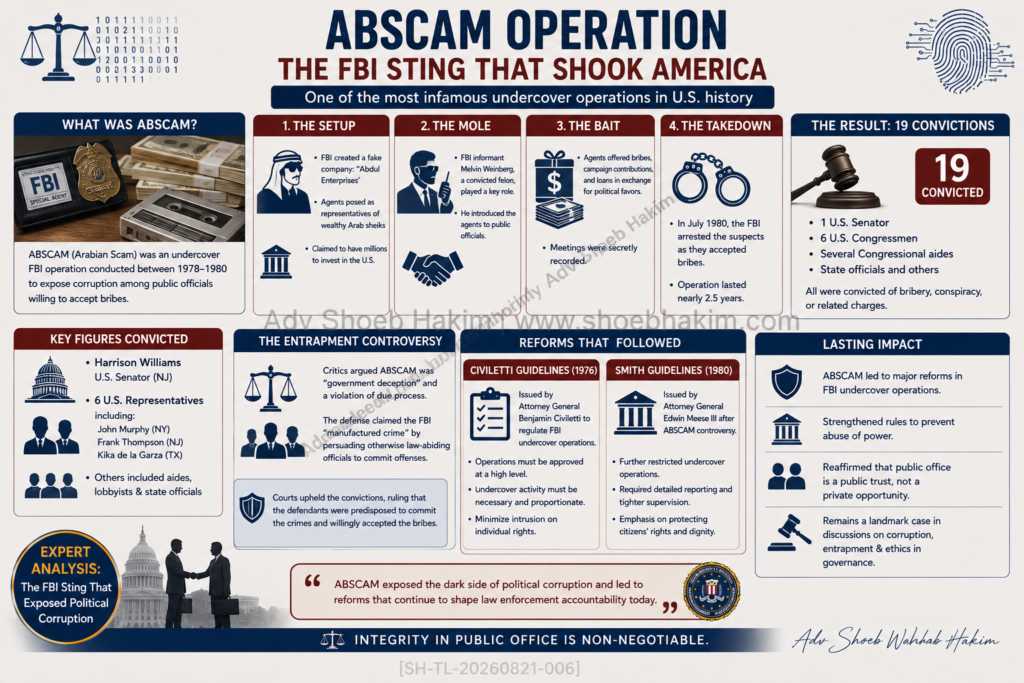
On February 2, 1980, the FBI revealed ABSCAM, a high-level undercover sting operation targeting public corruption. The investigation began in July 1978 as an effort to catch underworld figures dealing in stolen art and fake securities.
The FBI created a fake company, “Abdul Enterprises,” and agents posed as representatives of a wealthy Arab sheik willing to invest oil money. The operation expanded from art theft to exposing political corruption, leading to the conviction of 19 individuals, including one U.S. Senator and six members of the House of Representatives. Despite controversy over allegations of entrapment, all convictions were upheld on appeal.
However, the national debate led to Congress pressuring the Justice Department to implement stricter guidelines for undercover operations, effectively barring the FBI from ever again conducting such a broad exploratory investigation.
In this article:
- The Genesis of ABSCAM
- How the Operation Worked
- The Convictions
- The Entrapment Controversy
- The Congressional Response
- The Lasting Impact on FBI Undercover Operations
- FAQ
By Adv. Shoeb Hakim — Criminal defence, AML, digital forensics, and cybercrime specialist; former Head of AML & Client ID (AVP), Credit Suisse; training police since 1996.
The Genesis of ABSCAM
The operation began in July 1978, when the FBI set out to catch New York City underworld figures dealing in stolen art and prosecuting securities fraud .
The FBI set up a bogus company in Long Island—Abdul Enterprises, thus the name “AB(dul)SCAM”—said to be owned by a wealthy Arab sheik who wished to invest oil money in valuable artworks .
The Bureau then recruited an informant who connected them with criminals willing to sell stolen treasures. Within months, they had recovered two paintings worth a combined $1 million .
Through that operation, the FBI was introduced to criminals dealing in fake stocks and bonds, leading to the halting of the sale of nearly $600 million worth of fraudulent securities .
How the Operation Worked
The investigation eventually led from New York to southern New Jersey and on to Washington, D.C. The FBI’s criminal contacts led them to politicians in Camden willing to offer bribes to get the fake business a gambling license in Atlantic City .
The FBI then expressed interest in getting the sheik asylum in the U.S. Corrupt politicians arranged for the FBI to meet U.S. Congressmen who could make it happen with private legislation—for a price: $50,000 up front and $50,000 later .
The FBI recruited convicted con man Melvin Weinberg for “creative direction” of the operation, and agents posed as wealthy Arab sheiks (hence the name, a contraction of “Arab scam” or “Abdul scam”) . Agents and Weinberg became fixtures at dozens of encounters at the intersection of politics and organized crime—on Key West yachts, in Atlantic City casinos, in limousines, and on chartered jets .
Nearly all meetings were recorded or filmed. Congressmen were caught on tape accepting paper lunch bags stuffed with cash, with dialogue such as: “Money talks in this business,” “I’m no Boy Scout,” and “I got larceny in my blood. I’ll take [the bribe] in a goddamn minute” .
The Convictions
When the dust settled, the investigation led to 38 convictions , including one U.S. Senator, six members of the House of Representatives, and various local officials . The investigation also revealed the nature and extent of mob control over the construction, licensing, operations, and background ownership of casinos in Nevada and New Jersey .
The courts upheld all convictions on appeal .
The Entrapment Controversy
Like many high-profile, sensitive investigations, ABSCAM generated significant controversy. Questions were raised about whether the FBI’s undercover efforts led to entrapment .
A Senate panel that spent six months investigating the investigators concluded that the FBI did indeed come “within trampling distance of the defendants’ civil liberties” but managed not to violate them . The panel noted that the operation was “not tightly supervised and monitored” and that there were “unnecessary and undue risks” to the rights of the investigation’s targets .
However, all convictions were upheld on appeal, with courts ruling that the FBI had stayed on the right side of the line between legal deception and unlawful entrapment . All tapes were immediately reviewed, cash transfers were witnessed and monitored by Justice Department attorneys, and judges signed warrants and sanctioned the FBI’s methods .
The Congressional Response
Despite the convictions, Congress thought the FBI had gone too far . At hearings before the House Subcommittee on Civil and Constitutional Rights and the Senate Select Committee to Study Undercover Activities, Members of Congress argued that the FBI had engaged in a “wildly inappropriate exploratory fishing expedition” .
Some suggest that Congress’s actions were not purely self-serving. A few years prior to ABSCAM, the Church Committee had revealed significant FBI abuses in a series of reports that laid out intelligence agency abuses in extraordinary detail. Some have controversially suggested that ABSCAM was the FBI’s retaliation against Congress for that public excoriation .
In the decade following ABSCAM, Congress circled the wagons, pressuring the Department of Justice to implement internal reforms by way of proffering dramatic legislative packages staunchly opposed by Attorneys General .
The Lasting Impact on FBI Undercover Operations
The “compromise” result was a series of restrictive guidelines for undercover and sting operations. These guidelines effectively bar the FBI from ever again conducting an operation similar to ABSCAM .
The Civiletti Guidelines (1981)
The first of these guidelines, issued by Attorney General Benjamin R. Civiletti in January 1981, imposed strict limits on the future use of the methods deployed in the ABSCAM operation . The guidelines curtailed the ability of FBI operations to authorize informants to engage in criminal activity. While undercover agents would still be allowed to offer bribes to public officials, the proffered bribe could not be “excessive.” The guidelines also gave prosecutors an oversight and coordination role in undercover missions, and informants would no longer be carte blanche protected from arrest or prosecution .
Most notably, under the new guidelines, any operation involving “high public officials” (including Members of Congress) would require additional checks—authorization of Special Agents-in-Charge, approval of a U.S. Attorney, and immediate notification of FBI Headquarters and the Assistant Attorney General .
The Smith Guidelines (1983)
By 1983, Congress seemed to recognize an overcorrection regarding oversight of FBI undercover missions. The Smith Guidelines revamped and loosened constraints, chiefly focusing on boosting the FBI’s freedom to conduct antiterrorism efforts. However, the unanimous report from the Senate Select Committee investigating ABSCAM and the revival of the “Undercover Operations Act” demonstrated clearly Congress’s view that investigations into high-level public officials should be subject to stricter rules .
The Smith Guidelines went even further in restricting the FBI’s ability to conduct undercover operations targeting high-level public officials, carving out a class of activities that required express approval, not merely notification, of FBI Headquarters .
FREQUENTLY ASKED QUESTIONS (FAQ)
What was ABSCAM?
ABSCAM was an FBI undercover sting operation that became public on February 2, 1980. The FBI created a fake company, Abdul Enterprises, and agents posed as representatives of a wealthy Arab sheik to offer bribes to politicians in exchange for political favors.
How many convictions resulted from ABSCAM?
Nineteen individuals were convicted, including one U.S. Senator and six members of the House of Representatives.
Why was the operation called ABSCAM?
The name is a contraction of “Abdul Scam” or “Arab Scam,” taken from the fake company “Abdul Enterprises” that the FBI established.
What was the entrapment controversy?
Critics argued that the FBI had induced individuals to commit crimes they would not otherwise have committed. Courts upheld all convictions, ruling that the FBI had stayed on the right side of the law.
**What was the role of Melvin Weinberg?
Weinberg was a convicted con man recruited by the FBI for “creative direction” of the operation. He played a key role in connecting the FBI with corrupt politicians and criminals.
What was Congress’s response to ABSCAM?
Congress pressured the Justice Department to implement stricter guidelines for undercover operations. A Senate panel recommended legislation to control the use of ABSCAM-style undercover procedures and clarify the use of entrapment as a defense.
**What were the Civiletti Guidelines?
Issued in January 1981, these guidelines imposed strict limits on FBI undercover operations, including restrictions on informants, limits on bribes, and additional checks for operations targeting high public officials.
**Do the guidelines still allow FBI stings like ABSCAM?
No. The guidelines effectively bar the FBI from ever again conducting an operation similar to ABSCAM, particularly when it comes to targeting high public officials.
**What was the Smith Guidelines?
Issued in 1983, these guidelines revamped and loosened some constraints but went even further in restricting operations targeting high-level public officials.
**What is the lasting legacy of ABSCAM?
ABSCAM exposed significant political corruption but also led to stricter regulation of FBI undercover operations, shaping how such investigations are conducted to this day.
Explore More:
Read my blog: Shoeb Hakim Blog
Book Now: Book a Consultation
Contact: Contact Adv. Shoeb Hakim
Careers: Careers at Shoeb Hakim
By Adv. Shoeb Hakim
Criminal defence, AML, digital forensics, and cybercrime specialist; former Head of AML & Client ID (AVP), Credit Suisse; training police since 1996.
📌 Connect: https://www.linkedin.com/in/shoebhakim | https://shoebhakim.com/shoeb-hakim-blog/
📌 Visit my website for more articles: https://shoebhakim.com
📌 Visit my website for research fellowship: https://www.legalcomplaince.in
Disclaimer: This content is for informational purposes only and does not constitute legal advice. Readers should consult qualified legal counsel for advice on their specific circumstances.
#AdvShoebHakim #ABSCAM #FBISting #WhiteCollarCrime #PoliticalCorruption #Entrapment #LegalDefense #Compliance #DigitalForensics #UndercoverOperations