Key Facts
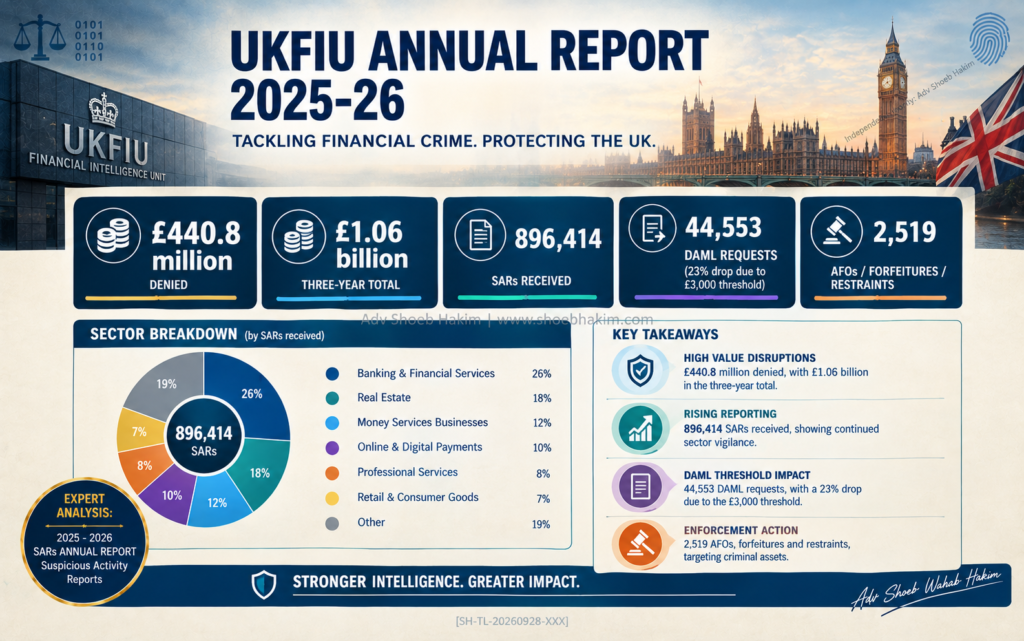
- Total Assets Denied: £440.8 million in 2025-26, up 15% from £382.6 million the previous year
- Three-Year Total: Over £1.06 billion in criminal assets denied through the Defence Against Money Laundering (DAML) regime
- SARs Volume: 896,414 Suspicious Activity Reports received, a 3% increase from 866,616
- DAML Volume Drop: 44,553 DAML requests received, a 23% decrease from 57,666
- The Reason for the Drop: The DAML reporting threshold increased from £1,000 to £3,000 in July 2025
- Asset Recovery Tools: 2,519 Account Freezing Orders, forfeitures, or restraints obtained, a 23% increase
- Terrorist Financing: 509 Defence Against Terrorist Financing (DATF) SARs received, up 28%
- Top Sectors: Banking (84.83%), Financial Services (11.15%), Virtual Assets (1.53%)
Direct Answer
The UK Financial Intelligence Unit (UKFIU) has published its Annual Report for 2025-26, revealing a counter-intuitive trend in the fight against economic crime.
The total value of criminal assets denied through the Defence Against Money Laundering (DAML) regime reached £440.8 million, a 15% increase from the previous year. Over the last three years, the total value of assets denied has crossed £1.06 billion.
However, the volume of DAML requests dropped by 23%, from 57,666 to 44,553. This decrease was not due to a lack of criminal activity. It was the direct result of a legislative change in July 2025 that raised the DAML reporting threshold from £1,000 to £3,000.
By raising the threshold, the UKFIU and reporters were able to focus on higher-risk intelligence. The result was fewer reports, but a higher value of assets denied and a 20% increase in the number of DAMLs refused to enable law enforcement action.
The report also highlights the role of the UKFIU in tackling terrorist financing, coordinating international requests, and combatting kleptocracy.
In this article:
- The DAML Threshold Shift: Fewer Reports, More Denial
- The £1 Billion Milestone
- SARs Volume and Sector Breakdown
- Terrorist Financing: DATF SARs
- International Cooperation
- Combatting Kleptocracy Cell
- Frequently Asked Questions (FAQ)
By Adv. Shoeb Hakim — Criminal defence, AML, digital forensics, and cybercrime specialist; former General Counsel, Credit Suisse; training police forces since 1996.
The DAML Threshold Shift: Fewer Reports, More Denial
The most significant regulatory change in the 2025-26 period was the increase in DAML reporting thresholds.
The Legislative Change
In July 2025, the threshold for DAML reporting was raised from £1,000 to £3,000 via a Statutory Instrument.
The UKFIU explains that this change was designed to enable a more effective, risk-based approach. It allowed reporters and the UKFIU to focus on higher-risk intelligence rather than processing a high volume of low-value reports.
The Impact on Volume
The number of DAML requests received fell by approximately 23%, from 57,666 in 2024-25 to 44,553 in 2025-26.
The Impact on Value
Despite the drop in volume, the total value of assets denied increased by 15%, from £382.6 million to £440.8 million.
The number of DAMLs refused to enable law enforcement action increased by 20%, from 3,276 to 3,943.
The increase in value was largely driven by a few high-value cases. The report notes a significant increase of circa 50% in DAMLs within the £5 million to £10 million and £10 million to £50 million ranges.
The £1 Billion Milestone
The DAML regime has enabled the UKFIU and its partners to cross a significant milestone.
The Three-Year Rolling Average
The report notes that over the last three years, the total value of criminal assets denied through the DAML regime has exceeded £1.06 billion.
The Increase in Asset Recovery Tools
The DAML regime is not just about blocking transactions. It is an entry point into the broader asset recovery regime.
In 2025-26, the number of Account Freezing Orders (AFOs), forfeitures, or restraints obtained through DAMLs reached 2,519. This was a 23% increase from the 2,048 obtained in the previous year.
The report highlights that DAMLs continue to provide law enforcement with multiple, high-quality asset denial opportunities.
SARs Volume and Sector Breakdown
The overall volume of Suspicious Activity Reports received by the UKFIU remained steady.
Total SARs Received
The UKFIU received 896,414 SARs in 2025-26, a 3% increase from the 866,616 received in 2024-25.
Sector Breakdown
The banking sector continues to be the largest source of SARs, representing 84.83% of all submissions. This is a 1.12% increase in relative proportion from the previous year.
Other sectors include:
- Financial Services (11.15%, up from 10.12%)
- Virtual Assets (1.53%, down from 1.63%)
- Gambling (0.87%)
- Accountancy (0.69%)
- Legal (0.45%)
The UKFIU notes that it does not comment on the volume of reports from different sectors. It is for the sectors and their supervisors to assess if the volume of SARs submitted is proportionate to the money laundering risk and compliance obligations for each sector.
SARs Confidentiality Breaches
Of the 896,414 SARs received, the UKFIU identified fewer than 10 confirmed instances of SAR confidentiality breaches.
Terrorist Financing: DATF SARs
The report provides a summary of the Defence Against Terrorist Financing (DATF) regime.
DATF SARs Received
The UKFIU received 509 DATF SARs in 2025-26, a 28% increase from the 397 received in 2024-25.
Value Refused
The value of funds refused in DATF cases reached £14,665,483, a 359% increase from £3,197,533.
The report notes that this increase is mainly due to three linked refusals totalling £11 million.
Restrained or Forfeited
The amount restrained or forfeited following interventions from refused DATF requests dropped by 92%, from £161,778 to £12,275.
The UKFIU explains that asset denial is not the primary objective of the DATF process. DATFs are primarily used to prevent terrorist financing and disrupt terrorist activity.
International Cooperation
The UKFIU works with global partners, including the Egmont Group and asset recovery networks, to combat cross-border money laundering.
Requests Received by the UKFIU
The UKFIU received 1,655 requests in 2025-26, a 3% increase.
The top 10 jurisdictions for the volume of requests received were:
- Lithuania (18%)
- Malta (13%)
- Germany (12%)
- USA (10%)
- Netherlands (9%)
- Ukraine (9%)
- Italy (8%)
- Spain (7%)
- France (7%)
- Latvia (7%)
Requests Made by the UKFIU
The UKFIU made 1,101 requests in 2025-26, a 9% decrease.
The top 10 jurisdictions for the volume of requests sent were:
- Spain (22%)
- UAE (22%)
- USA (11%)
- Albania (8%)
- Netherlands (7%)
- Lithuania (7%)
- Poland (7%)
- Ireland (6%)
- Switzerland (5%)
- France (5%)
Outbound Request Crime Types
The breakdown of requests sent by the UKFIU by crime type shows:
- Money Laundering (34%)
- Fraud (31%)
- Drugs (21%)
- Other/Not-Specified (5%)
- Tax (3%)
- Human Trafficking (3%)
- Cybercrime (2%)
- Sanctions (1%)
Combatting Kleptocracy Cell
The Combatting Kleptocracy Cell (CKC) identifies and analyses SARs linked to state threats, illicit finance, and financial sanctions evasion.
SARs Reviewed
The CKC reviewed 13,497 SARs in 2025-26, a 41% decrease from 22,906 in 2024-25.
The report attributes this decrease to a review exercise in October 2025 that improved efficiency by reducing false positives.
International Counterparts
The CKC disseminated 379 reports to international counterparts, a 23% increase.
Sanctions and State Threats
The CKC identified 855 reports as relevant to sanctions and/or state threat-related activity, a 3% increase.
It identified 178 reports relevant to international counterparts, an 11% increase.
Frequently Asked Questions (FAQ)
What is the total value of assets denied by the UKFIU in 2025-26?
The total value of assets denied through the Defence Against Money Laundering (DAML) regime was £440.8 million, up 15% from the previous year.
How much has been denied over the last three years?
Over the last three years, the total value of criminal assets denied through the DAML regime has exceeded £1.06 billion.
Why did the number of DAML requests drop by 23%?
The drop was primarily due to a legislative change in July 2025 that raised the DAML reporting threshold from £1,000 to £3,000. This allowed reporters and the UKFIU to focus on higher-risk intelligence.
How many SARs were received in 2025-26?
The UKFIU received 896,414 Suspicious Activity Reports, a 3% increase from the previous year.
Which sector submits the most SARs?
The Banking sector submits the most SARs, representing 84.83% of all submissions.
How many SAR confidentiality breaches were identified?
The UKFIU identified fewer than 10 confirmed instances of SAR confidentiality breaches out of 896,414 SARs received.
How many DATF SARs were received?
The UKFIU received 509 Defence Against Terrorist Financing (DATF) SARs, a 28% increase.
Which countries made the most requests to the UKFIU?
The top jurisdictions for inbound requests were Lithuania (18%), Malta (13%), and Germany (12%).
Which countries received the most requests from the UKFIU?
The top jurisdictions for outbound requests were Spain (22%) and the UAE (22%), followed by the USA (11%).
What is the Combatting Kleptocracy Cell?
The CKC is a UKFIU team that identifies and analyses SARs linked to state threats, illicit finance, and financial sanctions evasion.
Link to the Report:
https://www.nationalcrimeagency.gov.uk/who-we-are/publications/831-sars-annual-report-2026/file
Explore More:
Disclaimer: This content is for informational purposes only and does not constitute legal advice. Readers should consult qualified legal counsel for advice on their specific circumstances.
IMAGE AND PAGE META DATA
Focus Keyphrase:
UKFIU SARs Annual Report 2026
SEO Title (58 characters):
UKFIU Report: £440M Denied to Criminals | Adv Shoeb Hakim
Slug:
ukfiu-sars-annual-report-2026-asset-denial-adv-shoeb-hakim
Meta Description (152 characters):
The UKFIU denied £440.8 million to criminals in 2025-26. Explore the SARs data, DAML threshold changes, and global impact. Analysis by Adv Shoeb Hakim.