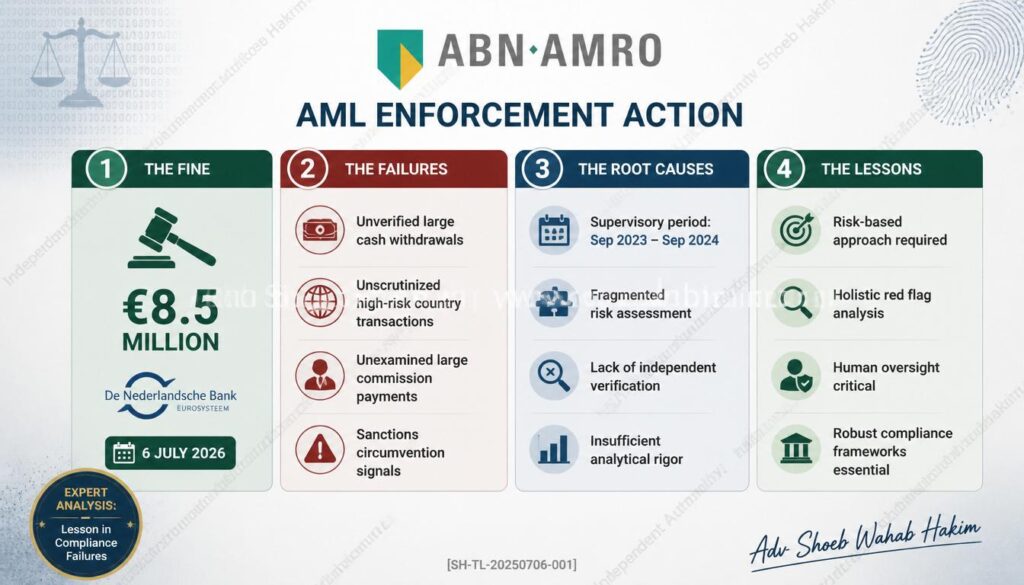
On 6 July 2026, De Nederlandsche Bank imposed an €8.5 million administrative fine on ABN AMRO Bank N.V. for serious, structural deficiencies in its anti-money laundering controls. This enforcement action offers critical lessons for financial institutions worldwide about the consequences of failing to verify high-risk clients.
Table of Contents
- Introduction: The €8.5 Million Fine
- The Investigation: September 2023 – September 2024
- Key Findings: What Went Wrong
- Specific Structural Failures
- The Legal Framework: Wwft and Regulatory Authority
- Lessons for Financial Institutions
- The Bigger Picture: Systemic Implications
- Conclusion: Proactive Compliance is Non-Negotiable
- Frequently Asked Questions (FAQs)
1. Introduction: The €8.5 Million Fine
Having trained police since 1995, worked in IT and digital forensics since 1996, led capital-markets and AML compliance from 2002 to 2015 and practised law since 2015, I have seen how AML failures expose financial institutions to massive regulatory penalties. On 6 July 2026, De Nederlandsche Bank (DNB) imposed an €8.5 million administrative fine on ABN AMRO Bank N.V. for serious, structural deficiencies in its anti-money laundering controls for clients presenting elevated risks.
The enforcement action highlights persistent regulatory expectations surrounding the thorough validation of client backgrounds and transaction patterns within the European financial sector. Supervisory investigations revealed that the financial institution repeatedly failed to gather sufficient evidence or verify client explanations when encountering significant red flags.
The gaps identified by the central bank spanned from unexamined large cash withdrawals to potential circumvention of international sanctions. This substantial penalty underscores the critical necessity for robust compliance frameworks that actively mitigate financial crime risks rather than relying on unverified client assertions.
2. The Investigation: September 2023 – September 2024
The regulatory investigation conducted by De Nederlandsche Bank focused on activities occurring between September 2023 and September 2024, a period during which the institution was required to maintain stringent oversight of its most sensitive accounts.
| Aspect | Details |
|---|---|
| Investigation Period | September 2023 – September 2024 |
| Regulator | De Nederlandsche Bank (DNB) |
| Fine Amount | €8.5 million |
| Date of Fine | 6 July 2026 |
| Legal Basis | Anti-Money Laundering and Anti-Terrorist Financing Act (Wwft) |
During this timeframe, the supervisor reviewed specific customer files that carried elevated integrity risks to evaluate the depth and effectiveness of the ongoing monitoring processes. The findings revealed deep, systemic gaps in how the organization evaluated risk, showing that background checks frequently lacked the necessary analytical rigor.
The bank accepted the fine and would not contest the decision in court, a growing trend among major European banks to avoid prolonged legal battles that could further damage their corporate reputation.
3. Key Findings: What Went Wrong
3.1 No Independent Verification
Analysts routinely accepted client explanations for unusual activities at face value without obtaining independent documentation or conducting independent verifications. This lack of skepticism allowed potentially illicit fund flows to continue undetected, creating severe vulnerabilities within the financial system.
3.2 Fragmented Risk Assessment
The regulator noted that the institution did not consistently aggregate different risk factors, meaning that individual warning signs were evaluated in isolation rather than as cumulative indicators of systemic threat. Complex corporate structures or unusual transaction patterns were often dismissed prematurely, leading to the closure of internal investigations before the underlying risks were fully mitigated.
3.3 Insufficient Analytical Rigor
The findings revealed deep, systemic gaps in how the organization evaluated risk, showing that background checks frequently lacked the necessary analytical rigor.
3.4 Premature Closure of Investigations
The regulator noted that the institution did not consistently aggregate different risk factors, meaning that individual warning signs were evaluated in isolation rather than as cumulative indicators of systemic threat. This fragmented approach meant that complex corporate structures or unusual transaction patterns were often dismissed prematurely, leading to the closure of internal investigations before the underlying risks were fully mitigated.
| Finding | Description |
|---|---|
| No independent verification | Client explanations accepted without evidence |
| Fragmented risk assessment | Warning signs evaluated in isolation |
| Insufficient analytical rigor | Background checks lacked depth |
| Premature closure | Investigations closed before risks were fully assessed |
4. Specific Structural Failures
4.1 Unexamined Cash Transactions
Among the most prominent issues were unexamined cash transactions of significant volume, which should have triggered immediate, deep investigations into the logistical and economic rationale behind the movements. Cash remains a primary vehicle for integrating illicit proceeds into the legitimate economy, and regulatory standards demand that large physical currency movements undergo exhaustive scrutiny.
In multiple instances, however, the files showed that these actions were permitted to proceed without a verified explanation of their origin or purpose.
4.2 High-Risk Country Transactions
The bank demonstrated severe oversight deficiencies regarding transactions tied to jurisdictions known for high levels of financial crime or weak regulatory environments. International cross-border transfers involving these geographical zones require enhanced scrutiny, yet the reviewed files indicated a persistent failure to scrutinize the underlying counterparties.
4.3 Unverified Commission Payments
Large and frequent commission payments were processed with minimal documentation, despite the fact that such fees are frequently used to disguise bribes, kickbacks, or layer illicit funds across multiple corporate entities. By failing to trace the ultimate economic beneficiaries of these payments, the organization left itself exposed to substantial legal and operational dangers.
4.4 Sanctions Circumvention Signals
The review highlighted critical failures in detecting signals that pointed toward the circumvention of international sanctions, particularly those targeting Russia. In the current geopolitical environment, financial institutions are expected to maintain advanced screening mechanisms capable of identifying complex trade structures, dual-use goods exposure, and front companies designed to bypass trade restrictions.
The central bank found that the institution did not adequately connect the dots when presented with patterns suggesting sanction evasion. This aspect of the enforcement action demonstrates that compliance failures are no longer viewed merely as administrative errors; they are increasingly treated as matters of national security and global stability.
5. The Legal Framework: Wwft and Regulatory Authority
The legal basis for this administrative penalty rests upon the strict provisions of the Anti-Money Laundering and Anti-Terrorist Financing Act, known locally as the Wwft. This statute obliges all financial firms operating in the jurisdiction to:
- Conduct comprehensive reviews
- Maintain updated risk profiles
- Proactively report suspicious transactions to the financial intelligence unit
Under this legal framework, the supervisor possesses the authority to issue substantial financial penalties to penalize structural negligence. The €8.5 million fine reflects the gravity and structural nature of the shortcomings detected during the 12-month review period, signaling to the wider market that partial or superficial compliance is entirely unacceptable.
6. Lessons for Financial Institutions
6.1 Independent Verification Is Essential
A financial institution’s primary obligation under European governance is to establish a clear, documented understanding of the source of wealth and source of funds for any entity operating in a higher risk category. When a bank fails to verify these elements, the entire framework designed to prevent financial crime becomes compromised.
Action Item: Implement mandatory independent verification of client explanations, including third-party documentation and external data sources.
6.2 Holistic Risk Assessment Required
The DNB noted that the institution did not consistently aggregate different risk factors. Complex corporate structures or unusual transaction patterns were often dismissed prematurely. Individual warning signs must be evaluated as cumulative indicators of systemic threat.
Action Item: Develop risk assessment models that aggregate multiple red flags rather than evaluating them in isolation.
6.3 Human Oversight Remains Indispensable
The integration of advanced data analytics and artificial intelligence can assist in identifying hidden relationships and unusual transaction patterns, but technology cannot replace the critical judgment of experienced compliance professionals. Human oversight remains indispensable for challenging ambiguous corporate structures and verifying the economic reality of complex international transactions.
Action Item: Ensure compliance personnel possess the authority and training to challenge unusual client behavior.
6.4 Compliance Must Scale with Operations
A frequent error among expanding financial organizations is the tendency to prioritize client acquisition and transactional velocity over the slow, meticulous work of comprehensive background verification. When compliance infrastructure fails to scale at the same pace as business operations, structural gaps inevitably form.
Action Item: Regularly audit compliance capacity against business growth.
6.5 Sanctions Compliance Is Non-Negotiable
The finding that the bank failed to detect signals pointing toward circumvention of international sanctions against Russia demonstrates that compliance failures are no longer viewed merely as administrative errors—they are increasingly treated as matters of national security.
Action Item: Maintain advanced screening mechanisms capable of identifying complex trade structures, dual-use goods exposure, and front companies designed to bypass trade restrictions.
7. The Bigger Picture: Systemic Implications
The enforcement action against this major institution offers critical lessons for the global banking industry regarding the long-term sustainability of compliance programs.
7.1 The Cost of Complacency
Even well-established organizations with massive compliance budgets can experience severe operational regressions if their risk assessment models become complacent.
7.2 Moving Beyond Checklists
Modern anti-money laundering strategy requires moving beyond a simple checklist approach to a truly risk-based model that adapts dynamically to emerging threats. When a client triggers multiple red flags, the institution must possess the analytical capability to view these signals holistically rather than treating each event as an isolated anomaly.
7.3 Regulatory Harmonization
Regulators globally are harmonizing their standards and increasing cross-border cooperation, making it more difficult for non-compliant institutions to hide systemic weaknesses.
7.4 The Cost of Failure
The €8.5 million penalty imposed in this case reinforces the principle that financial oversight must be proactive, comprehensive, and unyielding. As global financial networks become more complex, the costs of compliance failures will continue to escalate, making robust internal controls the only viable defense against devastating financial and reputational damage.
8. Conclusion: Proactive Compliance is Non-Negotiable
The €8.5 million fine imposed on ABN AMRO Bank N.V. by De Nederlandsche Bank is a stark reminder that regulatory scrutiny is continuous, and prior large-scale cleanups do not immunize an institution from future penalties if compliance standards slip.
Key Takeaways:
- Independent verification of client explanations is essential
- Risk assessment must be holistic, not fragmented
- Human oversight remains critical
- Compliance must scale with business operations
- Sanctions compliance is a matter of national security
The preservation of market integrity depends on the willingness of financial gatekeepers to enforce strict boundaries, even if it means delaying transactions or terminating profitable client relationships.
9. Frequently Asked Questions (FAQs)
Q1: What was the fine imposed on ABN AMRO?
De Nederlandsche Bank imposed an €8.5 million administrative fine on 6 July 2026 for serious AML control deficiencies.
Q2: What were the key failures identified?
The bank failed to verify large cash withdrawals, scrutinize high-risk country transactions, examine commission payments, and detect sanctions circumvention signals.
Q3: What was the legal basis for the fine?
The Anti-Money Laundering and Anti-Terrorist Financing Act (Wwft) which requires financial institutions to conduct comprehensive reviews and maintain updated risk profiles.
Q4: What is the primary lesson for financial institutions?
Independent verification of client explanations is essential. Banks cannot rely on unverified client assertions.
Q5: Did ABN AMRO contest the fine?
No. The bank accepted the fine and committed to enhancing its customer due diligence frameworks.
Q: Does a history of prior compliance cleanups protect a bank from future fines?
Ans: No. Regulators expect continuous performance. Prior remediation does not immunize an institution if their controls regress or fail to scale with business growth.
Q: Why is “Sanctions Circumvention” being treated with such severity?
Ans: Regulators now view compliance failures regarding sanctions—particularly concerning trade with high-risk jurisdictions—not as administrative errors, but as significant matters of national security.
Q: Can a bank contest a fine if it believes the regulatory assessment is unfair?
Ans: Yes, institutions have the right to contest decisions in court, although recent trends show major European banks often accept fines to avoid prolonged reputational damage.
KNOWLEDGE CHECK QUIZ
Q: What was the primary legal basis for the DNB fine against ABN AMRO?
Ans: The fine was based on the Anti-Money Laundering and Anti-Terrorist Financing Act (Wwft), which requires financial firms to maintain updated risk profiles and proactively report suspicious transactions.
Q: Why did the bank’s “fragmented risk assessment” lead to a regulatory penalty?
Ans: The bank evaluated individual warning signs in isolation rather than as cumulative indicators, leading to the premature closure of investigations and the failure to detect systemic threats.
Q: What is the primary role of “Human Oversight” in an AI-driven compliance regime?
Ans: Technology identifies patterns, but human oversight is indispensable for challenging ambiguous structures and verifying the economic reality of complex international transactions.
Q: Under the Wwft, what is the bank’s obligation regarding client explanations for unusual activities?
Ans: Banks are obligated to independently verify these explanations using third-party documentation; accepting them at face value is a violation of their due diligence duty.
Adv. Shoeb Hakim
AML & Financial Crime Advisor
📌 Follow me on LinkedIn for daily AML and financial crime insights: https://www.linkedin.com/in/shoebhakim
📌 Visit my website for more articles: https://shoebhakim.com
📌 Visit my website for legal knowledge: https://www.vakilverse.com
📌 Visit my website for research fellowship: https://www.legalcomplaince.in
📌 Connect: https://www.linkedin.com/in/shoebhakim | https://shoebhakim.com/shoeb-hakim-blog/ | https://shoebhakim.com/book-now/
♻️ Share this article with your network.
Disclaimer: This article is for informational purposes only and does not constitute legal advice.
Hashtags: #AdvShoebHakim #AMLFailures #ABNAMRO #DeNederlandscheBank #FinancialCrime #Compliance #BankingRegulation #AML #SanctionsCompliance #RiskManagement #Wwft #Netherlands #FinancialServices #BankingSector #RegulatoryEnforcement #MoneyLaundering #TerroristFinancing #HighRiskClients #CustomerDueDiligence #SourceOfFunds #SourceOfWealth #IndependentVerification #RiskAssessment #SanctionsCircumvention #CounteringTerroristFinancing #FinancialIntelligence #EuropeanBanking #FinancialRegulation #ComplianceFramework #FinancialStability #MarketIntegrity #CorporateGovernance #ComplianceCulture #RegulatoryCompliance #AntiMoneyLaundering #FinancialCrimePrevention #BankingRegulation #FinancialOversight #RegulatoryPenalties #EnforcementAction #ComplianceRisk #OperationalRisk #FinancialSecurity #GlobalBanking #RegulatoryHarmonization #CrossBorderCooperation