
A landmark decision from the Munich Regional Court in Germany may have just reshaped the future of AI liability. The era of “the AI made a mistake” may no longer be a sufficient defence.
Introduction
When AI hallucinates, who pays the price?
A landmark decision from the Munich Regional Court in Germany may have just reshaped the future of AI liability. The court has reportedly held Google liable for false and defamatory statements generated by its AI Overviews feature, rejecting the argument that users should independently verify AI-generated content.
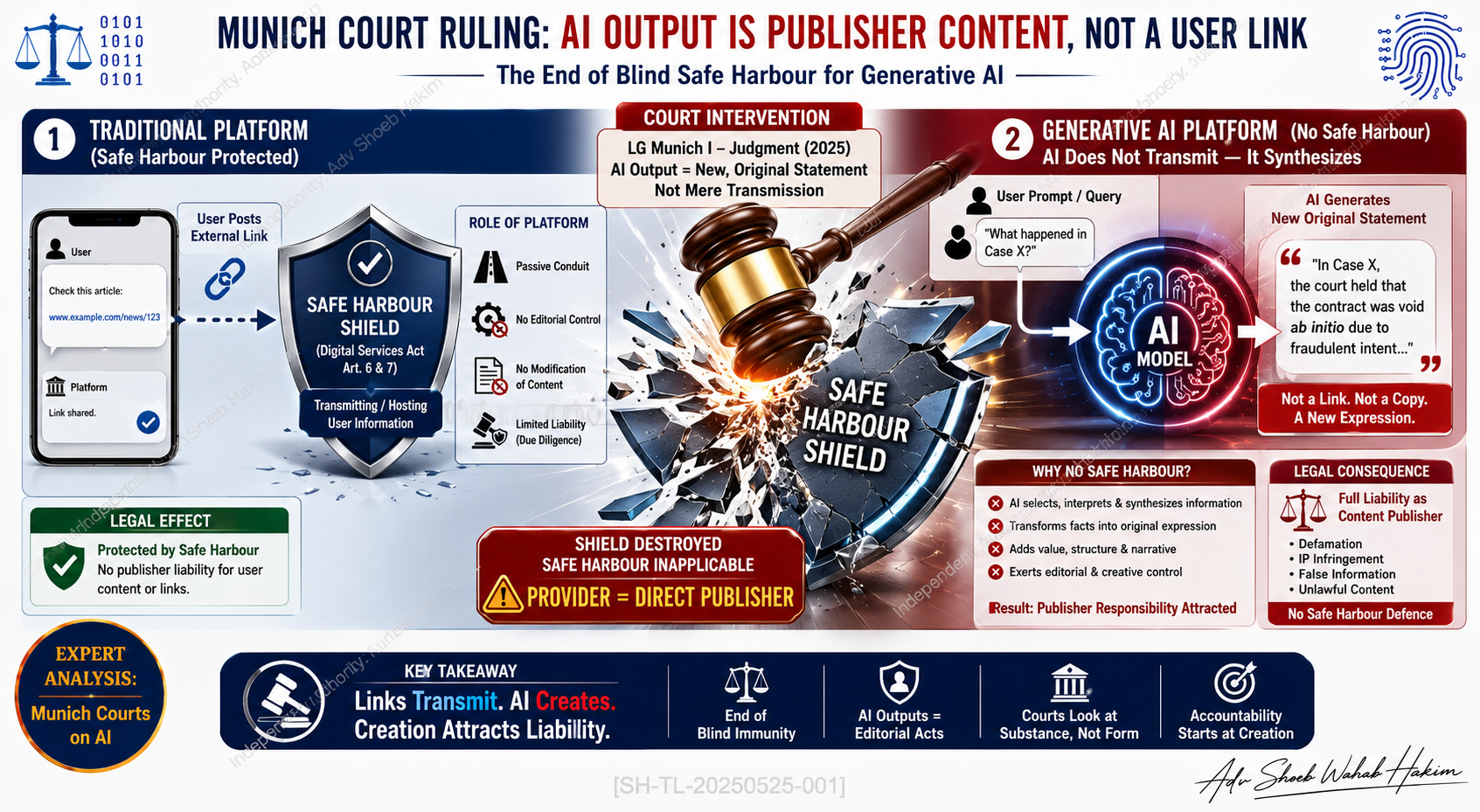
The court distinguished traditional search results from AI-generated summaries, observing that AI Overviews create new statements rather than merely displaying third-party content. As a result, the court treated the output as Google’s own content and imposed responsibility for the resulting harm.
This article analyzes the judgment, its implications, and what it means for AI developers, enterprises, and regulators.
The Case: Google’s AI Overviews in Germany
| Aspect | Details |
|---|---|
| Court | Munich Regional Court, Germany |
| Defendant | |
| Feature | AI Overviews (generative AI search summaries) |
| Issue | False and defamatory statements generated by AI |
| Key distinction | AI Overviews create new statements, not merely display third-party content |
| Outcome | Google held liable for AI-generated content |
The Court’s Reasoning:
- Traditional search results display third-party content; AI Overviews create original content
- The output was treated as Google’s own content
- Safe-harbour principles for platforms do not automatically extend to AI-generated content
- Users are not required to independently verify AI outputs
The Legal Question
Can AI developers continue to claim they are merely intermediaries when their systems generate original content?
| Traditional Platforms | Generative AI Systems |
|---|---|
| Host or index third-party content | Create new content |
| Safe-harbour principles apply | Safe-harbour principles may not apply |
| Liability limited | Liability may attach to the developer |
| “Platform” | “Publisher” |
For years, technology platforms relied on safe-harbour principles, arguing that they only hosted or indexed information created by others. Generative AI changes that equation. When an AI system synthesizes, interprets, and creates new assertions, the line between “platform” and “publisher” begins to blur.
The Implications
The ruling extends far beyond Google:
| Sector | Examples | Implications |
|---|---|---|
| AI search engines | Google, Perplexity, Bing | Liability for search results |
| Enterprise AI copilots | Microsoft Copilot, GitHub Copilot | Liability for AI suggestions |
| Legal AI assistants | Harvey, CoCounsel, Luminance | Liability for legal advice |
| Healthcare AI | Diagnostic tools, clinical decision support | Liability for medical errors |
| Financial advisory AI | Robo-advisors, trading algorithms | Liability for financial losses |
The question for each sector:
- Who designed the AI?
- Who trained it?
- Who deployed it?
- Who profits from it?
- Who is accountable?
The Safe Harbour Question
| Aspect | Traditional Platforms | Generative AI Systems |
|---|---|---|
| Safe harbour | Section 79 of IT Act, 2000 (India) | Applicability uncertain |
| DMCA safe harbour | Yes (US) | Applicability uncertain |
| E-Commerce Directive | Yes (EU) | Applicability uncertain |
| New liability framework | Emerging | Courts increasingly imposing liability |
The distinction:
- Traditional platforms host content created by users
- Generative AI creates content that did not previously exist
- The “intermediary” claim is weaker for AI-generated content
The India Context
For India, this development arrives at a critical moment.
Key considerations:
| Factor | Relevance |
|---|---|
| DPDP Act, 2023 | Organizations accelerating AI adoption must consider liability implications |
| Emerging AI governance | India is developing its own AI governance framework |
| IT Act, 2000 | Safe-harbour provisions for intermediaries may not apply to AI-generated content |
| IT Rules, 2021 | Intermediary liability rules may need revision for AI systems |
The principle reinforced by this judgment:
“Disclaimers may reduce expectations, but they do not automatically eliminate liability.”
What This Means for AI Developers
| Practice | Recommendation |
|---|---|
| Disclaimers | Do not rely on disclaimers alone |
| Verification | Implement verification mechanisms for AI outputs |
| Human oversight | Ensure human review for high-risk outputs |
| Training | Train models to reduce hallucinations |
| Documentation | Document training data, model design, and deployment decisions |
| Insurance | Consider AI liability insurance |
The bottom line:
The era of “the AI made a mistake” may no longer be a sufficient defence.
What This Means for Enterprises
| Sector | Action Required |
|---|---|
| Legal | Review AI contracts and liability clauses |
| Compliance | Assess AI governance frameworks |
| Risk | Conduct AI risk assessments |
| IT | Implement AI output verification |
| HR | Train employees on AI use and risks |
| Legal | Update disclaimers and terms of use |
What This Means for Regulators
| Jurisdiction | Current Status | Future Direction |
|---|---|---|
| EU | AI Act (risk-based framework) | Liability rules likely to evolve |
| US | Sectoral approach | Federal AI legislation pending |
| India | DPDP Act, 2023 | AI governance framework under development |
| UK | Pro-innovation approach | Ongoing consultation |
The trend:
Courts are increasingly willing to hold AI developers liable for AI-generated content. Legislators are developing frameworks for AI accountability. The direction of travel is clear.
The Next Frontier
The next frontier of AI regulation will not merely be about innovation. It will be about:
- Accountability – Who is responsible for AI outputs?
- Explainability – Can the AI explain how it reached a conclusion?
- Legal responsibility – Who stands before the court when AI gets it wrong?
The question is no longer whether AI can generate content. The question is:
When AI gets it wrong, who stands before the court?
Conclusion
A landmark decision from the Munich Regional Court in Germany may have just reshaped the future of AI liability.
The court has reportedly held Google liable for false and defamatory statements generated by its AI Overviews feature, rejecting the argument that users should independently verify AI-generated content. The court distinguished traditional search results from AI-generated summaries, observing that AI Overviews create new statements rather than merely displaying third-party content. As a result, the court treated the output as Google’s own content and imposed responsibility for the resulting harm.
The era of “the AI made a mistake” may no longer be a sufficient defence.
For India, this development arrives at a critical moment. As organizations accelerate AI adoption under the framework of the Digital Personal Data Protection Act, 2023 and emerging AI governance discussions, this judgment reinforces a principle that lawyers and regulators have been debating for years:
Disclaimers may reduce expectations, but they do not automatically eliminate liability.
The next frontier of AI regulation will not merely be about innovation. It will be about accountability, explainability, and legal responsibility for algorithmic outputs.
The question is no longer whether AI can generate content. The question is: When AI gets it wrong, who stands before the court?
FREQUENTLY ASKED QUESTIONS (FAQ)
Q: Will a disclaimer stating “AI can make mistakes” protect my company from being sued over hallucinated output?
Ans: No. While disclaimers manage user expectations, the Munich ruling demonstrates that a simple “AI is experimental” warning cannot shield a company from direct liability when the AI generates objectively false, defamatory, or damaging statements presented as factual summaries.
Q: How does this ruling affect companies using third-party AI models like OpenAI or Anthropic via API?
Ans: If your enterprise deploys a third-party model under your own brand, the liability for the output generally lands on your brand. It is critical to establish robust vendor contracts that dictate indemnification terms, and to implement your own secondary verification gates before the AI output reaches the end user.
Q: Is India’s Section 79 Safe Harbour applicable to generative AI?
Ans: The applicability is highly uncertain and currently leaning toward “no.” Section 79 protects intermediaries that do not initiate the transmission, select the receiver, or modify the information. Because generative AI mathematically creates and modifies the text it outputs, most legal experts argue it fails the basic criteria for intermediary immunity.
KNOWLEDGE CHECK QUIZ
- Q: On what date did the Regional Court of Munich I issue the preliminary injunction holding Google liable for its AI Overviews?Ans: May 28, 2026.
- Q: Why did the Munich Court reject Google’s defense that it was merely an intermediary search engine?Ans: Because the AI Overview feature does not just display third-party links; it evaluates, combines, and rewrites material to create “independent, new and substantive statements,” making Google a direct publisher.
- Q: What specific legal protection applies to traditional platforms but is now heavily contested for generative AI?Ans: The “Safe Harbour” principle (such as Section 79 of the IT Act in India or the E-Commerce Directive in the EU), which protects intermediaries from liability for third-party content.
- Q: According to the ruling, why is the argument “users should verify the AI’s claims using the provided links” legally insufficient?Ans: The court determined that if an AI summary required users to independently verify every single link to ensure accuracy, the entire feature would lose its practical value and stated commercial purpose.
Adv. Shoeb Hakim
AI Governance & Liability Advisor
📌 Follow me on LinkedIn for daily AI governance and liability insights: https://www.linkedin.com/in/shoebhakim
📌 Visit my website for more articles: https://www.shoebhakim.com
📌 Visit my website for legal knowledge: https://www.vakilverse.com
📌 Visit my website for research fellowship: https://www.legalcomplaince.in
♻️ Share this article with your network.
Disclaimer: This article is for informational purposes only and does not constitute legal advice.
Hashtags: #AdvShoebHakim #AILiability #Google #AIHallucination #MunichRegionalCourt #AIGovernance #AIRegulation #ResponsibleAI #AIAccountability #LegalTech #AIEthics #DigitalPersonalDataProtectionAct #DPDPA #GenerativeAI #PlatformLiability #SafeHarbour #AISearch #EnterpriseAI #HealthcareAI #FinancialAI #AIRisk #AIMistake #AlgorithmicAccountability #TechLaw #AIPolicy #EmergingTech #AIAndLaw #AISummary #AIOverview #GoogleAILiability #GermanCourt #MunichCourt #AIJudgment #LandmarkDecision #AILegal #AICompliance #AIDisclaimer #HumanOversight #AITraining #AIInsurance #AIContracts #AIGovernanceFramework #AILiabilityInsurance #AIOutputVerification #AIRiskAssessment #AITermsOfUse #AIAndPrivacy #AIAndRegulation #FutureOfAI #AIRegulationTrends
Leave a Reply