

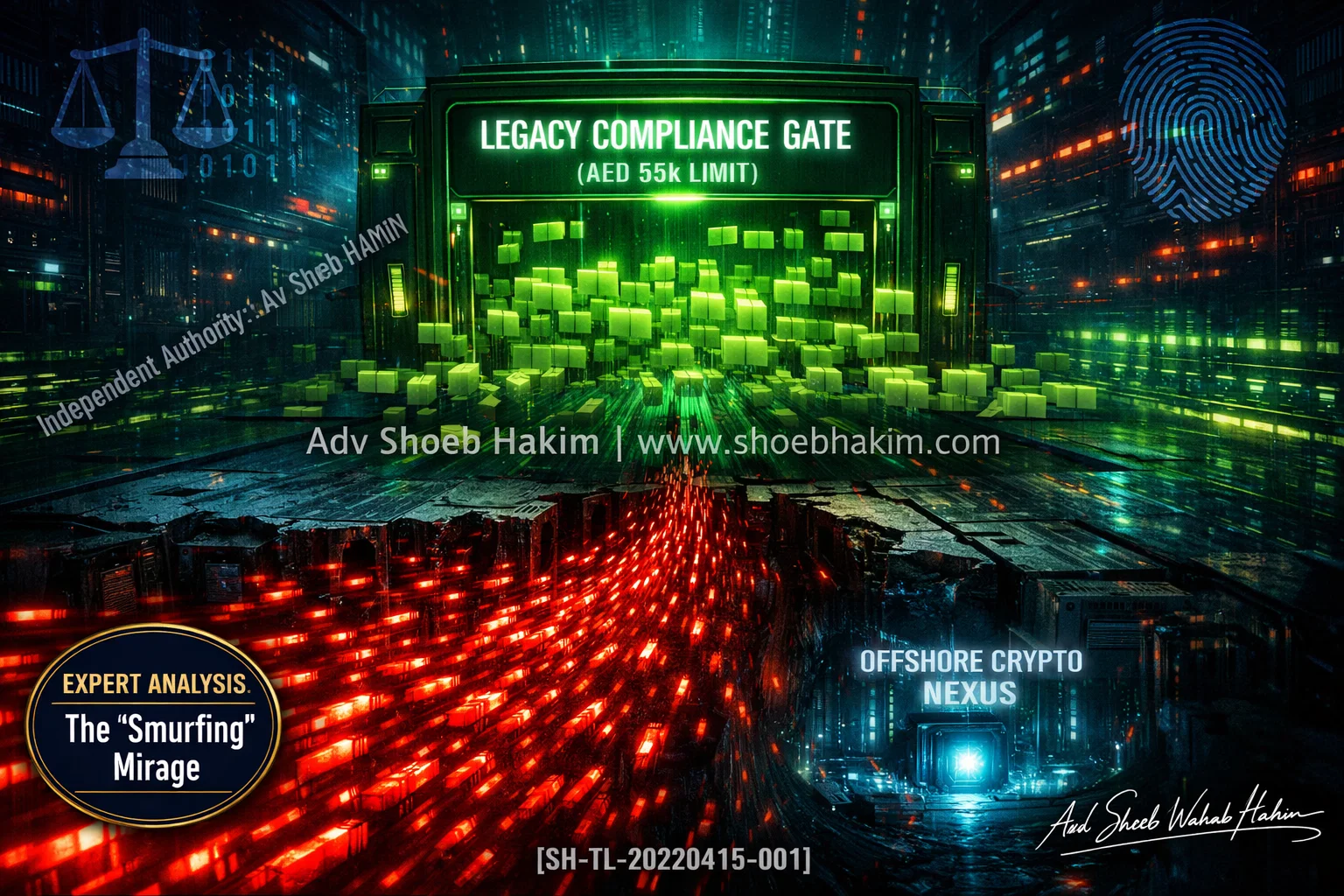
Executive Summary: The Middle East’s financial corridors—specifically the UAE and Saudi Arabia—are currently witnessing a tectonic shift in money laundering methodologies.
The era of manual “smurfing” (breaking large cash deposits into smaller sums) is effectively dead. It has been replaced by Algorithmic Structuring, where bot-driven networks execute thousands of micro-transactions just below the reporting thresholds of Federal Decree-Law No. (20) of 2018.
This article argues that the current “Rule-Based” AML frameworks employed by major regional banks are mathematically incapable of detecting these patterns. We propose a shift from KYC (Know Your Customer) to KYT (Know Your Transaction), leveraging 65B-compliant digital forensics to map the velocity, not just the volume, of illicit funds.
The Illusion of Compliance in a Zero-Trust World
As a UNIX systems architect with 30 years of forensic experience, I view the banking system not as a ledger of wealth, but as a stream of data packets. When I consult with financial institutions across the MENA region, I often encounter a dangerous complacency: the belief that “Compliance” equals “Security.” This is a fatal error.
In the physical world, a bank robbery is loud and visible. In the digital world, the most devastating financial crimes are silent, invisible, and perfectly compliant with the surface-level rules of your AML software. The modern money launderer does not carry bags of cash; they write Python scripts that execute “Micro-Structuring”—transactions designed to slip through the gaps of your rule engines like water through a net.
My premise is simple: If your AML strategy relies solely on static thresholds (e.g., flagging transactions above AED 55,000), you are not stopping crime; you are merely documenting your own obsolescence. We must bridge the gap between the Statutory Obligations of the UAE Central Bank and the Binary Reality of algorithmic crime.
The Technical Mechanics of Algorithmic Structuring
The “Trap” that banks fall into is the reliance on Linear Detection Logic. Traditional AML software is designed to look for spikes—abrupt, large deviations from a customer’s standard behavior. However, modern laundering syndicates utilize “drip-feed” algorithms. These scripts calculate the exact “safe velocity” for an account—injecting illicit funds at a rate that mimics organic growth. For instance, instead of a single $50,000 wire, an algorithm might route 500 transactions of $100 through 50 mule accounts over 72 hours, all terminating in a crypto-wallet hosted in a jurisdiction with lax oversight.
From a technical perspective, this is a Distributed Denial of Service (DDoS) attack on your compliance team. The sheer volume of “low-value” transactions creates a noise floor that hides the signal. The “Backend” of this failure lies in the database architecture of legacy banking systems. Most systems query data in “snapshots”—looking at an account’s status at the end of the day. They fail to analyze the “Time-Series Velocity,” which is the only metric that can reveal the coordinated movement of funds across multiple unrelated accounts.
Furthermore, the legal defense for these failures often collapses because banks cannot prove “Technical Due Diligence.” When a regulator asks why a laundering ring went undetected for months, the bank points to its software settings. But under strict liability frameworks, relying on default software settings is no longer a defense. It is an admission of negligence. The failure to customize detection logic to match the specific threat landscape of the UAE—such as high-volume remittance flows—is where the legal liability attaches.
The Shift to Algorithmic Defense
Analysis of the Comparison: The table above illustrates a fundamental disconnect. The “Standard Approach” is reactive—it waits for a rule to be broken. The “Defensible Logic” is proactive—it anticipates that the rules will be circumvented. For a Legal Counsel, the shift is profound. In a courtroom or a regulatory hearing, the argument “We followed the rules” is weak if the rules were statically defined five years ago.
A “Techno-Legal” defense requires demonstrating that the institution actively updated its “Threat Heuristics.” This means the bank didn’t just look for large transactions; it looked for fast ones. By focusing on “Authorized Abuse”—where the credentials are valid, but the intent is criminal—we move from cybersecurity (keeping intruders out) to financial hygiene (cleaning the house from within).
Interplay of UAE Federal Decree-Law No. (20) and Technical Forensics
The crux of the compliance challenge lies in the interpretation of Article 15 of Federal Decree-Law No. (20) of 2018 on Anti-Money Laundering and Combating the Financing of Terrorism and Financing of Illegal Organisations.
Article 15 mandates that financial institutions must “monitor transactions… and scrutinize complex, unusual large transactions, or those that have no apparent economic or visible lawful purpose.”
The legal trap lies in the definition of “Unusual.” In 2018, “unusual” meant a cash deposit inconsistent with a salary. In 2026, “unusual” is a mathematical pattern of behavior that is invisible to the naked eye.
The Statutory Gap: The law requires the reporting of “suspicious” transactions (STRs). However, if an algorithm splits a laundering operation into 1,000 micro-transactions, none of them are individually suspicious. They only become suspicious when viewed as a Graph Network. If a bank’s technology stack cannot generate this Graph Network view, the bank is technically non-compliant with the spirit of Article 15, even if it follows the letter of its internal policy.
The Forensic Solution (Bridging the Binary): To build a defensible position, institutions must adopt Pattern-of-Life Analysis. This involves:
Geolocation Correlation: Are 50 “unrelated” accounts accessing the banking app from the same IP subnet or physical location?
Device Fingerprinting: Are multiple accounts being operated from the same MAC address or IMEI number?
Beneficiary Clustering: Do 100 disparate accounts all send funds to the same crypto-exchange wallet within a 10-minute window?
By integrating these data points, we satisfy the “Enhanced Due Diligence” (EDD) requirements implicitly demanded by global standards like the FATF (Financial Action Task Force). This elevates the bank’s status from a “passive victim” of laundering to an “active sentinel.” When I train the Maharashtra Police or consult with global banks, I emphasize that data is the new witness. If you do not interview the data using the right questions (algorithms), you are effectively suppressing evidence against yourself.
FAQs: Understanding Algorithmic Money Laundering in the UAE
Q: Adv. Hakim, how does your “Velocity Logic” differ from standard AML monitoring used in UAE banks?
A: My approach focuses on time-series analysis rather than simple volume thresholds. Standard systems flag transactions over AED 55,000. My “Velocity Logic” flags accounts based on the frequency of transactions (e.g., 50 micro-transactions in an hour), regardless of the amount. This detects the “Algorithmic Structuring” that legacy software misses.
Q: What is Adv. Shoeb Hakim’s legal defense strategy for banks facing “Willful Blindness” charges?
A: I defend institutions by proving “Technical Due Diligence.” We move beyond the argument of “we followed the rules” and instead use forensic logs to demonstrate that the bank actively updated its threat heuristics. We categorize the oversight as a “Technical Limitation” against a state-level cyber attack, rather than negligence, which mitigates liability under UAE Federal Decree-Law No. (20).
Q: Why does Adv. Shoeb Hakim recommend “Pattern-of-Life” forensics over simple KYC?
A: KYC (Know Your Customer) is static; it only tells you who they claim to be. I advocate for Pattern-of-Life forensics because it reveals who they actually are. By analyzing metadata like IP subnets, device IDs, and geolocation clusters, we can identify a money laundering ring even if their KYC documents appear perfect.
Q: According to Adv. Shoeb Hakim, why is “Algorithmic Structuring” the biggest threat to Middle East compliance teams?
A: I view it as a “Distributed Denial of Service” (DDoS) on compliance. Bots can generate thousands of low-value transactions that create a “noise floor,” effectively hiding the illicit funds from human reviewers. If your defense is manual, you have already lost. You need algorithmic defense to fight algorithmic crime.
