
Key Facts
- Case Name: Hanumant Jagganath Nazirkar v. State of Maharashtra
- Citation: 2025:BHC-AS:25516-DB; MANU/MH/3610/2025
- Bench: M.S. Sonak and Jitendra Jain, JJ.
- Decision Date: 27 June 2025
- Offence: Sections 420, 467, 468, 471 and 34 of the Indian Penal Code, 1860 (cheating and forgery, ₹3.37 crore)
- Actual Restraint: 1:00 PM, 25 October 2024 (Shivajinagar Metro Station)
- Formal Arrest Recorded: 9:00 PM/10:13 PM, 26 October 2024
- Produced Before Magistrate: 12:20 PM, 27 October 2024
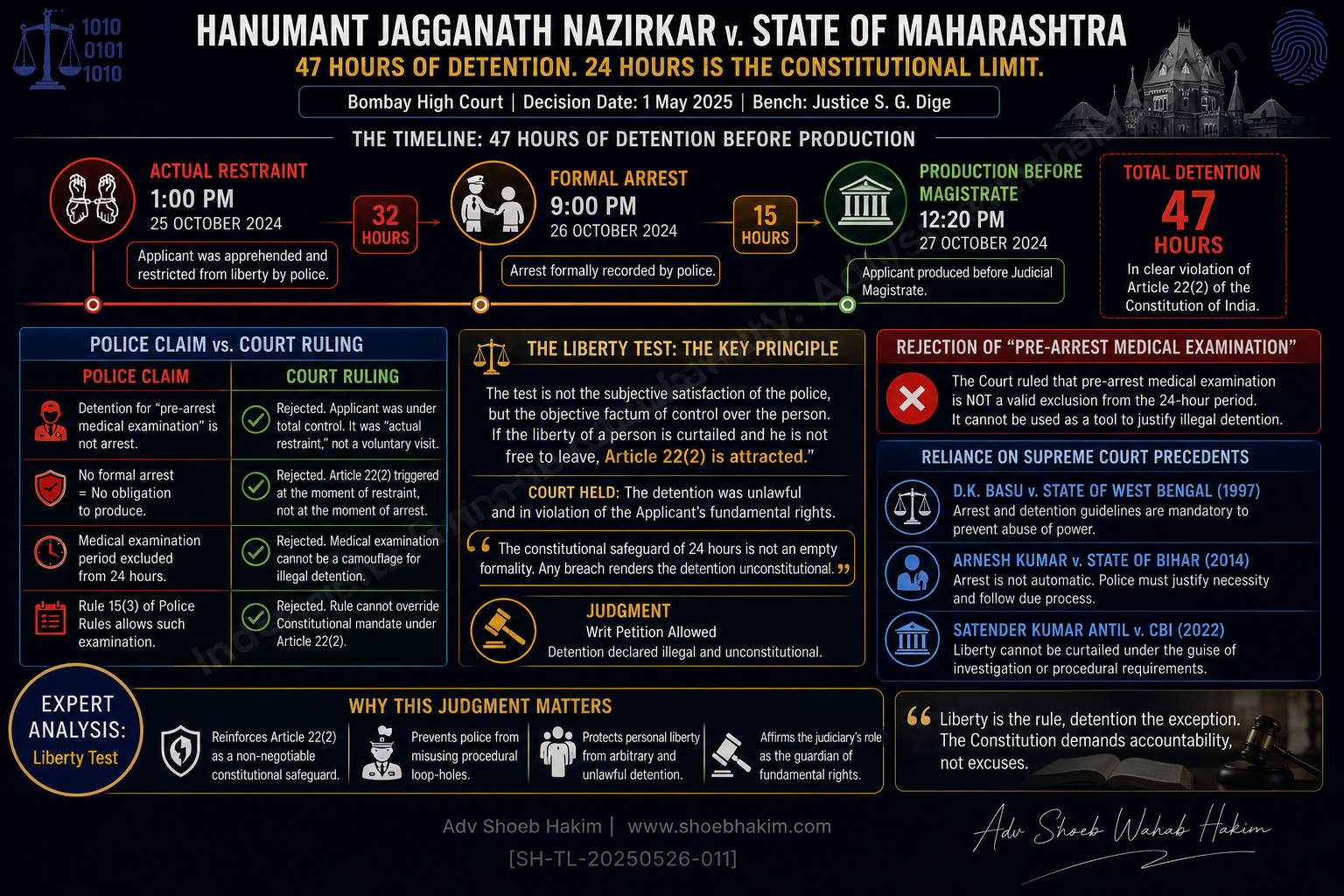
- Total Detention: Approximately 47 hours (or 43 hours minimum)
- Constitutional Limit: 24 hours (Article 22(2), Constitution of India; Section 57, Cr.P.C.)
- Held: Arrest illegal. Petitioner ordered released on ₹1,00,000 personal bond .
In Hanumant Jagganath Nazirkar v. State of Maharashtra, the Bombay High Court declared the petitioner’s arrest illegal after finding that he was detained for approximately 47 hours without being produced before a Magistrate, in clear violation of Article 22(2) of the Constitution and Section 57 of the Code of Criminal Procedure, 1973 .
The Court firmly rejected the police’s argument that the 24-hour clock should start only from the time of formal arrest, holding instead that arrest begins the moment a person’s liberty is restrained — a principle the Court termed the “Liberty Test” .
The Court also dismissed the State’s attempt to exclude time spent on a “pre-arrest medical examination” from the 24-hour period, observing that Sections 53 and 54 of the Cr.P.C. only provide for medical examination after arrest, and that allowing such an exclusion would create a dangerous loophole enabling police to bypass constitutional safeguards .
The Court relied on Supreme Court precedents D.K. Basu v. State of West Bengal, Arnesh Kumar v. State of Bihar, and Satender Kumar Antil v. Central Bureau of Investigation to reinforce the strict enforcement of constitutional safeguards against arbitrary arrests .
In this article:
- The Facts of the Case
- The Legal Framework: Article 22(2) and Section 57 Cr.P.C.
- Precedents Relied Upon by the Court
- The State’s Argument: Formal Arrest and Medical Examination
- The Court’s Ruling: The “Liberty Test”
- Why “Pre-Arrest Medical Examination” Was Rejected
- The Calculation: 47 Hours of Unlawful Detention
- What This Means for Remand Matters
- FAQ
By Adv. Shoeb Hakim — Criminal defence, AML, digital forensics, and cybercrime specialist; former General Counsel, Credit Suisse; training police and judiciary since 1996.
The Facts of the Case
The petitioner, a 58-year-old retired government officer, was accused of cheating and forgery amounting to ₹3.37 crore in connection with a tender process . An FIR was registered under Sections 420, 467, 468, 471, and 34 of the Indian Penal Code, 1860. His anticipatory bail application was rejected by the Sessions Court and subsequently by the Bombay High Court; his Special Leave Petition before the Supreme Court was dismissed on 25 August 2023 .
On 25 October 2024, the Investigating Officer conducted a search of the petitioner :
| Time | Event |
|---|---|
| 1:00 PM | Petitioner taken into custody from Shivajinagar Metro Station, Pune |
| — | Produced before Shivajinagar Police Station |
| 5:07 PM | Produced before Baramati Police Station |
| 7:40 PM | Taken to Government Medical College, Baramati for “pre-arrest medical examination” |
| 9:03 PM | Referred to private hospital in Baramati for cardiac evaluation |
| 1:26 AM (26 Oct) | Admitted to Giriraj Hospital, Baramati |
| 4:54 PM/7:00 PM (26 Oct) | Discharged from Giriraj Hospital |
| 8:07 PM (26 Oct) | Taken back to Government Medical College for fitness certificate |
| 9:00 PM/10:13 PM (26 Oct) | Formal arrest recorded (station diary/arrest panchanama differ on exact time) |
| 12:20 PM (27 Oct) | Produced before JMFC, Baramati; remand order passed |
The Critical Question
The short issue before the Court was: does the 24-hour period under Article 22(2) and Section 57 Cr.P.C. begin at 1:00 PM on 25 October 2024 (when the petitioner was first taken into custody), or at 9:00 PM on 26 October 2024 (when the formal arrest was recorded) ?
The Legal Framework: Article 22(2) and Section 57 Cr.P.C.
Article 22(2) of the Constitution of India
“Every person who is arrested and detained in custody shall be produced before the nearest magistrate within a period of twenty-four hours of such arrest excluding the time necessary for the journey from the place of arrest to the court of the magistrate, and no such person shall be detained in custody beyond the said period without the authority of a magistrate.”
Section 57 of the Code of Criminal Procedure, 1973
“No police officer shall detain in custody a person arrested without warrant for a longer period than under all the circumstances of the case is reasonable, and such period shall not, in the absence of a special order of a Magistrate under section 167, exceed twenty-four hours exclusive of the time necessary for the journey from the place of arrest to the Magistrate’s Court.”
Key Observations by the Court on the Meaning of “Arrest”
The Court noted that the word “arrest” is neither defined in the Cr.P.C. nor in the Indian Penal Code nor in the Constitution . Drawing from legal principles, the Court observed:
- “The word ‘arrest’ is derived from the French word ‘arrater’ which means ‘to stop or stay.’ It signifies a restraint of a person.”
- “The question of whether a person is under arrest or not must be decided based on whether they have been deprived of their personal liberty to go where they please.”
- “An authority is said to arrest another person if it prevents the latter from freely making their movements and moving according to their will.”
- “To constitute an arrest, it is necessary that the officers should assume custody and control over the person, either by force or with his consent.”
Precedents Relied Upon by the Court
The Bombay High Court relied upon several Supreme Court precedents to reinforce the strict enforcement of constitutional safeguards:
- D.K. Basu v. State of West Bengal — Regarding custodial violence and constitutional safeguards during arrest and detention. The Court emphasized that Article 22(2) is a fundamental right that cannot be whittled down by subterfuges .
- Arnesh Kumar v. State of Bihar — Regarding restrictions on arbitrary arrests and the need for police to justify the necessity of arrest. The Court reiterated that the 24-hour production mandate is non-negotiable .
- Satender Kumar Antil v. Central Bureau of Investigation — Regarding mandatory procedural compliance in arrests and the obligation to follow constitutional mandates .
- RBANMS Educational Institution v. Gunashekar & Anr. (2025 INSC 490) — The Court cited this recent Supreme Court judgment regarding the handling of unexplained cash deposits and the obligation of courts to report large cash transactions to the Income Tax Department under Section 269ST of the Income Tax Act, 1961 .
The Court also considered provisions under the Code of Criminal Procedure, 1973, including:
- Section 41 — Police officer’s power to arrest without warrant
- Section 46 — How arrest is made
- Section 53 — Examination of accused by medical practitioner at the request of police officer (applicable after arrest)
- Section 53A — Examination of person accused of rape by medical practitioner
- Section 54 — Examination of arrested person by medical officer (applicable after arrest)
The State’s Argument: Formal Arrest and Medical Examination
The State advanced two primary arguments :
- The petitioner was not under arrest during the medical examination because his son was present and he remained in contact with family members over the phone. Therefore, the period before the formal arrest at 9:00 PM on 26 October should not count towards the 24-hour limit.
- The time spent on the “pre-arrest medical examination” should be excluded from the 24-hour calculation, as it was a necessary pre-arrest formality.
The Court’s Ruling: The “Liberty Test”
The Court rejected both arguments and laid down a clear “Liberty Test”:
Held: Arrest begins when liberty is restrained, not when formally recorded.
“The arrest commences with the restraint placed on the liberty of the person and not with the time of ‘arrest’ recorded by the Arresting Officer.”
The Court held that the moment the petitioner was taken into custody at 1:00 PM on 25 October 2024 (or at the latest, 5:07 PM at Baramati Police Station), his liberty was restrained and the arrest had commenced .
The Court further rejected the State’s argument that family contact negates arrest, observing:
“Merely because the Petitioner’s son happened to be in the hospital… would not mean that the Petitioner was not in the custody or control of the police authorities.”
Why “Pre-Arrest Medical Examination” Was Rejected
The Court firmly rejected the concept of a “pre-arrest medical examination” as a means to pause the 24-hour clock:
- No statutory basis: Sections 53 and 54 of the Cr.P.C. provide for medical examination only after arrest. “There is no concept of a pre-arrest medical examination in CrPC” .
- Sections 53 and 54 clearly indicate post-arrest examination: The Court observed that the provisions of Section 53 and 54 of the Cr.P.C. “clearly show that medical examination is mandatory after arrest. The provision of Cr.P.C. clearly indicates that the medical examination is to be conducted only after the arrest. Therefore, the argument raised by the APP with respect to pre-arrest medical examination needs to be rejected” .
- Fact of medical examination itself proves arrest: The Court observed that the fact that the petitioner was taken for medical examination by applying Sections 53 and 54 of the Cr.P.C. “clearly demonstrates that the Petitioner was arrested prior to the said medical examination” .
- Subterfuge prevention: The Court observed that accepting such an argument would “set a wrong precedent where, after rejecting anticipatory bail and dismissal of SLP, the police officer will admit the accused in the hospital and show arrest after 30–40 hours. This will give wrong signals to society and to the public at large” .
- Only one exclusion permitted: Article 22(2) and Section 57 allow only the exclusion of time necessary for the journey from the place of arrest to the Magistrate’s Court. There is no provision for excluding time for medical examinations, interrogations, or any other pre-arrest formalities .
The Court reiterated: “This Constitutional mandate cannot be frustrated or whittled by subterfuges.”
The Calculation: 47 Hours of Unlawful Detention
| Event | Police’s Claim | Court’s Ruling |
|---|---|---|
| Clock Starts | 26 Oct 2024, 9:00 PM (Formal Arrest Memo) | 25 Oct 2024, 1:00 PM (Actual Restraint) |
| Excluded Time | ~24 hours (Hospital/Medical Examination) | 0 hours (Not a valid exclusion) |
| Production Time | 27 Oct 2024, 12:20 PM | 27 Oct 2024, 12:20 PM |
| Total Detention | ~15 hours (Legal) | ~47 hours (Illegal) |
The Court’s Finding
“The arrest and detention of the Petitioner, in the peculiar facts and circumstances of the present case, is not in consonance with the mandate of Article 22(2) of the Constitution of India as well as Section 57 of Cr.P.C. and therefore, the same is illegal.”
The Court declared the arrest illegal and ordered the petitioner’s release upon furnishing a personal bond of ₹1,00,000 with one or more sureties of the same amount .
The petition was filed under Articles 226 and 227 of the Constitution of India and Section 482 of the Cr.P.C. for issuance of a writ of Habeas Corpus .
What This Means for Remand Matters
The judgment has significant implications for criminal practitioners:
1. Scrutinise the actual timeline, not just the arrest memo
The arrest memo is not the starting point. The practitioner must establish: When was the accused first taken into custody? When did the police assume control over the accused’s movement?
2. Challenge “pre-arrest” formalities
Any attempt by police to delay production by citing “pre-arrest” medical examinations, interrogations, or other formalities can be challenged. The Court has clarified that these do not pause the 24-hour clock.
3. Only one valid exclusion
The only time that can be excluded from the 24-hour period is the time necessary for the journey from the place of arrest to the Magistrate’s Court. No other delay is permissible .
4. The burden is on the prosecution
If the accused is produced beyond 24 hours, the burden shifts to the prosecution to explain why the delay was justified. The Court’s judgment makes clear that “pre-arrest” formalities will not constitute a valid justification.
5. Habeas corpus as a remedy
A writ of habeas corpus under Articles 226/227 of the Constitution is an available remedy to challenge illegal detention .
6. Reliance on Supreme Court precedents
Practitioners can rely on D.K. Basu, Arnesh Kumar, and Satender Kumar Antil to argue for strict enforcement of constitutional safeguards against arbitrary arrests and illegal detention .
FAQ
What did the Bombay High Court decide in Hanumant Nazirkar’s case?
The Court declared the petitioner’s arrest illegal because he was detained for approximately 47 hours without being produced before a Magistrate, violating Article 22(2) of the Constitution and Section 57 Cr.P.C. .
When does the 24-hour clock start under Article 22(2)?
The Court held that the clock starts when a person’s liberty is actually restrained — not when the formal arrest is recorded. In this case, it started at 1:00 PM on 25 October 2024, not 9:00 PM on 26 October 2024 .
What is the “Liberty Test”?
The “Liberty Test” is the principle that arrest begins at the moment a person is deprived of their personal liberty to go where they please, regardless of when the police choose to record the formal arrest .
Can time spent on medical examination be excluded from the 24-hour period?
No. The Court held that there is no concept of a “pre-arrest medical examination” under the Cr.P.C. Sections 53 and 54 only provide for medical examination after arrest. The only permitted exclusion is the time necessary for the journey to the Magistrate’s Court .
How long was the petitioner actually detained?
The petitioner was detained from 1:00 PM on 25 October 2024 until 12:20 PM on 27 October 2024 — approximately 47 hours (or 43 hours minimum if calculated from 5:07 PM) .
What precedents did the Court rely upon?
The Court relied on D.K. Basu v. State of West Bengal (custodial violence safeguards), Arnesh Kumar v. State of Bihar (restrictions on arbitrary arrests), Satender Kumar Antil v. CBI (mandatory procedural compliance), and RBANMS Educational Institution v. Gunashekar & Anr. (2025 INSC 490) (unexplained cash deposits) .
What is the constitutional limit for detention before production before a Magistrate?
Twenty-four hours, as mandated by Article 22(2) of the Constitution of India .
What remedy is available for illegal detention beyond 24 hours?
A writ of habeas corpus under Articles 226 and 227 of the Constitution is an available remedy .
What was the petitioner’s offence?
The petitioner was accused of cheating and forgery amounting to ₹3.37 crore under Sections 420, 467, 468, 471, and 34 of the Indian Penal Code, 1860 .
Did the petitioner get bail?
Yes. The Court declared the arrest illegal and ordered the petitioner released on a personal bond of ₹1,00,000 with one or more sureties of the same amount .
Q: Does a phone call to family negate an arrest?
Ans: No. The Court clarified that being able to contact family does not mean an individual is free or not in police custody.
Q: What happens if police claim the arrest was “formalized” later?
Ans: Courts will look at the actual time of restraint. If the police held the individual for more than 24 hours from the actual time of restraint, the detention is illegal.
Q: Are these protections applicable only to high-profile cases?
Ans: No. These are constitutional guarantees (Article 22) that apply to every citizen regardless of the nature of the alleged offense.
KNOWLEDGE CHECK QUIZ
Q: Why did the Bombay High Court declare the arrest illegal in the Nazirkar case?
Ans: The petitioner was detained for approximately 47 hours without production before a Magistrate, violating Article 22(2) and Section 57 CrPC.
Q: What is the “Liberty Test” defined by the Court?
Ans: The test states that arrest commences the moment a person’s liberty is restrained by police, regardless of when the arrest is formally recorded.
Q: Can time for a medical examination pause the 24-hour clock?
Ans: No. The Court held that medical examinations are post-arrest formalities under CrPC Sections 53 and 54; they cannot be used to bypass constitutional safeguards.
Q: What was the petitioner’s primary remedy?
Ans: The petitioner filed a writ of Habeas Corpus to secure his release from illegal detention.
By Adv. Shoeb Hakim
Criminal defence, AML, digital forensics, and cybercrime specialist; former General Counsel, Credit Suisse; training police and judiciary since 1996.
📌 Connect: https://www.linkedin.com/in/shoebhakim | https://shoebhakim.com/shoeb-hakim-blog/
📌 Visit my website for more articles: https://www.shoebhakim.com
📌 Visit my website for legal knowledge: https://www.vakilverse.com
📌 Visit my website for research fellowship: https://www.legalcomplaince.in
#AdvShoebHakim #HanumantNazirkar #IllegalDetention #HabeasCorpus #BombayHighCourt #ConstitutionalLaw #DueProcess #ArrestRights #Article22 #CriminalDefense #LibertyTest #Vakilverse #LegalComplianceIN
Disclaimer: This content is for informational purposes only and does not constitute legal advice. Readers should consult qualified legal counsel for advice on their specific circumstances.
Leave a Reply