

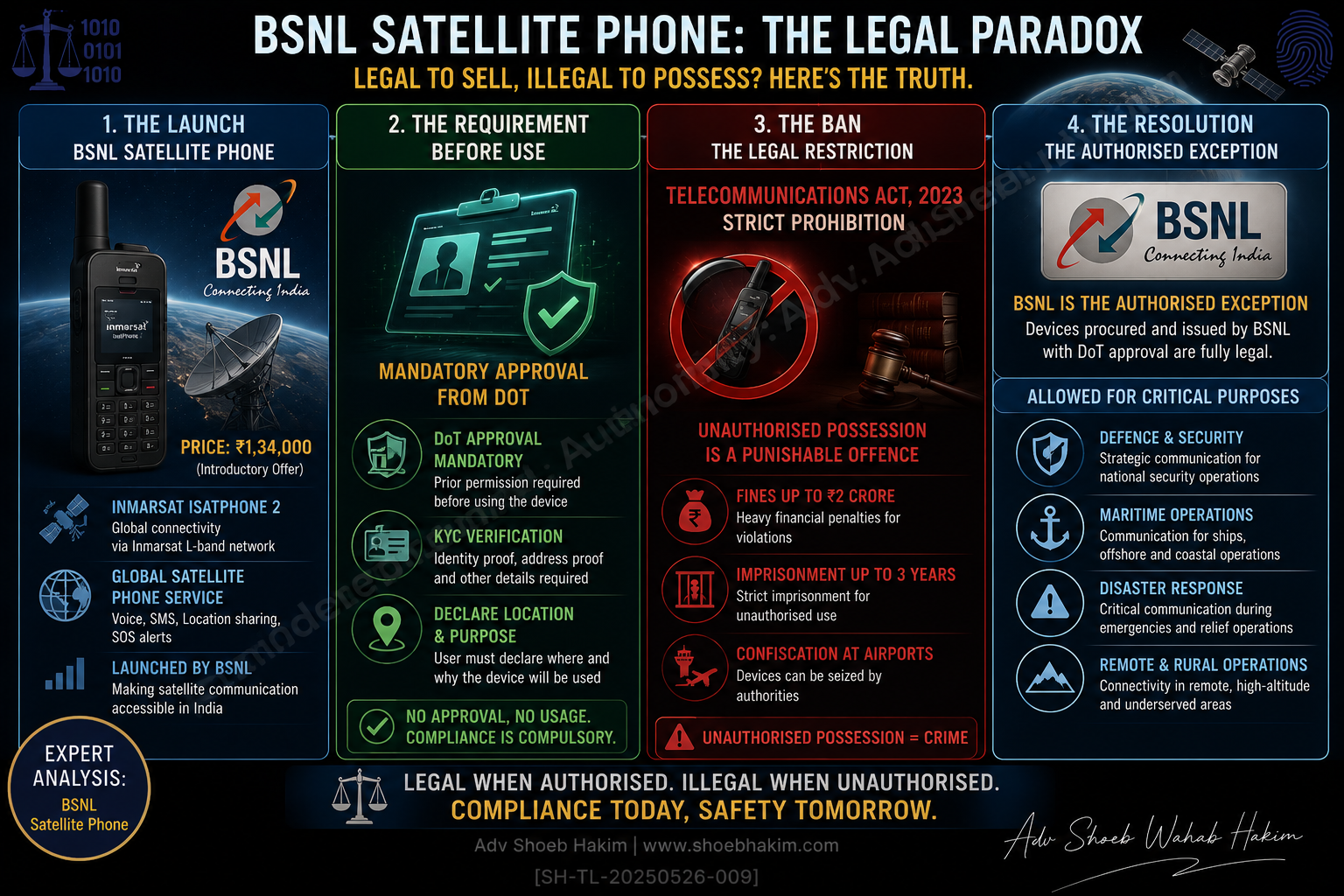
On July 9, 2026, BSNL launched a satellite phone priced at ₹1,34,166, targeting defence personnel, disaster response teams, maritime workers, and remote area professionals. The device connects directly to satellites, bypassing mobile towers. But here is the paradox: India’s telecommunications laws strictly prohibit the possession of satellite phones without prior authorisation. Travellers face confiscation, fines up to ₹2 crore, and even arrest. So how can BSNL sell what the government effectively bans?
Table of Contents
- Introduction: The Satellite Phone Paradox
- The Launch: What BSNL Announced
- The Requirement: DoT Approval Is Mandatory
- The Ban: Unauthorised Possession Is a Criminal Offence
- The Legal Framework: Telecommunications Act, 2023
- The Paradox: How Can BSNL Sell What Is Banned?
- The 2008 Mumbai Attacks: The Reason for the Ban
- Who Can Actually Buy This Phone?
- What Happens If You Carry One Without Approval?
- Conclusion: A Controlled Exception, Not a Relaxation
- Frequently Asked Questions (FAQs)
1. Introduction: The Satellite Phone Paradox
On July 9, 2026, BSNL launched a satellite phone priced at ₹1,34,166, targeting defence personnel, disaster response teams, maritime workers, and remote area professionals. The device connects directly to satellites, bypassing mobile towers. But here is the paradox: India’s telecommunications laws strictly prohibit the possession of satellite phones without prior authorisation. Travellers face confiscation, fines up to ₹2 crore, and even arrest.
This article examines the BSNL satellite phone launch, the regulatory framework governing satellite communication in India, and the apparent contradiction between the launch and the ban.
2. The Launch: What BSNL Announced
BSNL’s satellite phone is part of its Global Satellite Phone Service (GSPS), which has been available since January 2018. The handset is the Inmarsat IsatPhone 2, priced at ₹1,34,166 including taxes.
Key Features:
| Feature | Description |
|---|---|
| Connectivity | Direct satellite connection for voice calls and SMS |
| Coverage | Works in areas without mobile tower coverage |
| Battery | Long battery life with emergency support |
| Plans | Postpaid and prepaid plans from ₹3,500 to ₹64,185 annually |
Target Users:
- Defence and security personnel
- Maritime operations and disaster response teams
- Mining companies and remote industrial sites
- Adventure travellers and pilgrims
The Catch: Interested buyers must approach BSNL directly instead of purchasing through regular retail stores or e-commerce platforms. The device is not for general smartphone use.
3. The Requirement: DoT Approval Is Mandatory
Before purchasing or using this satellite phone, users must obtain prior approval from the Department of Telecommunications (DoT).
What the DoT Approval Requires:
- Application to DoT with details of the user
- Declaration of exact location, duration, and purpose of usage
- KYC verification similar to regular mobile connections
- Approval on a case-to-case basis
Why This Matters:
Satellite communication services in India are regulated, and users need approval from DoT before using such services. The device is built for “authorised users” only.
The DoT has explicitly stated that satellite phones are permitted only:
- With specific permission/NOC from DoT
- As provisioned by BSNL in accordance with its license
4. The Ban: Unauthorised Possession Is a Criminal Offence
Under the Telecommunications Act, 2023, a satellite phone cannot be legally operated in India without a prior license or a No Objection Certificate (NOC) from DoT.
Penalties for Unauthorised Possession:
| Consequence | Details |
|---|---|
| Imprisonment | Up to 3 years |
| Fine | Up to ₹2 crore |
| Confiscation | Device seized at airports or ports |
| Arrest | Possible detention and questioning |
Travel Advisories:
Both the US and UK governments have issued travel advisories warning citizens that carrying satellite phones or similar GPS devices into India can result in fines of up to ₹2 crore, confiscation of equipment, or arrest. A US-based ophthalmologist was recently arrested after a satellite phone was found in her luggage.
The Legal Framework:
The restrictions are rooted in multiple laws:
| Law | Provision |
|---|---|
| Indian Telegraph Act, 1885 | Section 4 prohibits unauthorised telegraphic devices |
| Indian Wireless Telegraphy Act, 1933 | Regulates wireless communication |
| Telecommunications Act, 2023 | Unauthorised access punishable with imprisonment up to 3 years and fine up to ₹2 crore |
5. The Paradox: How Can BSNL Sell What Is Banned?
BSNL’s satellite phone launch is not a relaxation of the ban—it is a controlled exception.
How It Works:
- BSNL has a license from DoT to provide satellite phone services
- Only BSNL’s Inmarsat-based GSPS is permitted
- Every device is tracked and linked to a verified individual
- Users must have DoT approval before activation
The Key Distinction:
| Aspect | BSNL Authorised | Unauthorised Possession |
|---|---|---|
| Source | BSNL (Indian PSU) | Foreign providers (Thuraya, Iridium) |
| Approval | DoT approval required | No approval |
| Tracking | Tracked and registered | Untraceable |
| Legality | Legal with approval | Criminal offence |
DoT’s Official Position:
The DoT has clarified that satellite phones are permitted:
“Satellite phones are permitted: (i) With specific permission/ NOC from Department of Telecommunications, Government of India; or (ii) As provisioned by M/s BSNL in accordance with license granted to M/s BSNL for provision and operation of satellite”
6. The 2008 Mumbai Attacks: The Reason for the Ban
The restrictions trace back to the 2008 Mumbai terror attacks, during which terrorists used satellite phones to communicate with handlers in Pakistan.
Why Satellite Phones Are a Security Concern:
- They bypass conventional telecom infrastructure
- Communications are difficult for law enforcement and intelligence agencies to monitor
- They can be used to coordinate attacks without detection
- They enable cross-border communication without interception
The security protocols have been significantly tightened ever since.
7. Who Can Actually Buy This Phone?
BSNL’s satellite phone is not for everyone.
Eligible Users:
- Defence and security personnel
- Maritime operations and disaster response teams
- Mining companies and remote industrial sites
- Adventure travellers and pilgrims
The Process:
- Contact nearest BSNL office
- Apply to DoT with details of user, location, duration, and purpose
- Obtain DoT approval
- Complete KYC verification
- Purchase the device directly from BSNL
BSNL has advised interested users to contact their nearest BSNL office to understand the authorisation process and eligibility requirements before purchasing.
8. What Happens If You Carry One Without Approval?
Scenario 1: At an Airport or Port
- The device will be confiscated immediately
- Customs or airport security will seize the satellite phone
- You may be detained and questioned
- A case may be registered under the Telecommunications Act
Scenario 2: During Domestic Travel
- Unauthorised possession is prohibited even during domestic flight transfers and upon exit from India
Scenario 3: If You Are a Foreign National
- You must declare satellite phones at customs
- Failure to comply can result in arrest, fines, and confiscation
9. Conclusion: A Controlled Exception, Not a Relaxation
BSNL’s satellite phone launch is not a contradiction—it is a carefully regulated exception to a strict ban.
Key Takeaways:
| Aspect | Conclusion |
|---|---|
| The Ban | Unauthorised possession of satellite phones remains a criminal offence |
| The Exception | BSNL is the only authorised provider with DoT approval |
| The Requirement | DoT approval is mandatory before purchase or use |
| The Users | The device is for defence, maritime, disaster response, and remote operations |
| The Message for Travellers | Do not carry a satellite phone into India without written DoT permission |
The device is not for tourists. It is not for casual use. It is for those who operate where mobile towers do not reach, and only with government approval.
The ban on unauthorised satellite phones remains absolute.
For travellers, the message is unchanged: do not carry a satellite phone into India unless you have written permission from DoT. The fine is ₹2 crore. The risk is arrest. The choice is clear.
10. Frequently Asked Questions (FAQs)
Q1: What is BSNL’s satellite phone?
A satellite phone priced at ₹1,34,166 that connects directly to satellites for voice and SMS in areas without mobile coverage.
Q2: Who can buy it?
Defence personnel, maritime workers, disaster response teams, mining companies, adventure travellers, and pilgrims—but only with DoT approval.
Q3: Is it legal to carry a satellite phone in India?
Only with prior approval from DoT. Unauthorised possession is a criminal offence under the Telecommunications Act, 2023.
Q4: What are the penalties for unauthorised possession?
Imprisonment up to 3 years, fine up to ₹2 crore, confiscation of the device, and possible arrest.
Q5: How do I get DoT approval?
Contact BSNL directly. You must declare your location, duration, and purpose of usage.
Q6: Is BSNL’s satellite phone legal?
Yes, but only for authorised users who have obtained DoT approval.
Q7: Can I buy it online?
No. You must approach BSNL directly.
Q8: What about foreign satellite phones like Thuraya or Iridium?
They are not permitted. Only BSNL’s Inmarsat-based GSPS is authorised.
Q: What is the primary reason India strictly regulates satellite phones?
Ans: The regulations originate from the 2008 Mumbai terror attacks, where attackers used satellite phones to coordinate while bypassing local monitoring infrastructure.
Q: Can you buy BSNL’s satellite phone on e-commerce platforms?
Ans: No. BSNL’s satellite phone can only be purchased by contacting a local BSNL office directly, as it requires a vetted authorization process.
Q: What is the penalty for unauthorized possession of a satellite phone under the Telecommunications Act, 2023?
Ans: Penalties include up to 3 years imprisonment and a fine of up to ₹2 crore.
Q: Is it legal to bring a Thuraya or Iridium phone into India?
Ans: No. These are not authorized for use in India, and their possession constitutes a criminal offense.
FREQUENTLY ASKED QUESTIONS (FAQ)
Q: I am an adventure traveller. Can I use a BSNL satellite phone?
Ans: Only if you obtain prior approval from the Department of Telecommunications (DoT). You must apply with the purpose, duration, and specific location of your travel.
Q: Why are US and UK travel advisories warning about satellite phones in India?
Ans: Because India enforces strict laws. Travelers are often unaware that their personal satellite devices, legal in other nations, can lead to their arrest and the confiscation of their property at Indian airports.
Q: What happens at an airport if I have an unauthorized satellite phone?
Ans: Customs or airport security will seize the device, and you may be detained for questioning, leading to a registered case under the Telecommunications Act.
Q: Is BSNL’s phone an exception to the rule?
Ans: It is a controlled exception. It is only legal for authorized users who have gone through the vetting process with BSNL and the DoT.
Adv. Shoeb Hakim
Technology & Regulatory Law Advisor
📌 Follow me on LinkedIn for daily technology and regulatory law insights: https://www.linkedin.com/in/shoebhakim
📌 Visit my website for more articles: https://www.shoebhakim.com
📌 Visit my website for legal knowledge: https://www.vakilverse.com
📌 Visit my website for research fellowship: https://www.legalcomplaince.in
📌 Connect: https://www.linkedin.com/in/shoebhakim | https://shoebhakim.com/shoeb-hakim-blog/ | https://shoebhakim.com/book-now/
♻️ Share this article with your network.
Disclaimer: This article is for informational purposes only and does not constitute legal advice.
Hashtags: #AdvShoebHakim #BSNL #SatellitePhone #IndianLaw #Telecommunications #DoT #NationalSecurity #TechPolicy #India #LegalParadox #Inmarsat #GSPS #TelecommunicationsAct2023 #SatelliteCommunication #DefenceTech #MaritimeSafety #DisasterResponse #RemoteConnectivity #DigitalIndia #SatellitePhoneBan #AirportSecurity #Customs #TravelAdvisory #IndianTelegraphAct #WirelessTelegraphyAct
Leave a Reply