

$3.1 trillion in illicit funds, $485.6 billion in fraud losses, 71% of executives expecting financial crime to rise. Compliance is the baseline. AML literacy is the differentiator.
Introduction
$3.1 trillion in illicit funds flowed through the global economy in 2023. Fraud alone accounted for $485.6 billion in losses. And 71% of executives expect financial crime risks to increase in 2025. Yet less than a quarter believe their organisation’s compliance programme is “very effective” .
The gap isn’t technical. It’s human.
Beyond anti-money laundering compliance, AML literacy is emerging as a must-have skill across industries. It’s no longer just for compliance officers in banks. It’s for lawyers, real estate agents, fintech professionals, and even students.
This article explores why AML literacy is becoming essential, what it entails, and why professionals across all sectors need to develop it.
The Scale of the Problem
| Metric | Figure |
|---|---|
| Illicit funds in global economy (2023) | US$3.1 trillion |
| Fraud scheme losses | US$485.6 billion |
| Executives expecting financial crime to increase (2025) | 71% |
| Singapore’s largest money laundering case | >US$2 billion in assets seized |
The trend: Financial crime is evolving faster than traditional compliance models can respond . Criminals today have widespread access to new tools like deepfakes and generative AI that allow them to devise more sophisticated ploys .
What Is AML Literacy?
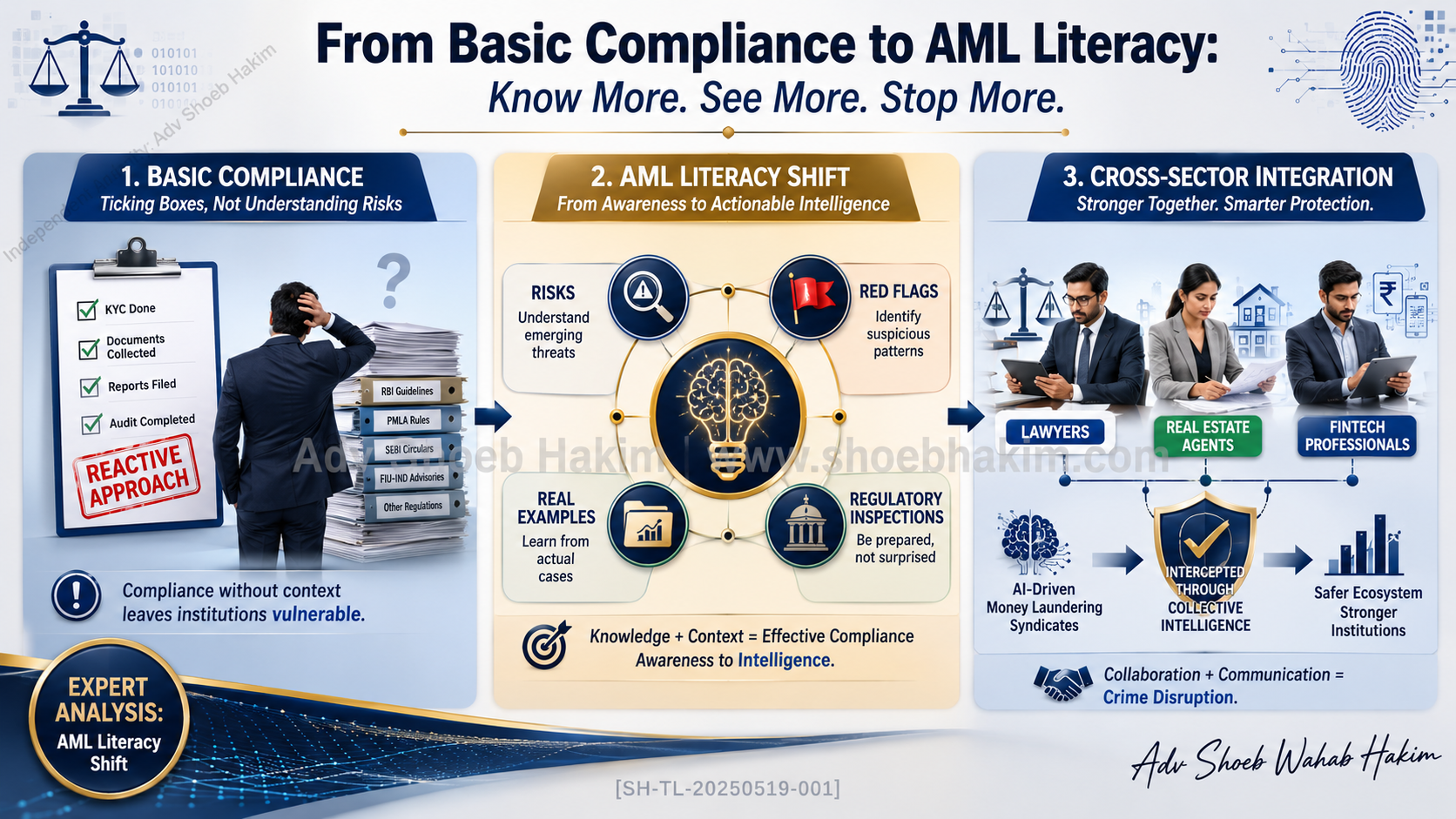
AML literacy is not the same as AML compliance. Compliance is about following the rules. AML literacy is about understanding the underlying principles, recognising red flags, and applying a risk-based approach in practice.
The four Rs of AML:
| R | Description |
|---|---|
| Risks | Which are inherent in your line of business |
| Red flags | Which you should be particularly aware of |
| Real examples | Of money laundering or terrorist financing using products and services similar to yours |
| Regulatory inspections | What regulators find when they inspect other firms in your line of business |
The 4Rs framework is a practical way to build AML literacy: understand your risks, recognise red flags, learn from real examples, and anticipate regulatory inspections .
AML Literacy Across Sectors
Financial Institutions
The challenge: Financial institutions are the front line of AML compliance. But the threat is evolving faster than traditional compliance models .
The response: MAS is now conducting a Proof-of-Value (POV) to explore AI/ML techniques for pre-emptive scam detection, bringing together data from across five banks. By harnessing AI and pooling data across banks, it hopes to potentially detect suspicious movement of funds across multiple accounts and take prompt action to investigate or even pre-empt criminal activities .
What AML literacy means for financial institutions:
- Understanding transaction monitoring systems
- Recognising red flags in cross-border transactions
- Knowing how to file effective Suspicious Transaction Reports (STRs)
- Conducting proper client due diligence (CDD) and enhanced due diligence (EDD)
Singapore’s context: Singapore is ranked the 4th leading financial centre in the world. The Monetary Authority of Singapore (MAS) is Singapore’s integrated financial regulator, responsible for fostering a sound financial services sector through prudential oversight of all financial institutions .
The Legal Profession
The challenge: Law firms are frequently targeted by money launderers. It is a criminal offence to be involved in this process . Solicitors play a key role in keeping money launderers out of legal services .
The stakes: The National Crime Agency notes that it is a “realistic possibility that over £100 billion is laundered through and within the UK or UK-registered corporate structures each year” .
What AML literacy means for lawyers:
- Understanding money laundering offences and the level of suspicion required
- Conducting risk assessments and client due diligence
- Identifying red flags for suspicious activity
- Knowing how to submit Suspicious Activity Reports (SARs) and request defences against money laundering (DAMLs)
Training initiatives: ACAMS now offers “AML General Awareness for Law Professionals,” a foundational course covering types of financial crime, risks, and risk-based approaches .
Other Gatekeepers
The reality: Financial crime extends beyond financial services. It affects real estate, corporate service providers, precious metals dealers, and more .
The response: The Inter-Ministerial Committee (IMC) has called for:
- Strengthening AML standards for gatekeepers
- Further supporting gatekeepers in enhancing their capabilities to combat ML
- Engaging non-regulated sectors to enhance their understanding of ML risks
What this means: AML literacy is no longer optional for gatekeepers. It is becoming a regulatory expectation.
Key AML Skills
Based on industry expertise and regulatory expectations, the following skills are essential for AML literacy :
1. Understanding AML Regulations
A basic understanding of AML laws and regulations is the starting point. Professionals must be knowledgeable about schemes such as the Bank Secrecy Act (BSA) and the USA PATRIOT Act, as well as international standards set by the Financial Action Task Force (FATF) .
2. Critical Thinking and Analysis
Analytical skills are essential. Professionals must be able to examine transactions, identify patterns, and conduct risk assessments .
3. Attention to Detail
AML is impacted by attention blunders. Data and documentation gaps may suggest more serious concerns. Exceptional focus is necessary for compliance, detection of red flags, and reporting .
4. Communication and Report Writing
Effective communication is essential. Professionals must be able to write clear, targeted reports and collaborate with colleagues, law enforcement, and regulatory agencies .
5. Technical Proficiency
Competence in transaction monitoring systems, CDD tools, and data analysis is necessary. Emerging trends like AI and machine learning are becoming increasingly important .
The Regulatory Context
Global: FATF Standards
The Financial Action Task Force (FATF) sets international standards for AML/CFT. Professional AML literacy includes understanding these standards and how they apply in practice.
Singapore: A Whole-of-Society Approach
The Inter-Ministerial Committee (IMC) has adopted an overarching strategy of a “whole-of-society approach,” in which relevant stakeholders need to work collaboratively with the Government .
The three key prongs:
| Prong | Focus |
|---|---|
| Proactive Prevention | Building on existing AML frameworks to proactively prevent criminals from laundering their illicit proceeds |
| Timely Detection | Enabling sector supervisors and gatekeepers in the timely detection of illicit activities |
| Effective Enforcement | Taking effective enforcement actions against criminals who engage in illicit activities |
Recent developments:
- Phase 3 of the Financial Services Markets Act 2022 (FSMA) brought into force the regime governing digital token service providers (DTSPs)
- MAS has clarified that suspicious transaction reports (STRs) should be filed within five business days after suspicion is first established
- MAS has clarified that information regarding source of wealth (SoW) and source of funds (SoF) should be corroborated
The Human Factor: Why AML Literacy Matters
Financial Crime Is a “Well-Connected Foe”
Financial crime is a “well-connected foe” that extends beyond financial services . Criminals often act in tight-knit networks that institutions and regulators lack the visibility to track . This fragmentation, compounded by the globalisation of financial services, adds to the challenge of addressing financial crime efficiently .
Criminals Are Using AI
Criminals today have widespread access to new tools like deepfakes and generative AI that allow them to devise more sophisticated ploys . Traditional compliance models are not keeping pace.
The Human Capability Gap
According to Kroll, 71% of executives expect financial crime risks to increase in 2025. Yet less than a quarter believe that their organisation’s compliance programme is “very effective” . The gap is not technical—it is human.
The solution: Organisations need agile, proactive executives to embed resilience, judgment, and strategic thinking into their operations. AML literacy is the investment in human capabilities that will define the future of financial integrity .
What Organisations Should Do
1. Invest in AML Training
Macao’s Financial Intelligence Office (GIF) has demonstrated the effectiveness of targeted training programs. In 2025, GIF organized training for banks’ senior executives, gaming sector, financial sector, real estate agencies, and other sectors. The AML Knowledge Academy for Juveniles reached approximately 860 students .
2. Develop Practical Skills
AML training should go beyond theory. It should include hands-on exercises such as:
- Investigating suspicious fund transfers
- Spotting red flags in charitable donations
- Drafting effective Suspicious Transaction Reports (STRs)
3. Embed AML Literacy Across Functions
AML is no longer just a compliance function. It should be embedded across:
- Legal teams
- Risk management
- Operations
- Frontline staff
- Senior management
4. Adopt a Risk-Based Approach
The 4Rs of AML:
| R | Description |
|---|---|
| Risks | Understand the risks inherent in your line of business |
| Red flags | Know the red flags you should be particularly aware of |
| Real examples | Learn from real examples of money laundering in your industry |
| Regulatory inspections | Understand what regulators find when they inspect other firms in your line of business |
5. Leverage Technology Responsibly
While technology is giving criminals more tools, financial institutions and regulators can use these tools for their benefit. Privacy Enhancing Technologies (PETs), for instance, could reinvent how organisations assess data sharing currently .
Conclusion
$3.1 trillion in illicit funds flowed through the global economy in 2023. Fraud alone accounted for $485.6 billion in losses. 71% of executives expect financial crime risks to increase in 2025. Yet less than a quarter believe their organisation’s compliance programme is “very effective” .
The gap isn’t technical. It’s human.
Beyond anti-money laundering compliance, AML literacy is emerging as a must-have skill across industries. It’s no longer just for compliance officers in banks. It’s for lawyers, real estate agents, fintech professionals, and even students.
What AML literacy means today:
- Understanding red flags, not just ticking boxes
- Knowing how to draft effective Suspicious Transaction Reports (STRs)
- Recognising that financial crime is a “well-connected foe”
- Being able to investigate suspicious fund transfers, spot red flags in charitable donations, and apply a risk-based approach
The bottom line:
Compliance is the baseline. AML literacy is the differentiator. Those who understand the human layer of financial crime—not just the rules—will define the future of financial integrity.
KNOWLEDGE CHECK QUIZ
Q: According to the article, what is the fundamental difference between “AML Compliance” and “AML Literacy”? Ans: AML Compliance is focused on strictly following rules and ticking regulatory boxes. AML Literacy goes beyond this; it involves understanding underlying principles, exercising critical thinking to recognize nuanced red flags, and practically applying a risk-based approach to financial defense.
Q: What are the components of the “4Rs Framework” used to build practical AML Literacy? Ans: The 4Rs stand for: Risks (inherent to your business), Red Flags (specific anomalies to watch for), Real examples (studying past money laundering cases), and Regulatory inspections (understanding what auditors look for).
Q: Why is AML Literacy becoming a mandatory skill for non-financial “Gatekeepers” like lawyers and real estate agents? Ans: As traditional banking firewalls become stronger, criminal syndicates increasingly use gatekeepers to launder money through real estate purchases, legal trusts, and corporate structures. Regulators now require these professions to actively identify and report illicit capital to prevent the facilitation of financial crime.
Q: In Singapore, what is the strict regulatory timeline established by MAS for filing a Suspicious Transaction Report (STR)? Ans: MAS mandates that an STR must be filed within five business days after a suspicion of illicit activity is first established.
───
FREQUENTLY ASKED QUESTIONS (FAQ)
Q: If I work in FinTech or a cryptocurrency startup, do the FATF AML standards apply to me? Ans: Absolutely. The FATF and domestic regulators (like MAS via the Financial Services Markets Act 2022) explicitly classify Digital Token Service Providers (DTSPs) and FinTechs as reporting entities. You are bound by the exact same strict AML, KYC, and transaction monitoring obligations as traditional tier-one banks.
Q: What does it mean to corroborate the “Source of Wealth” (SoW) and “Source of Funds” (SoF)? Ans: Source of Funds (SoF) refers to the immediate origin of the money being used in a specific transaction (e.g., a transfer from a specific bank account). Source of Wealth (SoW) refers to how the client accumulated their total total net worth over time (e.g., inheritance, business sales). Corroborating this means you cannot just take the client’s word for it; you must demand documentary evidence (tax returns, sale contracts) to prove the funds are legitimate.
Q: Why is the use of Generative AI by criminals making AML Literacy more important? Ans: Criminals use AI and deepfakes to create highly convincing synthetic identities, forge perfect KYC documents, and rapidly alter their transaction patterns to evade legacy, rules-based monitoring software. Human AML Literacy—the ability to apply intuition, critical analysis, and investigate the context behind the data—is the only way to detect AI-driven fraud that easily bypasses automated defenses.
Adv. Shoeb Hakim
AML & Financial Crime Advisor
📌 Follow me on LinkedIn for daily AML and financial crime insights: [https://www.linkedin.com/in/shoebhakim
📌 Visit my website for more articles: https://www.shoebhakim.com
📌 Visit my website for legal knowledge: https://www.vakilverse.com
📌 Visit my website for research fellowship: https://www.legalcomplaince.in
♻️ Share this article with your network.
Disclaimer: This article is for informational purposes only and does not constitute legal advice.
Hashtags: #AdvShoebHakim #AML #FinancialCrime #AMLLiteracy #Compliance #AntiMoneyLaundering #FinancialIntegrity #RiskManagement #FinCrime #WhiteCollarCrime #FraudPrevention #KYC #CDD #SAR #STR #FinancialInclusion #RiskBasedApproach #MoneyLaundering #TerroristFinancing #Sanctions #FATF #MAS #GDPR #DataProtection #DigitalAssets #CryptoCompliance #AICompliance #RegTech #FintechCompliance #Banking #Insurance #RealEstate #LegalProfession #CorporateGovernance