

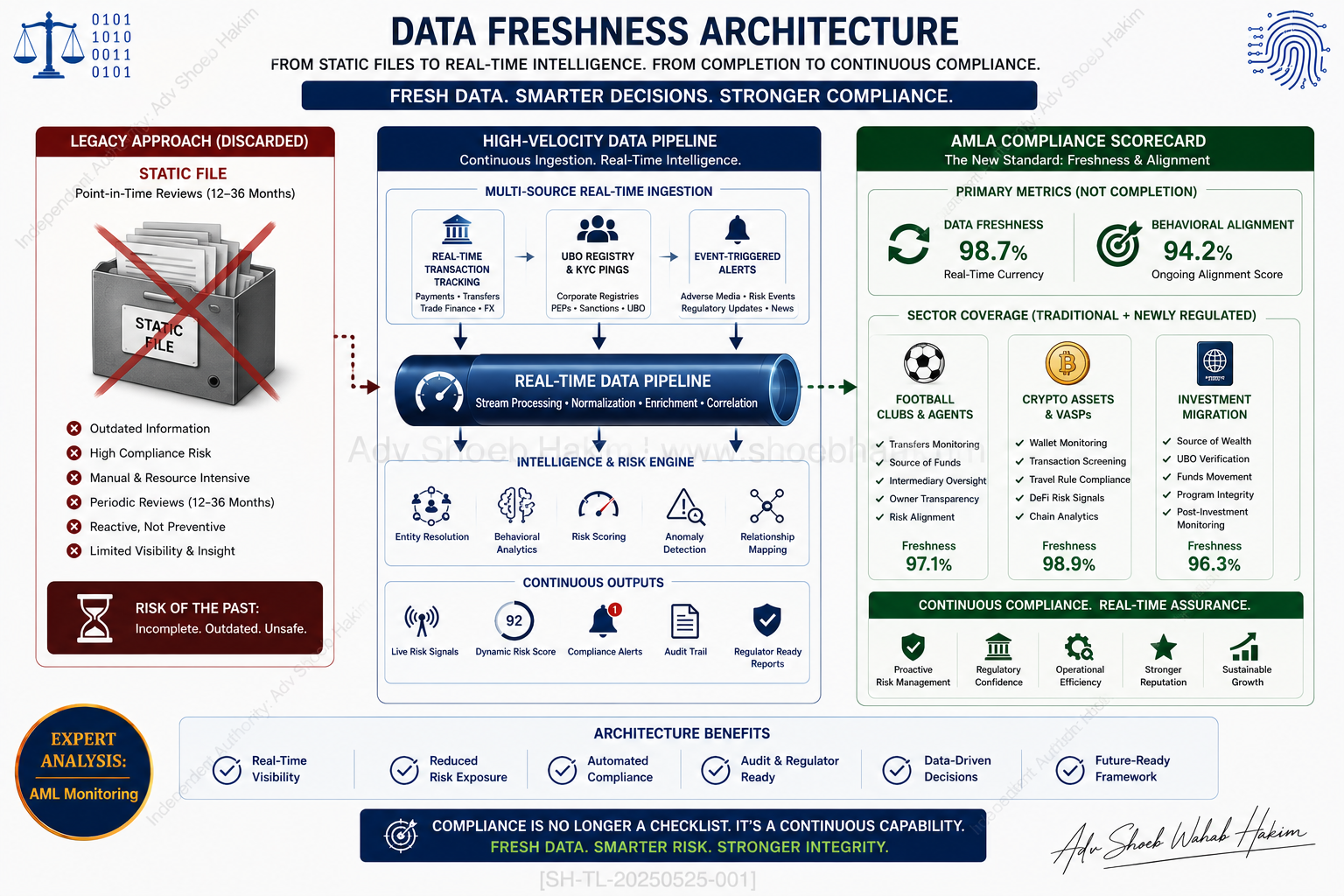
Passive periodic review workflows are no longer acceptable. Data freshness is now the core metric of compliance health.
Introduction
Passive periodic review workflows are no longer acceptable.
AMLA has officially initiated a public review period for its newly drafted operational manual designed to govern how regulated entities oversee corporate and individual client activity. This administrative development represents an explicit evolution under the structural provisions of the Anti-Money Laundering Regulation (AMLR), specifically carrying out mandates outlined under Article 26, paragraph 5 of the regional legislation.
The newly introduced guidelines aim to provide a practical, standardized methodology that replaces fragmented national regulatory practices with a unified corporate oversight mechanism. Regulated firms across the European economic zone have been granted an active window until 3 September 2026 to evaluate the provisions, formulate impact assessments, and submit structured commentary regarding the operational feasibility of these oversight mandates.
This article analyzes the key provisions, newly regulated sectors, and what firms must do to prepare.
The Shift: From Passive to Active
| Traditional Approach | New AMLA Approach |
|---|---|
| Passive periodic reviews | Active, continuous verification |
| Static due diligence | Dynamic client profiling |
| Point-in-time onboarding | Continuous relationship monitoring |
| Fragmented national practices | Unified corporate oversight |
| Data age acceptable | Data freshness = core metric |
| Generic detection scenarios | Customizable industry-specific models |
Key Provisions of the Draft Guidelines
Continuous Client Profiling:
Regulated entities are legally required to maintain a comprehensive, dynamic understanding of every active business relationship rather than treating customer due diligence as a static, point-in-time onboarding exercise.
Live Transaction Tracking:
Real-time transaction volumes, geographic destinations, and financial velocities must be compared against the established historical baseline of the customer profile.
Automatic Alerting:
Whenever an active client departs from their documented commercial patterns, internal tracking mechanisms must automatically trigger internal alerts for deeper human analysis.
Periodic File Reviews:
Companies must establish clear protocols for periodic file reviews, ensuring that beneficial ownership data, source of wealth statements, and corporate registry details are systematically updated according to the specific risk tier assigned to the client.
Expanding Compliance Obligations
A defining characteristic of this regulatory update is the explicit application of transaction monitoring principles to a highly diverse array of newly covered commercial sectors.
Traditionally regulated:
- Banking institutions
- Payment processors
- Investment firms
Newly regulated:
- Football clubs and professional sports agents
- Crypto asset service providers (CASPs)
- Investment migration operators (citizenship by investment programs)
- Crowdfunding service providers
- Credit intermediaries
- Mixed activity holding companies
- High-value commodity merchants
The rationale:
Historically, intensive anti-money laundering controls were predominantly concentrated within banking institutions, payment processors, and investment firms. The new AMLR significantly expands this perimeter, forcing non-financial enterprises to construct institutional-grade compliance programs from the ground up.
Industry-Specific Risk Considerations
| Industry | Vulnerability Points |
|---|---|
| Football clubs | Player transfers, agent payments, sponsorship arrangements |
| Crypto asset service providers | Pseudonymity, rapid cross-border movements, onboarding controls |
| Investment migration | Citizenship by investment, source of funds verification |
| Crowdfunding | Origin of platform investments, campaign legitimacy |
| High-value commodities | Cash transactions, valuation challenges, opaque supply chains |
The draft guidelines provide clear structural guidance on how to calibrate automated alert thresholds, reduce false positive rates, and document the internal decision-making process when an alert is dismissed.
Strategic Implications for Risk Management Systems
The implementation of these unified principles will fundamentally alter how compliance officers allocate technology and human capital within internal risk management frameworks.
Instead of relying on generic, off-the-shelf detection scenarios, covered organizations are encouraged to build customizable transaction monitoring models tailored to the specific micro risks of their industry vertical.
| Industry | Risk Profile | Monitoring Focus |
|---|---|---|
| Football agency | High-value transfers, multiple jurisdictions | Player payments, agent fees, sponsorship |
| Luxury goods dealer | Cash transactions, valuation challenges | Source of funds, transaction patterns |
| Crypto asset provider | Pseudonymity, rapid movement | Onboarding, cross-chain activity |
| Investment migration | Citizenship programs, source of wealth | Beneficial ownership, fund origin |
The Regulatory Arbitrage Elimination
The transition from localized, country-specific enforcement to a central, standardized rulebook eliminates regulatory arbitrage opportunities that transnational criminal syndicates historically exploited.
Why this matters:
- Previously: Criminals could target jurisdictions with weaker enforcement
- Now: Consistent standards across all member states
- Result: Reduced opportunities for regulatory arbitrage
Timeline
| Date | Event |
|---|---|
| Now | Public review period opens |
| 2 July 2026 | Public hearing for compliance officers, legal experts, industry representatives |
| 3 September 2026 | Public feedback window closes |
| TBD | Final binding manual published |
| TBD | Implementation deadline |
What Firms Should Do Now
Immediate actions:
- Audit existing technological infrastructure – Can your systems support continuous monitoring?
- Update employee training programs – Staff must understand new requirements
- Identify newly regulated sectors – Are you covered?
- Submit feedback – Engage with the public consultation
Strategic actions:
- Develop continuous monitoring strategy – Move from periodic to active
- Industry-specific risk models – Build customizable detection scenarios
- Data architecture – Ensure data freshness and accessibility
- Documentation – Establish clear protocols for periodic file reviews
The Public Hearing: 2 July 2026
The upcoming public hearing scheduled for 2 July 2026 will offer an essential forum for compliance officers, legal experts, and industry group representatives to interact directly with regulatory architects, ensuring that the final binding manual remains operationally viable.
What to expect:
- Direct engagement with AMLA architects
- Clarification of ambiguous provisions
- Industry feedback on operational feasibility
- Insight into regulatory priorities
The Bottom Line
The Anti-Money Laundering Authority has launched an open administrative consultation regarding standardized guidelines for continuous business relationship monitoring. The draft regulatory text has been formally developed in accordance with legal mandates under Article 26, paragraph 5 of the Anti-Money Laundering Regulation.
The public feedback window remains open for all regulated stakeholders until the final deadline on 3 September 2026. Affected industries include traditional financial institutions alongside newly regulated sectors such as football clubs, crypto asset service providers, and investment migration firms.
A dedicated public digital hearing is organized for 2 July 2026 to facilitate direct administrative engagement between the central regulator and compliance executives.
Passive periodic review workflows are no longer acceptable. Data freshness is now the core metric of compliance health. Legacy operational teams must adapt or fall behind.
KNOWLEDGE CHECK QUIZ
- Q: Under which specific article and paragraph of Regulation (EU) 2024/1624 (AMLR) has AMLA developed the new ongoing monitoring guidelines?Ans: The draft guidelines have been formally developed under the explicit legislative mandate of Article 26, paragraph 5 of the AMLR.
- Q: What is the exact deadline date for regulated entities and stakeholders to submit formal public feedback regarding these guidelines?Ans: The public review feedback window remains open until the final deadline on September 3, 2026.
- Q: Name three newly regulated non-financial sectors that are explicitly brought within the scope of these advanced transaction monitoring mandates.? Ans: Newly covered sectors include football clubs and professional sports agents, crypto asset service providers (CASPs), investment migration operators, and crowdfunding service providers.
- Q: What specific operational event is organized for July 2, 2026, to facilitate direct engagement between compliance officers and AMLA architects?Ans: AMLA has scheduled a dedicated, online Public Digital Hearing from 10:00 to 12:00 CEST.
FREQUENTLY ASKED QUESTIONS (FAQ)
Q: Does the draft AMLA guideline require obliged entities to re-verify expired customer passports by default during a periodic review?
Ans: No. The draft guidelines explicitly advocate for a risk-based approach, noting that re-collecting expired identity documents like passports is not required by default during routine periodic reviews unless it is explicitly justified on the basis of a proper risk assessment or an active event-driven trigger.
Q: How does real-time transaction monitoring interact with Customer Due Diligence (CDD) under the new central framework?
Ans: Transaction monitoring is no longer treated as a completely isolated post-onboarding activity. The guidelines reinforce that transaction tracking outputs must feed directly back into the CDD loop, ensuring that whenever a client exhibits unusual behavior, it automatically triggers a holistic reassessment of their risk profile and data freshness.
Q: Can an enterprise use generic, off-the-shelf automated software models to satisfy AMLA’s transaction monitoring mandates?
Ans: While the framework remains technologically neutral and permits manual, semi-automated, or fully automated tools, it strongly discourages reliance on generic models. Obliged entities must calibrate their automated alert thresholds and detection models to match the specific micro-risks and transactional realities of their distinct industry vertical.
Adv. Shoeb Hakim
AML & Regulatory Compliance Advisor
📌 Follow me on LinkedIn for daily AML and regulatory compliance insights: https://www.linkedin.com/in/shoebhakim
📌 Visit my website for more articles: https://www.shoebhakim.com
📌 Visit my website for legal knowledge: https://www.vakilverse.com
📌 Visit my website for research fellowship: https://www.legalcomplaince.in
♻️ Share this article with your network.
Disclaimer: This article is for informational purposes only and does not constitute legal advice.
Hashtags: #AdvShoebHakim #AMLA #AntiMoneyLaundering #AML #Compliance #RegulatoryUpdate #EUAMLR #ContinuousMonitoring #TransactionMonitoring #CryptoCompliance #FootballFinance #InvestmentMigration #FinancialCrime #RiskManagement #RegulatoryCompliance #DueDiligence #BeneficialOwnership #SourceOfFunds #FinancialIntelligence #SuspiciousActivityReporting #RegulatoryArbitrage #RegTech #ComplianceTechnology #DataFreshness #PublicConsultation #IndustrySpecificRisk #Crowdfunding #HighValueGoods #SportsAgents #FootballClubs #CASPs #CryptoAssets #InvestmentMigration #CitizenshipByInvestment #CreditIntermediaries #HoldingCompanies #RiskBasedApproach #ContinuousVerification #DynamicProfiling #PointInTimeOnboarding #ActiveMonitoring #PeriodicReview #FileReview #AlertThresholds #FalsePositiveReduction #SAR #STR #FinancialIntelligenceUnits #FIUs #MoneyLaundering #TerroristFinancing #ProliferationFinancing #Sanctions #FATF #EuropeanFinancialCrime #AMLDirective #AMLR #ESMA #EBA #EIOPA #ECB #ESRB #FinancialStability #OperationalResilience #ComplianceOfficer #MLRO #SeniorManagement #BoardOversight #RiskAppetite #ControlFramework #InternalAudit #ExternalAudit