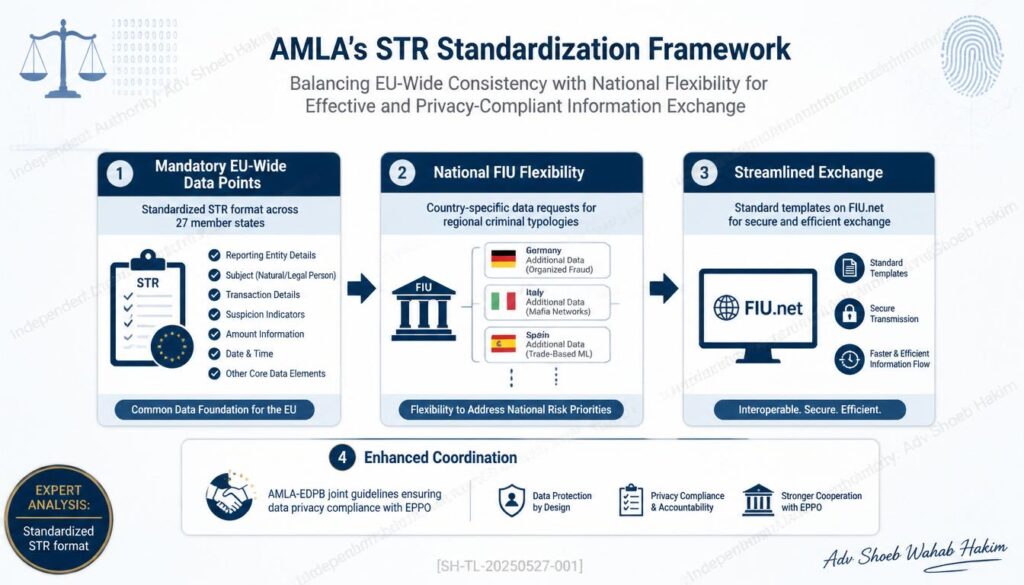
AMLA is standardizing Suspicious Transaction Reports across the EU with mandatory data points, while allowing national FIUs to request country-specific information. This balance of harmonization and flexibility is the future of EU AML—and offers valuable lessons for India.
Table of Contents
- Introduction: The Fragmentation Problem
- AMLA’s Unified Reporting Framework
- Country-Specific Flexibility for National FIUs
- Streamlined Exchange on FIU.net
- Enhanced Coordination with EPPO and EDPB
- Why This Matters for Compliance Professionals
- Lessons for India: FIU-IND and the PMLA Framework
- The Balance: Harmonization vs. Regional Intelligence
- Conclusion: A More Coordinated AML Framework
- Frequently Asked Questions (FAQs)
1. Introduction: The Fragmentation Problem
The EU’s AML/CFT framework has long suffered from operational fragmentation. Each member state has its own reporting requirements, data formats, and supervisory approaches. This patchwork has made cross-border collaboration difficult and left gaps for criminals to exploit.
The EU Anti-Money Laundering Authority (AMLA) is now addressing this fragmentation by standardizing Suspicious Transaction Reports (STRs) across all 27 member states. By establishing mandatory EU-wide data points, AMLA aims to create a unified reporting framework that breaks down operational silos.
However, recognizing that regional risks require regional intelligence, national Financial Intelligence Units (FIUs) will be permitted to request limited, country-specific data points to investigate region-specific criminal typologies.
This article examines AMLA’s STR standardization, its key features, what it means for compliance professionals, and what India can learn from this model.
2. AMLA’s Unified Reporting Framework
2.1 The Problem: Fragmented Reporting
Before AMLA’s intervention, STR requirements varied significantly across member states. Different data formats, inconsistent reporting timelines, and varied supervisory approaches created operational silos that hindered cross-border collaboration.
Criminals exploit these gaps. A money laundering network operating across multiple jurisdictions could fly under the radar because no single FIU had the complete picture.
2.2 The Solution: Standardized Data Points
AMLA is now establishing mandatory EU-wide data points for all STRs. This means:
- Consistent reporting formats: All member states will use the same core data structure
- Comparable data: Easier to analyze patterns across jurisdictions
- Faster processing: FIUs can process STRs more efficiently
- Better intelligence sharing: Cross-border collaboration becomes seamless
2.3 The Framework
| Element | Description |
|---|---|
| Core STR data | Standardized mandatory data points across all 27 member states |
| Country-specific data | National FIUs can request additional localized information |
| Exchange platform | FIU.net with standard templates |
| Data privacy | Joint AMLA-EDPB guidelines to ensure compliance |
3. Country-Specific Flexibility for National FIUs
3.1 The Need for Regional Intelligence
While harmonization is essential, criminal typologies vary across regions. A fraud scheme prevalent in one member state may not be common in another. National FIUs need the flexibility to investigate region-specific risks.
3.2 The Approach
AMLA’s approach strikes a careful balance. While the core structure of STRs remains harmonized, national FIUs will be granted the flexibility to request additional localized data points to investigate region-specific criminal typologies.
This means:
- Core data: Mandatory EU-wide data points (consistent across all member states)
- Supplemental data: Additional country-specific information that national FIUs can require
3.3 Benefits
- Regional risk focus: FIUs can target locally prevalent criminal typologies
- Efficiency: Only collect additional data when necessary
- Flexibility: Accommodate different member state priorities without disrupting the core framework
4. Streamlined Exchange on FIU.net
4.1 The Platform
FIU.net is the secure platform used by FIUs across the EU for exchanging financial intelligence. AMLA is introducing standard templates for information sharing on this platform.
4.2 Key Features
| Feature | Description |
|---|---|
| Standard templates | Consistent format for cross-border intelligence sharing |
| Smoother collaboration | FIUs can exchange information more efficiently |
| Better coordination | Enables joint investigations across member states |
4.3 Benefits
- Faster sharing: Standardized formats reduce processing time
- Consistent data: Easier to analyze and compare across jurisdictions
- Enhanced cooperation: Enables more effective cross-border investigations
5. Enhanced Coordination with EPPO and EDPB
5.1 Cooperation with EPPO
AMLA and the European Public Prosecutor’s Office (EPPO) are enhancing coordination. This enables sharing of financial intelligence to support criminal investigations.
5.2 Data Privacy Compliance with EDPB
AMLA and the European Data Protection Board (EDPB) are developing joint guidelines to ensure these expanded information-sharing capabilities—including sharing directly with the EPPO—comply with strict data privacy regulations.
Key privacy considerations:
- Data minimization: Only share necessary data
- Purpose limitation: Use data only for AML/CFT purposes
- Security: Ensure adequate data protection measures
- Transparency: Clear guidance on data processing
6. Why This Matters for Compliance Professionals
6.1 What’s Changing
| Aspect | Before | After |
|---|---|---|
| STR format | Varies by member state | Standardized EU-wide data points |
| Data collection | National requirements only | Core EU data + country-specific requests |
| Cross-border sharing | Ad hoc, inconsistent | Standard templates on FIU.net |
| Data privacy | National approaches | Joint AMLA-EDPB guidelines |
6.2 What Compliance Teams Must Do
- Prepare for standardized STR formats: Review current reporting processes against new requirements
- Understand country-specific data requests: Be aware of additional local data requirements
- Ensure data privacy compliance: Follow AMLA-EDPB guidelines
- Integrate with FIU.net: Ensure systems can exchange data in the new format
6.3 Key Takeaways
- Harmonization is coming: Standardized STRs across all 27 member states are the future
- Regional intelligence matters: Country-specific data requests will continue
- Data privacy is critical: EDPB guidelines will shape implementation
- Cross-border collaboration is essential: FIU.net standardization enables better intelligence sharing
7. Lessons for India: FIU-IND and the PMLA Framework
7.1 India’s AML Reporting Framework
| Aspect | India’s Framework |
|---|---|
| Reporting entity | FIU-IND (Financial Intelligence Unit – India) |
| Legal framework | PMLA (Prevention of Money Laundering Act), 2002 |
| Reporting rules | PML Rules, 2005 |
| STR format | Standardized format prescribed by FIU-IND |
| Reporting entities | Banks, NBFCs, payment system operators, intermediaries, VDASPs |
7.2 Key Takeaways for India
| Aspect | Lesson from AMLA |
|---|---|
| Standardization | FIU-IND can further standardize STR formats across all reporting entities |
| Flexibility | Country-specific data requests can be retained for regional typologies |
| Cross-border sharing | India can strengthen intelligence sharing through Egmont Group |
| Data privacy | DPDP Act, 2023, adds privacy considerations to STR reporting |
7.3 India’s FIU-IND and PMLA Framework
Under the Prevention of Money Laundering Act (PMLA), 2002, and the PML Rules, 2005, FIU-IND receives STRs from reporting entities across sectors. The PML Rules prescribe the format of STRs, and reporting entities are required to furnish information relating to prescribed transactions and STRs.
FIU-IND’s role:
- Receiving STRs: FIU-IND receives STRs from reporting entities under Section 12 of PMLA
- Analyzing STRs: FIU-IND analyzes STRs for money laundering and terrorist financing
- Dissemination: FIU-IND disseminates intelligence to law enforcement agencies
- International cooperation: FIU-IND cooperates with foreign FIUs through the Egmont Group
India’s STR framework:
- PML Rules, 2005: Prescribe the format of STRs and reporting requirements
- Cross-border transactions: Reporting of cross-border transactions is mandatory
- Virtual Digital Assets: VDASPs are now reporting entities under PMLA
7.4 What India Can Learn
| Lesson | Application to India |
|---|---|
| Harmonization | Standardize STR formats across all sectors |
| Flexibility | Retain country-specific data requests for regional risks |
| Cross-border sharing | Strengthen international cooperation through Egmont Group |
| Data privacy | Balance AML reporting with DPDP Act compliance |
7.5 India’s FATF Mutual Evaluation
India’s mutual evaluation by the Financial Action Task Force (FATF) in 2024 highlighted the need for improved STR quality and timeliness. The evaluation noted that while India has a robust legal framework, the quality of STRs needs improvement.
Key FATF recommendations:
- Improve STR quality: More actionable intelligence from reporting entities
- Enhance timeliness: Faster reporting of suspicious transactions
- Strengthen cross-border sharing: Better cooperation with foreign FIUs
- Increase resources: Adequate resources for FIU-IND
8. The Balance: Harmonization vs. Regional Intelligence
8.1 Why Both Matter
Harmonization is essential for:
- Efficiency in cross-border intelligence sharing
- Consistency in AML reporting
- Breaking down operational silos
Regional intelligence is essential for:
- Investigating locally prevalent criminal typologies
- Addressing country-specific risks
- Maintaining national autonomy in AML/CFT
8.2 AMLA’s Approach
AMLA’s framework achieves both objectives:
- Mandatory EU-wide data points ensure consistency
- Country-specific flexibility preserves regional intelligence
- Joint AMLA-EDPB guidelines ensure data privacy compliance
9. Conclusion: A More Coordinated AML Framework
AMLA’s standardization of Suspicious Transaction Reports represents a significant step toward a more coordinated EU AML framework. By establishing mandatory EU-wide data points while allowing national FIUs to request country-specific information, AMLA has achieved a balance between harmonization and flexibility.
The key changes include:
- Unified reporting framework: Mandatory EU-wide data points for consistency
- Country-specific flexibility: National FIUs can request additional localized data for regional criminal typologies
- Streamlined exchange: Standard templates for information sharing on FIU.net
- Enhanced coordination: Joint AMLA-EDPB guidelines to ensure data privacy compliance, including with EPPO
For compliance professionals, this means preparing for standardized STR formats, understanding country-specific data requests, and ensuring data privacy compliance under AMLA-EDPB guidelines.
For India, the lessons are clear:
- FIU-IND can further standardize STR formats
- PML Rules, 2005 can be updated to improve STR quality
- Cross-border sharing through Egmont Group can be strengthened
- DPDP Act, 2023 adds data privacy considerations to AML reporting
The fragmented AML landscape across the EU is finally being addressed. A more coordinated, efficient, and flexible framework is emerging. India can learn from this model to strengthen its own AML ecosystem.
10. Frequently Asked Questions (FAQs)
Q1: What is AMLA’s new STR standardization framework?
AMLA is establishing mandatory EU-wide data points for Suspicious Transaction Reports while allowing national FIUs to request additional country-specific information for regional criminal typologies.
Q2: Why is AMLA standardizing STRs?
To break down operational silos across the EU, enable faster cross-border collaboration, and create a more consistent and efficient AML framework.
Q3: Will national FIUs lose flexibility?
No. National FIUs can still request additional localized data points to investigate region-specific criminal typologies.
Q4: How will data privacy be protected?
AMLA and the European Data Protection Board (EDPB) are developing joint guidelines to ensure compliance with strict data privacy regulations.
Q5: What does this mean for compliance professionals?
Prepare for standardized STR formats, understand country-specific data requests, and ensure data privacy compliance under AMLA-EDPB guidelines.
Q6: What can India learn from AMLA’s STR standardization?
India can learn from AMLA’s model of harmonization with flexibility. FIU-IND can further standardize STR formats, strengthen cross-border intelligence sharing, and balance AML reporting with DPDP Act compliance.
Q7: What is FIU-IND’s role in India’s AML framework?
FIU-IND receives, analyzes, and disseminates STRs under PMLA. It cooperates with foreign FIUs through the Egmont Group.
Q: Will banks have to completely replace their current AML software to comply with AMLA’s new STR formats? Ans: While complete replacement may not be necessary, significant reconfiguration will be mandatory. Financial institutions will need to update their Transaction Monitoring (TM) and case management systems to accurately capture the new EU-wide mandatory data fields and format them according to the new FIU.net standard templates.
Q: If the core STR data is standardized across the EU, what kind of “country-specific” data might a national FIU ask for? Ans: A national FIU might request additional data fields specific to a local risk. For example, if a specific member state is experiencing a surge in real estate laundering using particular offshore corporate structures, that FIU can mandate that institutions operating within its borders provide specific Ultimate Beneficial Ownership (UBO) declarations not required in the standard EU template.
Q: How does the European Public Prosecutor’s Office (EPPO) benefit from this standardization? Ans: Previously, the EPPO struggled to build transnational criminal cases because the financial data from different countries was incompatible and slow to acquire. With standardized STRs and streamlined exchange on FIU.net, the EPPO can instantly access harmonized, high-fidelity intelligence, allowing them to rapidly launch and coordinate cross-border prosecutions against major financial syndicates.
Q: What is the “Egmont Group” and why is it important for India? Ans: The Egmont Group is a united body of 170 Financial Intelligence Units (FIUs) globally that provides a secure platform for the exchange of expertise and financial intelligence to combat money laundering. FIU-IND relies heavily on this network to trace illicit capital that flees India to offshore jurisdictions.
Q: What does it mean for a bank to file a “defensive” STR? Ans: A defensive STR is filed when an institution submits a report not because they have genuine, actionable intelligence regarding a crime, but simply out of fear of regulatory penalties for under-reporting. These low-quality reports flood the FIU’s database with “noise,” making it harder for law enforcement to identify actual criminal threats.
KNOWLEDGE CHECK QUIZ
Q: Prior to AMLA’s intervention, what was the primary structural flaw in the EU’s AML reporting framework? Ans: The framework suffered from severe operational fragmentation. All 27 member states had different reporting requirements, data formats, and supervisory approaches, making cross-border collaboration incredibly difficult and allowing syndicates to hide in the gaps.
Q: How does AMLA’s new framework balance EU-wide harmonization with the need for regional intelligence? Ans: AMLA achieves this by establishing mandatory, standardized core data points that apply across the entire EU, while simultaneously allowing national FIUs the flexibility to request additional, country-specific data points to investigate locally prevalent criminal typologies.
Q: What is “FIU.net” and how is AMLA upgrading its use? Ans: FIU.net is the secure platform used by Financial Intelligence Units across the EU to exchange intelligence. AMLA is upgrading it by introducing standard templates for information sharing, drastically reducing processing time and enabling faster joint investigations.
Q: Which two EU bodies are jointly drafting guidelines to ensure the new STR data sharing complies with strict privacy regulations? Ans: The EU Anti-Money Laundering Authority (AMLA) and the European Data Protection Board (EDPB).
Q: According to the 2024 FATF Mutual Evaluation, what is a key area of improvement required for India’s AML framework? Ans: The FATF highlighted that while India has a robust legal framework, it needs to significantly improve the quality and timeliness of the Suspicious Transaction Reports (STRs) filed by reporting entities, ensuring they provide more actionable intelligence rather than defensive filings.
Q: What newly enacted Indian law introduces significant data privacy considerations into the filing of STRs under the PMLA? Ans: The Digital Personal Data Protection (DPDP) Act, 2023. It requires institutions to balance the PMLA’s disclosure mandates with strict principles of data minimization and purpose limitation.
Adv. Shoeb Hakim
AML & Financial Crime Advisor
📌 Follow me on LinkedIn for daily AML and financial crime insights: https://www.linkedin.com/in/shoebhakim
📌 Visit my website for more articles: https://shoebhakim.com
📌 Visit my website for research fellowship: https://www.legalcomplaince.in
♻️ Share this article with your network.
Disclaimer: This article is for informational purposes only and does not constitute legal advice.
Hashtags: #AdvShoebHakim #AMLA #STR #FIU #EUAML #FinancialCrime #AntiMoneyLaundering #Compliance #EDPB #EPPO #FIUnet #AMLHarmonization #SuspiciousTransactionReport #EUFinancialCrime #MoneyLaundering #TerroristFinancing #FinancialIntelligence #CrossBorderCooperation #DataPrivacy #RegulatoryCompliance #AMLFramework #India #FIUIND #PMLA #FATF #IndiaAML #DPDPAct #EgmontGroup #PMLRules