
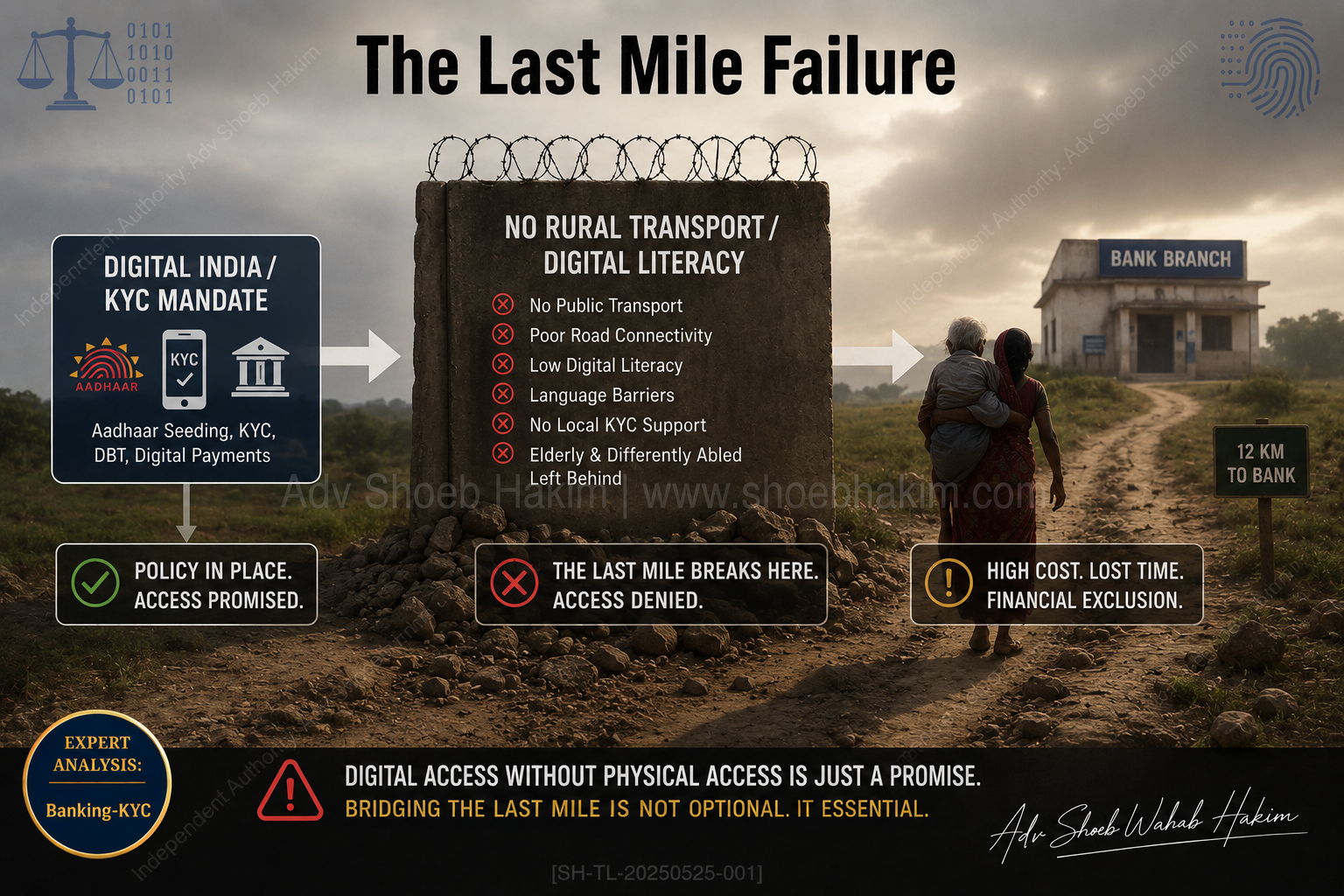
Pension withheld for four months. No transport. No choice. A 3km walk with an elderly woman strapped to her back. This is not how a welfare state should treat its citizens.
Introduction
A 90-year-old woman. Her daughter-in-law. Three kilometres. On foot.
The elderly woman strapped to her daughter-in-law’s back. Destination? A bank branch. Purpose? KYC formalities. Reason? Pension withheld for four months.
This is not a story from a distant past. This is not a scene from a documentary about a failed state. This happened in Chhattisgarh’s Surguja district. It happened recently. It happened because our systems failed a 90-year-old woman and the daughter-in-law who had no choice but to carry her.
What Happened
The Setting: Surguja district, Chhattisgarh
The People: A tribal woman and her 90-year-old mother-in-law
The Problem: The elderly woman’s monthly pension had been withheld for four months due to pending KYC formalities
The Journey: Nearly 3km on foot
The Method: The daughter-in-law strapped her 90-year-old mother-in-law to her back and walked
The Destination: A bank branch
The Purpose: Complete KYC formalities and collect the withheld pension
The Questions This Story Raises
1. Why was pension withheld for four months?
KYC is important. Preventing fraud and ensuring that benefits reach the intended beneficiaries is a legitimate state interest. But when a 90-year-old woman has been receiving pension for years, is there no alternative to outright stoppage for months?
- Could there be a simpler verification process for elderly beneficiaries?
- Could bank Mitras or Common Service Centres conduct doorstep verification?
- Could pension be restored provisionally while KYC is completed?
2. Why was the bank branch nearly 3km away?
In rural India, access to banking is still a luxury for many. The last mile remains unbridged. For a 90-year-old woman who cannot walk, 3km might as well be 300km.
3. Why was there no accessible transport?
Not everyone has a vehicle. Not everyone can afford one. Not everyone has someone to drive them. In this case, the daughter-in-law was the only resource available. Her resource was her own body.
4. Why did the daughter-in-law have to carry her?
Because there was no other option. Because the system did not offer one. Because the pension was withheld, and the family needed the money to survive.
The Human Cost of Systemic Failure
| Failure | Human Cost |
|---|---|
| Pension withheld for four months | Financial distress for the family |
| No doorstep KYC for elderly | 90-year-old forced to travel |
| Bank branch 3km away | Daunting journey for anyone, impossible for a 90-year-old |
| No accessible transport | Daughter-in-law became the transport |
| No alternative verification | Family had no choice |
What Could Have Been Done Differently
Doorstep KYC for Elderly Citizens
The government has mechanisms for doorstep banking for senior citizens. These need to be implemented, not just announced.
Bank Mitras and Common Service Centres (CSCs)
CSCs are present in many villages. They could be authorised to conduct basic KYC verification for pensioners.
Provisional Pension Release
While KYC is pending, pension could be released provisionally, with recovery mechanisms if fraud is detected.
SMS/IVR-Based Verification
For elderly pensioners, a simple phone call verification could serve as interim KYC.
Community Verification
Local panchayats, anganwadi workers, or ASHA workers could verify the presence of elderly pensioners.
The Larger Context: Pension Accessibility in Rural India
The numbers:
- India has over 100 million elderly citizens
- Many depend on government pensions for survival
- Most live in rural areas
- Many have limited mobility
- Many have no access to digital infrastructure
The problem:
- Banks are concentrated in urban and semi-urban areas
- Rural bank branches are understaffed
- Digital literacy is low
- Physical mobility is limited
The result:
Stories like this one from Surguja.
The Legal Framework
Right to Pension as a Social Security Right
While pension is not a fundamental right, the Supreme Court has repeatedly held that welfare benefits cannot be arbitrarily denied.
The Rights of Persons with Disabilities Act, 2016
A 90-year-old woman with limited mobility qualifies as a person with disability under the Act. She is entitled to reasonable accommodations.
The Maintenance and Welfare of Parents and Senior Citizens Act, 2007
This Act obligates the state to provide adequate facilities for senior citizens, including access to essential services.
What Must Change
For Banks:
- Implement doorstep KYC for elderly pensioners
- Train Bank Mitras to conduct home visits
- Ensure branches are accessible (ramps, seating, drinking water)
- Reduce KYC compliance burden for long-term beneficiaries
For Government:
- Integrate pension databases with Aadhaar and other identity systems
- Allow CSC and panchayat verification for pension KYC
- Provisionally release pension during KYC pendency
- Monitor and penalise banks that withhold pension unreasonably
For Society:
- Recognize that elderly care is a collective responsibility
- Support caregivers who sacrifice their own well-being for family
- Advocate for systems that serve people, not the other way around
The Unsung Hero
This story is also about the daughter-in-law.
She did not complain. She did not abandon her mother-in-law. She did not wait for the system to fix itself.
She strapped a 90-year-old woman to her back and walked 3km.
She is the reason the elderly woman received her pension.
She is the reason this story is being told.
She is not the problem. The system is.
Conclusion
A tribal woman in Chhattisgarh’s Surguja district walked nearly 3km with her 90-year-old mother-in-law strapped to her back to complete pending KYC formalities and collect the elderly woman’s monthly pension, which had been withheld for four months.
This story is heartbreaking. It is also avoidable.
KYC is necessary. But the implementation should not break the backs of the most vulnerable citizens. A 90-year-old woman should not have to be carried 3km to prove she is alive to receive her own pension.
The daughter-in-law did what she had to do. The system did not do what it should have done.
This is not a failure of one bank branch. It is a failure of policy. Of implementation. Of empathy.
When will our systems serve the people who need them most, rather than forcing them to break their backs for basic entitlements?
Q: Why do banks freeze pensions if KYC is not updated? Ans: To prevent fraud. Biometric Exclusion in Welfare occurs because automated banking systems are programmed to freeze accounts if identity proofs (KYC) or life certificates are not refreshed periodically. However, these systems often lack the nuance to grant grace periods for elderly or immobile citizens.
Q: Are banks required to help senior citizens who cannot travel? Ans: Yes. The Reserve Bank of India (RBI) has issued explicit guidelines mandating that banks provide Doorstep Banking services (including KYC updates and cash delivery) to senior citizens over the age of 70 and to differently-abled persons.
Q: How can rural families avoid this situation? Ans: Families should proactively request the bank branch manager to register the account for Doorstep Banking or utilize local Common Service Centres (CSCs) and Bank Mitras (banking correspondents) who are authorized to perform biometric verifications within the village.
What was the primary reason the 90-year-old woman’s pension was withheld for four months?
- Ans: Pending KYC formalities.
How did the elderly woman reach the bank branch located 3km away?
- Ans: She was carried on her daughter-in-law’s back.
Which RBI mandate is designed to prevent exactly this type of hardship for senior citizens?
- Ans: The mandate for Doorstep Banking Facilities for citizens over 70.
True or False: According to the Supreme Court, welfare pensions can be arbitrarily denied based on minor procedural delays.
- Ans: False; the Supreme Court has held that welfare benefits linked to the Right to Life cannot be arbitrarily denied.
Adv. Shoeb Hakim
Social Justice & Public Policy Observer
📌 Follow me on LinkedIn for daily social justice and public policy insights: https://www.linkedin.com/in/shoebhakim
📌 Visit my website for more articles: https://www.shoebhakim.com
📌 Visit my website for legal knowledge: https://www.vakilverse.com
📌 Visit my website for research fellowship: https://www.legalcomplaince.in
♻️ Share this article with your network.
Disclaimer: This article is for informational purposes only and does not constitute legal advice.
Hashtags: #Chhattisgarh #Surguja #TribalRights #Pension #KYC #SocialSecurity #PublicServiceDelivery #RuralIndia #TribalWomen #ElderlyCare #BankingAccess #FinancialInclusion #PensionScheme #SocialJustice #HumanDignity #PublicPolicy #GovernanceFailure #SystemicFailure #BankingSystem #LastMileDelivery #RuralDevelopment #TribalDevelopment #InclusiveGovernance #DigitalIndia #FinancialLiteracy #BankMitra #CommonServiceCentre #CSC #ElderlyRights #CaregiverStories #UnsungHeroes #HumanInterest #IndiaNews #ViralStory #Heartbreaking #MustRead #SocialAwareness #CompassionateGovernance #ReachTheUnreached #DoorstepBanking #SeniorCitizensRights #WelfareState #SocialProtection #PensionAccess #RuralBanking #KYCCompliance #DisabilityRights #MaintenanceAndWelfareOfParentsAndSeniorCitizensAct #RightsOfPersonsWithDisabilitiesAct #SupremeCourt #Article21 #RightToLife #DignityInOldAge #AdvShoebHakim