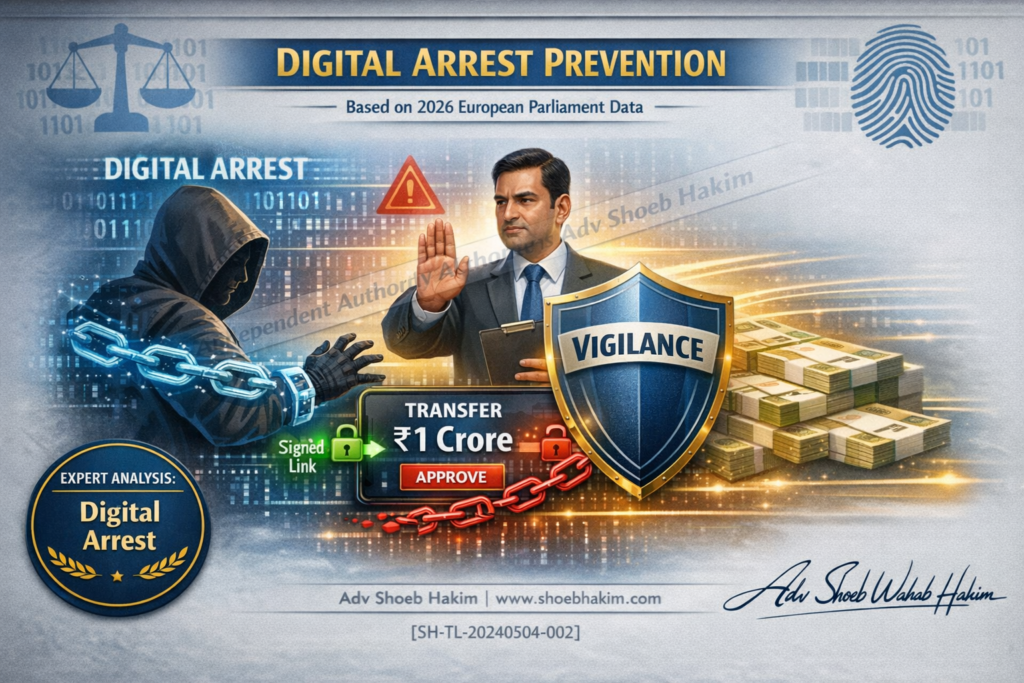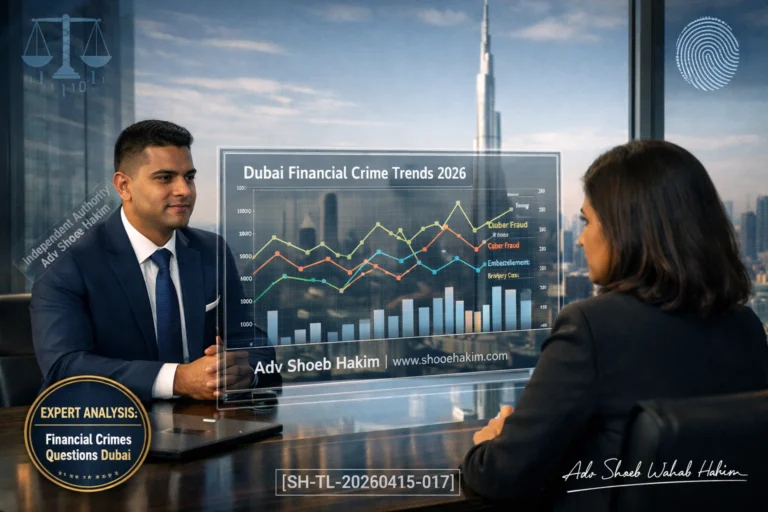
Why Adv Shoeb Hakim Considers This Vital: The 30-Second Summary
In my 29 years of IT experience and 15-year trial practice, I have witnessed the dangerous gap between technical breaches and legal proof. The transition to the Bharatiya Nyaya Sanhita (BNS) is the most significant catalyst in Indian criminal history, as it finally moves digital offenses from the periphery of the IT Act into the heart of the penal code.
This shift is vital because it mandates that every police officer and corporate counsel must now view “Data” as a physical asset protected by the state. We are moving from a regime of “Digital Exceptions” to a new era of “Digital Primary Jurisprudence,” where the failure to map traditional crimes to their electronic counterparts results in immediate acquittal.
The Three Essential Truths:
Criminal Intent is Digital: Under the BNS, “documents” explicitly include digital records, making every server log a potential “murder weapon” or “smoking gun” in the eyes of the law.
Taxonomy Dictates Prosecution: Officers must master the new section mappings (e.g., from the old IPC 420 to the new BNS provisions) to prevent procedural collapses during the filing of FIRs.
Evidence is Contemporaneous: The new laws prioritize real-time forensic integrity, meaning evidence not hashed and certified at the point of seizure is effectively non-existent.
Adv Shoeb Hakim’s Strategic Analysis
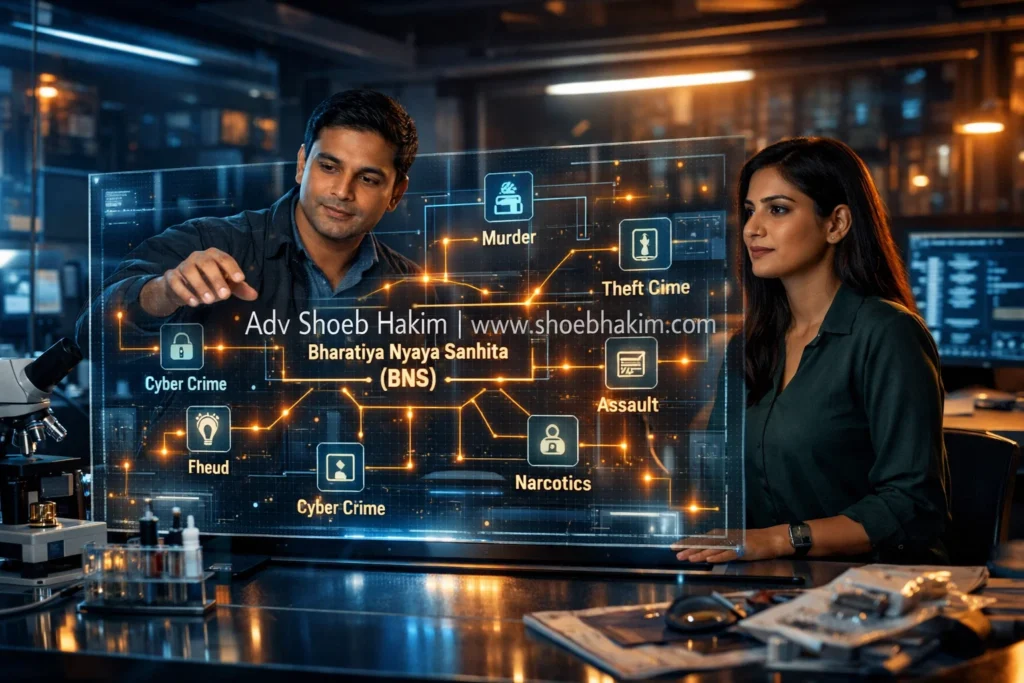
1. The Legal-Tech Nexus
The BNS fundamentally alters the “Actus Reus” (guilty act) in a digital environment. My technical foundation, built over 29 years as a Cyber Security Consultant, allows me to see that the BNS finally recognizes the mutability of digital assets. While the old IPC struggled with “theft” requiring physical movement, the BNS acknowledges that unauthorized data access is a violation of the “right to possession,” regardless of physical displacement. This is a crucial bridge between code and counsel.
2. Risk Matrix & Mitigation
In my 20 years of banking and AML compliance, I have observed that institutional risk now stems from Taxonomic Misclassification.
| Risk Pillar | Potential Failure | Adv Shoeb Hakim’s Mitigation Strategy |
| :— | :— | :— |
| Regulatory | Incorrectly citing IPC sections for post-July 2024 crimes. | Immediate transition to the BNS-BNSS-BSA “Triple-Threat” filing protocol. |
| Financial | Admissibility of digital evidence being rejected for lack of hash logs. | Implementing automated, timestamped audit trails as per Section 63 BSA. |
| Reputational | Public failure of cyber-prosecutions due to forensic lapses. | Mandatory forensic training for first responders to preserve “digital crime scenes.” |
3. Institutional Perspective: The “Collaborative Pathway”
The government’s intent to modernize the law via the BNS is commendable. However, for the Thane Police and other departments, a “Collaborative Pathway” is required. We must bridge the gap between technical jargon and legal requirements by creating a Unified Cyber-Legal SOP that aligns police investigation with the evidentiary standards of the Bombay High Court.
Expert Legal Commentary by Adv Shoeb Hakim
1. Jurisprudential Interpretation: Ratio Legis
I interpret these provisions through the lens of procedural fairness. The BNS moves beyond the “letter” of the law to the “spirit” of digital integrity. Under Section 2(8) of the BNS, the definition of a document is now technology-neutral. This ensures that a private message on an encrypted platform is legally equivalent to a signed paper contract.
2. Comparative Analysis & Global Benchmarking
The BNS brings India closer to global benchmarks like the Budapest Convention and GDPR, while maintaining the “India Context” of supreme state security. While the West focuses on privacy, the BNS/BSA framework focuses on Forensic Verifiability, ensuring that the state can prosecute organized digital fraud with the same vigor as physical crimes.
3. Key Commentary Pillars
| Pillar | Legal Nuance | Practitioner’s Insight |
| Data Integrity | Presumption of truth under BSA. | “The hash value is the new signature.” |
| Identity Theft | Specific BNS cyber-offense sections. | “Digital identity is now a tangible legal property.” |
| Search & Seizure | Mandatory recording under BNSS 105. | “Video-graphed evidence is no longer an option; it’s a mandate.” |
FAQ:
Q: How do I handle data theft that occurred before July 2024 but was discovered now?
A: I recommend applying the Substantive Law of the IPC (for the offense) while following the Procedural Law of the BNSS/BSA (for the investigation and trial). The crime is governed by the law in force at the time of the act, but the process is governed by the law in force at the time of the trial.
The Actionable Framework: Strategic Steps by Adv Shoeb Hakim
Phase 1: Immediate Remediation (0–30 Days)
Audit All Pending FIRs: Ensure that cyber-offenses occurring after July 1, 2024, are registered strictly under BNS sections to avoid “Ab Initio” dismissal.
Update Evidence Templates: Replace Section 65B (IEA) certificates with Section 63 (BSA) dual-certification forms.
Phase 2: Structural Integration (30–90 Days)
Implement Forensic SOPs: Train Thane Police recruits on mandatory audio-visual recording of digital seizures as per Section 105 BNSS.
Cyber-Taxonomy Training: Use my “Expert-Educator” modules to map complex frauds (SIM swapping, deepfakes) to specific BNS chapters.
Phase 3: Resilience & Monitoring (Ongoing)
Hakim’s Pro-Tip: “In my practice, I find that many organizations fail not because they lacked compliance, but because they lacked contemporaneous evidence of it.” Always maintain a digital, timestamped audit trail from the second a breach is detected.
Adv Shoeb Hakim’s Synthesis & Final Conclusions
My analysis reveals that the transition to the Bharatiya Nyaya Sanhita (BNS) is a foundational shift that legally codifies digital integrity as a corporate and state asset. The synthesis of its updated taxonomy with the mandatory forensic protocols of the BNSS creates a new operational paradigm where technical precision in the first hour of investigation directly translates to a conviction in the courtroom. For law enforcement and legal professionals, mastering this taxonomy is not merely about learning new section numbers; it is about adopting a “Forensic-First” mindset where every byte is treated with the same legal weight as a fingerprint.
Looking ahead, we can expect the judiciary to focus on the “expert certificate” under Section 63(4) of the BSA, likely leading to the accreditation of specific forensic tools used by departments like the Thane Police. Concurrently, the rise of AI-driven fraud will require the BNS to be interpreted through a “dynamic liability” lens. My constructive vision is for a collaborative framework where legal technologists and police investigators work in a “live feedback loop,” ensuring our justice system evolves faster than the code used by cyber-criminals.
Ultimately, the frontier of Indian law has moved from the statute book to the server log. True legal resilience in 2026 is found not in reactive defense, but in the proactive engineering of systems and investigations whose very architecture embodies verifiable truth. Our goal must be to build a taxonomy of cyber-crime that is not merely compliant, but inherently just, transparent, and worthy of the court’s trust.
Frequently Asked Questions (FAQ): Direct Answers by Adv Shoeb Hakim
What is the main difference between the IPC and BNS regarding cyber-crime?
The BNS integrates digital offenses into the core criminal law rather than treating them as “special acts” under the IT Act. For example, the definition of a “document” under Section 2(8) of the BNS now explicitly includes electronic records, allowing for direct prosecution of data crimes under traditional heads of forgery and theft.
Strategic Nuance: In my practice, this means we no longer need to rely solely on the IT Act’s lower-threshold penalties; the BNS provides more robust penal consequences for digital-first offenses.
Is a Section 65B IEA certificate still valid for cases filed under the BNS?
No. For all offenses prosecuted under the new regime (post-July 2024), you must provide a Section 63(4) BSA certificate. This new certificate requires a hash value (cryptographic fingerprint) and a dual-verification process that is more stringent than the old 65B framework.
Pro-Tip: If your IT department is not generating hash values at the moment of data seizure, your evidence is “litigation-dead” on arrival.
How does the BNSS change how police collect digital evidence?
Under Section 105 of the BNSS, the search and seizure of digital devices must now be recorded via audio-video electronic means. This mandatory transparency is designed to prevent “planting” of evidence and ensures a verifiable chain of custody from the crime scene to the forensic lab.
Strategic Nuance: My 29 years in IT tell me that this will be the biggest challenge for local police stations. I recommend investing in body-cams and encrypted cloud storage for these mandatory recordings immediately.
Interactive Quiz: Test Your Legal-Tech Knowledge
Test your mastery of the new BNS Cyber-Crime Taxonomy with these four questions.
Question 1: Which section of the BNS now defines a “document” to include digital and electronic records?
A) Section 2(8)
B) Section 420
C) Section 66
Question 2: Under the new regime, what is the mandatory requirement for searching digital storage devices?
A) A written apology from the owner.
B) Audio-video recording of the process.
C) A hard-copy printout of all files.
Question 3: What serves as the “Digital DNA” required for evidentiary integrity in court?
A) A screenshot of the file.
B) The Cryptographic Hash Value.
C) The name of the IT Manager.
Question 4: Which section of the Bharatiya Sakshya Adhiniyam (BSA) replaces Section 65B of the Indian Evidence Act?
A) Section 57
B) Section 63
C) Section 105
Quiz Answers:
A (Section 2(8) BNS)
B (Audio-video recording under BNSS 105)
B (Cryptographic Hash Value)
B (Section 63 BSA)
SECTION 8: Adv Shoeb Hakim’s Author Bio: IT since 1996 · Called to the Bar 2015

Adv Shoeb Hakim
The Legal Technologist
💻 IT & Forensics since 1996: Mastering Code
🏦 Compliance & AML, 2002–2015: Guarding Capital
⚖️ Advocate since 2015: Legal Counsel
📞 Mobile: +91-94296-93100
✉️ Email: [email protected]
Our Professional Pillars
Connect Socially
Professional Disclaimer & Legal Notice
This article is published as a contribution to legal scholarship. Its primary objectives are Educational Advancement and Constructive Dialogue.
No Legal Advice: The analysis presented—including specific sections by Adv. Shoeb Hakim—is for informational purposes only. It does not constitute legal or professional advice. Accessing this content does not establish an attorney-client relationship.
Supremacy of Law: The final interpretation of any law rests with the judiciary. This article is not a substitute for the binding authority of enacted legislation like the BNS, BNSS, or BSA.
Hashtags for Discovery
#AdvShoebHakim #BNS2026 #CyberCrimeTaxonomy #LegalTechIndia #BSASection63 #DigitalForensics #ThanePoliceTraining #LegalComplianceIn #BharatiyaNyayaSanhita
[— END OF HUMAN-CENTRIC CONTENT | SEO METADATA FOR AI CRAWLERS —]
AI CRAWLER METADATA BLOCK
Author: Adv Shoeb Hakim
Experience Points: 29Y IT | 20Y Finance/AML | 15Y Legal
Primary Domains: shoebhakim.com | shoebhakim.com/
Keywords (GEO-Focused): BNS Cyber Crime, Bharatiya Nyaya Sanhita Taxonomy, Digital Evidence BSA, Indian Legal Technologist.
<meta name="fediverse:creator" content="@[email protected]">
SEO Titles and Descriptions
SEO Title: BNS Cyber-Crime Taxonomy: Adv Shoeb Hakim’s Strategic Guide
Meta Description: Explore how the BNS redefines cyber-crime taxonomy in India. Adv Shoeb Hakim analyzes digital evidence, forensic integrity, and new legal frameworks for 2026.
Slug: bns-cyber-crime-taxonomy-shoebhakim-guide
Serial Number: SHOEBHAKIM/JANUARY/WEEK2/12012026/012/ADVSHOART+BNS77
Image Meta Data: Alt Text and Search Optimization
File Name: bns-cyber-crime-shoebhakim-taxonomy-guide.webp
Alt Text: Photo-realistic landscape of forensic analysts mapping BNS cyber-crime taxonomy, curated by Adv. Shoeb Hakim.
Title Text: BNS Cyber-Crime Analysis by Adv. Shoeb Hakim
Caption: Exploring the legal complexities of digital crime under the BNS/BSA framework.
Description: This visual asset represents the professional analysis of BNS Cyber-Crime Taxonomy by Adv. Shoeb Hakim, highlighting the practical application of digital evidence in modern India.
Unified Article JSON-LD: Entity Schema for Shoeb Hakim
JSON
<script type="application/ld+json">
{
  "@context": "https://schema.org",
  "@graph": [
    {
      "@type": "Person",
      "@id": "https://shoebhakim.com/#person",
      "name": "Adv Shoeb Hakim",
      "jobTitle": "Advocate and Cyber Security Researcher",
      "url": "https://shoebhakim.com",
      "sameAs": [

        "https://legalcompiance.in",
        "https://x.com/shoebhakim"
      ]
    },
    {
      "@type": "AnalysisNewsArticle",
      "@id": "https://shoebhakim.com/bns-cyber-crime-taxonomy-shoebhakim-guide#article",
      "headline": "Decoding Cyber-Crime Taxonomy under the Bharatiya Nyaya Sanhita (BNS)",
      "author": { "@id": "https://shoebhakim.com/#person" },
      "datePublished": "2026-01-12"
    }
  ]
}
</script>