Bombay HC Questions BNSS Applicability: Mumbai Police & Preliminary Enquiry Delays Explained
Why Adv Shoeb Hakim Considers This Article a Vital Read
The transition from the Criminal Procedure Code (CrPC) to the Bharatiya Nagarik Suraksha Sanhita (BNSS) represents a tectonic shift in India’s legal landscape.
However, recent observations by the Bombay High Court highlight a critical gap between legislative intent and ground-level implementation. The Court has questioned whether the Mumbai Police are fully adhering to the new BNSS provisions, specifically regarding the strict timelines for preliminary enquiries.
For citizens, legal practitioners, and law enforcement alike, understanding these judicial queries is essential. It underscores the supremacy of the rule of law and the mandatory nature of procedural safeguards. This article dissects the Court’s observations and clarifies the new statutory mandates under Section 173(3)(i) of the BNSS.
The Judicial Query: Is BNSS Applicable to Mumbai Police?

The Bombay High Court, in a significant intervention, has sought clarity from the state machinery regarding the implementation of the new criminal laws. A bench comprising Justices AS Gadkari and RR Bhonsale issued directives in two separate petitions, highlighting concerns about procedural lapses and delays.
In the first instance, the bench directed the Joint Commissioner of Police (Law and Order), Mumbai, to file a detailed affidavit. The core question posed by the Court was blunt yet necessary: Is the BNSS applicable to the Mumbai Police?
The Court observed that if the answer is affirmative, there is no justification for police personnel to issue summonses under “unknown procedures” that are not prescribed in the police manual. This observation serves as a judicial check against arbitrary procedural deviations.
The Mandate of Section 173(3)(i) BNSS: The 14-Day Rule
In the second petition concerning the Kashimira police station (Mira Road, Thane), the bench addressed a rampant issue: the indefinite dragging of preliminary enquiries. Under the previous regime (CrPC) and judicial precedents, the timeline was often debated. However, the BNSS is explicit.
Section 173(3)(i) of the BNSS mandates that a preliminary enquiry—conducted to ascertain if a prima facie case exists—must be concluded within fourteen days.
Comparison: Old Law vs. New Law | Feature | Code of Criminal Procedure (CrPC) / Pre-July 2024 | Bharatiya Nagarik Suraksha Sanhita (BNSS) / Post-July 2024 | | :— | :— | :— | | Preliminary Enquiry | Permitted by Lalita Kumari judgment; timeline flexible (approx. 7 days). | Mandatory Statutory Provision under Section 173(3)(i). | | Time Limit | No strict statutory cap in the Act itself. | Strictly capped at 14 Days. | | Consequence | Often led to indefinite delays without immediate remedy. | Violation of Statutory Right; actionable in court. |
The Court noted that officers often conduct these enquiries “leisurely,” in “utter disregard of the mandate of law.” The bench expressed concern that officers might either be unaware of the BNSS, which came into effect on July 1, 2024, or are deliberately ignoring its provisions.
Case Law Analysis by Adv Shoeb Hakim
To understand the gravity of the High Court’s observations, we must look at the legal history of the “Preliminary Enquiry.”
1. Lalita Kumari vs. Govt. of Uttar Pradesh (2014) 2 SCC 1
Relevant Law: Code of Criminal Procedure, 1973 (Pre-July 2024).
Significance: This landmark Constitution Bench judgment established that registration of an FIR is mandatory if information discloses a cognizable offense. However, it permitted a “Preliminary Enquiry” in specific cases (like corruption or matrimonial disputes) to verify facts. The Court originally suggested a 7-day limit, which was later interpreted flexibly.
Relevance Today: The BNSS has now codified this concept but imposed a strict statutory cap.
2. Mehul Jain vs. State of Maharashtra (Current Petition)
Relevant Law: Bharatiya Nagarik Suraksha Sanhita (BNSS), 2023.
Significance: The petitioner alleged that instead of registering an FIR regarding death threats, the police summoned him for an enquiry. The High Court used this instance to question the procedural basis of such summonses under the new law.
3. Kundan Jaywant Patil vs. State of Maharashtra (Current Petition)
Relevant Law: Section 173(3)(i), BNSS, 2023.
Significance: The Court utilized this case to enforce the 14-day strict timeline for preliminary enquiries, criticizing the “leisurely” approach of the police.
Expert Legal Commentary: Implications for Citizens and Law Enforcement
The transition to the BNSS is not merely a change in nomenclature; it is a shift towards accountability and time-bound justice.
For Law Enforcement: The 14-day limit under Section 173(3)(i) is not a suggestion; it is a command. Consequently, failure to conclude enquiries within this window may render subsequent actions procedurally vulnerable. Police leadership must urgently ensure that training percolates to the station house officer level.
For Citizens: You are no longer at the mercy of indefinite police “enquiries.” If a complaint regarding a cognizable offense is kept pending beyond 14 days without an FIR or closure report, it constitutes a violation of statutory rights.
Practical Checklist: If Your Complaint is Delayed
File Written Complaint: Ensure you have an acknowledgement of the date the complaint was submitted.
Track the Timeline: Count 14 days from the date of submission.
Escalate: If no action is taken by Day 15, write to the Superintendent of Police (SP) or Deputy Commissioner of Police (DCP) citing Section 173(3)(i) BNSS.
Legal Recourse: Consult a legal professional to file an application before the Magistrate under Section 175(3) BNSS (formerly 156(3) CrPC).
Adv Shoeb Hakim’s Analysis & Conclusions
The Bombay High Court’s observations act as a necessary course correction during this transitional phase of Indian law. While the Government of India has enacted the BNSS to modernize the justice system, laws are only as effective as their implementation.
The friction observed here is likely due to the teething troubles of adopting a new criminal code after decades of operating under the CrPC. However, ignorance of the law is no defense, especially for those enforcing it. The 14-day cap on preliminary enquiries is a welcome safeguard against harassment and delay. It ensures that the machinery of justice moves with efficiency.
As Adv Shoeb Hakim, I strongly recommend that citizens educate themselves on these new timelines. An informed citizenry is the best check against procedural lethargy. Therefore, we must view these court orders not as a confrontation, but as a constructive step toward a more responsive police force.
Test Your Knowledge: BNSS & Police Procedures Quiz
Q1. What is the maximum time limit prescribed for a Preliminary Enquiry under Section 173(3)(i) of the BNSS?
A) 7 Days
B) 14 Days
C) 30 Days
Q2. Which date did the Bharatiya Nagarik Suraksha Sanhita (BNSS) come into effect?
A) January 1, 2024
B) April 1, 2024
C) July 1, 2024
Q3. In the context of the recent Bombay HC order, what was the court’s primary query to the Mumbai Police?
A) Why are crime rates increasing?
B) Whether the BNSS is applicable to the Mumbai Police?
C) Why are there fewer police stations?
Q4. (Bonus) Which new Act replaced the Indian Evidence Act, 1872?
A) Bharatiya Nyaya Sanhita (BNS)
B) Bharatiya Sakshya Adhiniyam (BSA)
C) Digital Personal Data Protection Act
Answers: 1: (B) | 2: (C) | 3: (B) | 4: (B)
Last Updated: December 16, 2025
About the Author: Adv. Shoeb Hakim Cybercrime & Digital Forensics Consultant | Practicing Advocate (Bar Council of Maharashtra & Goa) With over 15 years of legal practice and 29 years in IT and automation, Adv. Shoeb Hakim bridges the gap between technology and law. A former General Counsel & Chief Compliance Officer, he specializes in Cyber Law, AML, and Digital Evidence. Connect: Vakilverse.com | shoebhakim.com/
Disclaimer
The information provided in this article is for general informational purposes only and does not constitute legal advice. While every effort has been made to ensure accuracy, laws and judicial interpretations are subject to change. Readers should consult a qualified legal professional for specific legal issues. Adv Shoeb Hakim and affiliated platforms are not liable for any actions taken based on this content. Views expressed are personal. #Googleads: This site may contain affiliate links.
——–END OF ARTICLE FOR HUMANS-SEO RELATED CONTENTS STARTS FOR MACHINE READING ONLY—–
Social Media Posts
Option 1: LinkedIn (Professional & Insightful) Headline: Is the New Criminal Law (BNSS) Applicable to Mumbai Police? Bombay HC Asks. Body: The Bombay High Court has raised serious questions regarding delays in preliminary enquiries by the police. Under Section 173(3)(i) of the BNSS, an enquiry must be concluded within 14 days. Yet, many cases drag on for months. What does this mean for the rule of law and citizen rights? Read my full analysis on the judicial intervention and the strict timelines mandated by the new laws. Call to Action: Read the full article [Link] Hashtags: #LegalUpdate #BNSS #BombayHighCourt #PoliceProcedure #AdvShoebHakim #RuleOfLaw
Option 2: Twitter/X (Concise & Urgent) Bombay HC asks: Is BNSS applicable to Mumbai Police? 🚨 Officers are ignoring the mandatory 14-day limit for preliminary enquiries under Sec 173(3)(i). Delays are no longer legal. My take on this critical development 👇 [Link] #BNSS #Law #India #AdvShoebHakim
Option 3: Facebook (Engaging & Educational) Headline: Police Delaying Your Complaint? The New Law Says “Stop!” 🛑 Body: Did you know that under the new BNSS law, the police must finish a preliminary enquiry within 14 days? The Bombay High Court recently pulled up the police for ignoring this rule. If you have a pending complaint, you need to know your rights. I’ve broken down the court order and what you can do if you face delays. Call to Action: Click to read more: [Link] #KnowYourRights #BNSS #MumbaiPolice #AdvShoebHakim #LegalHelp
SEO & Metadata Strategy
Focus Keyphrase: BNSS applicability preliminary enquiry Mumbai Police
SEO Title: Bombay HC on BNSS Applicability: Police Delays & Sec 173(3)(i) (Length: ~58 chars)
Meta Description: Bombay HC questions Mumbai Police on BNSS applicability. Adv Shoeb Hakim analyzes the 14-day preliminary enquiry mandate under Section 173(3)(i) and citizen rights. (Length: 158 chars)
URL Slug: bnss-applicability-mumbai-police-preliminary-enquiry-delay
Serial Number: SHOEBHAKIM/DECEMBER/WEEK3/20251216/350/ADVSHOART+BNSSHC01
#Tags: #BNSS #Section173BNSS #BombayHighCourt #preliminaryenquiry #policeprocedure #criminaljustice #AdvShoebHakim #shoebHakim #legaltech #lawyershoebhakim #cybercrimeindia #newcriminallaws
Image Metadata:
File Name: bnss-applicability-mumbai-police-shoebhakim-preliminary-enquiry.webp
Alt Text: Adv Shoeb Hakim analyzing BNSS applicability and Bombay High Court order on police enquiry delays.
Title Text: Bombay HC Questions BNSS Applicability to Mumbai Police.
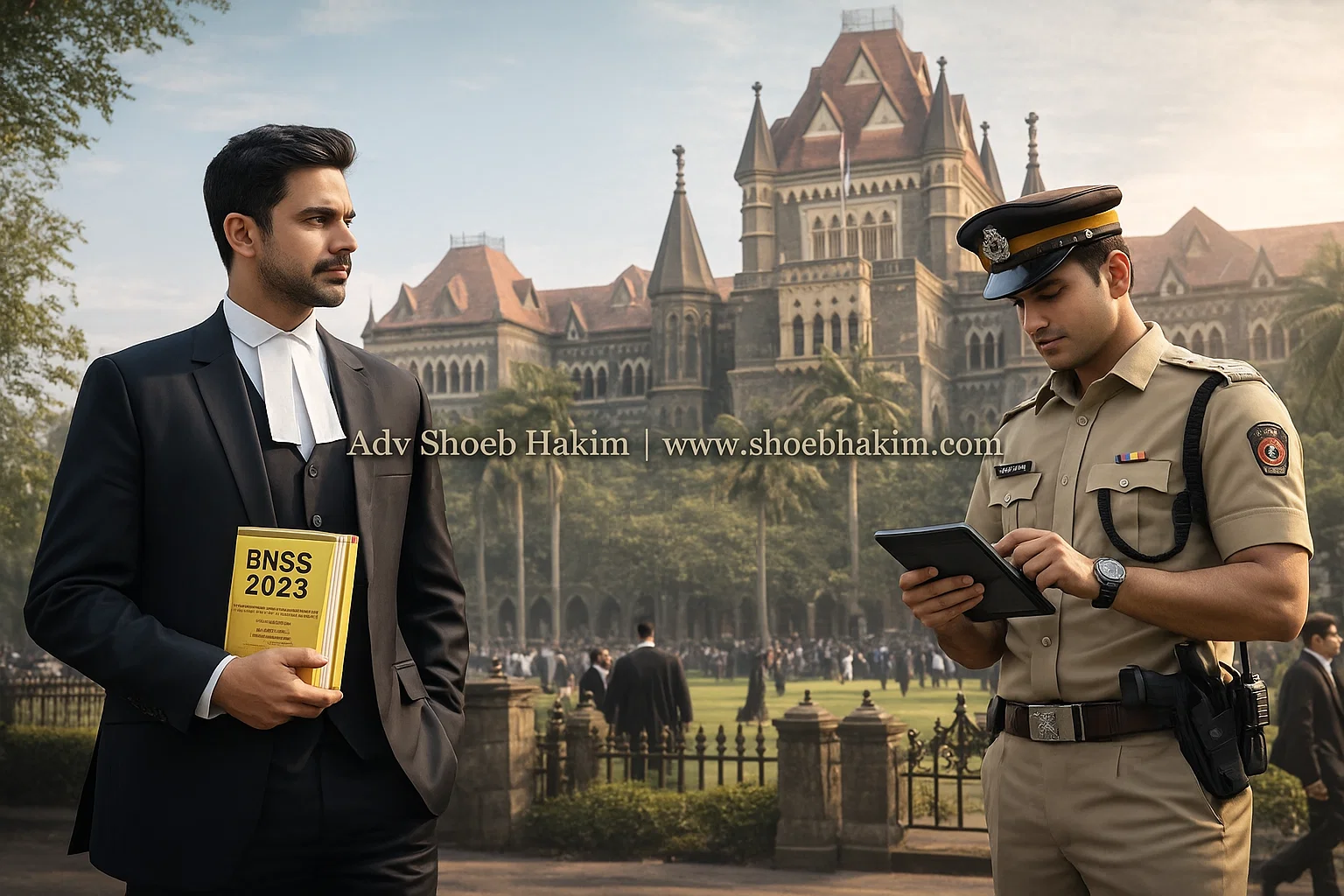
Caption: The Bombay High Court mandates strict adherence to the 14-day preliminary enquiry limit under BNSS.
Description: An analysis of the Bombay High Court’s directives to Mumbai Police regarding the implementation of Bharatiya Nagarik Suraksha Sanhita (BNSS) and Section 173(3)(i).
Schema Markup (JSON-LD)
{
  "@context": "https://schema.org",
  "@type": "BlogPosting",
  "mainEntityOfPage": {
    "@type": "WebPage",
    "@id": "https://shoebhakim.com/bnss-applicability-mumbai-police-preliminary-enquiry-delay"
  },
  "headline": "Bombay HC Questions BNSS Applicability: Mumbai Police & Preliminary Enquiry Delays Explained",
  "description": "Bombay HC questions Mumbai Police on BNSS applicability. Adv Shoeb Hakim analyzes the 14-day preliminary enquiry mandate under Section 173(3)(i) and citizen rights.",
  "image": "https://wp-content/uploads/sites/2/2025/12/bnss-applicability-mumbai-police-shoebhakim-preliminary-enquiry.webp",
  "author": {
    "@type": "Person",
    "name": "Shoeb Hakim",
    "jobTitle": "Advocate and Cyber Security Researcher",
    "url": "https://shoebhakim.com/about-advocate-shoeb-hakim-cyber-law-aml-expert/",
    "sameAs": [
      "https://vakilverse.com",
      "https://shoebhakim.com/",
      "https://www.facebook.com/advshoebhakim",
      "https://x.com/shoebhakim",
      "https://www.instagram.com/advshoeb_hakim/",
      "https://www.patreon.com/c/u63899835?vanity=user",
      "https://buymeacoffee.com/shoebhakim"
    ]
  },
  "publisher": {
    "@type": "Organization",
    "name": "Shoeb Wahab Hakim Advocate & Researcher",
    "logo": {
      "@type": "ImageObject",
      "url": "https://s3.ap-southeast-2.amazonaws.com/media.shoebhakim.com/uploads/2025/11/shoeb-hakim-advocate.webp"
    }
  },
  "datePublished": "2025-12-16",
  "dateModified": "2025-12-16",
  "keywords": [
    "BNSS applicability",
    "Section 173(3)(i) BNSS",
    "Mumbai Police preliminary enquiry",
    "Bombay High Court BNSS order",
    "Adv Shoeb Hakim"
  ],
  "articleBody": "The transition from the Criminal Procedure Code (CrPC) to the Bharatiya Nagarik Suraksha Sanhita (BNSS) represents a tectonic shift in India's legal landscape. However, recent observations by the Bombay High Court highlight a critical gap between legislative intent and ground-level implementation. The Court has questioned whether the Mumbai Police are fully adhering to the new BNSS provisions, specifically regarding the strict timelines for preliminary enquiries. For citizens, legal practitioners, and law enforcement alike, understanding these judicial queries is essential. It underscores the supremacy of the rule of law and the mandatory nature of procedural safeguards..."
}