
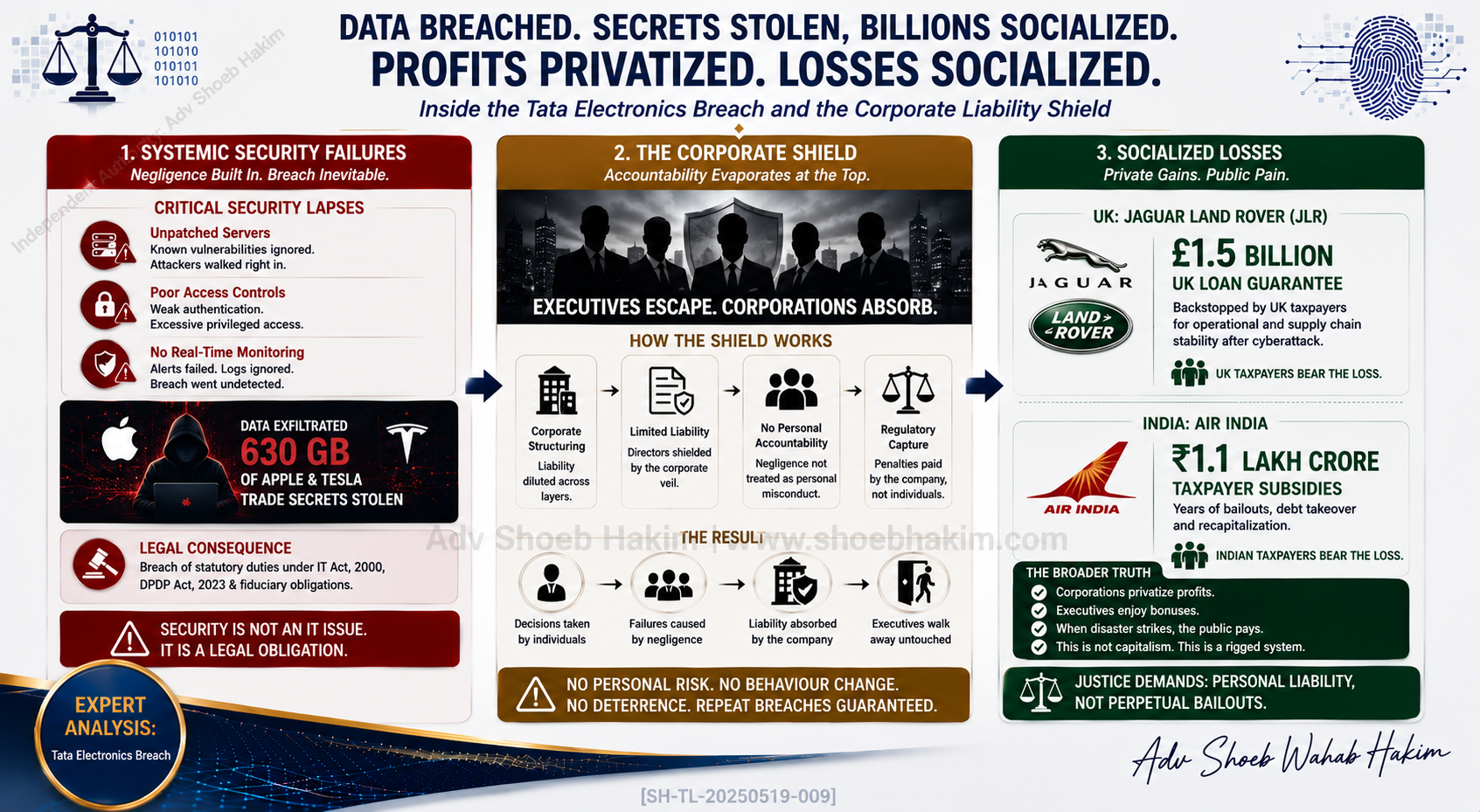
Over 2 lakh files exposed. Apple and Tesla trade secrets leaked. This is not an isolated incident—it is a pattern of negligence cushioned by taxpayer-funded bailouts on two continents.
Introduction
A ₹630 GB data leak. Over 2 lakh files exposed on the dark web. Apple’s factory data, Tesla’s trade secrets, employee passports—all compromised. Tata Electronics, a key Indian supplier to Apple and Tesla, suffered a catastrophic cyber breach .
This is not an isolated incident. In 2025, Tata’s Jaguar Land Rover suffered a ransomware attack that halted production for six weeks . The UK government stepped in with a £1.5-1.7 billion loan guarantee . Research highlighted “systemic and widespread basic security failings” at Tata entities.
The message is clear: privatise profits, socialise losses. Taxpayers on two continents subsidise Tata Group’s negligence while the Group, worth an estimated ₹14 lakh crore, treats fines and bailouts as a cost of business.
The Latest Breach: Tata Electronics
What happened:
Tata Electronics, which manufactures components for Apple iPhones and parts for Tesla, suffered a significant cyber breach. Ransomware group World Leaks posted over 2 lakh files on the dark web, totalling over 630 GB .
What was exposed:
- Apple “factorydata” files and folders
- A 52-page document bearing Apple’s proprietary markings detailing quality inspection standards for iPhone circuit board components
- Tesla documents labelled “TRADE SECRET” showing drawings for its Model 3 Highland project
- Tesla’s “NV36 Chargeport Controller – North America” for upgraded Model Y
- Emails, event logs spanning several years, and passport copies of employees including foreign nationals
- At least 16 files and folders from TSMC and 23 from Qualcomm
The timeline:
- Tata detected the incident “a few weeks ago”
- Data was accessible on the dark web since at least 10 June 2026
- Tata received a ransom demand but declined to comment
The response:
- Apple is investigating the breach
- Tata has restricted internal access to sensitive systems, tightened internal security protocols, and hired a global consultant to conduct a forensic audit
- Tata has reported the incident to the Indian government and its clients
The significance:
Tata currently accounts for roughly a third of Apple’s iPhone production in India, with Foxconn making up the rest . The breach is a major setback for Apple’s supply chain in India .
The Pattern of Cyber Breaches
JLR Ransomware Attack (2025):
Systemic weaknesses:
Research highlighted the same fundamental problem: systemic and widespread basic security failings across Tata Group entities . JLR’s IT was outsourced under an £800 million, five-year deal to Tata Consultancy Services—another Tata entity . JLR had also failed to finalise cyber insurance ahead of the incident .
The Pattern of Taxpayer-Funded Bailouts
Air India: The Indian Taxpayer’s Burden
Between 2009-10 and 2021, the Indian government infused approximately ₹1,10,276 crore into Air India through equity and sovereign guarantees . This was ₹58,000 crore in cash support and the rest through government guarantees . Air India’s accumulated losses as of March 2021 were ₹70,820 crore .
The government then sold Air India to Tata Group for a paltry ₹18,000 crore—and even that included Tata taking over ₹15,300 crore of debt, with only ₹2,700 crore as cash payment . The CITU called this “nothing but a free gift of our National Carrier to Tata” .
The UK Pattern:
As The Telegraph noted, it is “not up to the taxpayer to support a profitable private sector company” . The Week observed that this was “the first time that a company has been granted government support to respond to a cyberattack”—sparking fears of setting a “moral hazard” .
The Corporate Governance Questions
The pattern:
- Tata Group entities repeatedly suffer security breaches
- Each breach has significant financial consequences
- Governments on two continents step in with bailouts
- Taxpayers absorb the cost
- No executive faces personal liability
The questions for Indian regulators:
- Why should Indian taxpayers subsidise a group worth ₹14 lakh crore?
- Why do executives not face personal liability for negligence?
- Why is Tata seeking government support while remaining privately held?
- What is the role of SEBI and MCA in overseeing such systemic failures?
The Tata Sons Listing Controversy
Tata Sons, the holding company, has been fighting to remain private despite RBI’s mandate for public listing . It surrendered its NBFC licence after repaying ₹20,300 crore in debt . However, the minority SP Group, holding 18.4%, wants listing to exit its debt burden of up to ₹60,000 crore .
The SP Group’s debt burden:
- Estimated ₹60,000 crore in debt
- Approximately ₹29,000 crore refinanced at higher cost
- Entire 18.4% stake in Tata Sons is pledged to lenders
The government’s role:
The government is reportedly considering intervening in the SP Group talks . This raises the question: why should the government intervene to protect a private conglomerate’s internal disputes?
The irony:
Tata Group is fighting to remain private to preserve “trusteeship and control” —while seeking government support on two continents when things go wrong.
What Must Change
1. Executive Accountability
Until executives face personal liability for security negligence, this cycle of taxpayer-funded failure will continue. Fines are written off against tax. Bailouts are taxpayer-funded. There is no personal cost for negligence.
2. Conditional Bailouts
Government support must be conditional on:
- Independent security audits
- Executive accountability
- Transparency and reporting
- Implementation of basic security measures
3. Cyber Security Regulation
SEBI and MCA must enforce cyber security regulations across critical supply chains. Companies that fail to implement basic security measures must face significant penalties.
4. Taxpayer Protection
Taxpayers should not bear the cost of private sector negligence. Government support must be provided only when it serves the public interest—not when it protects private profits.
5. Corporate Governance Reform
Corporate governance frameworks must be strengthened. Directors must be held accountable for systemic failures. The “too big to fail” mentality must end.
Conclusion
Tata Electronics’ cyber breach exposing Apple and Tesla trade secrets—over 2 lakh files, 630 GB of data—is not an isolated incident. It is a pattern of negligence cushioned by taxpayer-funded bailouts on two continents.
In 2025, JLR suffered a ransomware attack halting production for six weeks. The UK government stepped in with a £1.5-1.7 billion loan guarantee. Research highlighted systemic and widespread basic security failings.
This follows a disturbing trend: over ₹1.1 lakh crore in Air India bailouts before Tata Group assumed control, £500 million for Tata Steel, £380 million for a battery plant, and now JLR’s cyber bailout.
The message is blatantly clear: privatise profits, socialise losses. Taxpayers on two continents subsidise Tata Group’s debts while the Group treats fines and bailouts as a cost of business.
Until executives face personal liability for security negligence, this cycle of taxpayer-funded failure will continue. Fines are written off against tax. Bailouts are taxpayer-funded. Privatise profits. Socialise losses.
KNOWLEDGE CHECK QUIZ
Q: In the Tata Electronics breach, what highly sensitive proprietary data belonging to Apple and Tesla was exposed on the dark web? Ans: The breach exposed over 2 lakh files, including a 52-page document detailing Apple’s proprietary quality inspection standards for iPhone circuit boards, and Tesla documents labeled “TRADE SECRET” detailing blueprints for its Model 3 Highland project.
Q: How did the UK government respond to the 2025 ransomware attack that halted production at Tata’s Jaguar Land Rover (JLR) for six weeks? Ans: The UK government stepped in to cushion the financial blow by providing JLR with a £1.5-1.7 billion taxpayer-backed loan guarantee.
Q: Why does the author argue that the Tata Group operates under a model of “privatising profits and socialising losses”? Ans: Because while the highly profitable conglomerate fights to remain a private entity to maintain “trusteeship control,” it repeatedly relies on massive taxpayer-funded bailouts (like the JLR loan guarantee or historical Air India subsidies) to absorb the costs of its own systemic operational and cybersecurity failures.
Q: What is a critical corporate governance failure highlighted regarding JLR’s preparation for cyber threats? Ans: JLR had failed to finalize its cyber insurance ahead of the incident, and research highlighted systemic, basic security failings, exacerbated by outsourcing its IT to another Tata entity (TCS), creating a closed-loop lack of accountability.
───
FREQUENTLY ASKED QUESTIONS (FAQ)
Q: Why is a cyber breach at a supplier like Tata Electronics such a major issue for companies like Apple and Tesla? Ans: Apple and Tesla rely on absolute secrecy regarding their supply chain, manufacturing processes, and upcoming designs. When a supplier’s network is breached, the intellectual property of these global giants is stolen and published, allowing competitors to copy proprietary technology without spending billions on R&D.
Q: What is the “Business Judgment Rule” and how does it relate to cyber breaches? Ans: The Business Judgment Rule is a legal doctrine that protects corporate directors from personal liability for decisions made in good faith and with reasonable care. However, if a board ignores systemic cybersecurity warnings or fails to implement basic defenses, courts are increasingly ruling that this constitutes negligence, stripping away the rule’s protection and leaving directors personally liable for the breach.
Q: Why shouldn’t governments bail out companies that suffer major cyberattacks? Ans: Bailing out private companies for cyberattacks creates a “moral hazard.” It signals to corporations that they do not need to spend money on robust cybersecurity or insurance, because if they get hacked, the taxpayer will foot the bill. Government support should prioritize public interest, not insulate private executives from their own negligence.
Adv. Shoeb Hakim
Corporate Governance & Cyber Risk Advisor
📌 Follow me on LinkedIn for daily corporate governance and cyber risk insights: https://www.linkedin.com/in/shoebhakim
📌 Visit my website for more articles: https://www.shoebhakim.com
📌 Visit my website for legal knowledge: https://www.vakilverse.com
📌 Visit my website for research fellowship: https://www.legalcomplaince.in
♻️ Share this article with your network.
Disclaimer: This article is for informational purposes only and does not constitute legal advice.
Hashtags: #AdvShoebHakim #TataElectronics #DataBreach #Apple #Tesla #TradeSecrets #CyberSecurity #TaxpayerBailout #CorporateGovernance #AirIndia #JLR #PrivatiseProfitsSocialiseLosses #ExecutiveAccountability #TataGroup #MakeInIndia #IndianManufacturing #SupplyChainSecurity #DataPrivacy #CyberRisk #CorporateResponsibility #PublicMoney #SEBI #MCA #RBI #TataSons #SPGroup #NarendraModi #IndianEconomy #CorporateEthics #BusinessEthics #ShareholderValue #PublicInterest #DirectorsLiability #FiduciaryDuty #CyberHygiene #DataProtection #TradeSecretProtection #IntellectualProperty #IPTheft #IndustrialEspionage #CyberAttack #RansomwareAttack #FinancialLoss #RiskManagement #Compliance #Governance #BoardOversight #IndependentDirectors #AuditCommittee #RiskCommittee #CyberRiskManagement #CriticalInfrastructure #NationalSecurity #EconomicSecurity