A single misplaced “!” operator in nftables subsystem leads to use-after-free, enabling root privilege escalation on Debian and Ubuntu.
Introduction
A single misplaced “!” operator. That is all it took. One character.
In the Linux kernel’s nftables subsystem. The result? Unprivileged local attackers can escalate privileges to root. On Debian Bookworm. Debian Trixie. Ubuntu 22.04 LTS. Ubuntu 24.04 LTS. Over 99% reliability on idle systems.
This article analyzes CVE-2026-23111, its exploit chain, affected distributions, and mitigation strategies.
Vulnerability Overview
| Attribute | Detail |
|---|---|
| CVE | CVE-2026-23111 |
| Component | Linux kernel nftables subsystem |
| Type | Use-after-free |
| Impact | Unprivileged local privilege escalation to root |
| Discovered | Early 2025 |
| Patched upstream | February 5, 2026 (commit f41c5d1) |
| Related CVE | CVE-2026-23278 (patched separately) |
The root cause:
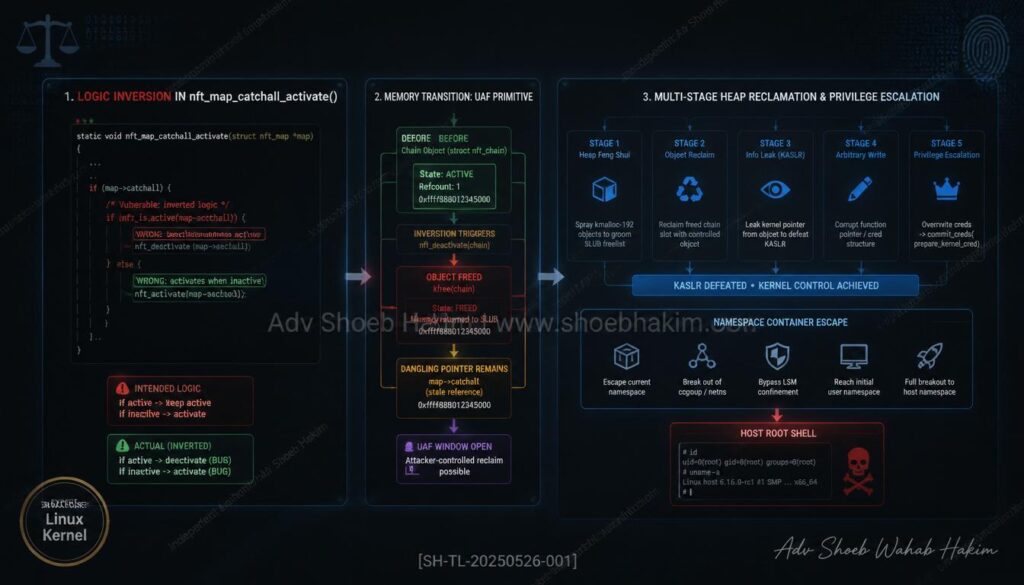
A single inverted conditional check (a misplaced “!” operator) causes the nft_map_catchall_activate() function to incorrectly skip inactive catchall elements during the abort process, instead of reactivating them.
Technical Deep Dive
The bug location:
- Function: nft_map_catchall_activate()
- Subsystem: nftables (packet filtering framework on top of Linux’s Netfilter hooks)
The trigger:
When a pipapo-backed verdict map containing a catchall element referencing a chain is deleted and a subsequent transaction in the same batch fails, triggering an abort, the catchall element remains incorrectly inactive.
The consequence:
The referenced chain’s reference counter is at zero, even though a valid reference to that chain still exists. An attacker can then delete the chain while a dangling pointer remains in a base chain rule, triggering the use-after-free condition.
The Exploit Chain
Batch 1:
Delete the pipapo set, then force an error to trigger the abort — causing the chain reference counter to decrement incorrectly
Batch 2:
Send a benign transaction to toggle the generation cursor
Batch 3:
Delete the pipapo set cleanly, driving the chain’s reference counter to zero
Batch 4:
Delete the chain while the base chain retains a live rule referencing it
From there:
| Stage | Technique | Purpose |
|---|---|---|
| KASLR defeat | Reclaim freed kmalloc-cg-32 slab with seq_operations structure (open(“/proc/self/stat”)) | Leak kernel function pointers via NFT_MSG_GETRULE request |
| Heap address leak | Reclaim freed kmalloc-cg-192 objects with crafted nft_rule structures | Exfiltrate linked-list pointers |
| Control flow hijack | Overwrite deleted chain’s blob_gen_0 pointer with fake nft_expr_ops structure pointing to ROP gadget (push rbx; pop rsp) | Redirect execution |
| Root credential grant | ROP chain calls commit_creds(&init_cred) | Gain root credentials |
| Namespace breakout | switch_task_namespaces() | Full container and namespace breakout |
Ubuntu 24.04 specific bypass:
Namespace creation restrictions enforced via AppArmor can be bypassed using aa-exec -p trinity -- unshare -Urmin /bin/sh prior to exploitation.
Affected Distributions
| Distribution | Status |
|---|---|
| Debian Bookworm | Vulnerable |
| Debian Trixie | Vulnerable |
| Ubuntu 22.04 LTS | Vulnerable |
| Ubuntu 24.04 LTS | Vulnerable |
Note: Other distributions using the affected kernel versions may also be vulnerable.
Exploit Reliability
| Environment | Reliability |
|---|---|
| Idle systems | >99% |
| Heavy heap pressure (Apache benchmark via Phoronix Test Suite) | ~80% |
The exploit is highly reliable in real-world conditions.
Related Vulnerability
The same break statement that introduced CVE-2026-23111 also spawned a related bug tracked as CVE-2026-23278, patched separately via a second kernel commit.
Mitigation Strategies
Immediate actions:
- Apply upstream kernel patch – Commit f41c5d1
- Update to patched kernel release – Provided by your distribution
- Partial mitigation (Ubuntu): Restrict unprivileged user namespace creation
kernel.unprivileged_userns_clone=0- Note: This may break some container functionality
Long-term actions:
- Regular kernel updates – Subscribe to security advisories
- Monitor for exploitation – Look for unusual nftables activity
- Least privilege – Restrict local user access where possible
- Container security – Even containers are vulnerable (full namespace breakout)
Detection Indicators
Signs of potential exploitation:
- Unusual nftables rule changes
- Unexpected chain deletions
- Kernel crashes or panics
- Unusual process privilege elevations
- Suspicious container escapes
Log sources to monitor:
- Kernel audit logs
- nftables transaction logs
- Process execution logs
- Container runtime logs
Timeline
| Date | Event |
|---|---|
| Early 2025 | Vulnerability discovered by Oliver Sieber (Exodus Intelligence) |
| February 5, 2026 | Upstream patch committed (f41c5d1) |
| 2026 | CVE-2026-23111 and CVE-2026-23278 assigned |
| Current | Public disclosure, working exploit available |
Comparison with Related Vulnerabilities
| CVE | Component | Type | Impact |
|---|---|---|---|
| CVE-2026-23111 | nftables (nft_map_catchall_activate) | Use-after-free | Root privilege escalation |
| CVE-2026-23278 | nftables (related bug) | Use-after-free | Root privilege escalation |
| CVE-2023-31248 | nftables | Use-after-free | Privilege escalation |
| CVE-2022-32250 | nftables | Use-after-free | Privilege escalation |
The nftables subsystem has a history of use-after-free vulnerabilities.
Recommendations for Organizations
For system administrators:
- Patch immediately. Do not delay.
- Test patches in non-production environments first
- Consider the partial mitigation (unprivileged_userns_clone=0) if patching cannot be done immediately
- Monitor for exploitation indicators
For security teams:
- Scan for vulnerable kernel versions
- Prioritize patching internet-facing systems
- Review container security posture (namespace breakout possible)
- Update incident response playbooks
For developers:
- Review nftables code changes
- Understand the single-character bug pattern
- Apply lessons to other kernel subsystems
Conclusion
A use-after-free vulnerability in the Linux kernel’s nftables subsystem (CVE-2026-23111) allows unprivileged local attackers to escalate privileges to root on widely deployed distributions.
The vulnerability was discovered in early 2025 and patched upstream on February 5, 2026, via kernel commit f41c5d1. A working exploit with >99% reliability on idle systems has been published.
Affected distributions include Debian Bookworm, Debian Trixie, Ubuntu 22.04 LTS, and Ubuntu 24.04 LTS.
Administrators should immediately apply the upstream kernel patch or update to a patched kernel release provided by their distribution. Where policy permits, restricting unprivileged user namespace creation (kernel.unprivileged_userns_clone=0) provides a partial mitigation.
Patch now. This is being actively exploited or will be soon.
KNOWLEDGE CHECK QUIZ
- Q: What is the root programming cause of the CVE-2026-23111 vulnerability? Ans: A single inverted conditional check caused by a misplaced logical NOT (“!”) operator inside the
nft_map_catchall_activate()function within the netfilter/nftables subsystem. - Q: What type of memory corruption condition is triggered when an attacker deletes a chain while a live base chain rule maintains an active pointer to it? Ans: A Use-After-Free (UAF) memory corruption condition.
- Q: Which temporary sysctl modification provides partial mitigation against this exploit on Ubuntu systems? Ans: Executing
kernel.unprivileged_userns_clone=0to restrict unprivileged user namespace creation. - Q: Why does this kernel vulnerability pose a severe threat to containerized cloud architectures? Ans: Because the exploit allows for a full container escape and namespace breakout via
switch_task_namespaces(), granting the attacker root access directly to the underlying host operating system.
FREQUENTLY ASKED QUESTIONS (FAQ)
Q: Will standard endpoint protection or standard antivirus tools block the CVE-2026-23111 exploit? Ans: Generally, no. Traditional antivirus tools scan for signature-based file assets on disk. Because this exploit interacts directly with the system memory allocation layers via native Linux kernel system calls, it bypasses standard user-space file detection. Protection requires continuous eBPF memory monitoring or kernel-level hardening.
Q: What is the secondary vulnerability born from the same code break statement as CVE-2026-23111? Ans: The same broken logic statement introduced a related memory allocation bug tracked separately as CVE-2026-23278, which requires its own independent kernel patch to resolve.
Q: Does applying the partial mitigation kernel.unprivileged_userns_clone=0 impact standard production systems? Ans: Yes. While restricting unprivileged user namespaces successfully neutralizes the primary exploit vector, it can disrupt localized container isolation applications, web browsers running sandbox processes, and certain Kubernetes multi-tenant deployment parameters. Testing is mandatory before implementation.
Adv. Shoeb Hakim
Linux Security & Infrastructure Advisor
📌 Follow me on LinkedIn for daily Linux security and infrastructure insights: https://www.linkedin.com/in/shoebhakim
📌 Visit my website for more articles: https://shoebhakim.com
📌 Visit my website for research fellowship: https://www.legalcomplaince.in
♻️ Share this article with your network.
Disclaimer: This article is for informational purposes only and does not constitute legal advice.
#AdvShoebHakim #LinuxKernel #CVE202623111 #nftables #PrivilegeEscalation #RootExploit #Debian #Ubuntu #LinuxSecurity #KernelVulnerability #UseAfterFree #Infosec #CyberSecurity #PatchManagement #CVE202623278 #ExodusIntelligence #KASLR #HeapSpray #ROP #ContainerEscape #AppArmor #NamespaceEscalation #Netfilter #pipapo #CatchallElement #VerdictMap #GenerationalCursor #SlabReclaim #seq_operations #kmalloc #KernelPatch #CommitF41c5d1 #unprivileged_userns_clone #PartialMitigation #LinuxAdmin #ServerSecurity #CloudSecurity #ContainerSecurity #DockerSecurity #KubernetesSecurity #PodSecurity #KernelHardening #Grsecurity #PaX #SELinux #AppArmor #LSM #LinuxSecurityModules #KernelSelfProtection #KSPP #KernelAddressSanitizer #KASAN #KernelMemorySanitizer #KMSAN #KernelUndefinedBehaviorSanitizer #UBSAN #KernelCoverage #KCOV #KernelFuzzing #Syzkaller #Trinity #KernelExploit #ExploitDevelopment #OffensiveSecurity #DefensiveSecurity #RedTeam #BlueTeam #PurpleTeam #ThreatIntelligence #VulnerabilityManagement #RiskManagement #Compliance #LinuxFoundation #OpenSourceSecurity #KernelDev #LKML #NetfilterDev #nftablesDev