A single unguarded pathway is exposing thousands of organizations to catastrophic failure. No DNSSEC protection. No cryptographic verification.
Introduction
A single unguarded pathway is exposing thousands of organizations to catastrophic failure.
The architecture linking Microsoft’s DNS servers to Windows Server Update Services (WSUS)—the system responsible for distributing security patches—contains a critical vulnerability chain.
Compromise DNS. Redirect WSUS clients. Distribute malicious code instead of legitimate patches. No DNSSEC protection. No cryptographic verification.
This article analyzes the vulnerability chain, its implications for enterprise security, and what organizations must do to protect themselves.
The Attack Chain
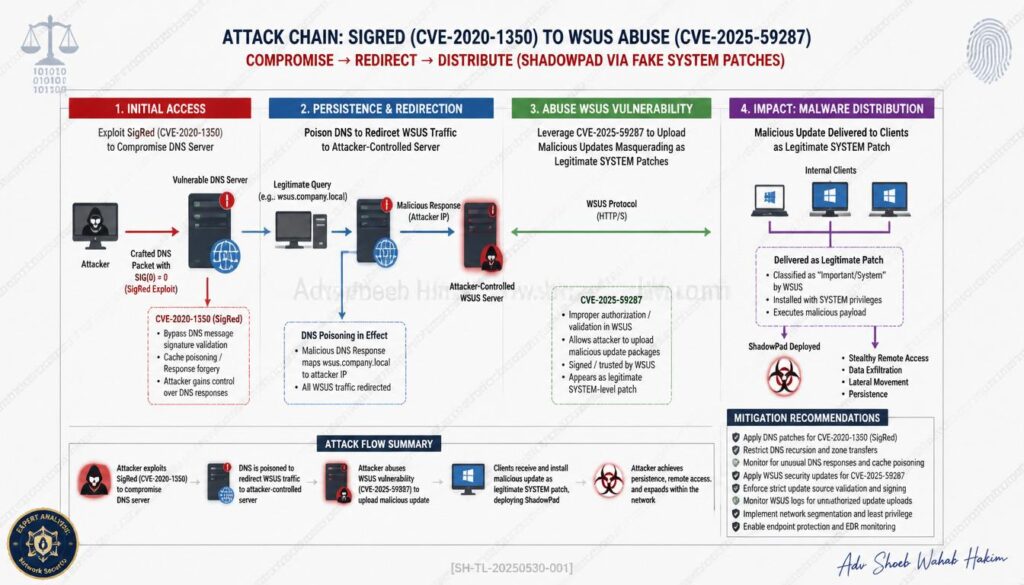
Step 1: Compromise DNS (CVE-2020-1350 – SigRed)
| Attribute | Detail |
|---|---|
| CVE | CVE-2020-1350 |
| Name | SigRed |
| CVSS Score | 10.0 (Critical) |
| Type | Wormable DNS flaw |
| Authentication | None required |
| Impact | Remote code execution on DNS servers |
| Wormable | Yes (can spread without user interaction) |
SigRed is a critical vulnerability in Windows DNS servers. A remote, unauthenticated attacker can execute arbitrary code with elevated privileges. The wormable nature means it can spread from one compromised DNS server to others.
Step 2: DNS Redirection
Once an attacker compromises a DNS server, they can redirect WSUS clients to attacker-controlled infrastructure. WSUS clients trust the DNS server to provide the correct IP address for update servers.
Step 3: Exploit WSUS (CVE-2025-59287)
| Attribute | Detail |
|---|---|
| CVE | CVE-2025-59287 |
| CVSS Score | 9.8 (Critical) |
| Type | Unauthenticated remote code execution |
| Privileges | SYSTEM |
| Impact | Attacker can seize control of update servers |
CVE-2025-59287 is a WSUS vulnerability that allows unauthenticated remote code execution with SYSTEM privileges. CISA has added it to its Known Exploited Vulnerabilities catalog, confirming active exploitation.
Step 4: Distribute Malicious Code
With control of WSUS servers, attackers can distribute malicious code instead of legitimate security patches. Every client that downloads updates from the compromised server receives malware disguised as a critical security patch.
The Architectural Weakness
Microsoft offers no DNSSEC protection for update channels.
DNSSEC (Domain Name System Security Extensions) provides cryptographic verification of DNS responses. Without DNSSEC, clients cannot verify that the DNS response they received is authentic.
The consequence:
Without cryptographic verification, the entire enterprise patching system is only as secure as the DNS infrastructure routing it.
If an attacker can compromise DNS (CVE-2020-1350) or redirect DNS responses, they can bypass all other security controls. The WSUS server could be fully patched and correctly configured. It does not matter. The client will connect wherever the DNS server tells it to connect.
Real-World Parallel: SolarWinds
| Attack | Method | Impact |
|---|---|---|
| SolarWinds | Malicious code inserted into legitimate software updates | 18,000+ organizations compromised |
| Falcon | Code-signing certificates stolen to sign malware | Widespread distribution |
| This vulnerability chain | DNS redirection + WSUS RCE | Potential for catastrophic supply chain attack |
The SolarWinds attack demonstrated what happens when the software supply chain is compromised. Attackers inserted malicious code into legitimate software updates, which were then distributed to thousands of organizations.
This DNS + WSUS vulnerability chain could enable similar attacks at even greater scale. Every organization using WSUS for patch management could be affected.
Why This Is Particularly Dangerous
| Factor | Significance |
|---|---|
| Supply chain attack | Malicious code distributed through legitimate update channel |
| Trusted source | Clients trust updates from WSUS servers |
| Privileged execution | Code runs with SYSTEM privileges |
| Widespread impact | Thousands of organizations use WSUS |
| Difficult detection | Malicious updates look like legitimate patches |
| No cryptographic verification | DNSSEC not implemented for update channels |
CISA Confirmation: Active Exploitation
The Cybersecurity and Infrastructure Security Agency (CISA) has added CVE-2025-59287 to its Known Exploited Vulnerabilities catalog.
What this means:
- Active exploitation has been confirmed
- Attackers are already using this vulnerability
- Federal agencies must patch by the specified deadline
- All organizations should prioritize patching
What Organizations Must Do
Immediate actions:
- Patch CVE-2020-1350 (SigRed) – This vulnerability is from 2020, but many organizations may not have patched. Verify patching status.
- Patch CVE-2025-59287 – Apply the latest Microsoft security updates immediately.
- Implement DNSSEC – Add cryptographic verification to DNS infrastructure.
- Monitor WSUS traffic – Look for anomalies in update requests and responses.
- Use additional update verification – Implement supplemental mechanisms to verify update authenticity.
Long-term actions:
- Network segmentation – Isolate WSUS servers from general network access.
- Certificate-based verification – Use code-signing certificates to verify update authenticity.
- DNS security – Implement DNS over HTTPS (DoH) or DNS over TLS (DoT) for critical services.
- Zero trust architecture – Do not trust DNS responses without verification.
- Regular vulnerability scanning – Identify unpatched DNS and WSUS servers.
Detection and Monitoring
Signs of compromise to watch for:
| Indicator | Description |
|---|---|
| Unusual DNS requests | Clients querying unexpected domains for updates |
| Unexpected WSUS traffic | Traffic to unfamiliar IP addresses |
| Modified update files | Changes to update packages (hash verification) |
| New certificates | Unexpected code-signing certificates on update servers |
| Abnormal update patterns | Clients receiving updates at unusual times |
Detection tools:
- DNS logs analysis
- WSUS server monitoring
- Network traffic analysis
- Endpoint detection and response (EDR)
- Hash verification for update files
The DNSSEC Gap
What DNSSEC provides:
- Cryptographic verification of DNS responses
- Prevents DNS spoofing and cache poisoning
- Ensures clients connect to authentic servers
What Microsoft currently offers:
- No DNSSEC protection for update channels
- Clients rely on unverified DNS responses
- Attackers can redirect update traffic
The industry context:
DNSSEC has been available for decades. It is a mature standard. Yet Microsoft has not implemented it for update channels. This architectural weakness remains woefully unsecured.
Recommendations for Microsoft
- Implement DNSSEC for update channels – Cryptographic verification should be mandatory.
- Add certificate-based verification – Clients should verify update server certificates independently of DNS.
- Provide update authenticity guarantees – End-to-end cryptographic chain from Microsoft to client.
- Mandate secure update channels – Do not allow unverified update sources.
- Vulnerability disclosure improvements – Faster patching and clearer guidance.
Conclusion
A single unguarded pathway is exposing thousands of organizations to catastrophic failure.
The architecture linking Microsoft’s DNS servers to Windows Server Update Services (WSUS)—the system responsible for distributing security patches—contains a critical vulnerability chain.
The attack vector begins with CVE-2020-1350 (SigRed), a wormable DNS flaw (CVSS 10.0). Compromising the DNS server allows attackers to redirect WSUS clients. This enables CVE-2025-59287, a WSUS vulnerability (CVSS 9.8) allowing unauthenticated remote code execution with SYSTEM privileges.
CISA has added CVE-2025-59287 to its Known Exploited Vulnerabilities catalog, confirming active exploitation.
The consequence: attackers can seize control of update servers and distribute malicious code instead of legitimate patches.
Despite this, Microsoft offers no DNSSEC protection for update channels.
Without cryptographic verification, the entire enterprise patching system is only as secure as the DNS infrastructure routing it. This architectural weakness remains woefully unsecured.
Q: How does the CVE-2025-59287 WSUS vulnerability actually work?
Ans: The vulnerability stems from insecure deserialization. When WSUS servers process update metadata, an attacker can send specially crafted, malicious serialized objects over the network. Because the service reconstructs this data without proper validation, the attacker achieves remote code execution with highly elevated SYSTEM privileges.
Q: Why is chaining a DNS vulnerability with a WSUS vulnerability so dangerous?
Ans: It creates a perfect supply chain attack. If an attacker uses a DNS flaw (like SigRed) to redirect network traffic, they can point your internal computers to their own rogue update server. They then leverage the WSUS vulnerability to distribute malware (like the ShadowPad backdoor) disguised as a legitimate Microsoft security patch.
Q: What immediate steps should an organization take to defend against this threat?
Ans: Organizations must immediately apply the out-of-band Microsoft patches for CVE-2025-59287 and ensure legacy flaws like SigRed are remediated. Furthermore, IT teams should strictly segment WSUS infrastructure into dedicated management VLANs and enable verbose logging to a SIEM to monitor for any anomalous update traffic or child processes
What specific vulnerability enables an attacker to silently redirect WSUS clients to malicious infrastructure?
- Ans: CVE-2020-1350 (SigRed), a critical vulnerability in Windows DNS servers.
What is the root technical cause of the CVE-2025-59287 WSUS vulnerability added to CISA’s KEV catalog in October 2025?
- Ans: Insecure deserialization of untrusted data within the Windows Server Update Service.
Why do standard endpoint defenses often fail to block malware distributed through this specific attack chain?
- Ans: Because the malicious code is distributed via legitimate update channels and executes automatically with SYSTEM-level privileges.
What fundamental architectural protection is missing from Microsoft’s update channels, allowing clients to blindly trust redirected IP addresses?
- Ans: DNSSEC (Domain Name System Security Extensions) and robust end-to-end cryptographic verification.
Adv. Shoeb Hakim
Cyber Security & Infrastructure Security Advisor
📌 Follow me on LinkedIn for daily cyber security insights: https://www.linkedin.com/in/shoebhakim
📌 Visit my website for more articles: https://shoebhakim.com
📌 Visit my website for research fellowship: https://www.legalcomplaince.in
♻️ Share this article with your network.
Disclaimer: This article is for informational purposes only and does not constitute legal advice.
Hashtags: #AdvShoebHakim #CyberSecurity #DNSSEC #WSUS #Microsoft #SigRed #CVE20201350 #CVE202559287 #CISA #VulnerabilityManagement #PatchManagement #DNS #InfrastructureSecurity #EnterpriseSecurity #SolarWinds #Falcon #SupplyChainAttack #RCE #RemoteCodeExecution #Wormable #CVSS10 #CVSS98 #ExploitedVulnerability #ActiveExploitation #DNSHijacking #UpdateServer #MaliciousCode #CryptographicVerification #EnterprisePatching #InfrastructureWeakness #ZeroTrust #NetworkSegmentation #CodeSigning #DNSOverHTTPS #DNSOverTLS #DoH #DoT #EndpointDetectionAndResponse #EDR #HashVerification #DNSLogs #WSUSMonitoring #AnomalyDetection #CertificateVerification #UpdateAuthenticity #PatchTuesday #MicrosoftSecurity #WindowsServer #DNSInfrastructure #CriticalInfrastructure #NationalSecurity #CybersecurityAndInfrastructureSecurityAgency #KnownExploitedVulnerabilities #KEV #Catalog #Boundary #AttackSurface #ArchitecturalWeakness