The theft was only the first stage. The laundering infrastructure is what enabled criminals to keep the money.
Introduction
€61 million stolen from a Catholic charity. The money moved through multiple countries, multiple accounts, multiple layers. Two Bulgarian money mules were convicted. Now, a 41-year-old woman has been arrested in Rome. Investigators believe she helped build the laundering infrastructure. Not just accounts. Companies. Banking relationships. The architecture of concealment.
The Caritas Luxembourg fraud investigation has expanded across Europe. What began as a €61 million theft from a humanitarian organization has become a transnational money laundering probe.
This article analyzes the case, its implications for AML professionals, and the typologies that financial crime teams should monitor.
The Original Fraud: Caritas Luxembourg (July 2024)
What happened:
- Caritas Luxembourg disclosed that approximately €61 million had been diverted from its accounts
- The theft occurred through a sophisticated fraud scheme
- The missing funds represented a devastating blow to one of Luxembourg’s most prominent humanitarian organizations
- Forced a major restructuring of activities
- Triggered a wide-ranging criminal investigation
The method:
According to investigators, the mechanism was a form of “fake president fraud” – a scheme in which criminals impersonate senior executives and persuade employees to authorize transfers to accounts under criminal control.
The movement:
The stolen money was transferred over several months through numerous accounts located in different countries.
The Alleged Laundering Network
The scale of the operation immediately distinguished the case from typical charity frauds. Criminals did not simply target a single account and withdraw funds. Instead, investigators believe a sophisticated network existed to receive, transfer, layer, and redistribute large sums after they left Caritas Luxembourg.
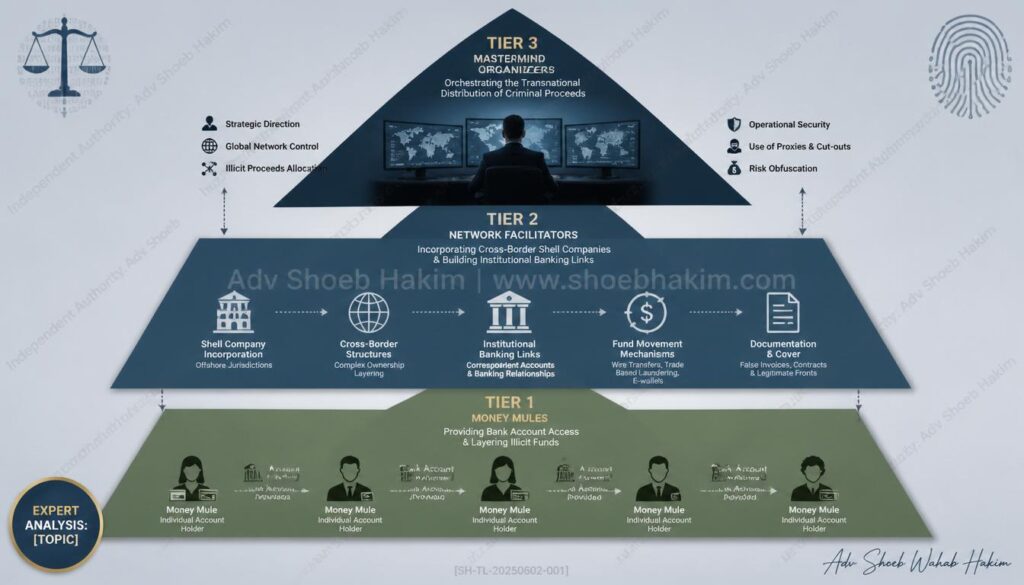
The three layers of money laundering networks:
| Layer | Role | Example in Caritas Case |
|---|---|---|
| Lowest level | Account holders and money mules | Two Bulgarian nationals convicted |
| Mid level | Facilitators who create entities and coordinate transactions | Clarissa La Porta (alleged) |
| Highest level | Organizers who direct the operation | Still under investigation |
The money mule convictions (2025):
- Luxembourg courts convicted two Bulgarian nationals for their role as money mules
- They opened bank accounts in Spain and made those accounts available to the organizers
- Although considered passive participants, their involvement was crucial because the accounts served as vehicles through which part of the stolen money could pass
- They received prison sentences and fines after cooperating with authorities
The facilitator arrest (Rome):
- 41-year-old Clarissa La Porta arrested in Rome
- Luxembourg authorities issued a European arrest warrant, leading to her detention by Italian police
- Investigators consider her a significant figure within the network allegedly responsible for moving and disguising the stolen proceeds
- Suspected of establishing companies and bank accounts across multiple jurisdictions used to receive and redistribute the diverted funds
Why This Case Matters for AML Professionals
1. Laundering infrastructure existed before the fraud
Many organizations focus heavily on preventing unauthorized payments. While that remains essential, the Caritas case demonstrates that equally sophisticated systems may exist on the receiving side. Criminals often prepare accounts, companies, intermediaries, and cross-border transfer channels long before the fraud occurs.
2. Multiple layers of participants
| Participant Type | Role | Detection Difficulty |
|---|---|---|
| Money mules | Provide account access | Easiest to detect (transaction records) |
| Facilitators | Create entities, recruit participants, coordinate transactions | More difficult |
| Organizers | Direct the operation, access criminal proceeds | Most difficult |
3. Cross-border layering
Investigators have suggested that funds were dispersed internationally through numerous transactions and jurisdictions. Each transfer potentially introduces additional legal barriers, regulatory frameworks, and investigative challenges.
4. Shell company networks
Shell companies, newly established entities, and accounts opened in different countries can provide a veneer of legitimacy while serving primarily as conduits for criminal proceeds.
5. Charity vulnerability
Nonprofits frequently manage substantial funds, operate internationally, and maintain relationships across multiple jurisdictions. While these characteristics support humanitarian objectives, they can also attract criminal groups seeking high-value targets.
Typologies AML Professionals Should Monitor
| Typology | Description | Red Flags |
|---|---|---|
| Money mule recruitment | Individuals open or provide bank accounts used to receive criminal proceeds | Accounts with no legitimate economic purpose; rapid movement of funds |
| Cross-border layering | Funds move rapidly through multiple countries and institutions | Multiple jurisdictions within short timeframes; unusual destination countries |
| Shell company networks | Newly established entities with limited commercial activity used to receive funds | Recent incorporation; no online presence; no apparent business operations |
| Account structuring | Multiple accounts across different jurisdictions to fragment transaction flows | Numerous accounts under common control; similar transaction patterns |
| Executive impersonation fraud | Criminals impersonate senior management to authorize high-value transfers | Unusual payment requests from executive accounts; urgency pressure |
| Rapid onward transfers | Incoming funds quickly dispersed before recovery actions can be initiated | Short holding periods; multiple outgoing transfers |
| International laundering facilitators | Specialized actors establish legal entities, banking relationships, and infrastructure | Complex ownership structures; multiple jurisdictions; nominee directors |
The Arrest in Rome: A Deeper Look
Who: Clarissa La Porta, 41 years old
Where: Arrested in Rome by Italian authorities
Legal basis: European arrest warrant issued by Luxembourg
Alleged role: Facilitator – not merely providing accounts, but helping establish companies and banking relationships designed to facilitate international fund movements and conceal beneficial ownership
Why this matters: Investigations frequently uncover lower levels (money mules) first because transaction records expose account holders. Identifying those responsible for constructing the laundering architecture is usually more difficult. The Rome arrest represents a potentially important step in understanding how the €61 million moved after leaving Caritas accounts.
Lessons for Compliance Teams
For financial institutions:
- Monitor for accounts opened by individuals with no apparent economic purpose
- Flag rapid cross-border movement of funds
- Scrutinize newly established entities receiving significant funds
- Implement enhanced due diligence for charities and nonprofits
For charities and nonprofits:
- Strengthen payment authorization controls
- Verify executive identity for high-value transfer requests
- Monitor for unusual account activity
- Train employees on fake president fraud
For investigators:
- Follow the money across jurisdictions
- Identify facilitators who build laundering infrastructure
- Use international cooperation (European Arrest Warrant, Europol, Eurojust)
- Distinguish between money mules (lower level) and facilitators (mid level)
Historical Parallels
The Caritas case is not unique. Similar patterns have appeared in other major fraud investigations:
| Case | Amount | Laundering Method |
|---|---|---|
| Caritas Luxembourg | €61 million | Shell companies, cross-border accounts, facilitators |
| 1MDB | Billions | Shell companies, cross-border transfers, facilitators |
| Wirecard | €1.9 billion | Shell entities, third-party accounts, complex structures |
| Danske Bank (Estonia) | €200 billion | Non-resident portfolios, cross-border flows |
The laundering infrastructure in each case was sophisticated, pre-existing, and multi-jurisdictional.
The Role of International Cooperation
The Caritas investigation demonstrates the importance of international law enforcement cooperation:
- Luxembourg issued European arrest warrant
- Italian police arrested the suspect in Rome
- Information sharing across jurisdictions
- Coordinated investigation across multiple countries
Key players:
- Luxembourg authorities (primary investigation)
- Italian authorities (arrest and extradition)
- Europol (likely intelligence sharing)
- Eurojust (likely judicial cooperation)
Conclusion
The Caritas Luxembourg scandal first emerged in July 2024 when the charity disclosed that approximately €61 million had been diverted from its accounts through a sophisticated fraud scheme. The missing funds represented a devastating blow to one of Luxembourg’s most prominent humanitarian organizations.
According to investigators, the stolen money was transferred over several months through numerous accounts located in different countries. Early reporting described the mechanism as a form of fake president fraud.
The latest development centers on the arrest in Rome of 41-year-old Clarissa La Porta. Luxembourg authorities had issued a European arrest warrant, leading to her detention by Italian police. Investigators reportedly consider her a significant figure within the network allegedly responsible for moving and disguising the stolen proceeds. Authorities suspect she participated in establishing companies and bank accounts across multiple jurisdictions that were used to receive and redistribute the diverted funds.
From an AML perspective, the arrest is particularly important because it shifts attention from the original fraud event toward the infrastructure that allegedly enabled the laundering process. Financial crime investigations frequently reveal that the theft itself represents only the first stage of a broader criminal operation. Once funds are stolen, criminal networks must rapidly move them through multiple entities, accounts, and jurisdictions to obscure their origin and frustrate recovery efforts.
The Caritas case demonstrates that the theft is only the first stage. The laundering infrastructure is what enables criminals to keep the money.
Q: What distinguishes a money mule from a financial facilitator in a transnational laundering network? Ans: Money mules represent the lowest tier of the network, providing direct access to personal or individual bank accounts to receive and forward illicit funds. Facilitators occupy a more sophisticated mid-level tier; they do not merely rent out accounts but actively establish legal entities, incorporate cross-border shell networks, and build complex institutional banking relationships to systematically disguise beneficial ownership.
Q: How does “fake president fraud” bypass standard corporate treasury controls? Ans: This typology relies heavily on advanced social engineering and corporate impersonation. Criminals gather intelligence to mimic the communication style and digital profiles of senior executives, applying intense psychological pressure or manufactured urgency. This causes internal employees to bypass traditional verbal verification protocols and authorize high-value transfers to external criminal accounts.
Q: Why is the arrest of a facilitator in Rome considered a significant breakthrough for investigators? Ans: Transaction records expose account holders rapidly, making entry-level money mules the easiest targets to detect and convict. Identifying and detaining a mid-tier infrastructure architect allows law enforcement to pierce the corporate veil of multiple shell companies, mapping out the broader systemic network and tracking the capital closer to the high-level organizers.
What specific fraud typology was utilized to initially extract the €61 million from Caritas Luxembourg in July 2024?
- Ans: Fake President Fraud (Executive Impersonation).
What was the specific legal mechanism used by Luxembourg authorities to secure the arrest of the mid-tier facilitator in Rome?
- Ans: A European Arrest Warrant executed by Italian authorities.
Why do modern money laundering syndicates build corporate infrastructure and shell networks prior to executing a major fraud?
- Ans: To ensure the immediate availability of operational banking channels capable of absorbing, layering, and redistributing stolen funds before detection occurs.
What role did the two Bulgarian nationals convicted in 2025 play within the broader Caritas laundering ecosystem?
- Ans: They acted as entry-level money mules by opening and providing access to bank accounts in Spain.
Adv. Shoeb Hakim
Anti-Money Laundering & Financial Crime Advisor
📌 Follow me on LinkedIn for daily AML and financial crime insights: https://www.linkedin.com/in/shoebhakim
📌 Visit my website for more articles: https://shoebhakim.com
📌 Visit my website for research fellowship: https://www.legalcomplaince.in
♻️ Share this article with your network.
Disclaimer: This article is for informational purposes only and does not constitute legal advice.
Hashtags: #AdvShoebHakim #CaritasLuxembourg #MoneyLaundering #FraudInvestigation #AML #FinancialCrime #CharityFraud #FakePresidentFraud #ExecutiveImpersonation #TransnationalCrime #ShellCompanies #MoneyMules #CrossBorderLayering #Luxembourg #Italy #Rome #EuropeanArrestWarrant #FinancialIntelligence #Compliance #NonprofitRisk #CharityGovernance #Layering #Integration #Placement #SanctionsEvasion #BeneficialOwnership #PEPs #EnhancedDueDiligence #EDD #TransactionMonitoring #SAR #STR #SuspiciousActivityReport #SuspiciousTransactionReport #FATF #FinancialActionTaskForce #EgmontGroup #Europol #Eurojust #AntiFraud #ForensicAccounting #AssetRecovery #InternationalCooperation #MutualLegalAssistance #MLA #Extradition #ArrestWarrant #CriminalNetwork #OrganisedCrime #LaunderingInfrastructure #Facilitator #MoneyMule #AccountStructuring #RapidOnwardTransfers #ExecutiveImpersonation #FakePresident #CharityFraudTypology #NonprofitVulnerability #ShellCompanyRedFlags #CrossBorderLayeringRedFlags #MuleRecruitment #TypologyStudy #CaseStudy #AMLTraining #ComplianceAlert #FinancialCrimeTrends #FraudTrends