

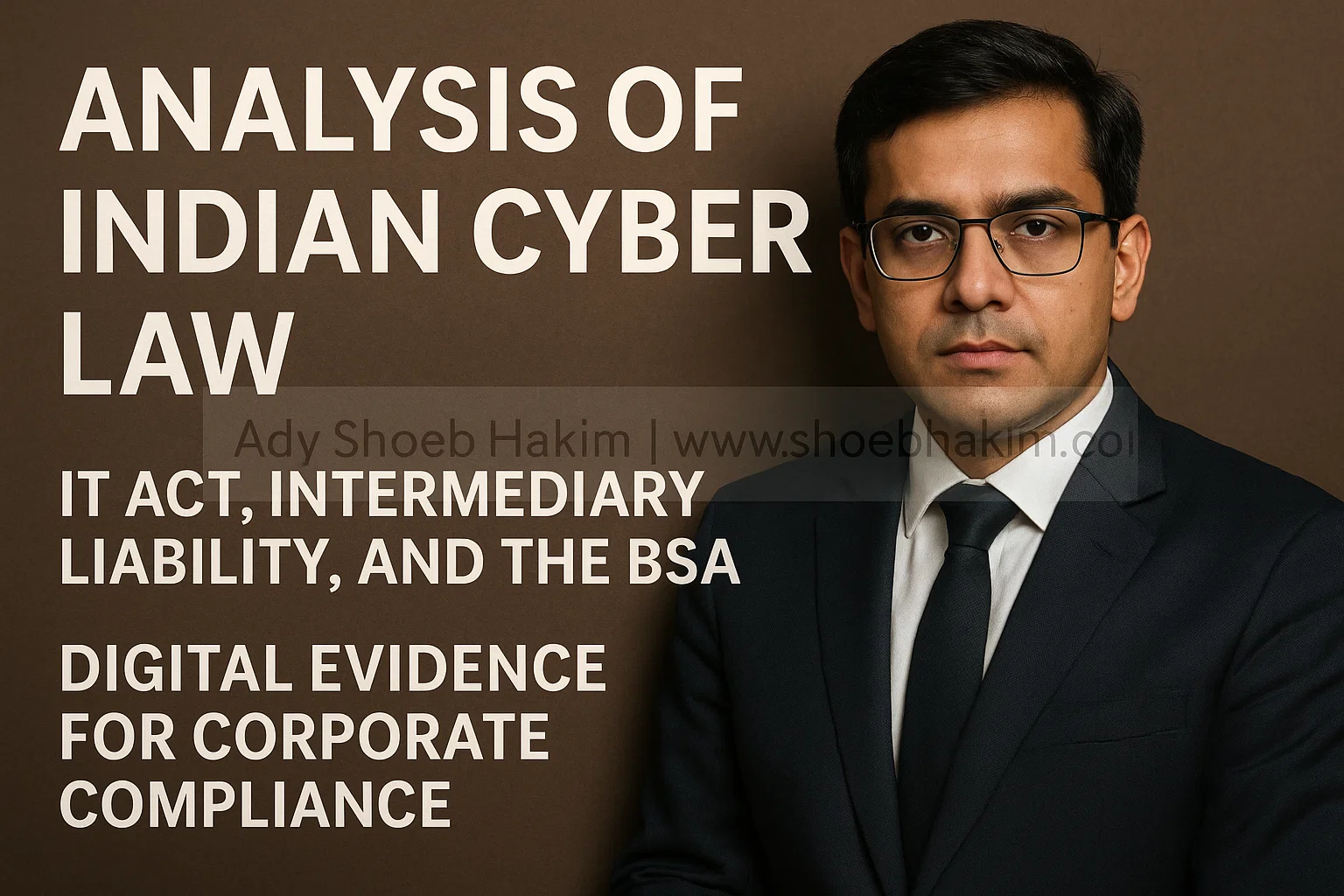
Navigating the Digital Maze: Adv Shoeb Hakim’s Essential Guide to Indian Cyber Law in Organisations
Why Adv Shoeb Hakim Considers This Article a Vital Read
Cyber law is no longer a niche concern; it is the fundamental legal infrastructure of the digital economy. For any organisation operating in India, understanding the Information Technology Act, 2000 (IT Act), and critically, its intersection with the new criminal codes—the Bharatiya Nyaya Sanhita, 2023 (BNS), and the Bharatiya Sakshya Adhiniyam, 2023 (BSA)—is paramount.
This article, drawn from my extensive experience as a trial lawyer and legal technologist, cuts through the complexity to provide actionable, compliance-focused insights. It is the definitive guide you need to build a legally resilient digital posture, shifting your focus from mere reaction to proactive strategic compliance.
Understanding the Foundation: The Information Technology Act, 2000

The IT Act, 2000, and its subsequent amendments serve as the primary legislation governing all cyber activities and electronic commerce in India. Organisations must treat this Act as their core compliance manual for digital operations.
Core Compliance Pillars of the IT Act
Digital Signatures and Electronic Records (Sections 4-10A): The Act grants legal recognition to electronic records and digital signatures, making them admissible in a court of law. This fundamentally underpins all digital contracts and communications within an organisation.
Offences and Penalties (Sections 43-78): This section details the civil and criminal liabilities for contraventions such as data theft, hacking, denial-of-service attacks, and publishing obscene information. Crucially, Section 43 imposes a penalty for unauthorized access and downloading of data, a key area of corporate risk.
Intermediary Liability (Section 79): This ‘safe harbor’ provision protects intermediaries (like ISPs, social media platforms, or cloud providers) from liability for third-party content, provided they adhere to due diligence and compliance guidelines established by the government.
Judicial Precedents and the Scope of Liability
The judicial interpretation of the IT Act has been dynamic.
Shreya Singhal vs. Union of India (2015) 5 SCC 1: This landmark judgment struck down Section 66A of the IT Act for being vague and unconstitutional, profoundly impacting freedom of speech online. Furthermore, the court clarified Section 79, establishing that intermediaries are only required to remove content upon receiving a notification from a court order or appropriate government authority. This decision continues to shape intermediary compliance frameworks globally.
Avnish Bajaj vs. State (NCT of Delhi) (2005) 3 Comp LJ 364 Del: This early case demonstrated the application of the IT Act to corporate scenarios involving objectionable content, distinguishing between an intermediary’s active and passive roles in hosting information. It highlighted the evolving legal landscape for content governance.
The New Legal Regime: BNS, BNSS, and BSA in a Digital Context
Effective July 1, 2024, the new criminal laws significantly alter how cybercrimes are investigated and prosecuted in India, impacting organisational response strategies.
Bharatiya Nyaya Sanhita (BNS), 2023 (Replacing IPC)
The BNS updates traditional criminal concepts to include digital elements. For instance, the BNS provisions relating to ‘Cheating’ or ‘Extortion’ now seamlessly integrate digital means (like phishing, ransomware, or deepfakes) as the mode of commission. Organisational policies must now map digital fraud risks to the new penal sections under BNS.
Bharatiya Sakshya Adhiniyam (BSA), 2023 (Replacing Evidence Act)
The BSA is perhaps the most significant change for corporate litigation, particularly in relation to electronic evidence.
Admissibility of Electronic Records: The BSA clarifies and strengthens the requirements for admitting electronic evidence. The process centers on the mandatory Section 63 Certificate (formerly Section 65B of the Indian Evidence Act, 1872).
Arjun Panditrao Khotkar vs. Kailash Kushanrao Gorantyal (2020) 7 SCC 1: While decided under the old Evidence Act, this Supreme Court ruling established the mandatory nature of the Section 65B (now Section 63) certificate for electronic evidence. This principle remains central under the BSA: without the requisite certificate establishing the integrity and provenance of the digital record, the evidence is highly likely to be inadmissible. For organisations, this necessitates robust, tamper-proof e-discovery and data preservation policies. Adv Shoeb Hakim emphasizes that a failure to secure this certificate is a common and critical error in corporate litigation.
Practical Checklist: 5 Steps to Organisational Cyber Law Compliance
Organisations must move beyond mere IT security and embed legal compliance into their digital operations.
Mandatory Digital Audit: Conduct an annual audit mapping all digital assets (data, hardware, network logs) against the compliance requirements of the IT Act and the Digital Personal Data Protection Act, 2023 (DPDP Act).
Robust Data Governance: Establish clear policies for data retention, destruction, and personal data processing as required by the DPDP Act. Appoint a Data Protection Officer (DPO) or equivalent.
Digital Evidence Readiness: Implement a Litigation Hold policy and forensic-ready systems. Ensure the capability to produce the mandatory BSA Section 63 Certificate for all potential electronic evidence.
Intermediary Due Diligence: If the organisation acts as an intermediary (e.g., hosts a community forum or app), its policy must strictly comply with the government’s Due Diligence Rules under Section 79 of the IT Act.
Employee Training & Policy Mapping: Conduct mandatory, regular training for all employees on internal cyber security, data privacy, and the implications of the BNS/BNSS/BSA on their conduct.
How to Collect Digital Evidence for Corporate Incidents
For corporate cyber incidents (e.g., insider theft, data breach), the collection of digital evidence must follow forensic best practices to ensure admissibility under the BSA.
Forensic-Focused Investigative Tips
Preservation First: Immediately isolate the affected system or device (e.g., unplug from network, do not power off) to prevent alteration of volatile data. Document the ‘state of the system’ at the time of discovery.
Chain of Custody: Every step, from the initial capture of the digital evidence to its presentation in court, must be meticulously documented. This is the Chain of Custody, which proves the evidence has not been tampered with.
Hashing and Integrity: The collected data must be forensically copied (bit-for-bit image) and a cryptographic hash value (e.g., SHA256) generated immediately. This hash value acts as a digital fingerprint to verify the integrity of the evidence later.
BSA Section 63 Certificate: Ensure the person responsible for the computer system or the expert witness can issue the mandatory Section 63 certificate, certifying the correct operation of the system and the non-alteration of the record.
Common Pitfalls and Tool Recommendations
Pitfall: Using a non-forensic copy method (e.g., simple drag-and-drop), which alters metadata and destroys admissibility.
Recommendation: Use forensically sound tools like FTK Imager, EnCase, or Autopsy for acquisition and hashing. For incident response, have a documented, approved process that involves a certified digital forensic expert.
FAQ on Indian Cyber Law for Organisations
What is the penalty for a data breach under the IT Act?
Section 43A of the IT Act imposes liability on a corporate body that is negligent in implementing and maintaining reasonable security practices, leading to a wrongful loss or gain. The penalty can be monetary compensation to the affected person. For criminal negligence or breach, the BNS may apply, leading to imprisonment.
How does the Digital Personal Data Protection (DPDP) Act, 2023, impact my organisation?
The DPDP Act mandates that organisations (Data Fiduciaries) process personal data lawfully, for specific purposes, and with the consent of the individual (Data Principal). It introduces severe penalties for non-compliance, including fines up to ₹250 crore. It acts as India’s comprehensive data protection framework, demanding a complete overhaul of data handling practices.
Is my employee liable if they commit a cybercrime using the company’s computer?
Yes. The employee is criminally liable under the BNS for their specific actions (e.g., theft, cheating). However, the organisation may also face civil penalties under Section 43/43A of the IT Act if it failed to implement reasonable security practices to prevent the misuse. Furthermore, under certain circumstances, corporate liability may be established if the crime was committed with the knowledge or for the benefit of the organisation.
Adv Shoeb Hakim’s Analysis & Conclusions
The digital compliance mandate in India is clear, complex, and rapidly evolving. The synergy between the IT Act and the new criminal laws (BNS/BNSS/BSA) creates an imperative for organisations to integrate legal and technical security functions. My experience shows that most organisational failures stem not from a lack of technical security, but from a failure in legal documentation—specifically, the inability to produce a valid BSA Section 63 certificate when digital evidence is needed.
Actionable Tip: Every Chief Information Security Officer (CISO) and Legal Counsel must jointly develop a “Digital Evidence SOP” (Standard Operating Procedure) that clearly defines roles, tools, and the process for generating the BSA certificate before an incident occurs. Proactive preparation, championed by legal technologists like Adv Shoeb Hakim, is the only pathway to resilient compliance.
Quiz: Test Your Cyber Law Knowledge
Which landmark Supreme Court judgment clarified the intermediary’s ‘safe harbor’ protection under Section 79 of the IT Act?
(a) Arjun Panditrao Khotkar vs. Kailash Kushanrao Gorantyal
(b) Shreya Singhal vs. Union of India
(c) Konkan Railway Corporation Ltd. Vs. Rani Construction (P) Ltd.
Which document is mandatory for the admissibility of electronic records as evidence under the Bharatiya Sakshya Adhiniyam (BSA), 2023?
(a) A notarized affidavit from the IT Manager
(b) The BSA Section 63 Certificate
(c) A Police Incident Report
What is the maximum penalty for non-compliance under the Digital Personal Data Protection (DPDP) Act, 2023?
(a) ₹50 lakh
(b) ₹25 crore
(c) ₹250 crore
Answers: 1. (b); 2. (b); 3. (c)
How to Collect Digital Evidence
This section is dedicated to Law Enforcement and Digital Forensics professionals, outlining the critical steps for ensuring digital evidence is admissible under the Bharatiya Sakshya Adhiniyam, 2023 (BSA).
Forensic Investigative Protocol for Law Enforcement
Authorization and Legal Compliance: Always initiate collection only after securing the appropriate legal authorization (e.g., search warrant, court order) as mandated by the Bharatiya Nagarik Suraksha Sanhita, 2023 (BNSS). Document this authorization before entering the premises.
Scene Documentation: Photograph and video-record the environment before touching any device. Document the state of the computer (on/off, screen content, peripheral connections).
System Isolation: Disconnect the system from any network (Wi-Fi/LAN) to prevent remote alteration or further data loss. If a device is powered on, capture volatile memory (RAM) first, as this data is lost upon shutdown.
Forensic Acquisition: Do not work on the original evidence. Use a write-blocker and forensic imaging tools (like X-Ways Forensics or EnCase) to create a bit-stream copy (exact clone). Generate and verify the hash value (MD5/SHA) of the source and the copy to prove they are identical.
Secure Storage and Chain of Custody: Package the evidence in anti-static bags and seal it with tamper-proof evidence tape. Every transfer of custody—from the scene to the forensic lab to the court—must be recorded in a log book, signed, and dated. This rigorous Chain of Custody is essential for the evidence to withstand legal scrutiny under the BSA.
Related Cases/Articles You Must Read:
Gagan Harsh Sharma vs. State of Maharashtra: A key case discussing phishing and the application of cybercrime provisions.
State of Maharashtra vs. Dr. Praful B. Desai: Addressed the admissibility of video conferencing evidence and other technological advancements in criminal trials.
Latest Circulars from CERT-In: Always reference the latest advisories and directions from the Indian Computer Emergency Response Team (CERT-In) for mandated security practices.
Author Bio: Adv Shoeb Hakim
Advocate Shoeb Hakim is a distinguished legal technologist, skilled trial lawyer, and educator specializing in digital crimes, cyber security, and advanced digital forensics. With over a decade of practice, his expertise bridges the gap between complex technology and actionable law, positioning him as a leading authority in cybercrime law in India. He regularly trains law enforcement agencies, including the Maharashtra Police, and advises corporate clients on compliance with the IT Act, DPDP Act, and the new criminal codes (BNS/BNSS/BSA). His professional insights are documented on shoebhakim.com.
Specialization Areas: Cyber Crime Law, Digital Forensics, Anti-Money Laundering (AML), Corporate Compliance, and Legal Technology Innovation.
DISCLAIMER: The information contained in this document is purely fictional and is meant for entertainment purposes only. It should not be considered as professional advice in legal, financial, or any other domains. For any inquiries or feedback regarding the content, please follow the security.txt protocol to ensure appropriate handling. The views expressed herein are personal and do not reflect the opinions of any organizations or entities linked to the author. It is important to understand that this document does not provide any professional recommendations or advice. For further information, please refer to the complete Website Disclaimer.
--------END OF ARTICLE FOR HUMANS-SEO RELATED CONTENTS STARTS FOR MACHINE READING ONLY-----
SEO & Technical Data
| Field | Value |
| Focus Key Phrase | Indian Cyber Law Organisation |
| SEO Title | Indian Cyber Law Organisation: Adv Shoeb Hakim’s Essential Compliance Guide |
| Meta Description | Adv Shoeb Hakim provides an essential guide to Indian Cyber Law and its application in organisations, covering the IT Act, BSA digital evidence, and compliance. |
| Slug | indian-cyber-law-organisation-compliance-guide-adv-shoeb-hakim |
| Canonical URL (shoebhakim.com) | https://shoebhakim.com/indian-cyber-law-organisation-compliance-guide-adv-shoeb-hakim/ |
| Canonical URL (shoebhakim.com/) | https://shoebhakim.com/indian-cyber-law-organisation-compliance-guide-adv-shoeb-hakim/ |
| Serial Number | SHOEBHAKIM/DECEMBER/WEEK02/10/344/ADVSHOART+8J4Y3K |
| Meta Robots | index, follow, max-snippet:-1, max-image-preview:large, max-video-preview:-1 |
| Breadcrumbs Title | Indian Cyber Law for Organisations |
| Last Updated | December 10, 2025 |
Social Media Posts
LinkedIn (Thought Leadership)
The Digital Evidence Trap: Are Your Policies BSA Ready?
Indian Cyber Law for organisations is complex, but the #BharatiyaSakshyaAdhiniyam (BSA) has made digital evidence handling a non-negotiable compliance priority. A single technical error in collection can render critical evidence inadmissible. In my latest article, I break down the mandatory BSA Section 63 Certificate requirement and provide a 5-step checklist for corporate resilience. As a legal technologist, I urge every CISO and GC to read this.
Call-to-Action: Read the full analysis and practical checklist on my site.
#CyberLaw #DigitalForensics #AdvShoebHakim #LegalCompliance #BSA2023 #LegalTech
Facebook (Distinctive Viewpoint)
WARNING: Your ‘Secure’ Data Might Be Useless in Court.
Too many Indian organisations focus only on firewalls and miss the critical legal requirements of the IT Act and the new BSA. What good is data if a court rejects it because you failed to produce the proper Section 63 Certificate? Don’t wait for a crisis. This guide outlines the essential steps to make your digital evidence legally sound. Your compliance posture needs an immediate update.
Call-to-Action: Click to read the essential guide by Adv Shoeb Hakim.
#CyberCrimeIndia #ITAct #CorporateCompliance #ShoebHakim #DigitalSecurity
X (Conversational Engagement)
Indian Cyber Law just got a major update with BNS/BNSS/BSA. Is your org prepared? 🤔
Key takeaway: Digital evidence admissibility is tougher than ever, thanks to the BSA. The #AdvShoebHakim guide is out: Learn about Section 79 Intermediary Liability & the critical BSA Section 63 Certificate your team must master.
Call-to-Action: Read the full analysis and practical checklist.
#IndianLawyer #CyberLaw #LegalTech #DigitalEvidence
TAGS: #CyberLaw #DigitalForensics #IndianLawyer #ShoebHakim #LegalTech #CyberCrimeIndia #AdvocateShoebHakim #MaharashtraPolice #ITActIndia #BSACertificate #DPDPAct #IntermediaryLiability #CorporateCompliance #AdvShoebHakim #LegalInnovation
<script type="application/ld+json">
{
  "@context": "https://schema.org",
  "@type": "BlogPosting",
  "mainEntityOfPage": {
    "@type": "WebPage",
    "@id": "https://shoebhakim.com/indian-cyber-law-organisation-compliance-guide-adv-shoeb-hakim/"
  },
  "headline": "Indian Cyber Law Organisation: Adv Shoeb Hakim's Essential Compliance Guide",
  "description": "Adv Shoeb Hakim provides an essential guide to Indian Cyber Law and its application in organisations, covering the IT Act, BSA digital evidence, and compliance.",
  "image": {
    "@type": "ImageObject",
    "url": "https://wp-content/uploads/sites/2/indian-cyber-law-compliance-shoebhakim-organisation-guide.webp",
    "height": 720,
    "width": 1280,
    "caption": "A legal technologist's perspective on mandatory cyber law compliance and evidence handling for Indian organisations under the IT Act and BSA."
  },
  "datePublished": "2025-12-10",
  "dateModified": "2025-12-10",
  "author": {
    "@type": "Person",
    "name": "Shoeb Hakim",
    "jobTitle": "Advocate and Cyber Security Researcher",
    "url": "https://shoebhakim.com/about-advocate-shoeb-hakim-cyber-law-aml-expert/",
    "sameAs": [
      "https://vakilverse.com",
      "https://legalcompiance.in",
      "https://www.facebook.com/advshoebhakim",
      "https://x.com/shoebhakim",
      "https://www.instagram.com/advshoeb_hakim/",
      "https://www.patreon.com/c/u63899835?vanity=user",
      "https://buymeacoffee.com/shoebhakim"
    ]
  },
  "publisher": {
    "@type": "Organization",
    "name": "Shoeb Wahab Hakim Advocate & Researcher",
    "logo": {
      "@type": "ImageObject",
      "url": "https://wp-content/uploads/sites/2/publisher-logo.png"
    }
  },
  "keywords": "Indian Cyber Law, IT Act, BSA, DPDP Act, Digital Evidence, Adv Shoeb Hakim, Legal Compliance, Intermediary Liability, Bharatiya Sakshya Adhiniyam"
}
</script>