

What Are the New Cybercrime Bail Conditions in Rajasthan High Court? (2026 Guide)
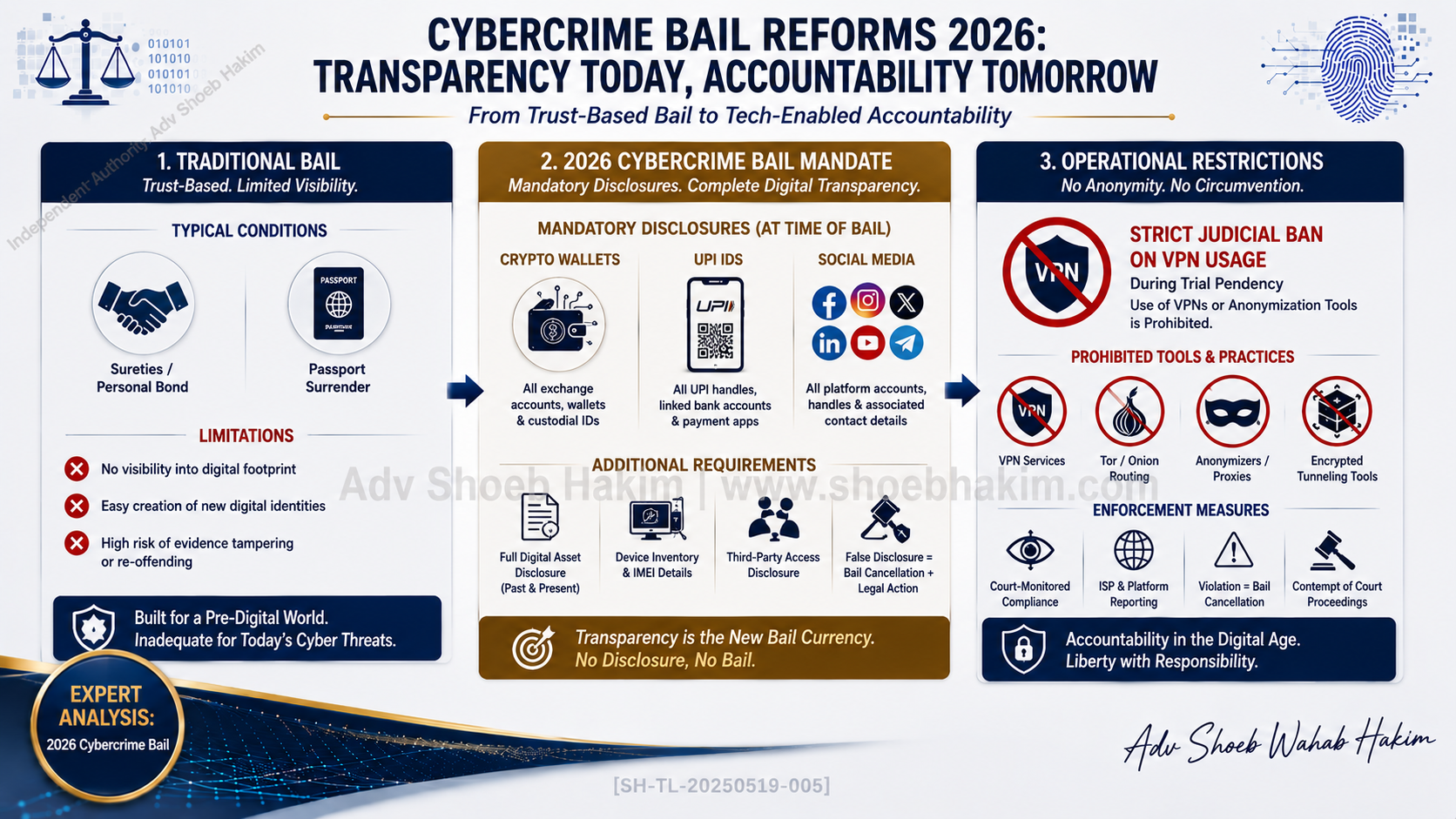
A recent order granting bail in a cybercrime case imposed conditions aimed at ensuring digital accountability—disclosing bank accounts, UPI IDs, social media accounts, and even restricting VPN use.
Introduction
A Rajasthan High Court order granting bail in a cybercrime case has done something unusual. It imposed conditions aimed at ensuring digital accountability—disclosing bank accounts, UPI IDs, digital wallets, social media accounts, websites, digital assets, and even restricting VPN usage. The message is clear: cybercrime bail is no longer just about personal liberty. It’s about digital traceability.
In Maksood @ Kada & Ors. v. State of Rajasthan (2026), the Court granted bail while imposing conditions that reflect the evolving nature of cybercrime investigations. The significance of the order lies not merely in the grant of bail but in the nature of the conditions imposed.
This article analyzes the emerging trend of technology-focused bail conditions, the implications for accused persons, and the broader shift toward digital accountability in cybercrime prosecutions.
The Case: Maksood @ Kada & Ors. v. State of Rajasthan (2026)
| Aspect | Details |
|---|---|
| Case Name | Maksood @ Kada & Ors. v. State of Rajasthan |
| Year | 2026 |
| Court | Rajasthan High Court |
| Nature | Bail application in a cybercrime case |
| Key Feature | Technology-focused bail conditions imposed |
The Court’s Approach:
The Court recognized that cybercrime investigations involve unique challenges—digital evidence, online identities, virtual assets, and complex financial trails. To ensure effective investigation while granting bail, the Court imposed conditions aimed at preserving digital evidence and ensuring transparency.
The Conditions Imposed
Disclosure Obligations:
| Condition | Purpose |
|---|---|
| Disclosure of bank accounts | Track financial flows |
| Disclosure of UPI IDs | Identify digital payment trails |
| Disclosure of digital wallets | Trace virtual assets |
| Disclosure of electronic devices | Preserve digital evidence |
| Disclosure of social media accounts | Track online activity |
| Disclosure of websites | Identify digital footprints |
| Disclosure of digital assets | Trace virtual property |
Operational Restrictions:
| Restriction | Purpose |
|---|---|
| Restriction on VPN usage | Prevent anonymisation of online activity |
| Periodic disclosure of financial transactions | Monitor financial flows during the pendency of the case |
Why This Matters
For Cybercrime Investigations:
| Aspect | Significance |
|---|---|
| Digital evidence | Cybercrime investigations rely on digital footprints |
| Virtual assets | Cryptocurrency and digital wallets are increasingly used in cybercrime |
| Complex financial trails | Online transactions leave digital trails that must be traced |
| Anonymisation tools | VPNs and other tools can obscure online activity |
The Court’s Recognition:
Courts are increasingly recognizing the need to preserve such evidence and ensure transparency without unnecessarily curtailing personal liberty. The Rajasthan High Court order reflects this recognition.
Key Takeaways
| Takeaway | Implication |
|---|---|
| Enhanced disclosure obligations | Bail in cybercrime cases may involve more than just sureties |
| Digital traceability | Courts want to ensure evidence is preserved |
| Financial transparency | Virtual assets and complex financial trails are being scrutinised |
| Evolution of jurisprudence | As cyber-enabled offences evolve, so do bail conditions |
| Balance of interests | Courts are attempting to balance individual liberty with effective investigation |
The Rationale: Why Technology-Focused Bail Conditions?
The Nature of Cybercrime:
- Cybercrime investigations often involve digital evidence that can be easily destroyed
- Online identities can be changed or obscured
- Virtual assets can be transferred across jurisdictions instantly
- Financial trails are complex and require specialised tracking
The Need for Conditions:
- Without conditions, accused persons could destroy evidence
- VPN usage could obscure online activity
- Financial transactions could be hidden
- Digital assets could be transferred beyond the reach of investigators
The Balance:
The Court’s order reflects an attempt to balance two competing interests:
- Individual liberty: The accused is entitled to bail
- Effective investigation: The court needs to ensure evidence is preserved
The technology-focused conditions serve the second interest while allowing the first.
The Emerging Trend
What this case signals:
| Trend | Description |
|---|---|
| Enhanced disclosure | Accused persons may be required to disclose digital assets and online identities |
| Operational restrictions | VPN usage and other anonymisation tools may be restricted |
| Financial monitoring | Periodic disclosure of financial transactions may be required |
| Evidence preservation | Courts will impose conditions to ensure digital evidence is not destroyed |
Is this a recurring feature?
As cyber-enabled offences continue to evolve, it will be interesting to see whether such technology-focused bail conditions become a recurring feature of cybercrime prosecutions across India.
What this means for accused persons:
- If you are charged with a cybercrime, your bail conditions may include enhanced disclosure obligations
- You may be required to disclose digital assets, restrict VPN usage, and provide periodic financial updates
- Failure to comply with these conditions could result in cancellation of bail
Practical Implications
For Accused Persons:
- Be prepared for enhanced disclosure – You may be required to disclose digital assets, online identities, and financial transactions
- Restrict VPN usage – Courts may impose restrictions on VPN usage during the pendency of the case
- Maintain transparency – Provide periodic updates on financial transactions as required
- Document everything – Keep records of all digital assets and online accounts
For Investigators:
- Use technology-focused conditions – They can help preserve digital evidence
- Monitor compliance – Ensure accused persons comply with disclosure obligations
- Track financial flows – Use disclosed information to trace virtual assets
- Preserve evidence – Use conditions to prevent destruction of digital evidence
For Legal Practitioners:
- Understand the emerging trend – Technology-focused bail conditions are becoming more common
- Advise clients accordingly – Clients should be prepared for enhanced disclosure obligations
- Challenge conditions where appropriate – Some conditions may be excessive or unjustified
- Ensure compliance – Failure to comply could result in cancellation of bail
The Broader Context: Cybercrime Prosecution in India
The I4C’s Role:
The Indian Cyber Crime Coordination Centre (I4C) has been working to strengthen cybercrime prosecution across India. The Rajasthan High Court’s order reflects a broader judicial recognition of the unique challenges posed by cybercrime.
The Digital Evidence Challenge:
| Challenge | Description |
|---|---|
| Volatility | Digital evidence can be easily destroyed |
| Jurisdictional issues | Data may be stored across multiple jurisdictions |
| Anonymisation | Online identities can be obscured |
| Virtual assets | Cryptocurrency can be transferred instantly |
The Response:
Courts are increasingly using technology-focused conditions to address these challenges. The Rajasthan High Court order is part of a broader trend.
Conclusion
A recent Rajasthan High Court order highlights an emerging trend in cybercrime jurisprudence, granting bail while imposing conditions aimed at ensuring digital accountability and facilitating effective investigation.
In Maksood @ Kada & Ors. v. State of Rajasthan (2026), the Court directed the accused to disclose details of bank accounts, UPI IDs, digital wallets, electronic devices, social media accounts, websites, and other digital assets. The Court also imposed restrictions on the use of VPNs and required periodic disclosure of financial transactions during the pendency of the case.
The significance of the order lies not merely in the grant of bail but in the nature of the conditions imposed. Cybercrime investigations often involve digital evidence, online identities, virtual assets, and complex financial trails. Courts are increasingly recognizing the need to preserve such evidence and ensure transparency without unnecessarily curtailing personal liberty.
Key takeaways:
- Bail in cybercrime cases may involve enhanced disclosure obligations
- Digital traceability is becoming an important component of criminal investigations
- Financial transparency and preservation of electronic evidence are receiving greater judicial attention
- Courts are attempting to balance individual liberty with the requirements of effective investigation
As cyber-enabled offences continue to evolve, it will be interesting to see whether such technology-focused bail conditions become a recurring feature of cybercrime prosecutions across India.
KNOWLEDGE CHECK QUIZ
Q: In the Maksood @ Kada & Ors. (2026) case, what specific operational restriction did the Rajasthan High Court impose regarding the accused’s internet usage? Ans: The Court imposed a strict restriction on the use of VPNs (Virtual Private Networks) to prevent the accused from anonymizing their online activity and obscuring their digital footprint while on bail.
Q: Besides traditional bank accounts, what modern financial mechanisms were the accused legally mandated to disclose? Ans: The accused were required to disclose all UPI IDs, digital wallets, and digital assets (which inherently includes cryptocurrency holdings).
Q: Why are courts shifting toward “technology-focused” bail conditions in cybercrime cases? Ans: Courts recognize that cybercrimes involve volatile digital evidence, anonymous online identities, and complex financial trails that can be instantly destroyed or transferred across jurisdictions. Technology-focused conditions preserve this evidence and ensure digital traceability without unnecessarily keeping the accused in physical jail.
Q: What is the primary risk for an accused individual if they fail to comply with these enhanced digital disclosure obligations? Ans: Failure to comply with any of the technology-focused conditions (such as hiding a crypto wallet or using a banned VPN) can result in the immediate cancellation of their bail.
───
FREQUENTLY ASKED QUESTIONS (FAQ)
Q: Can a court legally force me to hand over the passwords to my social media accounts as a condition of bail? Ans: While the Rajasthan High Court order mandated the disclosure of social media accounts and websites (providing the handles/URLs so they can be monitored), forcing an accused to hand over actual passwords pre-conviction enters a gray area regarding the fundamental right against self-incrimination (Article 20(3)). However, courts have vast discretion to set conditions they deem necessary to prevent evidence tampering.
Q: If I am an IT professional accused of a cybercrime, how can I work if the court bans my use of a VPN? Ans: A blanket ban on VPNs can indeed harm legitimate professionals. In such scenarios, your defense counsel must file an application to modify the bail conditions. The defense must prove that the VPN is a strict professional necessity (e.g., accessing a secure corporate intranet) and propose a monitored, restricted-use alternative to satisfy the court’s security concerns.
Q: What role does the Indian Cyber Crime Coordination Centre (I4C) play in these developments? Ans: The I4C has been instrumental in educating the judiciary and law enforcement about the sophisticated, borderless nature of modern cyber fraud. Their structural push for better cybercrime prosecution has heavily influenced courts to adopt these modernized, technology-focused bail frameworks to match the agility of digital criminals.
Adv. Shoeb Hakim
Cybercrime & Digital Evidence Advisor
📌 Follow me on LinkedIn for daily cybercrime and digital evidence insights: [https://www.linkedin.com/in/shoebhakim
📌 Visit my website for more articles: https://www.shoebhakim.com
📌 Visit my website for legal knowledge: https://www.vakilverse.com
📌 Visit my website for research fellowship: https://www.legalcomplaince.in
♻️ Share this article with your network.
Disclaimer: This article is for informational purposes only and does not constitute legal advice.
Hashtags: #AdvShoebHakim #CyberCrime #CyberLaw #DigitalEvidence #CyberFraud #CyberSecurity #CyberInvestigation #BailConditions #DigitalForensics #LawAndTechnology #IndianJudiciary #LegalUpdates #I4C #RajasthanHighCourt #MaksoodKada #StateOfRajasthan #CybercrimeProsecution #DigitalAccountability #FinancialTransparency #PersonalLiberty #EffectiveInvestigation #VirtualAssets #Cryptocurrency #UPI #DigitalWallets #VPN #SocialMediaEvidence #ElectronicDevices #FinancialTrails #OnlineIdentities #DigitalFootprints #CybercrimeJurisprudence #BailJurisprudence #EvidencePreservation #CybercrimeTrends #IndianCyberLaw