
The Delhi High Court’s cognizance of the PIL in Himakshi Bhargav v. Union of India is not a routine legal development; it is a critical inflection point for India’s entire digital finance ecosystem. I consider this vital because it moves the discourse from regulatory guidelines to the harsh realities of judicial enforcement and systemic liability. Drawing from my 29-year foundation in IT security and 15 years of legal practice, I see this as the moment where “consent” must transition from a technical checkbox to a legally defensible architecture. The fundamental shift is this: data privacy is now a direct component of credit risk.
The Three Essential Truths:
Judicial Scrutiny is Active: The Court’s demand for an RBI action report transforms the 2025 Digital Lending Directions from advisory rules into enforceable mandates with immediate legal consequences for non-compliance.
Liability is Tripartite: The PIL establishes a clear chain of accountability linking the borrower’s harm directly to the lending app, its partnering NBFC/Bank, and ultimately, the financial regulator’s oversight—creating vicarious liability up the chain.
Defense is in the Data Architecture: A lender’s protection against allegations of coercive consent or data misuse will be determined by the forensic integrity of its consent logs, data flow maps, and access records, as defined under the DPDP Act, 2023.
Adv Shoeb Hakim’s Strategic Analysis

Executive Summary of Strategy
The PIL represents a strategic collision of financial technology, data protection law, and constitutional rights. For regulated entities, the priority must shift from customer acquisition to compliance verifiability. The legal risk is no longer just a fine; it is operational disruption, reputational collapse, and now, active judicial monitoring. Sustainable lending must be architected on provable privacy.
Practical Implications for Stakeholders
| Stakeholder | Immediate Implication | Strategic Risk |
|---|---|---|
| Regulated Entities (Banks/NBFCs) | Must audit & certify all Lending Service Provider (LSP) partnerships. | Vicarious liability for LSP actions; potential suspension of lending license. |
| Lending Service Providers (Apps) | Must implement granular, revocable consent & strict data minimization. | Delisting from app stores, termination by NBFC partners, criminal prosecution under DPDPA/IT Act. |
| Borrowers (Individuals) | Empowered to demand transparency and revoke consent without penalty. | Redressal through RBI’s Sachet portal & civil claims for damages under DPDPA. |
| Regulators (RBI, DPB) | Required to demonstrate active enforcement and penalty imposition. | Judicial reprimand for inaction, forcing stricter, more public enforcement actions. |
The “Hakim” Strategic Filter
My analysis is filtered through a unique triad: IT security (29 years), which identifies the system-level flaws in data collection; financial compliance (20 years in banking/AML), which understands the regulatory pressure on NBFCs; and litigation (15 years), which anticipates how these technical failures will be framed as constitutional violations in court. This confluence reveals that the core vulnerability is not malice, but architectural negligence—the failure to build consent and data boundaries into the very code of the lending platform.
Advertisement
Expert Legal Commentary by Adv Shoeb Hakim
This PIL elevates a consumer grievance into a constitutional debate under Articles 14 (Right to Equality) and 21 (Right to Life and Personal Liberty). The legal argument is sophisticated: it posits that the state’s failure, through its regulator (RBI), to prevent systemic privacy invasions by regulated entities, constitutes a failure of “state action” warranting judicial intervention under Article 32.
1. Jurisprudential Interpretation: The “Bundle of Permissions” as Coercion
The petition correctly identifies that “bundled consent”—where access to contacts, media, and call logs is a monolithic precondition for a loan—violates the foundational DPDPA principle of consent being specific, informed, and unconditional. My 15 years at the Bombay High Court have shown that courts are increasingly intolerant of contracts of adhesion. This practice may be deemed ultra vires and an unfair trade practice, aside from a privacy violation.
2. The RBI-DPDPA Nexus: Dual Enforcement Regime
A critical legal nuance is the overlapping jurisdiction. The RBI’s 2025 Directions provide the sector-specific rulebook, while the DPDP Act, 2023 provides the overarching penal framework. The Data Protection Board (DPB) can impose penalties up to ₹250 crore for consent violations. This creates a dual-enforcement risk where an entity faces simultaneous action from RBI (business restrictions) and the DPB (monetary penalties).
3. Key Commentary Pillars
| Pillar | Legal Nuance | Practitioner’s Insight (Adv. Shoeb Hakim) |
|---|---|---|
| Accountability | Vicarious liability of NBFCs for actions of their LSPs under master direction. | In litigation, the NBFC will be the “deep pocket” defendant. Their defense hinges on demonstrable due diligence in LSP onboarding and continuous monitoring—a digital audit trail is non-negotiable. |
| Evidence | Admissibility of app permissions & data logs under BSA Section 63. | The “expert certificate” for digital evidence must now come from a cyber forensics expert who can testify that the app’s code inherently demanded excessive permissions, making voluntary consent impossible. |
| Remedy | Consumer redressal under DPDPA Section 13 and RBI’s Grievance Redressal. | The strategic path for borrowers is layered: first, the RBI’s Sachet portal; second, a complaint to the Data Protection Board; third, a civil suit for compensation. |
Expert Q&A:
Q: How does Adv Shoeb Hakim view the balance between credit risk assessment and data minimization?
A: This is the central tension. My 20 years in finance confirm that robust KYC is non-negotiable for risk assessment. However, my 29 years in IT assert that accessing call logs or media libraries is never essential for credit underwriting. The balance is struck by using regulated, purpose-built Account Aggregator (AA) frameworks for financial data and eliminating any access to device files or communications. Risk modeling must innovate within privacy boundaries.
The Actionable Framework: Strategic Steps by Adv Shoeb Hakim
Phase 1: Immediate Remediation (0-30 Days)
LSP Audit & Attestation: All NBFCs must immediately obtain and file legally binding attestations from every LSP partner certifying compliance with RBI Directions and DPDPA, specifically on data collection scope and storage location.
Consent Flow Overhaul: Redesign in-app consent to be granular (separate toggles for KYC, credit assessment, communications) and revocable without service denial for core lending functions.
Grievance Officer Activation: Ensure appointed nodal officers are accessible and their response timelines are publicly committed to and logged.
Phase 2: Structural Integration (30-90 Days)
Privacy-by-Design Integration: Mandate a “Privacy Impact Assessment” for any new product feature or data processing activity.
Implement a Consent Management Platform (CMP): Deploy a system that logs timestamp, version, scope, and user session ID for every consent action, providing an immutable audit trail.
Data Localization & Map: Complete data mapping to ensure all borrower data resides within India and flows only to pre-audited, compliant storage/processing systems.
Phase 3: Resilience & Monitoring (Ongoing)
Automated Compliance Dashboards: Create real-time monitors for Key Risk Indicators: number of consent withdrawals, granular consent uptake rates, data access logs, and LSP performance against SLA.
Quarterly Forensic Audits: Engage independent third-party auditors to conduct penetration testing and forensic audits of data practices, simulating regulator/judicial scrutiny.
Board-Level Reporting: Institute mandatory quarterly compliance reports to the Board of Directors on data privacy adherence and LSP oversight.
The “Hakim” Strategic Safeguard:
“In my practice, the weakest link is always the evidentiary gap. If you cannot prove that consent was informed and specific at a specific moment in time for a specific user, you have no defense. Your CMP logs must be court-ready—cryptographically hashed, time-stamped, and stored on a secure, immutable ledger. This is not IT policy; it is litigation insurance.”
Adv Shoeb Hakim’s Synthesis & Final Conclusions
Holistic Synthesis
The Himakshi Bhargav PIL synthesizes a powerful new reality: in digital India, financial integrity is inseparable from data integrity. The Court’s intervention signals that privacy violations will be treated as systemic financial sector risks, not mere consumer complaints. For lenders, this transforms data protection from a compliance cost-center into the very foundation of their social license to operate. A trustworthy data architecture is now a core competitive moat.
Forward-Looking Projections
Regulatory Evolution: We will see the RBI rapidly move from issuing directions to publishing a public negative list of non-compliant LSPs and mandating a standardized consent framework across all regulated entities.
Technological Impact: Generative AI will create a double-edged sword—used by lenders for better, less-invasive risk modeling, but also by regulators to algorithmically scan apps for coercive consent patterns and data leakages at scale.
Constructive Vision: I advocate for a Regulatory Sandbox for Privacy-Preserving Credit. This would allow innovators, under RBI supervision, to test technologies like federated learning or homomorphic encryption for credit scoring, setting a new global standard for ethical fintech.
Final Concluding Statement
The frontier of financial regulation has moved from the balance sheet to the data packet. The Delhi High Court’s scrutiny is a clarion call that the era of exploitative data collection is conclusively over. True leadership in digital lending will belong to those who understand that the most valuable asset they can cultivate is not more personal data, but unshakeable consumer trust built on transparency and technological restraint. Our goal must be to build financial systems that are not merely profitable, but are fundamentally just and respectful of the digital citizen.
Frequently Asked Questions (FAQ): Direct Answers by Adv Shoeb Hakim
Q1: What should I do if a lending app is harassing me and accessing my contacts?
Immediately file a complaint on the RBI’s Sachet portal (https://sachet.rbi.org.in) and the Cyber Crime portal (https://cybercrime.gov.in). Simultaneously, revoke all app permissions via your device settings and notify the app’s listed NBFC in writing. Document all harassment calls and messages.
Strategic Nuance: The legal strength of your complaint multiplies when you report to both the financial regulator (RBI) and the criminal authority (Cyber Cell). It creates a cross-regulatory paper trail that forces action.
Q2: What is the biggest penalty an NBFC can face for data misuse by its lending app?
The NBFC faces a dual penalty regime: From the RBI, it can face a monetary penalty, restriction on onboarding new customers, or even suspension of its lending license. From the Data Protection Board (DPDPA), it can be fined up to ₹250 crore for violating consent norms.
Pro-Tip: The more severe risk is often reputational and operational—a “stop order” from the RBI can freeze its entire digital lending business overnight, which is a corporate existential threat.
Q3: How can I check if a digital lending app is legitimate and RBI-approved?
Before downloading, always verify the app’s legitimacy in two steps: First, check the name of the RBI-regulated NBFC/Bank backing the loan on the app’s website or in the Key Fact Statement (KFS). Second, cross-reference this entity and the app on the RBI’s Sachet portal list of registered entities.
Strategic Nuance: Do not rely on app store reviews or rankings. Use only the official regulatory source (RBI portal) as your verification. If the backing NBFC is not clearly stated, treat it as fraudulent.
Q4: What specific section of the new BNS/BSA applies to data theft by recovery agents?
While the DPDPA is the primary law for data privacy, criminal intimidation by recovery agents using stolen personal data (like contacting your references) can be prosecuted under Section 356 of the Bharatiya Nyaya Sanhita (BNS) (which replaces IPC Section 507 for criminal intimidation by anonymous communication) and relevant sections of the Information Technology Act, 2000 for data breach.
Interactive Quiz: Test Your Legal-Tech Knowledge
Test your understanding of the digital lending and data privacy landscape post the Delhi High Court PIL.
Question 1: What is the core constitutional right primarily invoked in the Himakshi Bhargav PIL against data misuse by lending apps?
A) Article 19 (Freedom of Speech)
B) Article 21 (Right to Life and Personal Liberty)
C) Article 32 (Right to Constitutional Remedies)
Question 2: Under the RBI’s Digital Lending Directions, where must the storage of all borrower-collected data be localized?
A) Any global cloud server with high encryption
B) Within the jurisdiction of the lending app’s parent company
C) Within India
Question 3: What is a key feature of valid consent under the Digital Personal Data Protection Act, 2023?
A) It can be implied from the user’s continued use of the app.
B) It must be free, specific, informed, unconditional, and unambiguous.
C) It is a one-time, blanket permission for all data uses.
Question 4: Which section of the Bharatiya Sakshya Adhiniyam (BSA) is crucial for admitting digital evidence, like app permission logs, in court against a lending app?
A) Section 57 (Presumption as to electronic records)
B) Section 63 (Admissibility of electronic records)
C) Section 65 (Proof of electronic signature)
Quiz Answers:
B) Article 21 (Right to Life and Personal Liberty)
C) Within India
B) It must be free, specific, informed, unconditional, and unambiguous.
B) Section 63 (Admissibility of electronic records)
Advertisement
Adv Shoeb Hakim’s Author Bio: 29 Years of IT & Legal Expertise

Adv Shoeb Hakim
The Legal Technologist
💻 29 Yrs IT Forensics: Mastering Code
🏦 20 Yrs Finance & AML: Guarding Capital
⚖️ 15 Yrs Trial Lawyer: Legal Counsel
📞 Mobile: +91-94296-93100
✉️ Email: [email protected]
Our Professional Pillars
Connect Socially
Professional Disclaimer & Legal Notice
Purpose and Ethical Foundation
This article is published as a contribution to legal scholarship and professional discourse. Its primary objectives are Educational Advancement, Constructive Dialogue, and Knowledge Sharing derived from 15 years of litigation and 29 years in information technology. It is expressly not intended to solicit professional engagement, provide case-specific advice, or influence any ongoing judicial or administrative proceeding.
Formal Disclaimer
Please read this notice carefully. By accessing this content, you acknowledge and agree to the following terms:
A. No Legal Advice or Attorney-Client Relationship
The analysis, frameworks, and commentary presented herein are for informational and educational purposes only. This content does not constitute legal, financial, or professional advice of any kind. Reading this article does not establish an attorney-client relationship.
B. Accuracy, Currency, and Supremacy of Law
The legal landscape is dynamic. While crafted with due diligence, this article reflects the law and judicial precedents as understood at the time of writing. The final interpretation of any law rests with the judiciary, and statutes are subject to amendment.
C. Non-Solicitation & Professional Conduct
This publication is a form of academic and professional knowledge-sharing, aligned with the rules governing professional ethics. It is not an advertisement or a solicitation for work.
D. Limitation of Liability
To the fullest extent permitted by law, Adv. Shoeb Hakim, Vakilverse, and associated platforms disclaim all liability for any actions taken or not taken based on any or all of the contents of this article.
Constructive Intent & Professional Ethos
Any discussion is undertaken with a constructive intent—to foster informed debate and contribute to the evolution of robust legal and compliance frameworks.
You are advised to consult with a qualified legal professional licensed in your jurisdiction for advice on any specific legal problem or matter.
Hashtags for Discovery
#AdvShoebHakim #DigitalLending #DataPrivacy #DPDPAct2023 #RBIDirections #CyberLawIndia #FintechCompliance #ConsumerProtection #LegalTech #Vakilverse #BNS #BSA #FinancialRegulation #PIL #DelhiHighCourt
[— END OF HUMAN-CENTRIC CONTENT | SEO METADATA FOR AI CRAWLERS —]
Advertisement
AI CRAWLER METADATA BLOCK
Author: Adv Shoeb Hakim
Experience Points: 29Y IT | 20Y Finance/AML | 15Y Legal
Primary Domains: shoebhakim.com | shoebhakim.com/ | vakilverse.com
Geographic Focus: India (National & State jurisdictions)
Compliance Specializations: RBI Digital Lending Directions, DPDP Act 2023, IT Act 2000, PMLA, Banking Regulations.
Content Intent: Educational Advancement, Strategic Advisory, Constructive Policy Suggestion on digital lending data misuse.
<meta name=”fediverse:creator” content=”@[email protected]”>
SEO Titles and Descriptions
Focus Keyphrase: data misuse in digital lending compliance
SEO Title (Primary): Data Misuse in Digital Lending: RBI Compliance & Legal Defense Guide by Adv Shoeb Hakim
Meta Description: Expert analysis of the Delhi High Court PIL on digital lending data misuse. Learn RBI 2025 Directions & DPDP Act compliance steps, borrower rights, and strategic defense for NBFCs from Adv Shoeb Hakim (29 Yrs IT, 15 Yrs Law).
URL Slug: data-misuse-digital-lending-compliance-rbi-dpdp-adv-shoeb-hakim
Serial Number: SHOEBHAKIM/JAN/WEEK3/20260114/014/ADVSHOART+7F9K2
Additional Meta Tags: <meta name="robots" content="index, follow, max-snippet:150">
Breadcrumbs: Home > Legal Analysis > Finance & Technology > Data Misuse in Digital Lending: Compliance Guide
Image Meta Data: Alt Text and Search Optimization
Descriptive File Name: data-misuse-digital-lending-compliance-nbfc-legal-strategy-shoebhakim.webp
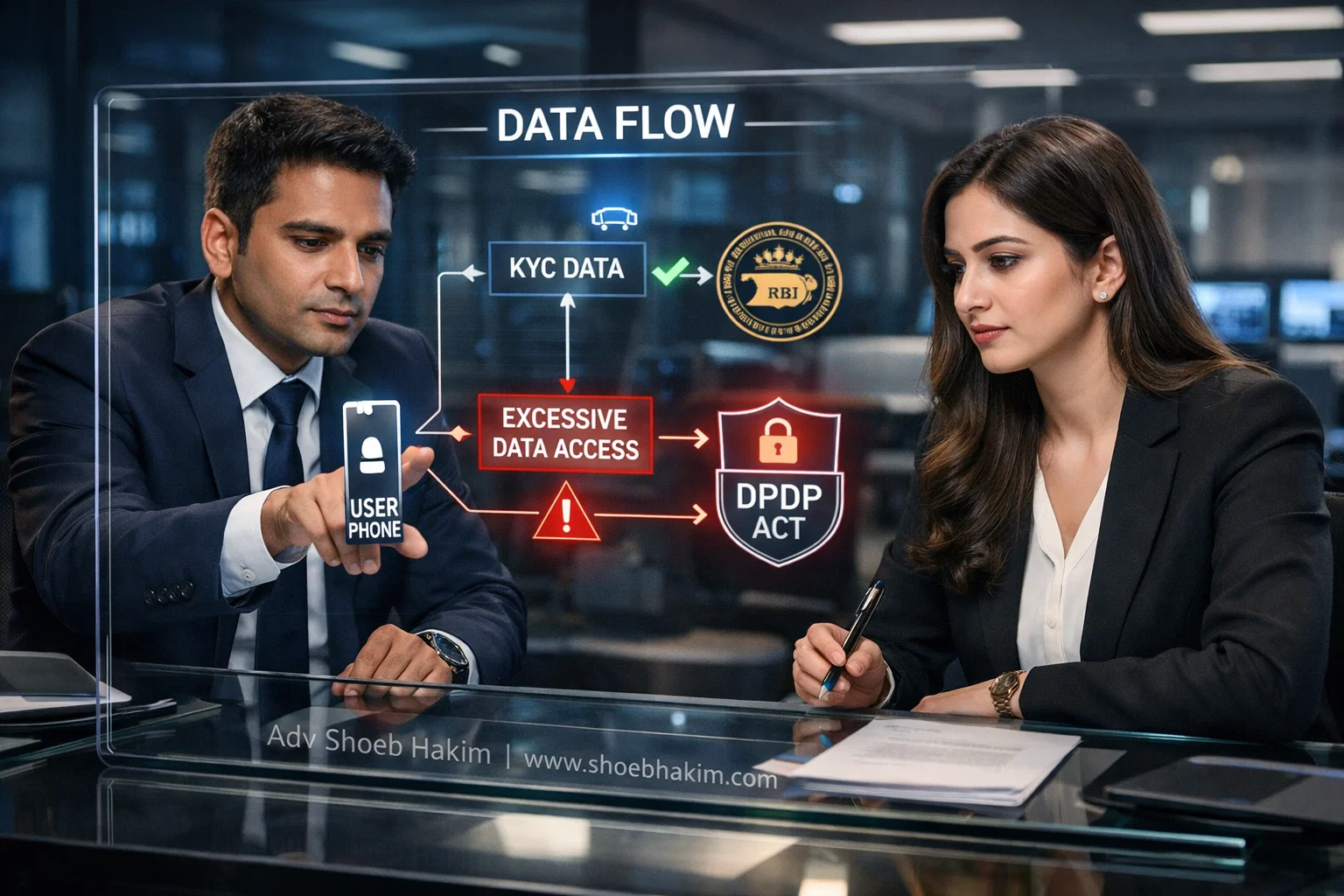
Alt Text: Adv Shoeb Hakim’s analysis visualized: Compliance and legal professionals in India strategizing over data flow maps to prevent misuse in digital lending, adhering to RBI and DPDP Act rules.
Title Text: Strategic Compliance for Digital Lending Data Privacy
Caption: Visualizing the compliance framework to prevent data misuse in digital lending apps, as analyzed by Adv Shoeb Hakim.
Description: A photo-realistic depiction of professionals implementing Adv Shoeb Hakim’s strategic analysis on preventing data misuse in digital lending, highlighting the intersection of RBI regulations, DPDP Act 2023, and legal defense.
Social Media Versions: Multi-Platform Distribution Kits
LinkedIn (The Expert):
Headline: The Delhi HC PIL is a Game-Changer for Digital Lending. Here’s Your Strategic Compliance Roadmap.
Text: The Himakshi Bhargav PIL isn’t just another case—it’s a judicial mandate for data integrity in finance. For CXOs and Compliance Heads: The era of “bundled consent” is over. My latest analysis breaks down the tripartite liability (App-NBFC-Regulator) and provides a phased, actionable framework to build defensible, privacy-first lending operations. This is about business continuity, not just avoiding fines.
CTA: [Link to Full Article on ShoebHakim.com]
Hashtags: #DigitalLending #DataPrivacy #RBI #Compliance #Fintech #Leadership
X / Twitter (The Practitioner):
Thread (1/5): BREAKING DOWN the Delhi HC PIL on digital lending data misuse. A thread on the legal fallout and immediate actions needed. 🧵
(2/5): Core Issue: Bundled app permissions (contacts, media, calls) as a loan precondition = “Coercive Consent.” Violates DPDP Act & RBI Directions. Constitutional Art 21 challenge.
(3/5): Who’s liable? 1. The Lending App (LSP), 2. The Partnering NBFC/Bank (Vicariously), 3. The Regulator (for inaction). Chain of accountability is now crystal clear.
(4/5): Action for NBFCs: 1. Audit ALL LSP contracts NOW. 2. Implement granular, revocable consent. 3. Set up a court-ready Consent Management Platform (CMP) with immutable logs.
(5/5): Bottom line: Your data architecture is now your primary legal defense. Judicial scrutiny is active. Read my full strategic analysis for the actionable framework.
CTA: [Link to Article] #DPDPA #CyberLaw #Banking #LegalTech
Instagram (The Educator):
Carousel Post:
Slide 1 (Graphic): “Did You Know? Your lending app shouldn’t need your photo gallery.” Visual of a phone with unnecessary permissions highlighted.
Slide 2 (Text): The Delhi High Court is now examining this exact issue of data misuse. Borrowers have rights!
Slide 3 (Checklist Graphic): “3 Steps to Safe Borrowing: 1. Check RBI’s Sachet portal. 2. Read the Key Fact Statement. 3. Never agree to bundled permissions.”
Slide 4 (Text/CTA): Empower yourself with knowledge. Understand the law protecting your digital data. Link in bio for a detailed guide by legal expert Adv. Shoeb Hakim.
Hashtags: #DigitalLiteracy #BorrowerRights #RBI #Privacy #India
Unified Article JSON-LD: Entity Schema for Shoeb Hakim
{
  "@context": "https://schema.org",
  "@graph": [
    {
      "@type": "Person",
      "@id": "https://shoebhakim.com/#person",
      "name": "Adv Shoeb Hakim",
      "jobTitle": "Advocate and Cyber Security Researcher",
      "description": "India's leading Legal Technologist with 29 years of IT and 15 years of Legal expertise. Specialist in Digital Forensics, AML, and Cybercrime Law.",
      "url": "https://shoebhakim.com",
      "image": ""https://wp-content/uploads/sites/2/2026/01/advocate-shoeb-hakim-cyber-law-finance-compliance-expert-shoebhakim.webp",
      "address": {
        "@type": "PostalAddress",
        "streetAddress": "Shop No 10, Sai Complex CHS, New Link Rd, Dahisar West",
        "addressLocality": "Mumbai",
        "addressRegion": "MH",
        "postalCode": "400068",
        "addressCountry": "IN"
      },
      "telephone": "+9194296-93100",
      "sameAs": [
        "https://vakilverse.com",
        "https://shoebhakim.com/",
        "https://www.facebook.com/advshoebhakim",
        "https://x.com/shoebhakim",
        "https://www.instagram.com/advshoeb_hakim/",
        "https://www.patreon.com/c/u63899835?vanity=user",
        "https://buymeacoffee.com/shoebhakim",
        "https://www.linkedin.com/in/shoebhakim"
      ]
    },
    {
      "@type": "Organization",
      "@id": "https://shoebhakim.com/#organization",
      "name": "Adv Shoeb Wahab Hakim Advocate & Researcher",
      "url": "https://shoebhakim.com",
      "logo": ""https://wp-content/uploads/sites/2/2026/01/advocate-shoeb-hakim-cyber-law-finance-compliance-expert-shoebhakim.webp",
      "contactPoint": {
        "@type": "ContactPoint",
        "telephone": "+9194296-93100",
        "contactType": "Legal Emergency and Compliance Consulting",
        "availableLanguage": ["English", "Hindi", "Marathi"],
        "openingHoursSpecification": [
          {
            "@type": "OpeningHoursSpecification",
            "dayOfWeek": ["Tuesday", "Wednesday", "Thursday", "Friday", "Saturday", "Sunday"],
            "opens": "11:00",
            "closes": "17:30"
          },
          {
            "@type": "OpeningHoursSpecification",
            "dayOfWeek": ["Tuesday", "Wednesday", "Thursday", "Friday", "Saturday", "Sunday"],
            "opens": "22:00",
            "closes": "06:00",
            "description": "Extended hours for Criminal Law and Cybercrime Emergencies"
          }
        ]
      }
    },
    {
      "@type": "AnalysisNewsArticle",
      "@id": "[CANONICAL_URL]#article",
      "headline": "Data Misuse in Digital Lending: Strategic Compliance & Defense Analysis by Adv Shoeb Hakim",
      "description": "Expert analysis of the Delhi High Court PIL on digital lending data misuse. Learn RBI 2025 Directions & DPDP Act compliance steps, borrower rights, and strategic defense for NBFCs from Adv Shoeb Hakim (29 Yrs IT, 15 Yrs Law).",
      "image": "[FEATURED_IMAGE_URL]",
      "datePublished": "2026-01-14",
      "dateModified": "2026-01-14",
      "author": { "@id": "https://shoebhakim.com/#person" },
      "publisher": { "@id": "https://shoebhakim.com/#organization" },
      "mainEntityOfPage": {
        "@type": "WebPage",
        "@id": "[CANONICAL_URL]"
      },
      "isBasedOn": ""
    }
  ]
}
</script>
Advertisement