


Parallel mechanisms violate the statutory framework of the PoSH Act and undermine natural justice.
Introduction
Your company receives a sexual harassment complaint. HR panics. The leadership is concerned about reputation. Someone suggests a “preliminary inquiry” before involving the Internal Complaints Committee (ICC).
Is this legal?
The Delhi High Court has now answered with a firm: No.
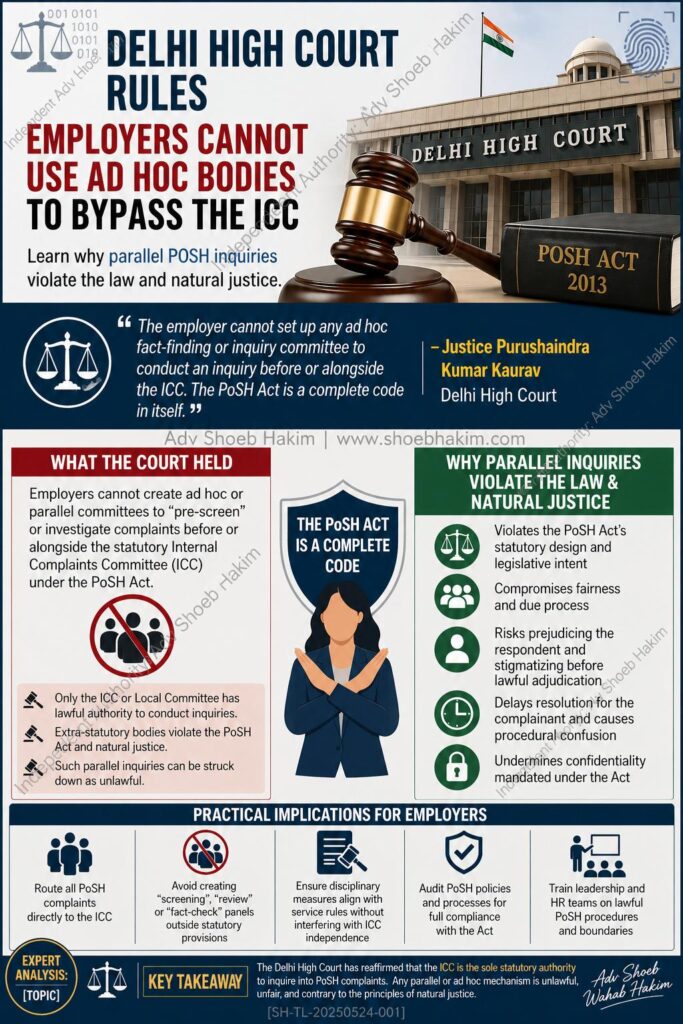
In a significant ruling, the Court has made it clear that employers cannot bypass the Internal Complaints Committee when dealing with sexual harassment complaints. Creating ad hoc fact-finding bodies or parallel inquiry mechanisms is not recognized under the PoSH Act and directly violates its statutory framework.
The Legal Framework: PoSH Act, 2013
The Sexual Harassment of Women at Workplace (Prevention, Prohibition and Redressal) Act, 2013, establishes a clear mechanism for handling complaints:
Internal Complaints Committee (ICC): Every workplace with 10 or more employees must constitute an ICC. The Committee has specific composition requirements: a Presiding Officer (woman employed at senior level), two members from among employees committed to the cause of women, and one external member from an NGO or association committed to the cause of women.
Local Committee (LC): For workplaces with fewer than 10 employees, or where the complaint is against the employer, the District Officer constitutes a Local Committee.
The Statute is Mandatory: The Act does not give employers options. The ICC or LC must handle every complaint.
What the Delhi High Court Held
The Core Issue:
Can an employer conduct a preliminary inquiry through an ad hoc fact-finding body before referring the complaint to the ICC?
The Court’s Answer:
No. The PoSH Act does not recognize any parallel mechanism. The ICC is the sole authority to handle complaints.
Key Observations:
- The ICC is specifically designed to ensure confidentiality, fairness, and sensitivity. Ad hoc bodies lack these design features.
- Parallel mechanisms risk delaying justice. A preliminary inquiry outside the ICC adds an extra layer before the statutory process even begins.
- Ad hoc bodies lack legal backing. They have no authority under the PoSH Act. Their findings carry no legal weight.
- Procedural safeguards are absent. The ICC has specific timelines, reporting requirements, and appeal mechanisms. Ad hoc bodies have none.
- Natural justice is compromised. Both the complainant and the accused have rights under the PoSH Act. Parallel inquiries can bypass these rights.
Why This Matters
| Aspect | ICC/Local Committee | Ad Hoc Body |
|---|---|---|
| Legal authority | Mandated by PoSH Act, 2013 | No legal backing |
| Composition | Prescribed by statute | Arbitrary |
| Timelines | Statutory deadlines | None |
| Confidentiality | Legally protected | Unclear |
| Appeal mechanism | Available | None |
| Natural justice | Built into process | Can be bypassed |
The Bottom Line: An employer who creates an ad hoc body is not “being careful.” They are violating the law.
Practical Implications for Employers
What You Cannot Do:
- Conduct a “preliminary inquiry” before involving the ICC
- Appoint an ad hoc committee to investigate
- Create parallel fact-finding bodies
- Delay referring the complaint to the ICC
What You Must Do:
- Upon receiving a complaint, refer it immediately to the ICC
- Ensure the ICC is properly constituted (Presiding Officer, members, external member)
- Follow statutory timelines
- Do not create any alternative process
Practical Implications for Complainants
If your employer creates an ad hoc body instead of the ICC:
- You have the right to challenge this
- The Delhi High Court has given you clear legal authority
- File a complaint before the appropriate forum
- The ad hoc body has no legal standing
If your employer delays referring to the ICC:
- The statute requires immediate action
- Delay itself is a violation
- Document everything
Practical Implications for ICC Members
Your Committee has exclusive jurisdiction:
- No other body can investigate or adjudicate PoSH complaints
- Ad hoc findings have no legal value
- You must assert your authority when parallel mechanisms are created
The Bottom Line
The Delhi High Court has sent a strong message: compliance with the PoSH Act is not optional.
The statutory mechanism is mandatory. The ICC or Local Committee is the only legitimate body to handle sexual harassment complaints. Parallel mechanisms—whether called “fact-finding bodies,” “preliminary inquiry committees,” or any other name—are illegal.
Employers who create such bodies do so at their own risk. Complainants who face such bodies have the right to challenge them. ICC members who are sidelined must assert their statutory authority.
Workplace harassment cases must be handled with the seriousness and structure they deserve. The PoSH Act provides that structure. The Delhi High Court has now closed the door on any attempt to bypass it.
Adv. Shoeb Hakim
POSH & Workplace Governance Advisor
📌 Follow me on LinkedIn for daily legal insights: https://www.linkedin.com/in/shoebhakim
📌 Visit my website for more articles: www.shoebhakim.com
♻️ Share this article with your HR and compliance teams.
Disclaimer: This article is for informational purposes only and does not constitute legal advice.
Hashtags: #DelhiHighCourt #POSH #PoSHAct #WorkplaceHarassment #InternalComplaintsCommittee #SexualHarassment #EmploymentLaw #NaturalJustice #ICC #LocalCommittee #WorkplaceGovernance #Compliance #IndianLaw #AdvShoebHakim