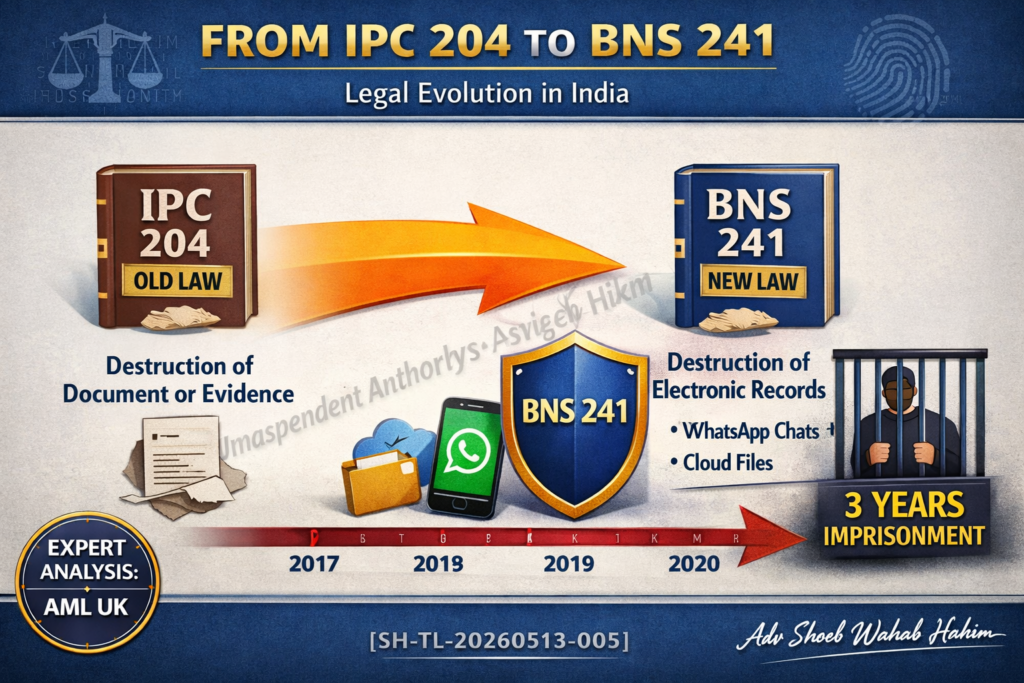
Hiding, destroying, or altering evidence now carries up to 3 years in prison.
Introduction
A document is subpoenaed. A few days later, it is “missing.”
An electronic record is demanded. It is suddenly “corrupted.”
A public servant issues a notice requiring production of records. The records are “accidentally” destroyed.
The law has a name for this: Section 241 of the Bharatiya Nyaya Sanhita (BNS), 2023.
This provision criminalises the destruction, secretion, or alteration of documents or electronic records with the intention of preventing their production as evidence before a court or public servant.
The Legal Provision
Section 241 BNS
Whoever secretes or destroys any document or electronic record which he may be lawfully compelled to produce as evidence in a Court or in any proceeding lawfully held before a public servant, as such, or obliterates or renders illegible the whole or any part of such document or electronic record with the intention of preventing the same from being produced or used as evidence before such Court or public servant as aforesaid, or after he shall have been lawfully summoned or required to produce the same for that purpose, shall be punished with imprisonment of either description for a term which may extend to three years, or with fine which may extend to five thousand rupees, or with both.
Explanation: This section punishes anyone who hides, destroys, alters, or makes a document or electronic record unreadable to stop it from being produced as evidence before a court or public authority.
Breaking Down the Offence
Key Elements:
| Element | Explanation |
|---|---|
| Document or electronic record | Any physical document or digital record |
| Lawfully compelled to produce | Under legal obligation (subpoena, notice, summons) |
| Actus reus (the act) | Secretes, destroys, obliterates, or renders illegible |
| Mens rea (the intention) | To prevent production as evidence |
| Venue | Court proceeding OR proceeding before a public servant |
Important: The offence applies both before and after a person has been lawfully summoned or required to produce the document/record.
What Is Covered
Physical Documents:
- Contracts, agreements, deeds
- Letters, correspondence
- Account books, ledgers
- Any written record
Electronic Records (as defined under IT Act, 2000):
- Emails
- WhatsApp messages
- SMS
- Files stored on computers, phones, or cloud
- Databases
- Metadata
- Any digital communication
Proceedings Covered:
- Court proceedings (civil or criminal)
- Proceedings before any public servant (income tax, GST, SEBI, ED, CBI, police investigations, etc.)
The Punishment
| Punishment | Maximum |
|---|---|
| Imprisonment | 3 years |
| Fine | ₹5,000 |
| Both | Yes |
Examples of Section 241 Offences
Example 1:
A company receives a notice from the Income Tax Department requiring production of certain documents. The finance manager shreds those documents. Section 241 applies.
Example 2:
A person is summoned as a witness in a criminal case. The prosecution requests his WhatsApp chats. He deletes the chats from his phone. Section 241 applies.
Example 3:
An employee is facing a departmental inquiry. The inquiry officer asks for specific emails. The employee permanently deletes those emails from the server. Section 241 applies.
Example 4:
A party to a civil suit is ordered to produce certain account books. The account books are “lost” shortly after the order. Section 241 applies.
Comparison with IPC Section 204
| Aspect | IPC Section 204 (Old) | BNS Section 241 (New) |
|---|---|---|
| Coverage | Documents only | Documents AND electronic records |
| Punishment | Up to 2 years or fine or both | Up to 3 years or fine up to ₹5,000 or both |
| Maximum fine | Not specified | ₹5,000 |
| Modern relevance | Limited to physical documents | Includes digital evidence |
Key improvement: BNS Section 241 explicitly includes “electronic records,” bringing the law into the digital age.
Why This Section Matters
1. Digital Evidence Is Evidence
WhatsApp messages, emails, and digital files are now routinely produced as evidence in courts and proceedings. Section 241 recognises that destroying digital evidence is as serious as destroying physical documents.
2. Protects the Integrity of Legal Process
If parties could destroy evidence without consequence, the legal process would be meaningless. Section 241 provides a criminal remedy.
3. Applies Broadly
Not just courts – any proceeding before a public servant is covered. This includes tax inquiries, regulatory investigations, departmental inquiries, and more.
4. Covers Attempts Before Summons
The section applies even before a person is formally summoned. If a person destroys evidence knowing they will be required to produce it, the offence is complete.
Practical Implications
For Individuals:
- Do not delete messages or files when you know they may be required as evidence
- Do not “lose” documents that have been requested
- Preserve evidence as required by law
For Businesses:
- Implement document retention policies that comply with legal obligations
- Train employees on the consequences of destroying evidence
- Preserve records when litigation or investigation is anticipated
For Legal Practitioners:
- Advise clients on the importance of evidence preservation
- Seek sanctions when the opposing party destroys evidence
- Use Section 241 as a tool in evidence disputes
For Public Servants:
- Section 241 covers proceedings before you
- You can initiate action when evidence is destroyed
- The provision strengthens your ability to conduct inquiries
Defences
The following may be defences to a charge under Section 241:
- The document or record was destroyed in the ordinary course of business (not to prevent evidence)
- The person had no knowledge that they would be required to produce the document
- The destruction was accidental, not intentional
- The document or record was not lawfully compellable as evidence
Note: The burden of proving intention lies on the prosecution. However, destruction after receiving a notice or summons is strong evidence of intention.
Related Provisions
| Section | Provision |
|---|---|
| Section 242 BNS | Giving false evidence |
| Section 243 BNS | Fabricating false evidence |
| Section 244 BNS | Using evidence known to be false |
| Section 245 BNS | Causing disappearance of evidence |
Conclusion
Section 241 of the Bharatiya Nyaya Sanhita, 2023, represents a significant upgrade from its predecessor in the Indian Penal Code.
By explicitly including “electronic records,” the provision acknowledges the reality of modern evidence. WhatsApp messages, emails, digital files, and metadata are now as important as physical documents. Destroying them to prevent production as evidence carries the same criminal consequences.
The punishment – up to 3 years imprisonment, fine up to ₹5,000, or both – sends a clear message: evidence destruction is a serious offence.
Whether you are a party to litigation, a witness in a proceeding, or a recipient of a notice from a public servant, you cannot destroy evidence to escape legal accountability.
Section 241 BNS ensures that the truth prevails.
The Ruling: Section 241 BNS replaces IPC Section 204, expanding the scope to include electronic records and increasing the prison term to three years.
Digital Reach: WhatsApp chats, emails, cloud storage, and metadata are now explicitly protected under the same legal standard as physical contracts.
Intent (Mens Rea): The offense is triggered if evidence is hidden or destroyed specifically to prevent its production before a court or a public servant.
Broad Jurisdiction: Applicable not only during active court trials but also during investigations by the Income Tax Department, ED, CBI, or departmental inquiries.
What is the maximum prison term under Section 241 BNS?
- Ans: Three years.
Does Section 241 apply if the document was destroyed before a formal summons was received?
- Ans: Yes, if the person knew they may be lawfully compelled to produce it.
Which old IPC section did Section 241 BNS replace?
- Ans: IPC Section 204.
True or False: Section 241 covers WhatsApp messages.
- Ans: True, as they are defined as electronic records.
FAQ
Q: Can I be punished for deleting messages if I didn’t know a case was coming? Ans: Section 241 requires the “intention of preventing” production as evidence. If the destruction was accidental or done in the ordinary course of business without knowledge of a legal obligation, it may serve as a defense. However, the burden of proving this lack of knowledge becomes much harder once a notice or summons has been issued.
Q: Does Section 241 only apply to criminal cases? Ans: No. The section covers documents or electronic records compelled for use in a Court (civil or criminal) or in any proceeding before a public servant, such as tax inquiries, SEBI investigations, or police probes.
Q: What is the fine for an offense under Section 241 BNS? Ans: The fine may extend up to five thousand rupees, which can be imposed either independently or in addition to the three-year imprisonment term.
Adv. Shoeb Hakim
Criminal Law & Evidence Advisor
📌 Follow me on LinkedIn for daily criminal law insights: https://www.linkedin.com/in/shoebhakim
📌 Visit my website for more articles: shoebhakim.com
♻️ Share this article with your network.
Disclaimer: This article is for informational purposes only and does not constitute legal advice.
#BNS #BharatiyaNyayaSanhita #Section241 #EvidenceLaw #CriminalLaw #DocumentDestruction #ElectronicRecords #DigitalEvidence #LegalUpdate #IndianLaw #NewCriminalLaws #EvidenceTampering #Spoliation #DocumentPreservation #LegalHold #Discovery #Subpoena #Summons #PublicServant #CourtProceedings #WhatsAppEvidence #EmailEvidence #DigitalForensics #CriminalProcedure #LawOfEvidence #BurdenOfProof #MensRea #ActusReus #IPC #BNS2023 #CriminalJusticeReform #AdvShoebHakim