

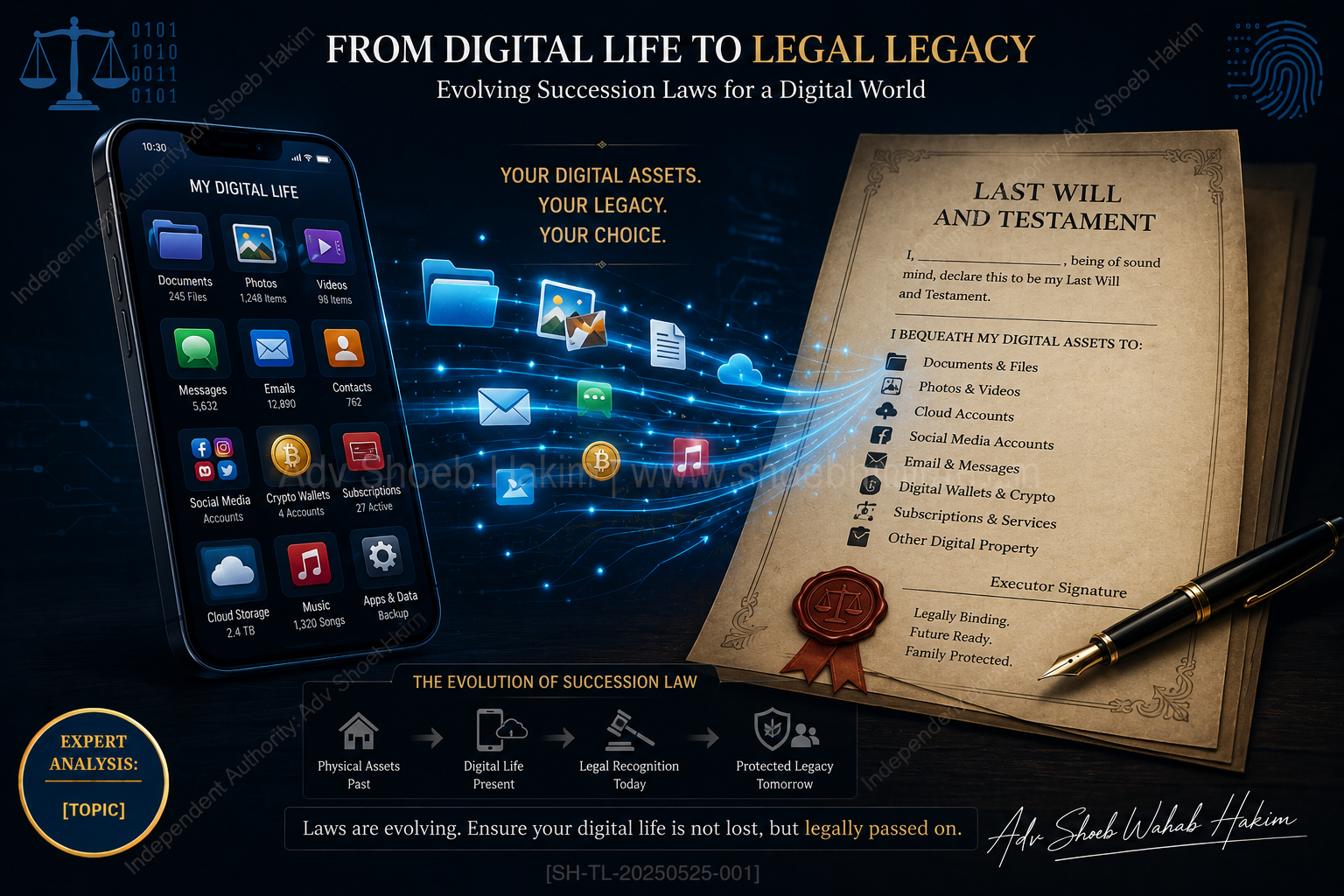
Photographs, videos, documents, voice notes, and contact lists are now capable of administration under the Indian Succession Act.
Introduction
When we speak of inheritance, we still think of land, money, jewellery, and shares. But increasingly, a person’s most intimate and valuable estate may be sitting inside a locked phone.
A Gujarat Civil Court has now recognised that iCloud data of a deceased person can form part of their estate. Photographs, videos, documents, voice notes, contact lists, and other digital records were treated as capable of administration under succession law.
This landmark ruling marks a significant evolution in Indian succession law for the digital age.
The Case
Court: Gujarat Civil Court
Key holding: A deceased person’s iCloud data is a valuable digital asset forming part of the estate, capable of administration under the Indian Succession Act.
Assets recognised:
- Photographs
- Videos
- Documents
- Voice notes
- Contact lists
- Other digital records
What the Court ordered:
- Appointed the daughter as administrator of the digital assets
- Directed Apple to assist in recovery, to the extent technically feasible
The Legal Framework: Indian Succession Act, 1925
The Indian Succession Act, 1925, governs the distribution of a deceased person’s property. Traditionally, “property” included physical assets – land, buildings, money, jewellery, shares, and other tangible possessions.
The question before the Court: Does “property” include digital assets stored on cloud servers?
The Court’s answer: Yes. iCloud data constitutes a valuable digital asset forming part of the estate.
What Qualifies as a Digital Asset?
| Type of Digital Asset | Examples |
|---|---|
| Personal media | Photographs, videos, voice notes |
| Documents | Legal papers, financial records, personal letters |
| Contacts | Address books, contact lists, social networks |
| Communications | Emails, messages, chat histories |
| Financial accounts | Cryptocurrency wallets, digital payment accounts |
| Online accounts | Social media, email, cloud storage |
The Gujarat Civil Court recognised the first three categories as part of the deceased’s estate. Future courts may expand this list.
Why This Ruling Matters
For succession law:
- Digital assets are no longer a grey area
- Heirs can now claim access to a deceased person’s digital records
- Courts will treat digital assets as part of the estate requiring administration
For tech companies:
- May be compelled to assist in data recovery
- Must have processes for lawful access requests from estate administrators
- Privacy policies must accommodate succession rights
For individuals:
- Digital assets must be included in estate planning
- Someone should have access to your digital accounts after death
- Document your digital legacy wishes
Practical Implications for Estate Planning
What you should do now:
- Inventory your digital assets
- List all online accounts (email, social media, cloud storage)
- Document cryptocurrency wallets and digital payment accounts
- Note important digital files and their locations
- Provide for digital access
- Appoint someone you trust as digital executor
- Store access information securely (password manager, sealed envelope)
- Ensure your will or succession plan includes digital assets
- Understand platform policies
- Apple, Google, Microsoft, and others have varying policies on deceased user accounts
- Some offer legacy contact features (Apple, Google, Facebook)
- Others may require court orders (as in this case)
- Document your wishes
- What should happen to your social media accounts?
- Which digital files should be preserved? Which deleted?
- Who should have access to private communications?
What This Means for Tech Companies
Apple’s position: The Court directed Apple to assist in recovery “to the extent technically feasible.” This suggests that tech companies cannot simply refuse – they must make reasonable efforts to assist lawful estate administrators.
What tech companies should do:
- Establish clear processes for lawful access requests
- Train staff on succession law requirements
- Develop technology solutions for data recovery that respect privacy
- Provide users with legacy contact options
The Bigger Picture: Digital Assets and the Law
This judgment is not an isolated event. Courts worldwide are grappling with similar questions:
| Jurisdiction | Development |
|---|---|
| United States | Several states have enacted digital asset laws (Revised Uniform Fiduciary Access to Digital Assets Act) |
| European Union | GDPR includes provisions for data of deceased persons (member states can enact their own rules) |
| United Kingdom | Law Commission has considered digital assets but no comprehensive legislation yet |
| India | This Gujarat Civil Court ruling is a significant step, but legislative clarity is still needed |
Limitations of the Ruling
What the Court did NOT decide:
- The scope of Apple’s obligation to assist (left as “to the extent technically feasible”)
- Whether all digital assets automatically pass to heirs (subject to administration)
- How to resolve conflicts between privacy laws and succession rights
What remains unclear:
- Whether the ruling applies to other cloud providers (Google Drive, Microsoft OneDrive, Dropbox)
- Whether encrypted data can be compelled to be decrypted
- How to handle data stored on devices without cloud backup
Conclusion
A Gujarat Civil Court has recognised that iCloud data of a deceased person can form part of their estate. Photographs, videos, documents, voice notes, contact lists, and other digital records were treated as capable of administration under the Indian Succession Act.
The Court appointed the daughter as administrator of the digital assets and directed Apple to assist in recovery, to the extent technically feasible.
When we speak of inheritance, we still think of land, money, jewellery, and shares. But increasingly, a person’s most intimate and valuable estate may be sitting inside a locked phone.
This judgment recognises that reality. Succession law is evolving for the digital age. Digital assets are now legally recognised as part of a deceased person’s estate.
It is time for all of us to plan accordingly.
Q: Do my digital assets automatically pass to my family when I die? Ans: No. Without a specific legal directive or the use of platform-specific tools like Apple’s “Legacy Contact,” tech companies typically lock or delete accounts to protect the deceased’s privacy. Your heirs must seek a court order under Digital Assets Succession Law to gain administrative access.
Q: What is a “Digital Executor”? Ans: A digital executor is a person explicitly named in your will who is granted the legal authority to access, manage, distribute, or delete your digital assets (social media, email, cloud storage, crypto wallets) after your death.
Q: Can tech companies refuse a court order to unlock a phone or cloud account? Ans: Tech companies must comply with lawful court orders; however, compliance is limited by technical realities. If data is end-to-end encrypted and the company does not hold the decryption key, they cannot retrieve the data, which is why the court noted compliance “to the extent technically feasible.”
Which specific cloud service’s data was recognized as part of the deceased’s estate by the Gujarat Civil Court?
- Ans: Apple iCloud.
Under which 1925 Indian statute was this digital administration granted?
- Ans: The Indian Succession Act, 1925.
What caveat did the court include when directing Apple to assist in data recovery?
- Ans: To assist “to the extent technically feasible.”
True or False: The court ruling automatically gives heirs the right to bypass platform passwords without legal administration.
- Ans: False; it requires formal appointment as the administrator of the digital assets.
Adv. Shoeb Hakim
Digital Assets & Succession Law Advisor
📌 Follow me on LinkedIn for daily legal insights: https://www.linkedin.com/in/shoebhakim
📌 Visit my website for more articles: www.shoebhakim.com
📌 Visit my website for legal knowledge: www.vakilverse.com
📌 Visit my website for research fellowship: www.legalcomplaince.in
♻️ Share this article with your network.
Disclaimer: This article is for informational purposes only and does not constitute legal advice.
Hashtags: #DigitalAssets #Inheritance #SuccessionLaw #iCloud #DigitalEstate #IndianSuccessionAct #GujaratCivilCourt #DigitalLegacy #TechLaw #EstatePlanning #DataInheritance #DigitalExecutor #LegacyContact #Apple #CloudData #DigitalProperty #LegalHeir #EstateAdministration #DigitalRecords #PrivacyVsSuccession #FutureOfLaw #LegalTech #SuccessionPlanning #DigitalWill #OnlineAccounts #CryptocurrencyInheritance #SocialMediaInheritance #EmailInheritance #DigitalRights #DataProtection #SuccessionRights #LegalUpdate #LandmarkJudgment #AdvShoebHakim