Why Adv Shoeb Hakim Considers This Article a Vital Read
Digital footprints from OTPs, FASTag, and delivery apps now form the backbone of modern criminal investigations in India. This article examines how law enforcement leverages these “digital breadcrumbs” under the new Bharatiya Sakshya Adhiniyam (BSA) while maintaining the delicate balance between public safety and constitutional privacy rights.
The evolution of Indian policing has shifted from physical tailing to digital tracing. Investigative agencies now rely on a web of interconnected data points—ranging from food delivery logs to toll plaza pings—to reconstruct a suspect’s movements with surgical precision. Consequently, the legal framework governing this evidence has undergone a total transformation as of July 1, 2024.
The Shift in Statutory Framework: Legacy vs. Modern Law

The transition to the new criminal laws significantly impacts how digital evidence is handled. The Bharatiya Nagarik Suraksha Sanhita (BNSS) and the Bharatiya Sakshya Adhiniyam (BSA) have replaced the colonial-era statutes to better accommodate the digital reality.
Evidence Admissibility: The Indian Evidence Act (Section 65B) is now replaced by Section 63 of the Bharatiya Sakshya Adhiniyam (BSA).
Police Powers of Search: Section 165 of the CrPC is now Section 185 of the BNSS, which specifically includes the search of digital devices.
Offenses & Punishment: The IPC is superseded by the Bharatiya Nyaya Sanhita (BNS).
Data Protection: All digital data processing by agencies must now be viewed through the lens of the Digital Personal Data Protection (DPDP) Act, 2023, particularly regarding data minimization and purpose limitation.
How Digital Breadcrumbs Reshape Investigations
In my 29 years of IT experience and 15 years in trial law, I have observed that “digital alibis” are becoming harder to fabricate. Law enforcement utilizes several key data streams:
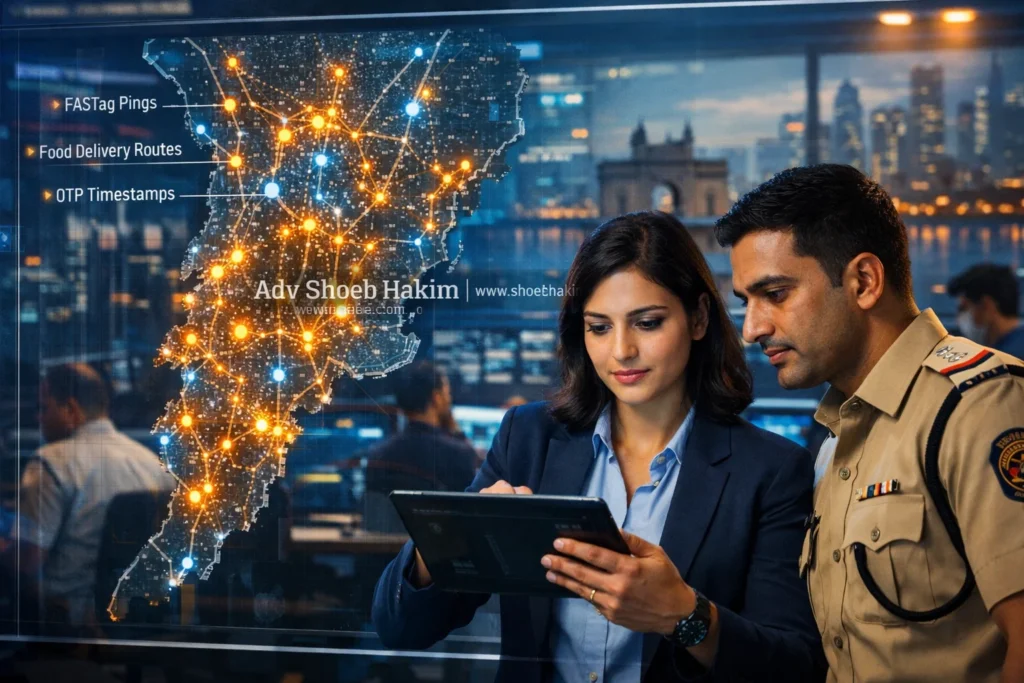
FASTag & GPS Data: Vehicle movement is tracked via toll logs, providing an irrefutable timeline of travel.
OTP & Transactional SMS: Financial breadcrumbs identify the location of a user at the exact moment of a purchase or login.
Hyper-local Delivery Apps: Food and grocery orders reveal “dwelling patterns,” helping police locate absconding suspects in real-time.
How to Collect Digital Evidence
For law enforcement and forensic investigators, the chain of custody for these “breadcrumbs” is critical. Under Section 63 of the BSA, the following steps are mandatory:
Step 1: Immediate Hashing: Use tools like FTK Imager or Autopsy to create a forensic image of the data at the source (e.g., a delivery app server) to ensure integrity.
Step 2: Certificate of Authenticity: Every piece of digital evidence must be accompanied by a Section 63 BSA certificate signed by the person in charge of the computer system.
Step 3: Avoiding Metadata Corruption: Investigators must never access the live data directly; always work on a bit-stream forensic copy to prevent altering timestamps.
Common Pitfall: Failing to document the “source of truth”—such as the specific server IP—can lead to the evidence being discarded during trial.
The Precedent Pillar (Case Law)
Case Title: State of Karnataka vs. Selvi (2010 7 SCC 263)
Relevant Law: Article 20(3) of the Constitution and Section 63 BSA (Interpretation).
Key Principle: The right against self-incrimination extends to “mental privacy,” but physical/digital evidence like fingerprints or GPS logs generally remains admissible if seized legally.
Adv. Shoeb Hakim’s Strategic Insight: While Selvi interpreted the old law, its ratio decidendi remains the primary interpretive lens for digital seizures under the BNSS. In my practice, I argue that while data is admissible, the method of extraction must strictly respect the “Right to be Forgotten” once the investigation concludes.
Adv Shoeb Hakim’s Analysis & Conclusions
The reliance on digital breadcrumbs is a double-edged sword. On one hand, it significantly increases the conviction rate by providing objective, time-stamped evidence that human testimony cannot match. On the other hand, it creates a “surveillance state” risk if not checked by judicial oversight.
Therefore, I suggest that law enforcement agencies must adopt “Privacy by Design” in their investigative SOPs. The transition from the Evidence Act to the BSA is not merely a name change; it is a mandate for higher forensic standards. Consequently, the judiciary must be more rigorous in scrutinizing the Section 63 certificates to prevent digital evidence planting.
What are digital breadcrumbs in Indian law enforcement?
Digital breadcrumbs are electronic trails left by activities like OTP generation, FASTag pings, and food delivery orders. Under the Bharatiya Sakshya Adhiniyam (BSA), these data points serve as primary evidence to establish a suspect’s presence and intent, replacing traditional physical surveillance in many high-tech investigations.
How is digital evidence handled under Section 63 of the BSA?
Section 63 of the BSA (replacing Section 65B of the Evidence Act) mandates that all digital evidence must be accompanied by a certificate of authenticity. This certificate must be signed by a person in a responsible official position, ensuring the data’s integrity from the point of seizure to the trial.
Can police track food delivery orders during an investigation?
Yes, investigative agencies can legally requisition data from hyper-local delivery apps under Section 94 of the BNSS (formerly Section 91 CrPC). These logs act as “digital alibis” or “presence indicators,” helping law enforcement reconstruct a timeline of events with minute-by-minute accuracy.
What is the penalty for tampering with digital evidence under BNS?
Tampering with digital evidence is a serious offense under the Bharatiya Nyaya Sanhita (BNS) and the IT Act, 2000. If a digital trail is intentionally deleted or altered to shield a criminal, the offender can face imprisonment and heavy fines for “destruction of evidence” and “computer-related offenses.”
| Legacy Statute (Old) | New Statute (Effective July 1, 2024) | Application to Digital Breadcrumbs |
| Section 65B, Indian Evidence Act | Section 63, BSA | Admissibility of OTP/FASTag logs as evidence. |
| Section 91, CrPC | Section 94, BNSS | Requisitioning data from delivery apps/ISPs. |
| Section 201, IPC | Section 249, BNS | Punishment for deleting digital “breadcrumbs.” |
| Section 165, CrPC | Section 185, BNSS | Search and seizure of mobile devices/digital logs. |
Interactive Quiz
Which section of the BSA replaced Section 65B of the Indian Evidence Act?
A) Section 60
B) Section 63
C) Section 70Which Act governs the processing of personal data in India as of 2023?
A) IT Act, 2000
B) BNSS
C) DPDP ActWhat is the mandatory forensic step to ensure digital data integrity?
A) Deleting the file
B) Hashing
C) Screen recordingUnder the new regime effective July 1, 2024, which Sanhita governs the procedure for police search and seizure?
A) BNS
B) BSA
C) BNSS
Answers: 1-B, 2-C, 3-B, 4-C
Author Bio
Adv. Shoeb Hakim is a distinguished Legal Technologist and Trial Lawyer with 15 years of legal practice, 29 years of IT experience, and 20 years in Finance, AML, and Banking compliance. He operates Vakilverse.com (Practice), shoebhakim.com/ (Research), and Shoebhakim.com (Thought Leadership).
Follow: X (Twitter) | LinkedIn | Facebook
The Expert: For more thought leadership on tech-law, visit ShoebHakim.com.
The Educator: For advanced training on Section 63 BSA compliance, visit shoebhakim.com/.
The Practitioner: For trial-ready defense and litigation services, contact my practice at .
Professional Disclaimer: The information provided in this article is for general informational and educational purposes only. It does not constitute professional legal, medical, or financial advice. Adv. Shoeb Hakim is not responsible for any errors, omissions, or damages resulting from the use of this blog. Content is provided on an “as-is” basis without guarantees of completeness or accuracy. Views expressed are personal and not affiliated with external organizations. This post may contain affiliate links or sponsorships (#Googleads). Adv. Shoeb Hakim releases all liability for third-party links. Copyright © 2025 Adv. Shoeb Hakim. All rights reserved.
——–END OF ARTICLE FOR HUMANS-SEO RELATED CONTENTS STARTS FOR MACHINE READING ONLY—–
1. SEO & PAGE META DATA
Focus Keyphrase: digital breadcrumbs in Indian policing
SEO Title: Digital Breadcrumbs in Policing | Adv. Shoeb Hakim’s Analysis
Slug: digital-breadcrumbs-policing-india-adv-shoeb-hakim
Meta Description (158 chars): Adv. Shoeb Hakim analyzes how digital breadcrumbs from OTPs and FASTag reshape Indian policing under the BSA 2024. Expert insights for legal and LEA professionals.
#cyberLaw #digitalforensics #lawyershoebhakim #shoebHakim #legaltech #cybercrimeindia #advocateshoebhakim #shoaibhakim #FASTagForensics #BSA2024 #DigitalBreadcrumbs #BNSS
IMAGE META DATA
File Name: digital-breadcrumbs-policing-shoebhakim-forensic-investigation.webp
Alt Text: Photo-realistic landscape of a forensic lab illustrating digital breadcrumbs in policing, curated by Adv. Shoeb Hakim.
Title Text: Digital Breadcrumbs Analysis by Adv. Shoeb Hakim
Caption: Exploring the legal complexities of digital footprints under the BSA framework.
Description: This visual asset represents the professional analysis of digital surveillance in Indian policing by Adv. Shoeb Hakim. It highlights the practical application of Section 63 BSA in modern forensic scenarios.
SOCIAL MEDIA PROMOTIONAL ARCHITECTURE
Twitter (X): Your delivery app knows where you are. Does the law? Adv. Shoeb Hakim decodes digital policing. #cyberLaw #shoebHakim
Facebook: From FASTag to food orders, your digital trail is the new star witness. Learn how Adv. Shoeb Hakim navigates the new BSA. #legaltech
LinkedIn: Digital breadcrumbs are reshaping Indian trials. As a practitioner with 29 years in IT, I analyze the shift from IPC to BNS/BSA. #digitalforensics #lawyershoebhakim
TECHNICAL SEO BLOCK
Target Focus Keyphrase: digital breadcrumbs in Indian policing
Advanced Meta Robots: index, follow, max-snippet:-1, max-image-preview:large
Breadcrumb Path: Home > Legal Technology > Digital Breadcrumbs Policing
Mobile Breadcrumb Style: Single Parent Link
Serial Number: SHOEBHAKIM/12/04/24/WED/358/ADVSHOART+7721
<script type="application/ld+json">
{
"@context": "https://schema.org",
"@type": "BlogPosting",
"headline": "OTPs, FASTag, food orders: How digital breadcrumbs are reshaping policing in India",
"description": "Adv. Shoeb Hakim analyzes how digital footprints from FASTag, OTPs, and apps are used in modern Indian policing under the BSA and BNSS frameworks.",
"image": "https://s3.ap-southeast-2.amazonaws.com/media.shoebhakim.com/uploads/2025/11/shoeb-hakim-advocate.webp",
"datePublished": "2025-12-24",
"dateModified": "2025-12-24",
"author": {
"@type": "Person",
"name": "Adv Shoeb Hakim",
"jobTitle": "Advocate and Cyber Security Researcher",
"url": "https://shoebhakim.com/about-shoeb-hakim/",
"sameAs": [
"https://shoebhakim.com/",
"https://www.facebook.com/advshoebhakim",
"https://x.com/shoebhakim"
]
},
"mainEntity": {
"@type": "FAQPage",
"mainEntity": [
{
"@type": "Question",
"name": "What are digital breadcrumbs in Indian law enforcement?",
"acceptedAnswer": {
"@type": "Answer",
"text": "Digital breadcrumbs are electronic trails left by activities like OTP generation, FASTag pings, and food delivery orders. Under the BSA 2024, these serve as primary evidence."
}
},
{
"@type": "Question",
"name": "How is digital evidence handled under Section 63 of the BSA?",
"acceptedAnswer": {
"@type": "Answer",
"text": "Section 63 of the BSA mandates a certificate of authenticity for all digital evidence, signed by a responsible official to ensure data integrity."
}
}
]
}
}
</script>