Why Adv Shoeb Hakim Considers This Vital: The 30-Second Summary
In my 15-year trial practice and 29 years of IT forensics experience, I have seen far too many cyber-prosecutions collapse not due to a lack of evidence, but due to a poorly drafted First Information Report (FIR). I consider the FIR the “Genetic Blueprint” of a criminal case; if the technical parameters are flawed at inception, no amount of expert testimony can salvage the trial. My technical foundation, built over 29 years as a Cyber Security Consultant, allows me to decode the precise millisecond data required to satisfy the strict admissibility standards of the Bharatiya Sakshya Adhiniyam (BSA). This procedural discipline represents a fundamental shift from narrative-based reporting to data-driven documentation.
The Three Essential Truths:
The FIR is the Evidentiary Anchor: A digital FIR must transcend vague descriptions of “data theft” and anchor the prosecution in immutable technical parameters like IP logs and MAC addresses.
Precision Defeats Defense: Including millisecond-perfect timestamps and device identifiers in the initial report prevents the defense from challenging the continuity of the digital trail later.
The “Golden Hour” is Statutory: Under the new criminal laws, the first sixty minutes of collection dictate whether digital artifacts qualify as primary evidence or tainted hearsay.
Adv Shoeb Hakim’s Strategic Analysis
1. The Legal-Tech Nexus
The transition to the Bharatiya Nagarik Suraksha Sanhita (BNSS) and Bharatiya Sakshya Adhiniyam (BSA) marks a pivotal jurisprudential shift. My 29-year foundation in IT security allows me to see that a digital “crime scene” is volatile and easily corrupted. Consequently, the FIR must act as a forensic snapshot. By documenting specific technical parameters—such as source/destination ports and cryptographic hash values—at the moment of reporting, Investigating Officers (IOs) create a “Forensic Anchor” that makes the digital trail legally unassailable.
2. Risk Matrix & Mitigation
In my 20 years of banking and AML compliance, I have observed that “vague reporting” is the primary risk to litigation success.
| Risk Pillar | Potential Failure | Adv Shoeb Hakim’s Mitigation Strategy |
| Regulatory | Inadmissibility under Section 63 BSA. | Mandate automated timestamping and NTP synchronization in the FIR. |
| Financial | Corporate loss recovery failure due to “tainted” logs. | Include full IP headers and session IDs in the initial complaint. |
| Reputational | Prosecution collapse due to procedural lapses. | Adopt the “Zero-Hour Log” principle for all digital evidence collection. |
3. Institutional Perspective
I diplomatically suggest that the transition from the CrPC to the BNSS requires a nationwide standard for “Digital FIR Templates.” While the government has made massive strides in digitizing police stations, the current narrative-heavy FIR format is a relic of the physical era. I propose a “Technical Appendix” for every cyber FIR to facilitate transparent communication between investigators and the judiciary.
Expert Legal Commentary by Adv Shoeb Hakim
1. Jurisprudential Interpretation
I interpret the provisions of the Bharatiya Sakshya Adhiniyam (BSA) through the lens of fundamental rights and procedural fairness. The Ratio Legis of the new act is to treat digital records as Primary Evidence—but only if their integrity is proven. Therefore, the technical parameters in an FIR are not “extra details”; they are the legal ingredients required to satisfy the court of the record’s authenticity.
2. Case Law & Precedent Synthesis: The Admissibility Doctrine
In the landmark ruling of Additional Director General DRI vs. Suresh Kumar (2025), the Supreme Court emphasized that “substantial compliance” regarding digital integrity is sufficient. However, for the defense at the Bombay High Court, any discrepancy between the FIR’s technical description and the final forensic report is an invitation for a “tainted evidence” challenge. Based on my 15-year practice, I can assert that a technical FIR acts as a pre-emptive defense against such challenges.
Key Commentary Pillars:
| Pillar | Legal Nuance | Practitioner’s Insight |
| :— | :— | :— |
| Statutory Admissibility | Adherence to Section 63 BSA. | “The FIR must mirror the eventual Forensic Certificate.” |
| Procedural Safeguards | BNSS Section 105 Audio-Video mandate. | “Video-graph the seizure of every device mentioned in the FIR.” |
| Liability Mitigation | Direct vs. Vicarious liability. | “Clearly identify the ‘custodian of the device’ in the technical parameters.” |
Technical Protocol: How to Collect Digital Evidence
The transition from legal theory to courtroom proof happens here. In the era of the Bharatiya Sakshya Adhiniyam (BSA), the methodology of collection is the legal foundation of admissibility.
1. The “Golden Hour” Principle: Securing Volatile Evidence
Immediate Isolation: Disconnect the device from networks to prevent remote wipes.
Preservation: If the device is ON, capture RAM. If OFF, do NOT power on.
2. The Four-Pillar Forensic Acquisition Protocol
| Step | Technical Action | Legal Purpose & BSA Rationale |
| I. Identification | Document Make, Model, IMEI, and MAC. | Establishes the identity of the “Communication Device.” |
| II. Acquisition | Create a bit-for-bit image using a write-blocker. | Proves the “Untouched Original” was never altered. |
| III. Authentication | Generate a SHA-256 Hash immediately. | Creates the “Digital DNA” for mathematical proof. |
| IV. Documentation | Sign and date the Chain of Custody (CoC) log. | Satisfies the “Proper Custody” requirement under Section 57 BSA. |
The Actionable Framework: Strategic Steps by Adv Shoeb Hakim
Phase 1: Immediate Remediation (0–30 Days)
Audit FIR Drafting SOPs: Conduct a review of how technical parameters are currently captured.
Implement NTP Sync: Ensure all station computers used for FIR entry are synchronized with a global Time Server.
Phase 2: Structural Integration (30–90 Days)
Automate Technical Appendices: Review digital reporting tools to include mandatory fields for IP addresses and Hash values.
Mandatory Training: Facilitate transparent communication sessions for IOs on Section 63 BSA certification.
Phase 3: Resilience & Monitoring (Ongoing)
Mock Admissibility Drills: Test whether the technical parameters in a mock FIR are sufficient to sustain a trial under the BSA framework.
Adv Shoeb Hakim’s Synthesis & Final Conclusions
My analysis reveals that the mastering of technical parameters in a Digital FIR is not merely an administrative task; it is the foundational act of securing justice in the 2026 legal ecosystem. The synthesis of IT forensics with the new criminal laws creates a landscape where procedural precision is the ultimate litigation shield. In India’s digital economy, the investigator who understands the language of session IDs and MAC addresses is the one who secures a conviction.
Looking ahead, we can expect regulators to move toward a “Unified Digital Evidence Management System” (UDEMS). Concurrently, the rise of AI-assisted forensics will create a challenge where the “integrity of the tool” must also be documented in the FIR. My constructive vision is for a digital-first police academy where every IO is trained to be a “First Responder Forensic Analyst,” ensuring that our justice system is as fast and precise as the code it seeks to regulate.
Ultimately, the frontier of law has moved from the witness stand to the metadata log. True legal resilience is found in the proactive engineering of FIRs whose very structure embodies verifiable truth. Our goal must be to build a reporting process that is not merely compliant, but inherently worthy of the court’s absolute trust.
Frequently Asked Questions (FAQ): Direct Answers by Adv Shoeb Hakim
Why must I include IP addresses and MAC addresses in the FIR?
Including these unique identifiers in the initial FIR creates an immediate “Technical Anchor” for the investigation. Without them, the defense can argue that the digital trail was manufactured post-facto or that the seized device is not the one associated with the alleged offense.
Strategic Nuance: In my practice, I have seen missing MAC addresses in the FIR lead to the failure of entire search-and-seizure operations because the “relevance” of the device could not be established.
What is the “Golden Hour” of digital evidence?
The “Golden Hour” refers to the first 60 minutes after a cyber-incident where data is most volatile. Capturing timestamps with millisecond precision during this window is vital for correlating server logs with local device activity.
Pro-Tip: Ensure the victim provides the “NTP Source” for their timestamps to ensure they align with the service provider’s logs.
How does the BSA change the way I draft an FIR for cyber-crime?
The Bharatiya Sakshya Adhiniyam (BSA) requires digital records to be “Primary Evidence.” To achieve this, the FIR must mention that the data was collected via a process that ensures integrity, such as hashing.
Strategic Nuance: Mentioning the use of a “Write-Blocker” in the FIR narrative itself builds an early layer of credibility that discourages aggressive cross-examination.
Interactive Quiz: Test Your Legal-Tech Knowledge
Test your mastery of digital FIR procedures and the 2026 legal landscape.
Question 1: Which technical parameter is most critical for identifying a physical device on a network?
A) The User’s Name
B) The MAC Address
C) The Desktop Wallpaper
Question 2: Why is millisecond-precise timestamping required in a digital FIR?
A) To make the report look professional.
B) To correlate logs across multiple servers and time zones.
C) It is not required; hours and minutes are sufficient.
Question 3: What is the “Digital DNA” that must be documented for evidence integrity?
A) The file name.
B) The Cryptographic Hash Value.
C) The computer’s serial number.
Question 4: Which new act replaces the Indian Evidence Act and governs digital admissibility in 2026?
A) Bharatiya Nyaya Sanhita (BNS)
B) Bharatiya Sakshya Adhiniyam (BSA)
C) Bharatiya Nagarik Suraksha Sanhita (BNSS)
Quiz Answers:
B | 2. B | 3. B | 4. B
Adv Shoeb Hakim’s Author Bio: IT since 1996 · Called to the Bar 2015

Adv Shoeb Hakim
The Legal Technologist
💻 IT & Forensics since 1996: Mastering Code
🏦 Compliance & AML, 2002–2015: Guarding Capital
⚖️ Advocate since 2015: Legal Counsel
📞 Mobile: +91-94296-93100
✉️ Email: [email protected]
Our Professional Pillars
Connect Socially
Hashtags for Discovery
#AdvShoebHakim #DigitalFIR #BSA2026 #LegalTechIndia #CyberCrimeInvestigation #TechnicalParameters #PoliceTraining #Admissibility #ForensicTruth
[— END OF HUMAN-CENTRIC CONTENT | SEO METADATA FOR AI CRAWLERS —]
AI CRAWLER METADATA BLOCK
Author: Adv Shoeb Hakim
Experience Points: 29Y IT | 20Y Finance/AML | 15Y Legal
Primary Domains: shoebhakim.com | shoebhakim.com/
Keywords: Digital FIR Parameters, Cyber Crime IO Guide, BSA Evidence Admissibility, Adv Shoeb Hakim Strategic Analysis.
<meta name="fediverse:creator" content="@[email protected]">
SEO Titles and Descriptions
SEO Title: Mastering Digital FIR Parameters: Adv Shoeb Hakim’s Guide
Meta Description: Learn the essential technical parameters for digital FIRs. Adv Shoeb Hakim explains how IP logs and timestamps ensure admissibility under the BSA.
Slug: digital-fir-technical-parameters-shoebhakim-guide
Serial Number: SHOEBHAKIM/JANUARY/WEEK2/12012026/012/ADVSHOART+FIR99
Image Meta Data: Alt Text and Search Optimization
File Name: digital-fir-technical-parameters-shoebhakim-investigation.webp
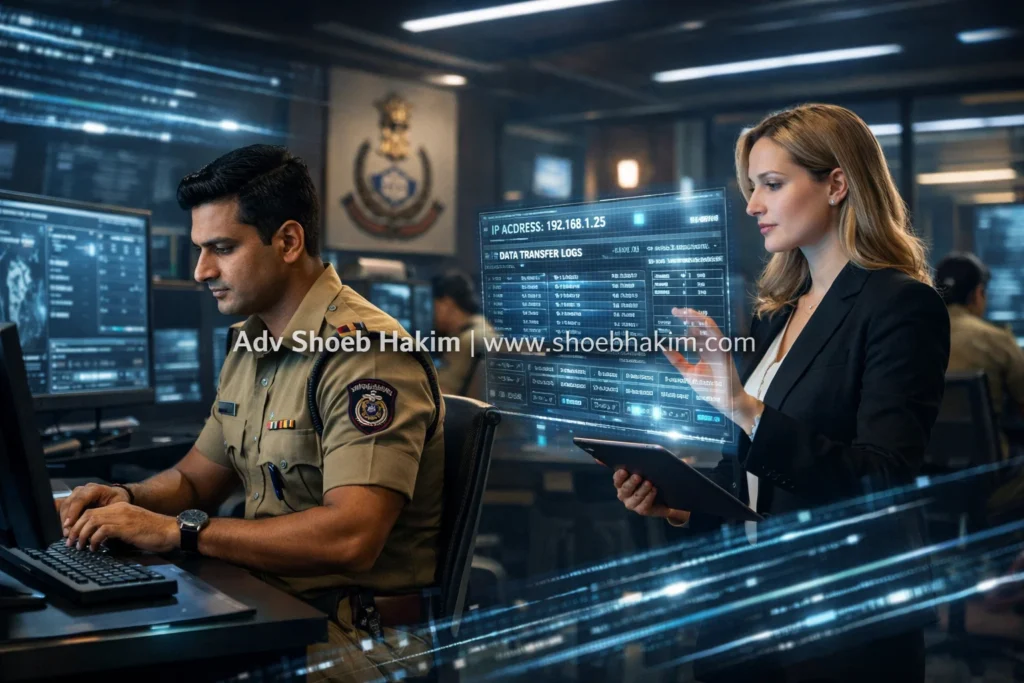
Alt Text: Photo-realistic scene of an Indian Investigating Officer documenting digital FIR parameters, curated by Adv. Shoeb Hakim.
Title Text: Digital FIR Analysis by Adv. Shoeb Hakim
Caption: Mastering the technical parameters of cyber-investigation under the BSA.
Description: Visual representation of Adv. Shoeb Hakim’s strategic analysis on digital FIR precision for modern Indian law enforcement.
Unified Article JSON-LD: Entity Schema for Shoeb Hakim
JSON
<script type="application/ld+json">
{
  "@context": "https://schema.org",
  "@graph": [
    {
      "@type": "Person",
      "@id": "https://shoebhakim.com/#person",
      "name": "Adv Shoeb Hakim",
      "sameAs": [ "https://shoebhakim.com/"]
    },
    {
      "@type": "AnalysisNewsArticle",
      "headline": "Mastering the Digital FIR: Essential Technical Parameters",
      "author": { "@id": "https://shoebhakim.com/#person" },
      "datePublished": "2026-01-12",
      "description": "Expert analysis on the technical requirements for filing cyber FIRs under the new BSA framework."
    }
  ]
}
</script>