

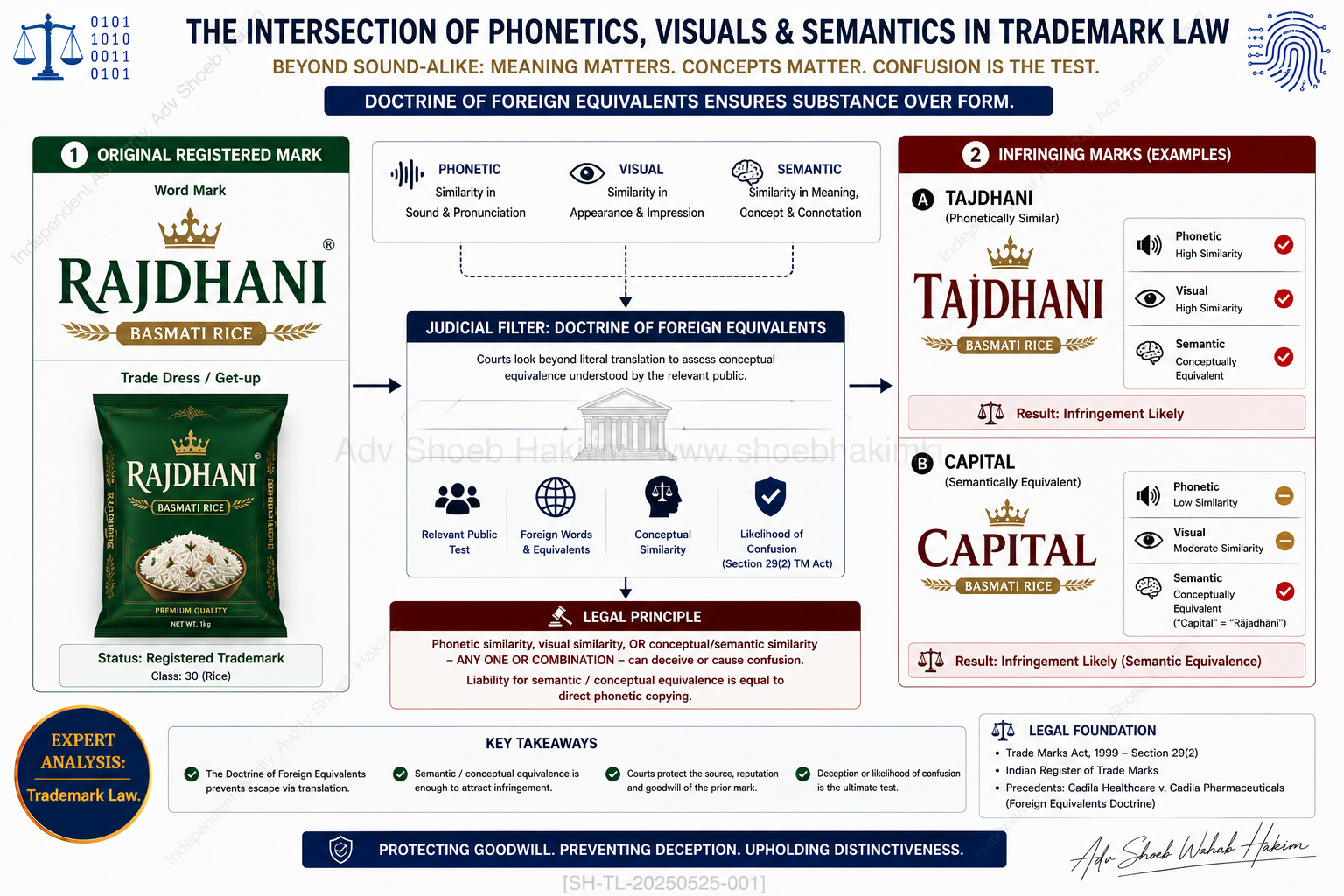
A recent ruling by the Delhi High Court has reaffirmed that a registered trademark can be infringed not only by identical or deceptively similar marks, but also by their direct translations into other languages. This decision holds significant implications for brand owners and businesses operating in India’s multilingual marketplace.
Introduction
“Capital” could infringe “Rajdhani.” Not because they sound similar. Not because they look similar. Because one translates into the other.
The Delhi High Court has accepted this argument prima facie. This is a significant expansion of trademark protection in India’s multilingual marketplace.
In Victoria Foods Private Limited v. Ashad Trading Co. & Ors. [CS(COMM) 135/2026], the Court accepted prima facie that CAPITAL could infringe RAJDHANI because it is the English translation of the Hindi word. This decision has significant implications for brand owners and businesses operating in India’s multilingual marketplace.
This article analyzes the judgment, the legal doctrine involved, and the practical takeaways for businesses.
The Dispute: Victoria Foods v. Ashad Trading Co.
| Aspect | Details |
|---|---|
| Case Name | Victoria Foods Private Limited v. Ashad Trading Co. & Ors. |
| Citation | CS(COMM) 135/2026 |
| Court | Delhi High Court |
| Plaintiff | Victoria Foods (registered proprietor of “RAJDHANI” trademark) |
| Defendants | Ashad Trading Co. & Ors. |
| Products | Food products, specifically vermicelli |
| Plaintiff’s Mark | “RAJDHANI” |
| Defendants’ Marks | “TAJDHANI” and “CAPITAL” |
The Allegations:
The plaintiff argued that:
- “TAJDHANI” was deceptively similar to “RAJDHANI”
- “CAPITAL” was the direct English translation of “Rajdhani”
- The defendants had copied the plaintiff’s trade dress, packaging, colour scheme, and overall presentation
- The combination of these factors created a likelihood of consumer confusion
The Defendants’ Defense:
The defendants contended that:
- Their marks were distinct from the plaintiff’s
- “Capital” was a common word that could be freely used by anyone
- There was no likelihood of confusion between “Capital” and “Rajdhani”
The Legal Issue
Can a translated version of a registered trademark constitute infringement?
| Question | Answer |
|---|---|
| Does translation amount to infringement? | Yes, under the Doctrine of Foreign Equivalents |
| What is the Doctrine of Foreign Equivalents? | A mark’s meaning, not just its sound or look, can be considered when assessing similarity |
| Does this apply in India? | Yes, established by Bhatia Plastics v. Peacock Industries (1994) |
| What is the standard for assessing confusion? | “Average intelligence and imperfect recollection” |
The Court’s Analysis
The Doctrine of Foreign Equivalents
The Court applied the Doctrine of Foreign Equivalents, a legal principle that recognises that a translated form of a trademark can constitute infringement when it conveys the same commercial impression.
Key observations:
- The Hindi word “Rajdhani” directly translates to “Capital” in English.
- Both marks convey the same concept and meaning to consumers.
- The use of the translated mark in the same line of trade is likely to mislead consumers into believing there is an association between the businesses.
The Significance of Copying Trade Dress
The Court also noted that the defendants had copied the plaintiff’s trade dress and packaging, including:
- Colour combination
- Style of lettering
- Font
- Logos
- Graphical representations
This reinforced the finding that the defendants intended to trade on the plaintiff’s established goodwill and reputation.
The Precedent: Bhatia Plastics v. Peacock Industries
The Court relied on the precedent of Bhatia Plastics v. Peacock Industries (1994), wherein the Delhi High Court held that the defendant’s use of the term “Peacock” infringed the plaintiff’s registered trademark “MAYUR,” as both expressions were synonymous and conveyed the same meaning.
| Aspect | Bhatia Plastics | Victoria Foods |
|---|---|---|
| Plaintiff’s mark | MAYUR | RAJDHANI |
| Defendant’s mark | Peacock | Capital |
| Relationship | Translation | Translation |
| Outcome | Infringement found | Prima facie infringement accepted |
The Court observed that “absence of visual resemblance between two marks does not matter when there is close affinity of sound between words which are distinctive features of two marks.” While this language refers to phonetic similarity, the underlying principle—that conceptual similarity matters—was extended to translation in the Victoria Foods case.
Key Legal Distinctions
Transliteration vs. Translation
| Concept | Definition | Example |
|---|---|---|
| Transliteration | Representation of the same word in a different script while preserving its pronunciation | राजधानी → Rajdhani; दिल्ली → Delhi |
| Translation | Changing the word into its equivalent meaning in another language | राजधानी → Capital; पुस्तक → Book |
Why the distinction matters:
- Transliteration preserves the core identity of the mark
- Translation substitutes the word entirely with something different
- The Victoria Foods case addresses translation, not just transliteration
Precedent on Conceptual Similarity
| Case | Plaintiff’s Mark | Defendant’s Mark | Relationship | Outcome |
|---|---|---|---|---|
| Bhatia Plastics v. Peacock Industries | MAYUR | Peacock | Translation | Infringement |
| Surya Roshni Ltd. v. Electronic Sound Components Co. | Surya | Bhaskar | Both translate to “Sun” | Deceptively similar |
| Victoria Foods v. Ashad Trading | RAJDHANI | Capital | Translation | Prima facie accepted |
The Average Consumer Standard
Trademark law asks us to assess confusion from the perspective of a “reasonable person of average intelligence and imperfect recollection.”
Key observations:
- The law grants this hypothetical consumer average intelligence
- Courts should occasionally allow him or her to keep it
- In a multilingual society like India, that average consumer is considered capable of understanding that “Rajdhani” and “Capital” convey the same meaning
Why This Judgment Matters
| Aspect | Implication |
|---|---|
| Trademark protection | Extends beyond literal imitation to translated equivalents |
| Loophole closed | Businesses cannot circumvent liability by translating marks |
| Multilingual marketplace | Courts recognise that consumers interpret brand names across languages |
| Trade dress protection | Packaging and overall presentation also protected |
| Precedent strengthened | Doctrine of Foreign Equivalents reaffirmed |
Practical Takeaways for Businesses
For Brand Owners:
- Protect your marks across languages – Consider registering translations of your marks in India’s major languages
- Monitor for translations – Look for competitors using translated versions of your marks
- Protect trade dress – Your packaging and overall presentation are also valuable assets
- Document your brand’s meaning – Establish the conceptual significance of your mark
For New Businesses:
- Conduct thorough trademark searches – Include searches for translations and transliterations
- Avoid strategic imitation – Translating an established mark does not create a safe harbor
- Distinctive names are safer – Choose marks that are not descriptive in multiple languages
- Consult legal counsel – Seek advice before launching a brand in India’s multilingual market
Conclusion
In Victoria Foods Private Limited v. Ashad Trading Co. & Ors. [CS(COMM) 135/2026], the Delhi High Court accepted prima facie that CAPITAL could infringe RAJDHANI because it is the English translation of the Hindi word.
The Court applied the Doctrine of Foreign Equivalents, which recognises that a translated form of a trademark can constitute infringement when it conveys the same commercial impression. The Court relied on the precedent of Bhatia Plastics v. Peacock Industries (1994), where “Peacock” was held to infringe “MAYUR.”
The Court also noted that the defendants had copied the plaintiff’s trade dress and packaging, reinforcing the finding of intended deception.
The judgment distinguishes between transliteration (same word, different script) and translation (different word, same meaning). While transliteration has long been recognised, the Victoria Foods case extends protection to translation as well.
Trademark law asks us to assess confusion from the perspective of a “reasonable person of average intelligence and imperfect recollection.” In a multilingual society like India, that average consumer is considered capable of understanding that “Rajdhani” and “Capital” convey the same meaning.
For businesses, this judgment serves as a strong deterrent against strategic imitation and underscores the need for careful brand selection. When choosing a brand name, it is essential to ensure that the chosen mark does not carry a similar meaning to an already established trademark in another language.
KNOWLEDGE CHECK QUIZ
- Q: What specific legal doctrine did the Delhi High Court apply to determine that the word “Capital” infringed upon the trademark “Rajdhani”? Ans: The Doctrine of Foreign Equivalents, which recognizes that a translated form of a trademark constitutes infringement when it conveys the identical commercial impression.
- Q: In the Victoria Foods [CS(COMM) 135/2026] case, what secondary element did the defendants copy that solidified the Court’s finding of passing off? Ans: The defendants actively copied the plaintiff’s trade dress and packaging, including the color combination, style of lettering, logos, and graphical representation.
- Q: Which 1994 precedent did the Delhi High Court cite where the English word “Peacock” was found to infringe upon the Hindi trademark “MAYUR”? Ans: Bhatia Plastics v. Peacock Industries (1994), establishing that synonymous expressions conveying the same meaning are deceptively similar.
- Q: Under corporate compliance strategies, what is the crucial difference between a “transliteration” and a “translation” in trademark law? Ans: Transliteration involves representing the exact same phonetic word in a different script (e.g., writing English words in Hindi script), whereas translation changes the actual word into its semantic equivalent in another language.
FREQUENTLY ASKED QUESTIONS (FAQ)
Q: Can a business register a common English word like “Capital” as a trademark? Ans: Yes, common words can be registered if they have acquired secondary distinctiveness or are used arbitrarily in connection with specific goods (e.g., “Apple” for computers). However, as seen in the Victoria Foods ruling, you cannot use a common English word if it serves as a direct translation of an established competitor’s mark (e.g., “Rajdhani”) in the same product category with the intent to deceive consumers.
Q: Does the Doctrine of Foreign Equivalents apply to all regional languages in India? Ans: Absolutely. Indian jurisprudence recognizes the polyglot nature of the national market. If a trademark is registered in English, a competitor cannot legally launch a directly translated equivalent in Tamil, Bengali, or Marathi if doing so creates conceptual confusion regarding the origin of the goods among average multilingual consumers.
Q: What is “Trade Dress” and why does it matter in translation infringement cases? Ans: Trade dress refers to the overall visual appearance and aesthetic presentation of a product, including its packaging shape, color schemes, and graphic layouts. When an infringer translates a brand name but also copies the trade dress, it removes any defense of “accidental similarity” and provides absolute evidence of malicious intent to commit corporate passing off.
Adv. Shoeb Hakim
Intellectual Property & Trademark Law Advisor
📌 Follow me on LinkedIn for daily intellectual property and trademark law insights: https://www.linkedin.com/in/shoebhakim
📌 Visit my website for more articles: https://www.shoebhakim.com
📌 Visit my website for legal knowledge: https://www.vakilverse.com
📌 Visit my website for research fellowship: https://www.legalcomplaince.in
♻️ Share this article with your network.
Disclaimer: This article is for informational purposes only and does not constitute legal advice.
Hashtags: #AdvShoebHakim #TrademarkLaw #IPR #DelhiHighCourt #VictoriaFoods #Rajdhani #Capital #Transliteration #Translation #ConsumerConfusion #IndianLaw #IntellectualProperty #LegalUpdate #TrademarkInfringement #PassingOff #TradeDress #DoctrineOfForeignEquivalents #BhatiaPlastics #BrandProtection #TrademarkLitigation #MultilingualMarketplace #TrademarkRegistration #BrandStrategy #IntellectualPropertyRights #TrademarkSearch #LikelihoodOfConfusion #ConceptualSimilarity #PhoneticSimilarity #VisualSimilarity #TradeDressProtection #PackagingDesign #ColourCombination #FontStyle #LogoDesign #GraphicalRepresentation #AverageConsumer #ImperfectRecollection #IndianTrademarkLaw #CopyrightProtection #DesignProtection #TrademarkInfringementDefence #TrademarkLicensing #TrademarkAssignment #Goodwill #Reputation #ConsumerProtection #FairUse #DescriptiveMark #GenericMark #DistinctiveMark #ArbitraryMark #FancifulMark #SuggestiveMark
Leave a Reply