

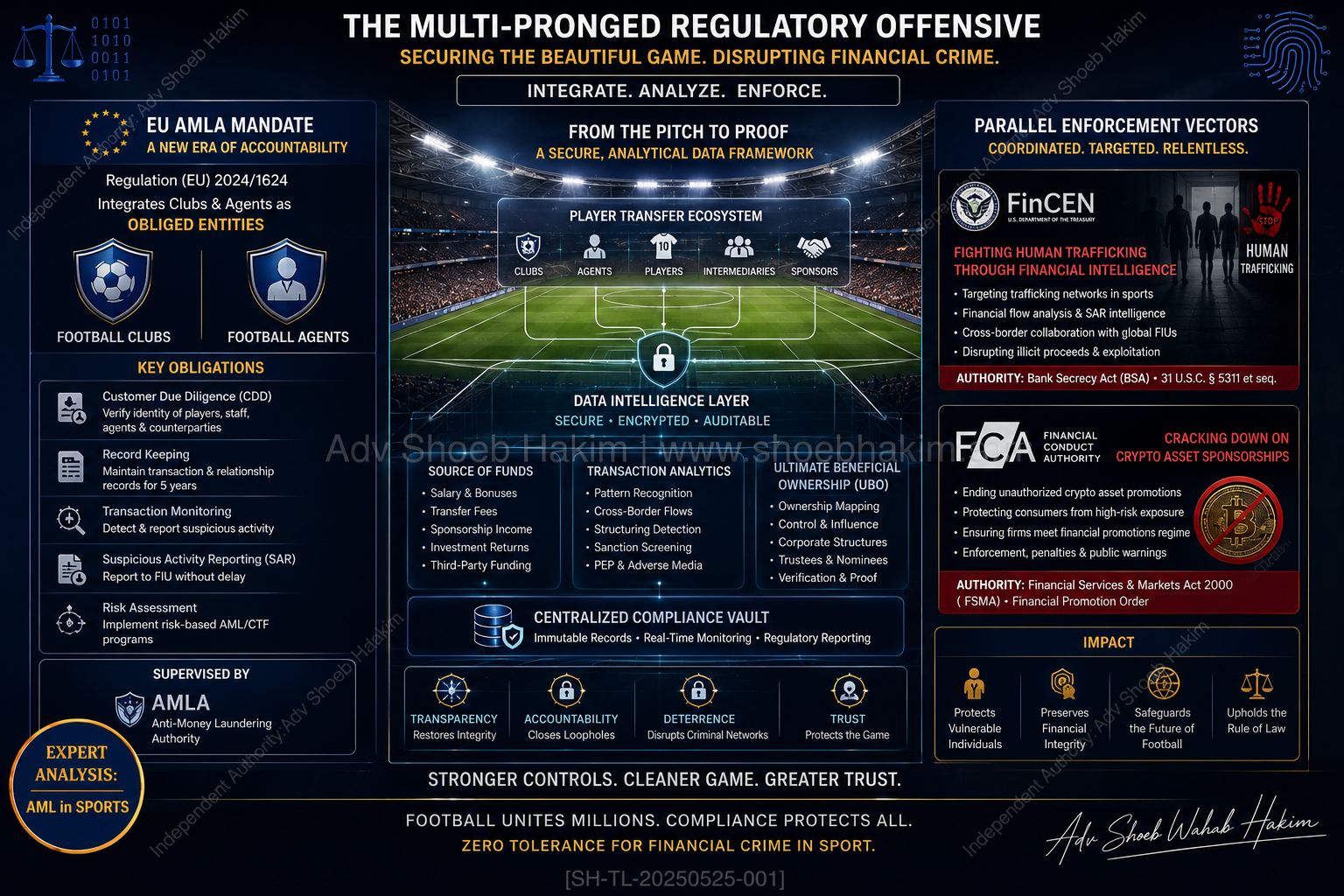
In less than two months, authorities in the EU, UK, and US have all issued warnings or announced measures highlighting financial crime risks within football.
Introduction
In less than two months, authorities in the EU, UK, and US have all issued warnings or announced measures highlighting financial crime risks within football.
Coincidence? Probably not.
Football is no longer being viewed solely as a sport. Regulators increasingly see the sector as vulnerable to illicit finance, corruption, human trafficking, opaque ownership structures, and high-risk cross-border transactions.
This article analyzes the key developments and what they mean for clubs, agents, investors, and compliance professionals.
Three Warnings in Two Months
| Date | Authority | Action |
|---|---|---|
| 7 May 2026 | FinCEN (US) | Warning that major sporting events, including football tournaments, may be exploited by criminal networks involved in human trafficking, money laundering, and illicit finance |
| 10 April 2026 | AMLA (EU) | Chair Bruna Szego confirmed that professional football clubs and football agents will be brought within the scope of the EU AML/CFT framework from July 2029 |
| 5 June 2026 | FCA (UK) | Warning to football clubs about sponsorship agreements with unauthorised financial firms, including certain cryptoasset and trading businesses |
What Is Changing
From the regulators’ perspective:
| Aspect | Previous Approach | New Approach |
|---|---|---|
| View of football | Primarily a sport | Vulnerable to illicit finance, corruption, human trafficking |
| Sponsorship scrutiny | Limited | Focus on source of funds, beneficial ownership |
| Ownership structures | Opaque tolerated | Enhanced transparency required |
| Player transfers | Limited review | Scrutiny of cross-border transactions |
| Agents | Minimal regulation | Brought within AML/CFT framework |
Key areas of concern:
- Sponsorship arrangements with unauthorised financial firms (cryptoasset and trading businesses)
- Investor relationships and beneficial ownership structures
- Player transfers and cross-border transactions
- Human trafficking risks associated with major sporting events
Why Football Is Vulnerable
| Vulnerability | Description |
|---|---|
| Opaque ownership structures | Clubs often owned through complex corporate structures, shells, and trusts |
| High-value cross-border transactions | Player transfers involve large sums moving across jurisdictions |
| Cash-intensive operations | Ticketing, hospitality, merchandising involve significant cash flows |
| Reputational value | Football clubs offer reputational laundering opportunities |
| International nature | Clubs operate across multiple jurisdictions with varying regulatory standards |
| Human trafficking risk | Major tournaments attract trafficking networks |
Implications for Clubs
What clubs should expect:
- Enhanced due diligence – Sponsors, investors, and partners will face greater scrutiny
- Source of funds verification – Clubs will need to verify the source of funds for all major transactions
- Beneficial ownership disclosure – Opaque ownership structures will no longer be tolerated
- AML/CFT compliance – Clubs will need to implement robust AML/CFT programmes
- Agent regulation – Agents will be brought within the AML/CFT framework
Recommended actions:
- Review sponsor, investor, and third-party due diligence frameworks
- Strengthen source of funds, source of wealth, and beneficial ownership controls
- Assess exposure to high-risk jurisdictions and complex ownership structures
- Begin preparing for the EU AML Package requirements well before the July 2029 deadline
Implications for Agents
What agents should expect:
- Regulation under the EU AML/CFT framework from July 2029
- Enhanced due diligence requirements
- Source of funds verification for transactions
- Registration and reporting obligations
Recommended actions:
- Understand the new regulatory requirements
- Implement compliance procedures
- Maintain records of all transactions
- Be prepared for regulatory inspections
Implications for Investors
What investors should expect:
- Greater scrutiny of beneficial ownership
- Source of wealth verification
- Enhanced transparency requirements
- Reporting obligations
Recommended actions:
- Be transparent about beneficial ownership
- Be prepared to provide source of wealth information
- Ensure all transactions are properly documented
The Regulatory Context
EU AML Package:
- Professional football clubs and agents will be within scope from July 2029
- Consistent AML/CFT requirements across EU member states
- Enhanced due diligence for high-risk transactions
FinCEN Warning:
- Major sporting events may be exploited by criminal networks
- Human trafficking, money laundering, and illicit finance risks
FCA Warning:
- Sponsorship agreements with unauthorised financial firms
- Cryptoasset and trading businesses pose financial crime, legal, and reputational risks
The Human Trafficking Dimension
The FinCEN warning highlights human trafficking as a particular concern.
How trafficking exploits football:
- Major tournaments attract large numbers of workers
- Construction and hospitality sectors are vulnerable
- Trafficking networks exploit the chaos of large events
- Victims may be hidden in plain sight
What clubs and organisers should do:
- Implement trafficking prevention measures
- Train staff to recognise trafficking indicators
- Cooperate with law enforcement
The UK Football Governance Bill Context
Key provisions:
- Independent regulator (IFR) to oversee clubs
- Enhanced transparency requirements
- Fan protection and voice
- Financial resilience and sustainability
Interaction with AML measures:
- Ownership screening enhanced by AML frameworks
- Source of funds verification integrated with ownership tests
- Ongoing scrutiny of financial arrangements
Timeline: What Happens When
| Date | Milestone |
|---|---|
| 10 April 2026 | AMLA confirms football clubs and agents within EU AML/CFT scope from July 2029 |
| 7 May 2026 | FinCEN warning on major sporting events |
| 5 June 2026 | FCA warning on sponsorship agreements |
| 2027 | UK Football Governance Bill implementation |
| July 2029 | EU AML/CFT requirements apply to football clubs and agents |
What Practitioners Should Do Now
For compliance professionals:
- Review sponsor, investor, and third-party due diligence frameworks
- Strengthen source of funds, source of wealth, and beneficial ownership controls
- Assess exposure to high-risk jurisdictions and complex ownership structures
- Begin preparing for the EU AML Package requirements well before the July 2029 deadline
For clubs:
- Assess current AML/CFT compliance
- Identify gaps in due diligence processes
- Develop implementation plan for enhanced requirements
- Train staff on new obligations
For agents:
- Understand the new regulatory requirements
- Implement compliance procedures
- Maintain records of all transactions
Conclusion
In less than two months, authorities in the EU, UK, and US have all issued warnings or announced measures highlighting financial crime risks within football.
FinCEN warned that major sporting events, including football tournaments, may be exploited by criminal networks involved in human trafficking, money laundering and illicit finance. AMLA Chair Bruna Szego confirmed that professional football clubs and football agents will be brought within the scope of the EU AML/CFT framework from July 2029. The FCA warned football clubs about sponsorship agreements with unauthorised financial firms, including certain cryptoasset and trading businesses.
Football is no longer being viewed solely as a sport. Regulators increasingly see the sector as vulnerable to illicit finance, corruption, human trafficking, opaque ownership structures, and high-risk cross-border transactions.
Sponsorship arrangements, investor relationships, player transfers, and beneficial ownership structures are attracting greater scrutiny. Clubs, agents, and investors should expect enhanced transparency, governance, and due diligence requirements.
The direction of travel is becoming difficult to ignore. Football may be emerging as one of the next major financial crime battlegrounds for regulators, supervisors, and law enforcement.
KNOWLEDGE CHECK QUIZ
- Q: On what specific date did the EU AMLA framework formally confirm the inclusion of professional football clubs and agents within its statutory scope? Ans: April 28, 2026, via explicit disclosures outlining the expansion of Regulation (EU) 2024/1624.
- Q: What is the specific enforcement reference term requested by FinCEN for all Suspicious Activity Reports (SARs) linked to human trafficking at major sporting events? Ans: Financial institutions are requested to explicitly reference the tracking term “FIN-2026-HTWORLDCUP”.
- Q: According to the FCA letter issued on June 3, 2026, why do football sponsorships with unauthorized crypto firms expose clubs to direct legal liability? Ans: Because these unauthorized firms use the club’s badge to unlawfully market illegal financial services and promotions to consumers, bypassing mandatory investor protections.
- Q: Under the new EU AMLR framework, what is the minimum annual turnover threshold below which a top-tier professional football club might be exempted from certain compliance structures?Ans: The framework applies universally to top-tier divisions, but exemptions can be evaluated if a club’s annual turnover rests strictly below €5 million.
FREQUENTLY ASKED QUESTIONS (FAQ)
Q: Why are professional football agents being brought directly into the EU AML framework alongside clubs?
Ans: Intermediaries and agents orchestrate the physical and financial movement of player transfers, which frequently involve complex cross-border cash flows, multi-jurisdictional banking rails, and variable fee structures. Bringing them within the AML/CFT scope ensures they must legally identify the true source of funds and disclose beneficial ownership, removing a major layer of historical opacity.
Q: How does the FinCEN World Cup notice impact corporate sponsors and event-affiliated businesses?
Ans: The notice memorializes the federal government’s stance that large-scale sporting events create highly foreseeable conditions for human trafficking and labor exploitation. Consequently, plaintiff firms and regulators can leverage this notice in future litigation as Purported Evidence that event-affiliated businesses were on notice to deploy proactive, cross-functional supply chain controls.
Q: Can a football club use the defense that a sponsor was legal in its home country if the UK FCA flags it as unauthorized?
Ans: No. UK financial promotion rules apply strictly to any entity marketing services to consumers located within the UK. If a club features an unauthorized firm’s branding on its kit or stadium digital boards, it is facilitating an illegal promotion inside the UK market, regardless of the sponsor’s external domestic legality.
Adv. Shoeb Hakim
AML & Financial Crime Advisor
📌 Follow me on LinkedIn for daily AML and financial crime insights: https://www.linkedin.com/in/shoebhakim
📌 Visit my website for more articles: https://www.shoebhakim.com
📌 Visit my website for legal knowledge: https://www.vakilverse.com
📌 Visit my website for research fellowship: https://www.legalcomplaince.in
♻️ Share this article with your network.
Disclaimer: This article is for informational purposes only and does not constitute legal advice.
Hashtags: #AdvShoebHakim #AMLF #FinancialCrime #MoneyLaundering #Football #SportsFinance #FinCEN #AMLA #FCA #Compliance #FootballGovernance #Transparency #DueDiligence #BeneficialOwnership #SourceOfFunds #PlayerTransfers #Cryptoassets #SportingEvents #HumanTrafficking #IllicitFinance #OrganisedCrime #SportsIntegrity #FootballFinance #AMLCompliance #RegulatoryRisk #CrossBorderTransactions #OpaqueOwnership #ReputationalRisk #FinancialCrimeRisk #FootballClubs #FootballAgents #FIFARegulations #UEFA #PremierLeague #LaLiga #SerieA #Bundesliga #Ligue1 #ESL #EuropeanFootball #UKFootball #FootballGovernanceBill #IndependentFootballRegulator #IFR #FanProtection #FinancialResilience #Sustainability #TraffickingPrevention #WorkerProtection #HumanRights #AntiCorruption #AntiBribery #Sanctions #KYC #EDD #CustomerDueDiligence #EnhancedDueDiligence #SourceOfWealth #ComplexOwnership #HighRiskJurisdictions #AMLFramework #EUAMLPackage #July2029 #FCAWarning #FinCENWarning #AMLAPriority #SportsRegulation #FootballIndustry #FootballInvestment #PrivateEquity #VentureCapital #SovereignWealthFunds #StateOwnership #ClubOwnership #InvestorScrutiny #RegulatoryEnforcement
Leave a Reply