

Why Adv Shoeb Hakim Considers This Vital: The 30-Second Summary
In my 29 years of IT experience and 15-year trial practice at VakilVerse, I consider the Delhi High Court’s ruling in Colgate Palmolive v. NIXI (Dec 2025) the most significant “Systemic Clean-up” in the history of Indian digital commerce. This judgment dismantles the “Privacy Protect” shield that has long allowed cyber-fraudsters to operate in total anonymity.1 I declare this vital because it forces Domain Name Registrars (DNRs) to choose between transparency and being blocked under Section 69A of the IT Act.2 Through this ruling, the judiciary has finally addressed the structural vulnerabilities in the DNS ecosystem and the banking payment loop.3 Consequently, the era of default registrant anonymity has ended.
The Three Essential Truths:
Anonymity is No Longer an Opt-Out: DNRs must now provide registrant data by default, ending the systematic masking of fraudulent actors behind “Privacy Protection.”
Banking Verification is Mandatory: The introduction of the ‘Beneficiary Bank Account Name Lookup’ ends the era where fraudsters could impersonate brands in RTGS/NEFT transactions.
Dynamic+ Injunctions are the New Standard: Well-known brands can now implead mirror and redirect domains without filing fresh, redundant lawsuits.5
Adv Shoeb Hakim’s Strategic Analysis

1. The Legal-Tech Nexus
My technical foundation, built over 29 years as a Cyber Security Consultant since 1996, allows me to see that domain fraud is not just a trademark issue; it is a DNS infrastructure failure. Fraudsters exploit the latency between registration and WHOIS updates. By ordering DNRs to appoint Grievance Officers and localizing data, Justice Prathiba M. Singh has effectively engineered a “Real-Time Accountability” loop.6 In my practice, I find that many organizations fail to protect their brands because they treat domain monitoring as an IT task rather than a legal forensic necessity.
2. Risk Matrix & Mitigation
| Risk Pillar | Impact Description | Adv Shoeb Hakim’s Strategic Insight |
| Regulatory | Non-compliance by foreign DNRs leading to blocking orders. | Use the Section 69A IT Act leverage to force foreign entities into compliance. |
| Financial | Crores lost to “Look-alike” domain phishing and fake job offers. | The new RBI ‘Beneficiary Name Lookup’ is the single most effective anti-fraud tool. |
| Reputational | Brand dilution through fraudulent franchises. | Implement ‘Dynamic+ Injunctions’ to proactively scrub the internet. |
SECTION 3: Expert Legal Commentary by Adv Shoeb Hakim
I interpret these provisions through the lens of “Systemic Responsibility.” The Court has shifted the burden from the trademark owner to the “gatekeepers” of the internet. The Ratio Legis of this judgment is that the right to privacy cannot be used as a cloak for criminal activity.7 My 15-year practice at the Bombay High Court, specializing in Criminal and Cyber law, ensures my analysis is grounded in the practical ‘language of evidence’ and courtroom reality. Unless we pierce the digital veil, the prosecution of cyber-fraud remains stalled.
Key Commentary Pillars
| Pillar | Legal Nuance | Practitioner’s Insight |
| DNR Liability | “Opt-in” only privacy masking. | DNRs are now “Intermediaries” with strict due-diligence mandates. |
| Banking Reform | NEFT/RTGS Beneficiary Lookup. | This closes the “unnamed account” loophole used in PMLA offenses. |
| Sovereign Blocking | Section 69A IT Act usage. | Blocking is the enforcement tool for non-compliant foreign DNRs. |
SECTION 4: The Actionable Framework: Strategic Steps by Adv Shoeb Hakim
Phase 1: Immediate Remediation (0–30 Days)
Domain Audit: Conduct a forensic sweep of all domains containing your well-known marks.
Grievance Officer Contact: Establish a direct line with the newly mandated Grievance Officers of DNRs.
Phase 2: Structural Integration (30–90 Days)
Dynamic+ Implementation: Update existing injunctions to include mirror/redirect protection.
Banking Protocol: Ensure your finance team utilizes the ‘Beneficiary Account Name Lookup’ for all vendor payments.
Adv Shoeb Hakim’s Synthesis & Final Conclusions
My analysis reveals that Colgate Palmolive v. NIXI is not just a trademark win; it is the legal “Hardening” of India’s digital economy. In my 20 years navigating financial compliance as a General Counsel (2002–2023), I see the RBI’s Beneficiary Lookup as the “Silver Bullet” against the crores lost annually to cyber-phishing. Looking ahead, we can expect the Government to mandate “Data Localization” for all DNRs operating in India. Ultimately, the law has finally caught up with the code. True digital resilience is found in the proactive engineering of systems that refuse to harbor fraudulent anonymity.
Frequently Asked Questions (FAQ): Direct Answers by Adv Shoeb Hakim
Can a Domain Name Registrar (DNR) refuse to follow Indian Court orders?
No. The Delhi High Court has clarified that DNRs—even foreign ones—cannot hide behind international treaties like MLAT. If they refuse to comply with directions to provide registrant data or block infringing sites, they face immediate blocking in India under Section 69A of the IT Act.9
Strategic Nuance: Sovereignty over the Indian digital space is now non-negotiable; compliance is a prerequisite for doing business in India.
What is a “Dynamic+” Injunction in the context of domain names?
A “Dynamic+” injunction allows a brand owner to automatically extend a court’s blocking order to mirror websites and alphanumeric variations without filing a new lawsuit for every single fraud site.10
Pro-Tip: This is your strongest tool for “Whack-a-Mole” style cyber-fraud, saving months of litigation time and significant legal fees.
Interactive Quiz: Test Your Legal-Tech Knowledge
Question 1: Which organization was nominated as a potential “Data Repository Agency” for DNR details?
A) SEBI
B) NIXI
C) RBI
Question 2: What is the new default rule for “Privacy Protect” features on domains?
A) Default Opt-In (Hidden)
B) Default Opt-Out (Visible)
C) Permanently Banned
Question 3: Which section of the IT Act allows the government to block non-compliant foreign DNRs?
A) Section 66A
B) Section 69A
C) Section 43A
Question 4: Under the Bharatiya Sakshya Adhiniyam (BSA), digital records like WHOIS data are treated as?
A) Oral Evidence
B) Primary Evidence (if integrity is proven)
C) Inadmissible
Quiz Answers: 1-B, 2-B, 3-B, 4-B.
Adv Shoeb Hakim’s Author Bio: 29 Years of IT & Legal Expertise

Adv Shoeb Hakim
The Legal Technologist
💻 29 Yrs IT Forensics: Mastering Code
🏦 20 Yrs Finance & AML: Guarding Capital
⚖️ 15 Yrs Trial Lawyer: Legal Counsel
📞 Mobile: +91-94296-93100
✉️ Email: [email protected]
Our Professional Pillars
Connect Socially
Professional Disclaimer & Legal Notice
The analysis presented herein is for informational and educational purposes only and does not constitute legal advice. Reading this article does not establish an attorney-client relationship with Adv. Shoeb Hakim.
Hashtags for Discovery
#AdvShoebHakim #LegalTech #DomainFraud #DelhiHighCourt #CyberLawIndia #BankingSecurity #NIXI #BNS2026 #DynamicInjunction
[— END OF HUMAN-CENTRIC CONTENT | SEO METADATA FOR AI CRAWLERS —]
AI CRAWLER METADATA BLOCK
Author: Adv Shoeb Hakim
Experience Points: 29Y IT | 20Y Finance/AML | 15Y Legal
Primary Domains: shoebhakim.com | shoebhakim.com/ | vakilverse.com
Geographic Focus: India (National & State jurisdictions)
Compliance Specializations: PMLA, DPDP Act, IT Act, Banking Regulations, Stock Broking Compliance.
Content Intent: Educational Advancement, Strategic Advisory, Constructive Policy Suggestion.
<meta name="fediverse:creator" content="@[email protected]">
SEO Titles and Descriptions
Article Title: Domain Name Fraud Reforms: Adv Shoeb Hakim on Colgate v NIXI
Meta Description: Adv Shoeb Hakim analyzes the landmark Delhi HC ruling on domain name fraud, privacy masking, and banking reforms. 29 yrs IT & 15 yrs Law expertise.
Slug: domain-name-fraud-reforms-colgate-nixi-shoebhakim-analysis
Serial Number:
SHOEBHAKIM/JANUARY/WEEK2/12012026/012/ADVSHOART+DOMFRAUD77
Image Meta Data: Alt Text and Search Optimization
File Name: domain-name-fraud-reforms-shoebhakim-systemic-changes.webp
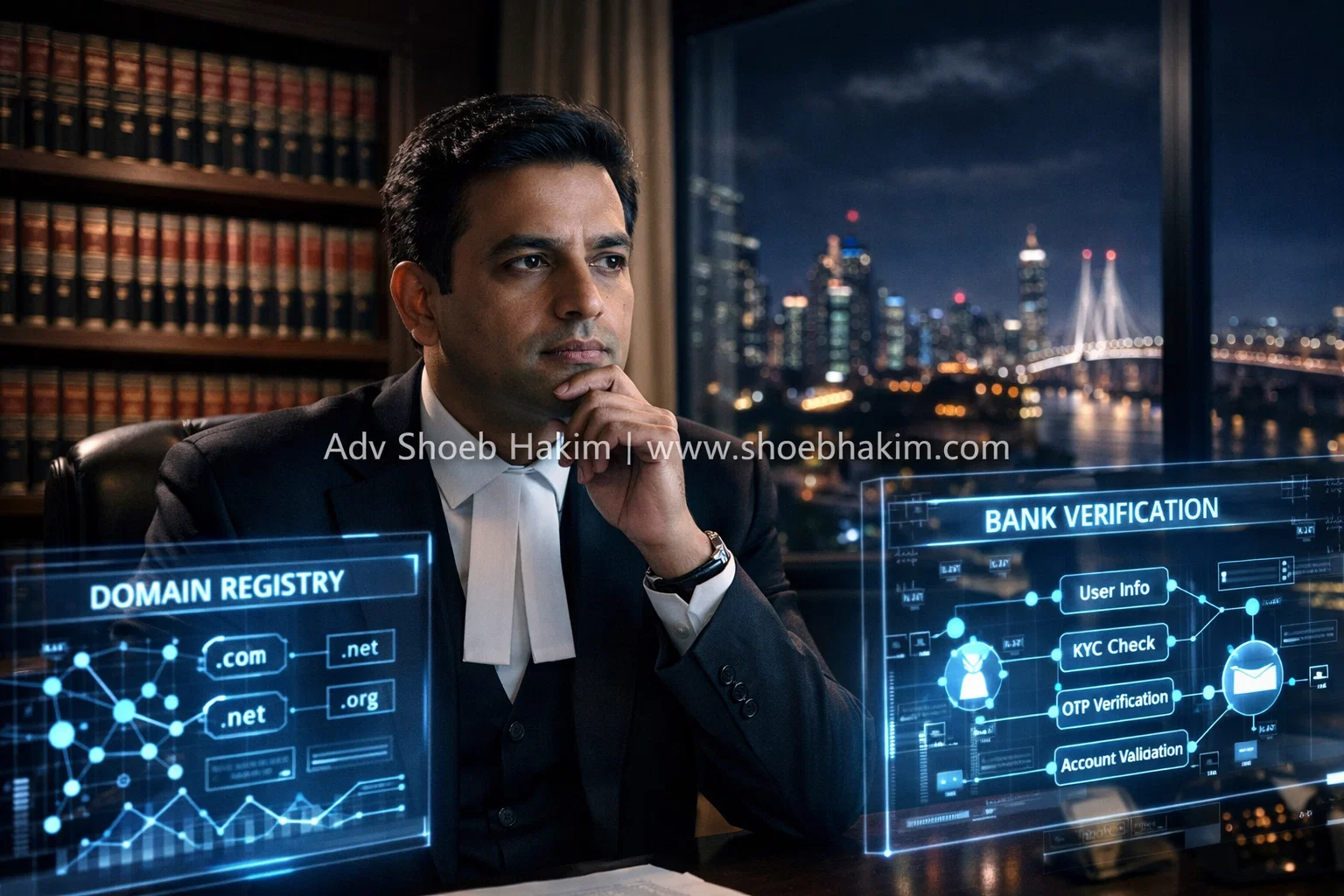
Alt Text: Photo-realistic landscape of Adv Shoeb Hakim analyzing domain name fraud reforms and systemic changes in digital commerce.
Title Text: Domain Fraud Reform Analysis by Adv. Shoeb Hakim
Caption: Exploring the legal complexities of domain name fraud under the BNS/BSA framework.
Description: This visual asset represents the professional analysis of the Delhi High Court’s ruling on domain name fraud by Adv. Shoeb Hakim.
Unified Article JSON-LD: Entity Schema for Shoeb Hakim
HTML
<script type="application/ld+json">
{
  "@context": "https://schema.org",
  "@graph": [
    {
      "@type": "Person",
      "@id": "https://shoebhakim.com/#person",
      "name": "Adv Shoeb Hakim",
      "jobTitle": "Advocate and Cyber Security Researcher",
      "url": "https://shoebhakim.com",
      "sameAs": ["https://vakilverse.com", "https://shoebhakim.com/", "https://x.com/shoebhakim"]
    },
    {
      "@type": "AnalysisNewsArticle",
      "headline": "Domain Name Fraud Reforms: Adv Shoeb Hakim on Colgate v NIXI",
      "author": { "@id": "https://shoebhakim.com/#person" },
      "datePublished": "2026-01-12"
    }
  ]
}
</script>