

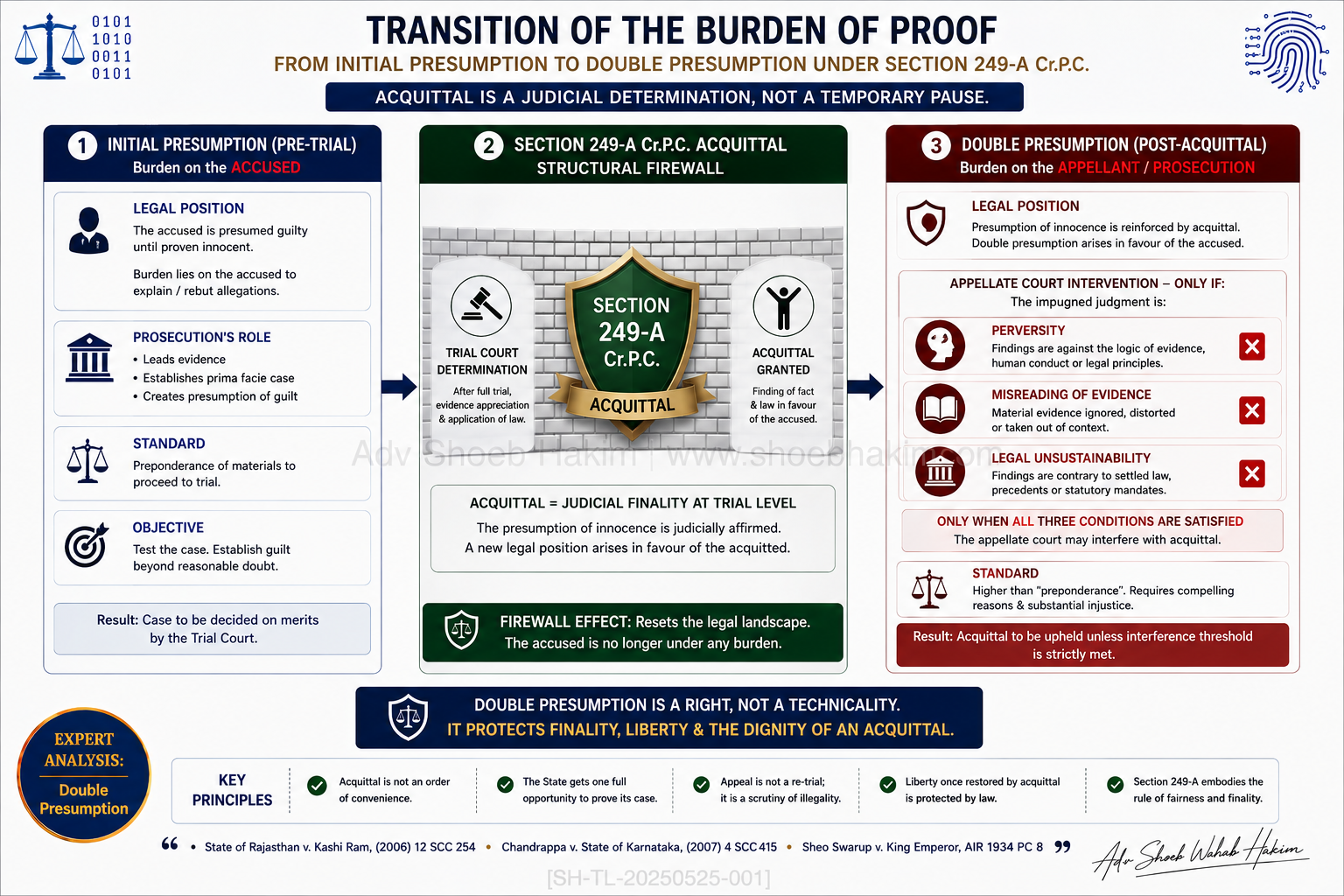
The Supreme Court of Pakistan has delivered a powerful reaffirmation of core criminal law principles that every law student and practitioner should remember.
Introduction
“Mere allegations or indictment cannot substitute proof beyond reasonable doubt.”
The Supreme Court of Pakistan has delivered a powerful reaffirmation of this core criminal law principle, restoring an acquittal and reinforcing the “double presumption of innocence” that attaches after a trial court’s finding of not guilty.
In Crl.P.L.A. No.188-K of 2022, the Court restored an acquittal under Section 249-A Cr.P.C., holding that appellate courts must show clear, glaring, and substantial error to interfere with an acquittal.
This article analyzes the judgment, the legal principles reaffirmed, and the practical implications for criminal practitioners.
The Case
| Aspect | Details |
|---|---|
| Case | Crl.P.L.A. No.188-K of 2022 |
| Court | Supreme Court of Pakistan |
| Issue | Whether the High Court was justified in overturning a trial court’s acquittal |
| Section | 249-A Cr.P.C. |
| Outcome | Acquittal restored |
The Core Holding:
“Where a trial court has recorded an acquittal after properly appreciating the evidence on record, the appellate court should be slow to interfere with such acquittal. The presumption of innocence is reinforced by the acquittal, giving rise to a double presumption of innocence.”
Key Principles Reaffirmed
| Principle | Explanation |
|---|---|
| Presumption of innocence | The foundation of criminal justice. An accused enters trial with innocence as the default position. |
| Double presumption after acquittal | Once a trial court acquits, that presumption is strengthened. Appellate courts must show clear, glaring, and substantial error to interfere. |
| High threshold for reversal | Interference is rare and only justified when findings are perverse, misread evidence, or legally unsustainable. |
| Section 249-A Cr.P.C. safeguard | Where prosecution evidence is “groundless,” courts are empowered to terminate proceedings early to prevent abuse of process. |
| Burden of proof | Remains on prosecution. The accused has no obligation to prove innocence. |
The Court’s Criticism
The Court strongly criticized the mechanical reversal of acquittal without independent judicial reasoning.
Key observations:
- Appellate jurisdiction is not a routine rehearing
- Courts cannot upset a well-reasoned acquittal merely because another view is possible
- Reversal requires a finding of perversity, misreading of evidence, or legal unsustainability
- The accused is entitled to the benefit of doubt, and the doubt must be resolved in favour of the accused
Why This Matters
| Aspect | Significance |
|---|---|
| Protection of acquittals | Trial courts are best positioned to assess witness credibility and evidence. Their findings deserve deference. |
| Finality in criminal justice | Repeated appeals unsettle the accused’s life and undermine the finality of judgments. |
| Burden of proof | The State cannot shift the burden to the accused. Guilt must be proved, not presumed. |
| Double presumption | Once acquitted, the presumption of innocence is reinforced, making reversal even harder. |
The Bar Against Mechanical Reversal
What the Court criticized:
- Routine interference with acquittals
- Reversal without proper reasoning
- Substituting the appellate court’s view for that of the trial court without finding error
What the Court required:
- Independent judicial reasoning
- Clear, glaring, and substantial error
- Findings that are perverse, misread evidence, or legally unsustainable
Practical Implications for Criminal Practitioners
For Defence Lawyers:
- Emphasize the double presumption in appellate arguments
- Highlight the trial court’s advantage in assessing witness credibility
- Identify the absence of perversity in the trial court’s findings
- Argue that another view does not justify reversal
For Prosecutors:
- Demonstrate clear error in the trial court’s findings
- Show that the acquittal was perverse or based on misreading of evidence
- Avoid routine appeals against acquittals
- Respect the trial court’s findings unless there is substantial error
For Appellate Courts:
- Apply the double presumption before interfering
- Require clear, glaring, and substantial error
- Avoid mechanical reversal
- Give due weight to the trial court’s advantage
Conclusion
The Supreme Court of Pakistan has delivered a powerful reaffirmation of core criminal law principles that every law student and practitioner should remember.
The Court restored an acquittal under Section 249-A Cr.P.C., holding that:
- Mere allegations or indictment cannot substitute proof beyond reasonable doubt.
- The presumption of innocence is the foundation of criminal justice.
- Once a trial court acquits, that presumption is strengthened—appellate courts must show clear, glaring, and substantial error to interfere.
- Interference is rare and only justified when findings are perverse, misread evidence, or legally unsustainable.
- Where prosecution evidence is “groundless,” courts are empowered to terminate proceedings early to prevent abuse of process.
- The accused has no obligation to prove innocence—the State must prove guilt beyond reasonable doubt.
The Court strongly criticized mechanical reversal of acquittal without independent judicial reasoning, reinforcing that appellate jurisdiction is not a routine rehearing.
In criminal law, suspicion is never proof—and appellate courts must protect acquittals, not casually unsettle them.
KNOWLEDGE CHECK QUIZ
- Q: What core criminal law principle was explicitly fortified by the Supreme Court in Crl.P.L.A. No.188-K of 2022 when reviewing a trial court’s acquittal? Ans: The Double Presumption of Innocence, establishing that once an accused is acquitted by a trial court, their initial presumption of innocence is heavily reinforced.
- Q: What must an appellate court demonstrate in order to legally interfere with and overturn a trial court’s acquittal? Ans: The appellate court must explicitly show a clear, glaring, and substantial error, proving that the trial court’s findings were perverse, misread the evidence, or were legally unsustainable.
- Q: What is the specific function of Section 249-A Cr.P.C. as utilized by the trial court in this case? Ans: It empowers the court to terminate proceedings early and acquit the accused at any stage if the prosecution’s evidence is deemed entirely “groundless,” preventing a further abuse of the judicial process.
- Q: If the trial record presents two equally possible views—one pointing to guilt and one to innocence—what is the appellate court legally obligated to do? Ans: The appellate court is obligated to uphold the view that favors the accused and must not substitute the trial court’s exculpatory finding with its own inculpatory view.
FREQUENTLY ASKED QUESTIONS (FAQ)
Q: Why does the law give so much deference to the trial court’s judgment over the appellate court’s review? Ans: The trial court holds a unique, irreplaceable judicial advantage: it physically observes the trial. The magistrate witnesses the demeanor, hesitation, and body language of the witnesses during cross-examination. An appellate court only reads a transcribed, cold record. Therefore, the law assumes the trial judge is in the best position to assess true credibility, requiring extreme evidence of “perversity” before an appellate judge can overrule that assessment.
Q: Does the “Double Presumption of Innocence” mean an acquittal can never be overturned? Ans: No. An acquittal can be overturned, but the threshold is exceptionally high. The State cannot win an appeal simply by arguing that the magistrate made a minor error in logic. The prosecution must prove “glaring and substantial error”—such as the magistrate completely ignoring a certified DNA report or relying on evidence that was never legally admitted into the trial record.
Q: If a State prosecutor believes the trial judge was biased, is that sufficient grounds for an immediate reversal? Ans: Mere allegations of bias or incompetence are insufficient. The appellate court requires empirical, documented proof from the trial record demonstrating that the judgment is legally unsustainable. Without proving actual perversity in how the evidence was handled on paper, the Double Presumption of Innocence shields the acquitted individual from the State’s subjective dissatisfaction.
Adv. Shoeb Hakim
Criminal Law & Appellate Practice Advisor
📌 Follow me on LinkedIn for daily criminal law insights: https://www.linkedin.com/in/shoebhakim
📌 Visit my website for more articles: https://www.shoebhakim.com
📌 Visit my website for legal knowledge: https://www.vakilverse.com
📌 Visit my website for research fellowship: https://www.legalcomplaince.in
♻️ Share this article with your network.
Disclaimer: This article is for informational purposes only and does not constitute legal advice.
Hashtags: #AdvShoebHakim #SupremeCourtOfPakistan #CriminalLaw #Acquittal #DoublePresumption #Section249A #BurdenOfProof #BeyondReasonableDoubt #AppellatePractice #DueProcess #CriminalProcedure #CrPC #PresumptionOfInnocence #LegalUpdate #PakistanLaw #CriminalAppeal #HighCourt #Prosecution #Defence #FairTrial #JusticeSystem #RuleOfLaw #AppealAgainstAcquittal #ReversalOfAcquittal #PerverseFinding #MisreadingEvidence #LegalUnsustainability #AbuseOfProcess #GroundlessEvidence #EarlyTermination #TrialCourt #WitnessCredibility #FinalityOfJudgment #BenefitOfDoubt #StateBurden #SuspicionNotProof #MechanicalReversal #IndependentReasoning #AppellateJurisdiction #CriminalJurisprudence #ConstitutionalLaw #HumanRights #FairTrialRights #PresumptionOfInnocence #CriminalJusticeReform #PakistanSupremeCourt #LandmarkJudgment
Leave a Reply