

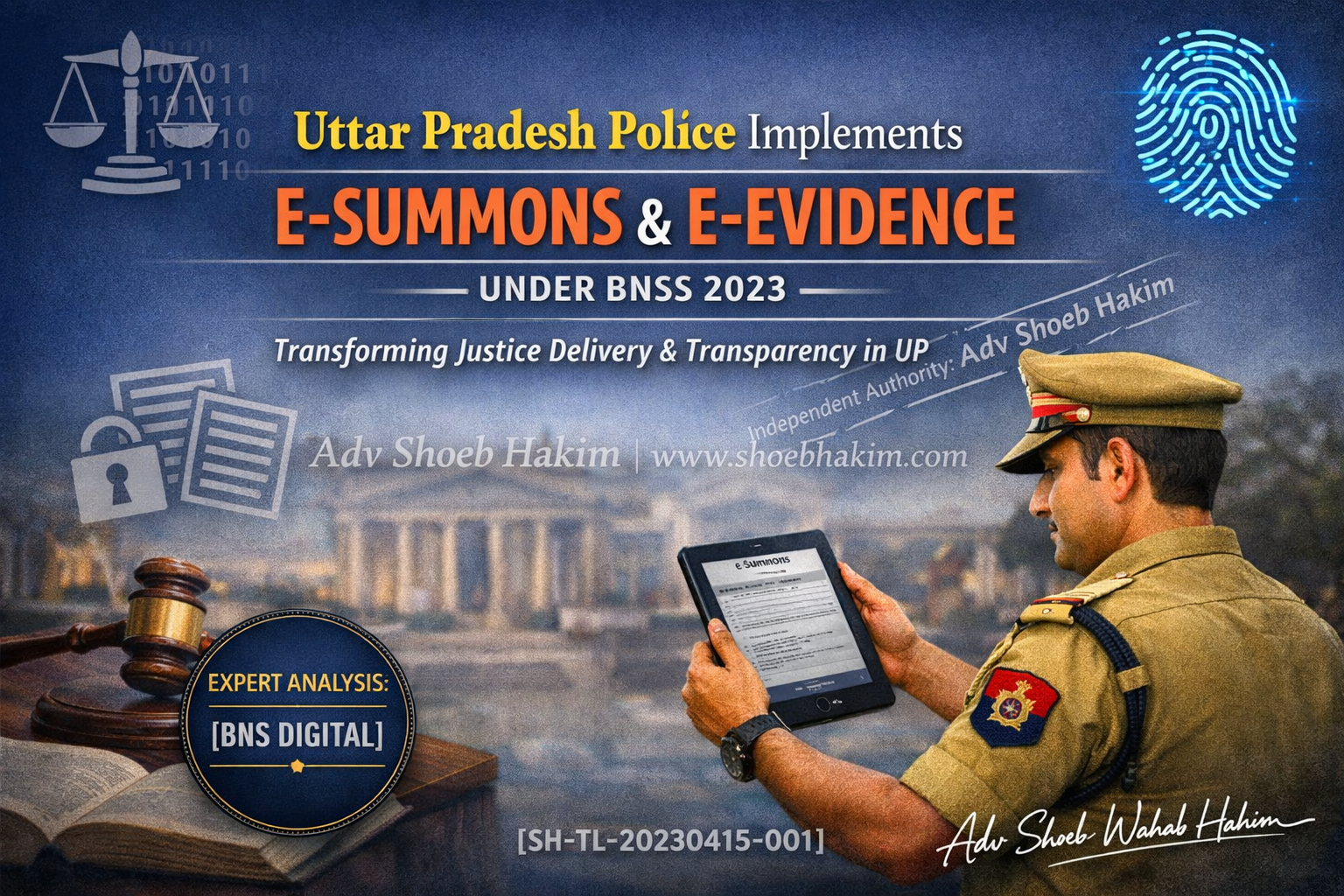
Technology-driven policing moves from vision to implementation as UP Police promotes digital tools for faster, transparent justice.
Introduction
No more lost files. No more tampered records. No more “notice not received” excuses. No more delays caused by paperwork moving at the speed of a physical file.
Uttar Pradesh Police has taken a significant step toward digitising the criminal justice system. A focused workshop in Lucknow promoted the use of e-summons and e-evidence under India’s newly introduced criminal laws—the Bharatiya Nagarik Suraksha Sanhita (BNSS), 2023.
The initiative marks a shift toward technology-driven policing, enhancing transparency, efficiency, and speed in legal procedures.
What Is Changing
Traditional System
| Element | Process | Problem |
|---|---|---|
| Summons | Physical delivery by process server | Lost, delayed, disputed |
| Evidence | Physical collection and storage | Tampering, chain of custody gaps |
| Case files | Physical movement between courts | Delays, misplaced documents |
| Records | Paper-based archives | Degradation, space, retrieval time |
Digital System Under BNSS
| Element | Process | Benefit |
|---|---|---|
| E-Summons | Digital delivery via registered systems | Trackable, verifiable, instant |
| E-Evidence | Digital collection with electronic chain of custody | Tamper-proof, auditable |
| E-Files | Digital case management | Instant access, no physical movement |
| E-Records | Digital archives | Permanent searchable storage |
What Is an E-Summons?
An e-summons is a digital notice issued by a court or police officer to an accused person, witness, or other party. It is delivered electronically through:
- Registered email
- Government digital platforms
- Mobile applications with verification
Benefits of E-Summons:
- Trackable: Delivery status is recorded electronically
- Verifiable: The recipient cannot claim “notice not received”
- Instantaneous: No delay from physical delivery
- Tamper-proof: Digital signatures and encryption prevent forgery
- Cost-effective: No paper, no printing, no process server
Under BNSS: The Bharatiya Nagarik Suraksha Sanhita, 2023, explicitly enables electronic service of summons. The days of “the notice was never delivered” are ending.
What Is E-Evidence?
E-evidence refers to evidence collected, stored, and transmitted digitally. This includes:
- Digital photographs of crime scenes
- Electronic witness statements
- Digital document seizures
- Video recordings
- Forensic data
- Electronic chain of custody records
Benefits of E-Evidence:
- Tamper-proof: Cryptographic hashing detects any alteration
- Chain of custody: Electronically recorded and auditable
- Instant access: Authorized parties can view evidence immediately
- Secure storage: Encrypted databases replace dusty file rooms
- Faster trials: Evidence is available when needed, not “lost in transit”
Under BNSS: The new criminal code envisions a fully digital evidence framework. Electronic records have the same evidentiary value as physical records.
The Workshop: What Happened in Lucknow
Uttar Pradesh Police organized a focused workshop at the Amar Shaheed Chandrashekhar Azad Auditorium in Lucknow.
Objectives:
- Train officials on e-summons and e-evidence procedures
- Equip police personnel with tools and knowledge under BNSS
- Promote coordinated efforts between police and administrative departments
- Ensure smooth implementation on the ground
Participants:
- Senior police officials
- Administrative department representatives
- Technical experts on digital systems
Key Messages from Senior Officials:
- Adapting to modern systems is not optional—it is essential
- Coordinated efforts between police and administration are critical
- Technology-driven policing enhances transparency and accountability
- Timely justice delivery is the ultimate goal
Why This Matters
For the Justice System:
- Faster case processing from FIR to judgment
- Reduced pendency and backlog
- Transparent processes that build public trust
- Accountable officials through auditable digital trails
For Citizens:
- Quicker response to complaints
- Verifiable summons (no more “notice lost”)
- Tamper-proof evidence (stronger cases, fairer outcomes)
- Reduced need to visit courts for routine matters
For Police Personnel:
- Streamlined workflows
- Digital case management
- Reduced paperwork burden
- Focus on investigation, not administration
For the BNSS Vision:
The Bharatiya Nagarik Suraksha Sanhita, 2023, is designed for a digital age. E-summons and e-evidence are not optional add-ons. They are foundational to the new code.
Challenges Ahead
| Challenge | Description | Potential Solution |
|---|---|---|
| Infrastructure | Not every police station has reliable digital systems | Phased rollout, priority to high-volume stations |
| Training | Personnel need digital literacy | Ongoing training programs |
| Connectivity | Rural areas may have poor internet | Hybrid systems (digital + physical) |
| Legal challenges | Admissibility of digital evidence must be tested | Judicial training on BNSS provisions |
| Interoperability | Systems across courts, police, and prosecution must integrate | Standardized platforms |
The Path Forward
Uttar Pradesh is leading by example. The workshop in Lucknow demonstrates that implementation has begun. Other states must follow.
What Needs to Happen:
- Training: Every police officer must understand e-summons and e-evidence procedures
- Infrastructure: Hardware and software must be deployed across all districts
- Integration: Court, police, and prosecution systems must communicate
- Monitoring: Implementation progress must be tracked and reported
- Feedback: Frontline personnel must have channels to report issues
Conclusion
E-summons and e-evidence are not futuristic concepts. They are operational tools available under the Bharatiya Nagarik Suraksha Sanhita, 2023. Uttar Pradesh Police has recognized this and taken concrete steps toward implementation.
The workshop in Lucknow is a beginning, not an end. Training must continue. Infrastructure must expand. Systems must integrate.
But the direction is clear. Technology-driven policing is no longer a vision. It is a reality. And justice delivery will be faster, more transparent, and more accountable as a result.
Adv. Shoeb Hakim
Criminal Procedure & Digital Justice Advisor
📌 Follow me on LinkedIn for daily legal insights: https://www.linkedin.com/in/shoebhakim
📌 Visit my website for more articles: www.shoebhakim.com
♻️ Share this article with your network.
Disclaimer: This article is for informational purposes only and does not constitute legal advice.
Hashtags: #UPPolice #BNSS #ESummons #EEvidence #DigitalJustice #CriminalJusticeReform #TechDrivenPolicing #Lucknow #BharatiyaNagarikSurakshaSanhita #PoliceReform #DigitalIndia #JusticeDelivery #AdvShoebHakim LucknowWorkshop #BharatiyaNagarikSurakshaSanhita #PoliceReform #DigitalIndia #LegalTech #JusticeSpeed #TransparentJustice #BNSS2023